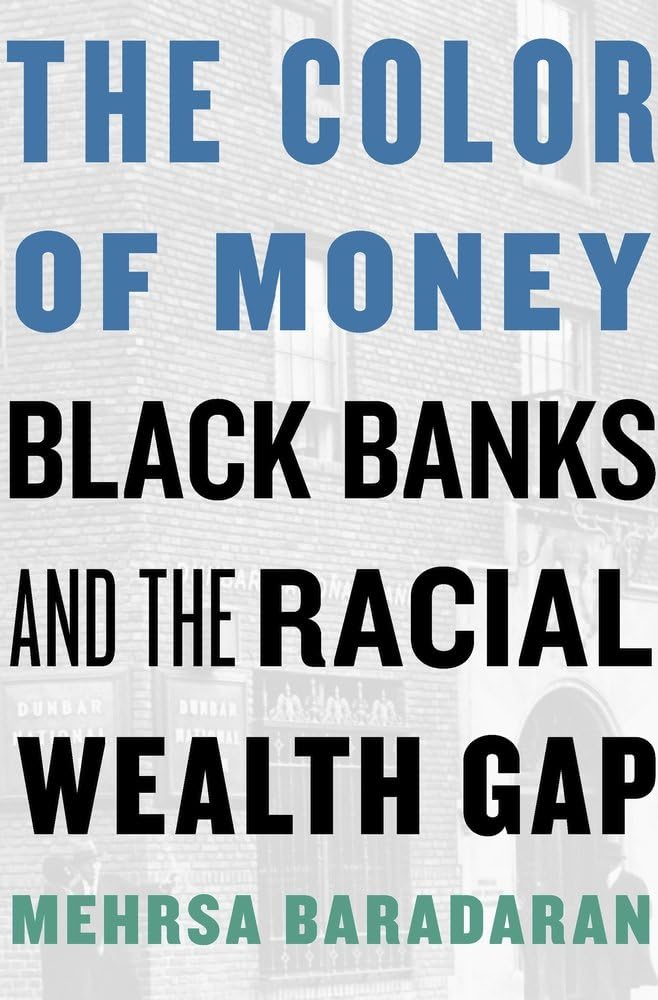
The Color of Money: Black Banks and the Racial Wealth Gap
Product ID: 47398165
Desertcart purchases this item on your behalf and handles shipping, customs, and support to Senegal.
“Read this book. It explains so much about the moment…Beautiful, heartbreaking work.” ―Ta-Nehisi Coates When the Emancipation Proclamation was signed in 1863, the black community owned less than one percent of the United States’ total wealth. More than 150 years later, that number has barely budged. The Color of Money pursues the persistence of this racial wealth gap by focusing on the generators of wealth in the black community: black banks. Studying these institutions over time, Mehrsa Baradaran challenges the myth that black communities could ever accumulate wealth in a segregated economy. Instead, housing segregation, racism, and Jim Crow credit policies created an inescapable, but hard to detect, economic trap for black communities and their banks. The catch-22 of black banking is that the very institutions needed to help communities escape the deep poverty caused by discrimination and segregation inevitably became victims of that same poverty. Not only could black banks not “control the black dollar” due to the dynamics of bank depositing and lending but they drained black capital into white banks, leaving the black economy with the scraps. Baradaran challenges the long-standing notion that black banking and community self-help is the solution to the racial wealth gap. These initiatives have functioned as a potent political decoy to avoid more fundamental reforms and racial redress. Examining the fruits of past policies and the operation of banking in a segregated economy, she makes clear that only bolder, more realistic views of banking’s relation to black communities will end the cycle of poverty and promote black wealth.
| Asin | 0674970950 |
| Dimensions | 6.12 x 1.3 x 9.25 inches |
| Isbn 10 | 9780674970953 |
| Isbn 13 | 978-0674970953 |
| Item Weight | 1.52 pounds |
| Language | English |
| Print Length | 384 pages |
| Publication Date | September 14, 2017 |
| Publisher | Belknap Press: An Imprint of Harvard University Press |
User
Both a Bridge and a Battle Cry
"to be a poor man is hard, but to be a poor race in a land of dollars is the very bottom of hardships."- W.E.B. DuBoisEvery few years there is a book that is so powerful it turns me into a book nerd, policy evangelical. I go out and buy several copies and press them into friends hands with the fervor of a recent convert and tell them they "NEED" to read it. I think the last nonfiction book to do this for me was 'Dark Money: The Hidden History of the Billionaires Behind the Rise of the Radical Right' or maybe 'The Big Short: Inside the Doomsday Machine.' Usually, the book has both a financial angle and a policy tint. It usually also explores unfairness. That makes sense. In my previous life I was a policy analyst and I now work in the finance industry as a financial planner. Most days, I'm a pretty mellow guy. I meditate, read, drink tea, Netflix and chill. But reading about inequality and unfairness, for me, catalyzes me for action.If the last few political cycles have taught us anything, it is America still struggles with its "original sin" of slavery and the ugly descendants of slavery: discrimination, segregation, inequality, despair. We have seen, just this week (actually for the last few years), protests about the way Black Americans are treated by police officers. That subject deserves its own space, so I wont dwell too much on that here, other than to say the interaction of Black Americans and police officers ISN'T simple. It isn't a subject that can easily be explained just by saying police are racists, or unarmed Black Americans should behave differently (different from whom?). There are structural, geographic, economic, historical, and political forces that all contribute to awful outcomes.Just like blue on black violence isn't easily explained in a tweet or a FB post, the interaction between Black Americans and banks has a long, ugly, and painful history. It is a history that is important to understand if one REALLY wants to explore topics like income inequality, segregation, credit, crony capitalism, corruption, exploitation, state power, wealth, etc... Mehrsa's book explores the policies, laws, programs, politics, economics, and history of black banks AND the history of Black Americans with banks. She points a fairly bleak picture of the fault/chasm that exists between the two financial markets that exist in America. One is the banking structure that exists for a majority of Americans and doesn't need to be explored. But for years that economic structure, that allows people to save (AND BORROW) didn't exist for a large segment of Americans. And when it eventually did, it was skewed heavily. Separate was never equal in banking. Blacks paid a heavy price to save, to borrow (if they could). Even laws that were designed to help pull Americans out of poverty, accumulate wealth and avoid taxes through home ownership, benefited one segment of America while ignoring or fleecing the other.It is a painful read. It is also necessary. Unlike Mehrsa Baradaran's* previous book, 'How the Other Half Banks: Exclusion, Exploitation, and the Threat to Democracy', this one spends little/less time on prescriptions. She is laser focused on what is wrong, what went wrong, and why. It is a dense (without ANY of the negative connotations typically associated with that word) book. One that required me to open THREE different post-it flag packages. I was marking things that were new, quotes that amazed, items I didn't want to forget and I often found myself marking 3 or 4 times a page.A few caveats before I end. This isn't a perfect book. It isn't as exciting as a Michael Lewis book (this probably won't get made into a movie) and the prose isn't as pretty as Robert Caro's LBJ series. But it is important. It is a labor of both love and skill. Reading some chapters in it, I could tell Mehrsa spent months in presidential libraries. Well researched books give me a thrill. Especially when you recognize that a certain nugget of data or quote may never have seen the light of day if it wasn't for the doggedness of a skilled lawyer/historian. 'The Color of Money' deserves to be in the library of anyone who deals with or seriously thinks about income inequality, race, banking, inner cities, etc.As a white, upper-middle, male who has benefited from educated parents, stability, wealth, and every advantage American history and politicians have blessed me with, it is difficult and humbling to realize just how many of the economic realities I take for granted every day weren't available to the parents of my black friends. Hopefully, more of these same financial realities WILL be available to the children of ALL my friends. Hopefully we can begin to cover both the scars of the disadvantaged, and the economic and social chasms that separate (unfairly) us. This book is both a bridge and a battle cry.
User
Unerring Truth
An epic exposé!A highly successful monumental undertaking, which unearthed and scrutinised torrents of evidence based, and yet, uncomfortable truths.Every stroke of the pen is, shockingly, dripping with painfully ugly but enlightening information.All traditional hollow platitudes, strenuously erected and embellished to escape, disown and shamelessly revise history and heap blame on generations of black victims - which have by now assumed an art-form by the white establishment - were intelligently deconstructed by way of thorough research and revelation of irrefutable facts.A telling success was made at debunking elaborately designed devious and scurrilous efforts to whitewash, manipulate and revise immutable historical facts. Equally, here’s a tome of information and knowledge sufficient enough to eternally shame very determined traducers and violators of sacred recorded history.This audacious work is an odyssey, which at every turn, exposed in broad strokes, the ugly innards and elaborate evil machinations of the despicable original American sin: SLAVERY. And remarkably, in equal measure, it explodes the huge myth called the “American Dream”, as it relates to the Blackman.The work is imbued with dazzling facts, and ennobling high-minded scholarship attention to details. It is brilliantly rendered in elegant, engaging prose and riveting cadence, that easily recommends it as a masterpiece, and therefore, a must-read for every black person and others that genuinely seek to understand the current sorry situation of the Black population in America, and indeed, the entire emerging world trapped in similar unsavoury situation.A remarkable work, which succinctly underscores the clarion call for justice and compensation for all the black victims of centuries of blatant and systematic practices of heinous slavery and odious racism in America.The body of work parades an impressive array of documented evidence that, relentlessly, obliterates any escape route for any shamelessly flighty revisionists and or obscurantists.Thankfully, just as Truth has proven to be stubbornly constant, this author will be proven to be forever truthful in almost all conclusions.
User
Money and Capitalism
The book is great reading. The author Mehrsa Baradaran has done extensive research and put her legal knowledge to good use. After all she is a law professor at University Of California, Irvine her area of expertise is banking law. Race and racial issues, socioeconomic conditions evolving around money, politics capitalism, and so forth are integral factors in this book. This book should be required reading for college students, mandatory reading for everyone who wants America to share the wealth. When I read a review by Ta-Nehisi Coates, I was hooked so I went out and purchased the book. If you are an advocate of social justice and you want real reforms in your community then read this book, it should be a book that is included in your bookshelf collection. Finally when you hear African Americans talk about Black Wall Street—Tulsa Oklahoma 1921 destruction of the Black community by White folk angry at the mega success of this community back then—you can understand the intellectual dynamics Mehrsa Baradaran shares as she explains and teaches America in a scholarly way about the her book.
User
My words can't do this awesome book justice
I absolutely cannot say enough good about this book. I deal with these issues for a living, and this is, hands down, one of the best books I have ever read on putting together, dot, by dot, why we are where we are in 2017. How the author made it so compelling, readable, interesting and accessible is beyond me. The only negative thing I have to say is that the title does so little to belie the real significance of this book. It has a title that will turn off some because a book about banking sounds boring, and a book about a racial wealth gap would scare away those who would think it is too "radical." It is so neither!!! In a tremendously interesting way, the author does an incredible job of telling the story, step by step, of where we all find ourselves in 2017 and why. The factual, but not dry, story, is one that EVERYONE can learn from. It is truly, truly, an awesome book. I'm on my second read and I have recommended to everyone from my Uber driver to the head of the Finance department of a major university. Do yourself a favor and read it. You will NOT regret it!
User
Absolutely Brilliant Book
This book is absolutely brilliant, for anyone who seeks to know the historical account of the economic marginalization, faced by the African in America. In addition, it is overall inspiring, as it reinforces why, blacks should continue to build wealth.
User
History I didn't learn in school
Well written and filled with facts I didn't know - especially regarding FHA loans and veteran's benefits once denied to people based on race. I remember visiting an older sister whose husband was stationed in an Army base in Alabama 60 years ago in 1962. Coming from Michigan I had never seen separate drinking fountains or bathrooms - I was horrified as we passed a chain gang working on the highway. Yet I remember that even in the North the fact that black people might own a nice car and a shabby house was a common joke - now I better understand the housing discrimination they faced. I am glad to see many accomplished black artists and professionals these days - our daughter had the benefit of a wonderful black teacher she admired. Still, I know that there are many black people living in poverty. Our daughter taught in the Bronx for Teach for America and she witnessed parents who often had two jobs just to provide for their families and the hardship this imposed on the children. People need to earn a living wage. Perhaps too many businesses are overpaying the executives and underpaying essential employees. Reparations?? Perhaps a better solution would be to increase the minimum wage and provide affordable housing with low interest mortgages.
User
This book should be required reading for every voter
Dear Friends and voters – I am recommending that you read the following book before you go cast your vote in the 2020 election.“THE COLOR OF MONEY BLACK BANKS AND THE RACIAL WEALTH GAP” by MEHRSA BARADARAN has triggered my sense of civic duty like no other event has done. The first few chapters were hard for me to read and the fact that I only read this book on my way to work, while riding the train, had made it a daily morning reminder that I must use my actuarial expertize to share the essence of this book with everyone who wishes to listen.The laws of arithmetic are universal and non-partisan. If you invest $100 at an APR of 3%, at the end of the year the bank will pay you $103 regardless of your race, religious beliefs, political affiliation or sexual orientation. The payout of this investment is identical in every country on planet earth.Imagine my reaction when I read the following statistic: “The perpetuation of poverty is stunning – 75 percent of black children who grow up in families in the bottom wealth category remain in that same category as adults. A 2013 study found that for white families, every additional dollar they earn in income leads to $5.19 in wealth. For black families, each dollar creates only sixty-nine cents ($0.69) in total wealth.” The Color of Money, page 249-250.Using simple arithmetic: $5.19 divides by $0.69 = 7.52. Translation: because black families and white families have access to the same investments universe, white families will always accumulate 7.52 times more wealth than black families on AVERAGE. Using my actuarial training, the wealth Gap multiplier is even bigger if you were to use MEDIAN as metric, the multiplier would be 13 instead of 7.52 to the Atlantic.This may sound too much for some voters, but trust me this is the most simplistic way to make the argument for REPARATIONS on behalf of African Americans. And I am not an African American.The judicial system is full of case laws that make reparations for African Americans a thing of the past. But to show respect to the author (MEHRSA BARADARAN), I must share her legal argument with you:“Proposal to address the wealth gap directly by providing some form of reparations will be met with powerful political resistance. A 2016 Marist / PBS poll found 81 percent of white Americans opposed reparations (58 percent of blacks supported the idea). Yet equality must proceed down a path that acknowledges past wrongs and provides compensatory damages. An essential first step in dealing with the wealth gap is to acknowledge that it was created through racist public policy. Full justice demands a recognition of the historic breach of the social contract between America’s constitutional democracy and black Americans. And contract breach requires a remedy. Without that recognition, the Constitution itself stands as a roadblock to redress because it demands that all individuals be neither harmed nor benefited based on group characteristics. But it is unfair to be held to a contract that has already been violated. Blacks have been harmed in direct contradiction to the Constitution’s promise of equal treatment in seeking a remedy. It is indeed time for a new social contract with Black Americans that deals honestly with the past breach.” The Color of Money, page 281.Would you please post this message on your social media (e.g. Facebook), send a copy to your elected officials, your friends and families. When an old car breaks down on the highway during rush hour, every driver behind it are forced to deal with the problem. Did you know Wall Street bankers received more than $700 billion in bailout money from the federal government after they took advantage of black families with subprime mortgages (a.k.a. ghetto loans) that caused the 2008 financial crisis?How does the US Supreme Court justify compensatory damages in Product liability laws, but object to compensatory damages for African Americans subjected to forced labor and racist public policy?
User
Fermentation jars
Great product
User
Excellent book
This book really shows you that this is not just in the states but the agenda is set Globally, and off course England must always be in the middle of corruption.
User
Magnífico!
Livro essencial para entender como a democracia liberal capitalista constrói os apartheids sociais onde aprisiona o povo negro.
User
Very informative and is a must read!
I thoroughly enjoyed this book and its detailed explanation of the racial wealth gap in America. It tackles a lot of misinformation and any age old excuses that try to dismiss that the racial wealth gap exists today. This book is backed up by intensive research and thoroughly explains how the racial wealth gap was created. I really enjoyed learning more about how banks operate and how the past wrongdoings of America actively affect the present. I challenge people to read this book the next time they try to deny that the racial wealth gap exists.
User
Amazing research!
Loaded with valuable information. Amazing research.
User
Civil rights of accessability to money are colored.
Detailed notes of historic aspects of banking including political motivations and their real intentions taught me that American real power group prefers status quo to revolution toward equal free society.
Trustpilot
1 month ago
2 weeks ago