Buy anything from 5,000+ international stores. One checkout price. No surprise fees. Join 2M+ shoppers on Desertcart.
Desertcart purchases this item on your behalf and handles shipping, customs, and support to Senegal.
๐ฒ Cut High, Save Big, Stay Sharp!
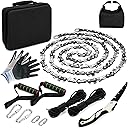
The 48 Inch High Rope Saw by Loggers Art Gens features a 48-inch carbon steel blade with 62 manganese steel serrated teeth arranged bi-directionally for smooth, jam-free cutting. Equipped with two 33-foot heavy-duty ropes and nylon strap handles, it enables safe, efficient pruning of high tree limbs up to 66 feet away. Lightweight and portable, this kit is ideal for camping, gardening, and wilderness survival, offering a cost-effective alternative to expensive tree services with a 30-day money-back guarantee.


| ASIN | B0B38DXL5X |
| Best Sellers Rank | #41,767 in Sports & Outdoors ( See Top 100 in Sports & Outdoors ) #20 in Camping Saws |
| Blade Length | 48 Inches |
| Blade Material | Carbon Steel |
| Blade Shape | Rectangular |
| Brand | Loggers Art Gens |
| Brand Name | Loggers Art Gens |
| Color | Orange, Black |
| Customer Reviews | 4.2 out of 5 stars 457 Reviews |
| Cutting Angle | 360 Degrees |
| Handle Material | Nylon |
| Included Components | Case |
| Item Dimensions L x W x H | 48"L x 48"W x 48"H |
| Item Weight | 2 Pounds |
| Manufacturer | Loggers Art Gens |
| Number of Teeth | 62 |
| Other Special Features of the Product | Bi-directional, self-cleaning cutting blades |
| Power Source | Corded Electric |
| Special Feature | Bi-directional, self-cleaning cutting blades |
| Surface Recommendation | Alloy Steel |
| UPC | 724156206924 711577749086 |
P**Y
Using correctly is key to success
Like with most tools, good technique is critical to how well the tool functions, particularly with non-power tools like this high limb rope chainsaw. If you've been reading reviews you've surely noticed that most negative reviews mention chain becoming stuck. This is due to bad technique using the saw. If you just throw a rope over a branch and stand underneath (hopefully of to the side a bit) this chainsaw will get stuck. It's pretty much guaranteed. You are sawing from the top but cut is the same shape as the top of the branch, an inverted "U" shape. As you cut the "U" gets narrower as you cut through the branch when the weight of the branch starts to open at the top it squeezes towards the bottom and causes the chain to get stuck. The correct technique requires 2 people standing way out to the sides of the branch. If you don't have another person to help you can do what did. I used spiral stakes which can be put in to the ground using cordless drill/driver (see photos). Since I already made myself a monkey's fist using a 1/2 lead weight (see photos) I used this to throw a messenger line over the branch. I used 1.8mm UHMWPE line for the messenger line. It's 550 lbs test, very slippery, and light weight. I was able to throw it over a branch 30' up 2nd try. I missed the first try because I didn't unspooled enough line. Anyway, I used the messenger line to pull up the straps with the chainsaw section in-between. I used 750 lbs test paracord with double bungee cords between the strap and the paracord. Walked it out away from the branch a good ways (more than 50ft) where I drilled the screw stake into the ground (see photo) I fastened the paracord to the loop with a bowline so I could use the loop to attach a Nitize cam clip. This allows for easy adjustment of the bungee tension. You could use a cam tie down strap or a lever adjustable strap. You could probably use a simple tent guyline adjuster knot as well. I used a second screw stake to make sure when I tightened the bungee tension I wouldn't pull the chain right off the branch. I did make a starter cut using the incorrect technique, standing under the branch, because I wanted my cut about a foot from the tree trunk. This made sure the chain didn't slide down the branch to the trunk, I learned this the hard way. Now I have the chain on a starter cut a foot or so from the trunk straps on both sides, one side with bungee adjusted tight ( with the chain mostly on the opposite side of the branch). I unattached the strap from the non-bungee side, walked to roughly opposite the staked bungee side and start pulling and releasing the strap. The bungee acts like a second person keeping tension on the chainsaw chain and returning it so it can be pulled again. It cuts both ways. How much effort this takes depends on your degree of patience and how sharp the chain is. As long as your spacing is wide enough the chain doesn't get stuck. I had to adjust the tension on the bungee several times because the branch was quite thick, 11" diameter oak. You need to use fairly long bungee because they stretch about 50%. They need to be heavy duty because you want about 2-3 ft at least of movement of the chain. I used 3', 3/8" bungee cords. Happened to work great. If you want to make your own I highly suggest getting marine bungee. I use bungee to hold a tarp over my skiff and they had to be replaced every year. I finally made my own using marine bungee it's been about 8 years now and none have failed. I use them to tension a tarp lean-to roof. I've on my 3rd tarp none of the marine bungees have failed. If this technique worked on 11" oak 30ft up in sure it will work on smaller stuff better. Obviously a helper will be much easier. On this particular model of high limb rope chainsawthere are several differences I really like. They use nylon strap with cam cleats to attach to chain instead of rope. There are strap handles with cam cleats. These make length adjustments really easy. I think the straps help keep chain aligned better when starting the cut. The straps are long as well. If I had had a helper the straps would have been long enough to cut this branch without needing additional length.
J**R
Excellent Tool if Youโve Always Wanted CrossFit to Involve Trees
This thing absolutely works, but I need to be honest with future buyers: this is not โlight yard work.โ This is โdiscover muscles you didnโt know existed while questioning your cardiovascular healthโ work. Once you get it set up correctly, it cuts surprisingly well. Great for limbs that are too high for a normal saw and way safer than balancing on a ladder with poor judgment and a chainsaw. The ropes are long enough to reach some pretty serious branches, and the chain bites hard when you keep steady tension on it. That said, Iโm convinced this tool was designed exclusively for young, fit lumberjacks raised by wolves in the Pacific Northwest. After about 15 minutes I needed water, electrolytes, and a short motivational speech. Still, impressive tool. Just stretch first and maybe notify a loved one before starting.
M**Y
Mostly easy to use
This little chain saw is a wonderful idea in most situations. It has cutters on both sides, which is great if you have to use a throw-rope to get to high branch and have no control over which side it lands on. This eliminates the problem of having to try to flip it over. Once yo get it in position, the saw works almost effortlessly, as the cutting teeth will quickly grab the wood and chisel out a rut that keeps it from rolling. If the branch or limb is not more than 5or 6 inches thick, it cuts through it with very little resistance. If you're trying the cut through a bigger limb, you apparently have zero understanding of basic physics and shouldn't be standing directly under a limb you are trying to remove that is heavy enough to kill you when it falls on you. If you are one of those people who cannot comprehend cause and effect,don't buy this manual chainsaw. I like mine and used it to clear out a lot of excess tree branches and limbs in my back yard. The only problem I had with it was in order to reach the higher branches, you have to use a throw rode to loop over that branch, then afix the handles to that to hoist it up. This works to make an 'extension' on the saw to accommodate the extra height.I'm almost 70 and just don't have the "ooomph" to throw the weighted rope that high over my head. So I had to ask a neighborhood teenager to do that part for me. This brought me to the second reason not to give 5 stars...he thought it was so cool, that he came back later and stole it. But I guess that might be considered a high rating too! Lol. Buy it, it's a worthwhile tool.
M**O
Effective and easy to use for moderately sized trees
Effective, we used to trim tree branches growing too close to the home. Important: Follow safety precautions, wear helmet, eye protection and gloves, never stand in the path of falling branches!. For very tall trees, better hire a professional.
B**L
Not as easy as it looks, but it WIll GET THE JOB DONE!
the first thing I am going to recommend before trying a saw of this type is to MAKE SURE you buy one with cutting teeth on BOTH sides of the blade. Some of the camp style chain saw blades have teeth on only ONE side, (as if you took a gas powered chainsaw blade and opened a link to make a hand saw version. That's fine if you are using it like a hand survival saw and can flip the blade easily, but I can't imagine how frustrating tossing a rope over a high, difficult branch only to find the coaster end is against the wood and you have to START OVER. You want cutting teeth on BOTH SIDES, and BI DIRECTIONAL teeth so that it cuts in both directions of the pull. I can't emphasize enough that you will want this procedure to take less time that It's going to end up taking. That's the kind of saw this is: It's meant to be thrown up high and to cut branches that you can't otherwise reach. That's NOT necessarily true for all the chain type saws that you can find on Amazon. I was trying to save money and almost bought one that could have created a lot more work and frustration for me. I had a branch high up in an elm tree that had snapped but not completely broken off, so that the 30 foot long branch just barely touched the ground. There was still enough meat left to the connection point that pulling in all directions (and even using a come-along) could not break it loose). Using this type of saw seemed the only option as the base of the broken branch was taller than my ladder, and even my Fiskars pole saw couldn't get close. I ordered the 48 inch version, thinking all the accessories would come in handy, but actually having the full length of the saw was the most important thing, because it takes a LONG time to cut down even a relatively small branch and you want to make every pull count. The 30' straps that are included don't feel like a great idea for attaching to a system like this. The straps have buckles, and I thought the buckles might get caught in a crack in the bark and trap the saw up there. The included instructions had only the most basic low-resolution images that didn't help to assemble the sytem. I ended up using two 50' ropes that I already had and with those each person holding a rope could be out a ways from the tree, safe from the eventually falling branch and the sawdust that rained down. If I HAD used the straps, both of us would have had to stand directly under the branch- and don't kid yourself that you will hear the final crack and dodge out of the way in time. This process takes a long time and you will lose focus as you concentrate on keeping the tension perfect and in sync with your partner. This kit includes some gloves, (kind of small, but nice to have a grippy coating) a sharpening file for the chain (you'll want that if you use this often) some shorter handles, and two long straps with buckles. The included weight bag for throwing the straps/ropes over the target branch is nice, but I think such a bag is bulky and would be hard to use if your space has obstructions like small branches. I tied two heavy 1 1/2 " nuts to my rope and took about a half hour to get my rope in the desired spot. Having chunks of metal like that on a rope you are tossing overhead is probably not the smartest or safest method, but I took the risk. Once my weight was successfuly over the branch, I let the weight slide down until I could reach the end of the rope and remove the nuts and tie the rope through one of the saw's strap handels. I tied the other rope to the other handle and pulled the saw up and just over the branch. Now, with the saw in the desired spot and plenty of rope on each side of the branch, we were ready to go to work. With 48" to work with, you can get some nice long pulls and take advantage of as many of the teeth on the saw as possible. It's easy to imagine this chain cutting through the branch similar to a powered chainsaw, but THAT kind of chain has a much higher density of teeth that cut in ONE direction and that chain would be spinning at a high rate of speed. Most of my strokes used at least 36" of the available length. You want to try to stop before hitting the eng of the saw, as you might jam the strap handle into your cut if you pull too hard and too far. The further away each person can get from the tree, the "flatter" the cut and the less chance the saw will bind up. It takes a while to find the rhythm and tension that balances cutting speed with the ease of the stroke. You have to pull firmly but then keep a bit less tension as your partner pulls, not fighting them, but also NOT letting the saw go too easily that no cutting is happening. Truth be told, my partner could not really get the rhythm and tension thing down. I sent them off, and I built a rig with several caribiners, a large spring and some heavy chain. I attached the spring to my deck and the rope to the spring so that when the spring was not under tension the saw was mostly on that side of the branch. When I pulled from MY side, the saw came my way but would be drawn back by the spring when I let up. I added the chain to increase the opposing force and kept going from there. I cut for about 20 minutes with a partner, and then for almost another 40 minutes with my spring rig. The branch broke suddenly, and I was glad not to be under it when it fell. As you can see from the picture, the branch was not especially large- only about 10 inches by 6 inches, but it took a WHILE. I will try to upload my security camera footage of the branch falling. My overall impression is that this is a well made saw, and could stand up to constant use. Not a bad deal.
C**Y
Way cheaper than what the pros will charge you.
We have a dying oak tree in the yard. At full height no matter which way I fell it, it would land in an area that would crush something. I was quoted $1000 just to cut the two middle vertical branches. That's without cleanup or stump grinding. Ridiculous! I used a bow and shot thick fishing line where I wanted the strap to go. This worked amazingly well. The bow with arrows cost me $11 at Goodwill by the way. Using two people to saw the limbs keeps it from pinching. My wife, I have been told, is very tired. My suggestion is to cut for 5 minutes take a 5 minute break and cycle like that. It seems much easier that way. I did end up buying two of these because my first one got stuck. I got a little too greedy and pulled it over a different limb where it got wedged in a fork. I suggest cutting the fishing line and trying again if you go over a lot of branches by accident. Earlier I made it sound like a lot of work, but in the picture you can see that the limbs we were working on were pretty thick. Plus it's been in the 90ยฐs. I'll also add that we are both in our 50s. This chain produces a lot of shaving with every pull. The product is strong and well made. We spent $60; some time; and some sweat, and saved us $940. To me that is a good deal. If you're curious we cut down 8 large limbs from this oak, and several smaller limbs when they were in the way. I would definitely recommend this product. You'll put in some work, but it wasn't that bad.
B**L
not as advertised. scam
false advertisement - it only one sided teeth and horrible .
R**T
Does the job nicely!
I agree with many reviewers that the instructions leave a lot to be desired, but if you're the least bit handy, you can figure it our easily. If you're not, you probably shouldn't be messing with this - it could be dangerous. The bottom line is that this product works very nicely and, for certain situations, is the only way to trim high branches, and is a lot safer than getting on high ladders. My situation was unique and challenging - the limbs I needed to cut were in a very awkward area and at a difficult angle, so throwing a weight over them would be impossible. I used a very long extendable lopper (Fiskars), and jerry-rigged it so it could hoist the weighted bag, and I could just drop it over the branch. That was the hardest part (clue - don't make the bag TOO heavy, or the pole/lopper gets very hard to manage). Once the bag was over the limb, it was a piece of cake to let it down slowly, and grab both ends, and pull until the chain gets up to the limb. Then it went through the limb like a hot knife through butter, and it dropped nicely. Obviously, be sure to be clear of the limb or this could be suicidal. My wife insisted that I wear a helmet, which was an excellent suggestion - you never know where and how a heavy limb might fall. If you're up to a bit of a challenge, this product really works and does the job nicely. P.S., use the nice gloves they include - the blades on the chain are very sharp. The gloves are nice, tight and have a good grip, so you don't lose much dexterity.
S**Y
Works like a charm!
This thing works like a charm. Highly recommend for those hard to reach branches.
S**Z
Excelente
Funciona de maravilla!
M**E
This thing works awesome use it in the trails when driving my UTV
Best thing works awesome I use it in the trails while driving around in my UTV many trees fall across and this cuts through it way quicker than my bucksaw and takes up minimal space
Trustpilot
1 month ago
2 days ago