
The Samurai's Tale: A Historical Adventure for Kids (Ages 10-12) About a Boy's Journey to Warrior and a Redeemed Legacy
Product ID: 4495877
Desertcart purchases this item on your behalf and handles shipping, customs, and support to Senegal.
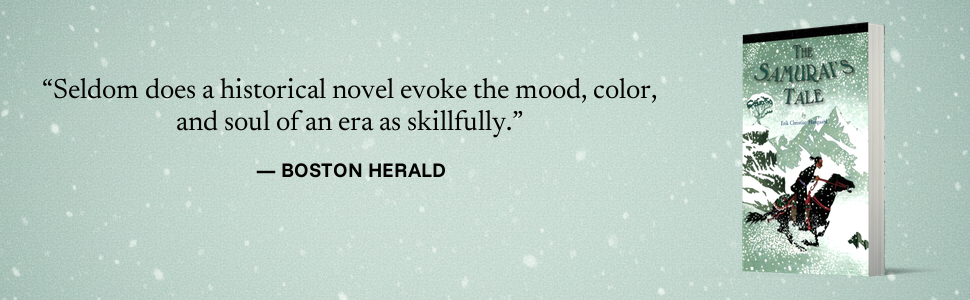
Taro will become a samurai and redeem the family legacy that has been stolen from him. A classic tale of adventure. When the powerful Lord Takeda’s soldiers sweep across the countryside, killing and plundering, they spare the boy Taro’s life and take him along with them. Taro becomes a servant in the household of the noble Lord Akiyama, where he meets Togan, a cook, who teaches Taro and makes his new life bearable. But when Togan is murdered, Taro’s life takes a new direction: He will become a samurai, and redeem the family legacy that has been stolen from him. " The Samurai's Tale , poetic yet unflinching, is excellent." — Boston Herald Review: A Personal Childhood Favorite, but also a Perfect Read as an Adult - This is the type of childhood book that flies under the radar. Told succinctly without overly romanticizing the location or period. That's not easy to do, given the richness of the setting. But the story flows and connected very strongly with me as both an adolescent and adult. Review: Book - Good book club book for 6th graders

| Best Sellers Rank | #131,627 in Books ( See Top 100 in Books ) #115 in Children's Historical Fiction on Military & Wars #133 in Children's Books on Violence #159 in Children's Asia Books |
| Customer Reviews | 4.6 out of 5 stars 222 Reviews |
R**G
A Personal Childhood Favorite, but also a Perfect Read as an Adult
This is the type of childhood book that flies under the radar. Told succinctly without overly romanticizing the location or period. That's not easy to do, given the richness of the setting. But the story flows and connected very strongly with me as both an adolescent and adult.
T**S
Book
Good book club book for 6th graders
C**M
Review for adult readers
A Samurai's Tale is a juvenile novel that has the potential to please adults. It is not really a coming-of-age story, but does trace the life of an orphan from a boy to a young adult. Events in the boy's life are set against and entwined with the historical background of the samurai of Kai province during the last years of Takeda Shingen's life, and so covers some of the same ground as the Kurosawa film Shadow Warrior. The character is the son of one of Uesugi Kenshin's samurai and is brought to work in the stables of a Takeda clan general following a battle. Eventually, the boy works up from the stables to become one of the general's trusted samurai, and the book ends on something of a cliff-hanger after the famous battle of Nagashino. The book is unquestionably a juvenile novel and lacks graphic violent or sexual content. The storyline is essentially episodic and lacks complexity, such as subplots, beyond the historical background material. The writing is mostly centered on action and dialogue without much attention to description, and the prose is slightly simplistic. However, despite all that, it turned out to be a fairly engaging book. The author lived in the area where the events are set, and an attempt was clearly made to keep the story grounded in time and place. Written in the first person in the form of a memoir, it might have been easy to lapse into anachronism, but instead the author has done a good job of creating a believable character who has reactions and outlook appropriate to (a) a relatively sensitive and reflective boy, living in (b) feudal Japan. To me, the book feels like the kernel of a great epic story. The boy's inner life, judgement, and narrative voice are balanced and appealing enough that a great number of scenes, plot elements, and descriptive passages could have been kneaded in. The negative reviews of this book on Amazon are mostly from young students who found the end particularly boring. This is interesting because the latter part of the book is where historical events come to the fore, and the author spends more time on the character's attempts to navigate the labyrinth of manners and duties expected of him due to his social position. For me, this was where the book became most interesting, and it was the beginning chapters, recounting friendships and adventures, that left me cold. No one would mistake this book for great literature, and it's also not vapid entertainment. So, what is the point? I'm not sure. As the boy attempts to become worthy of being appointed as a samurai, he idealizes and adopts the mores of his culture, in turn developing into an honest and self-reliant, yet not naive or shallow, adult. Despite this moralistic bent, I am interested enough in the characters and plot to coninue with the sequel, The Boy and the Samurai. Also, one can never have enough versions of Chushingura, so the author's will get added to my collection. Of note, before the 2005 Sandpiper edition of this book, there was a 1984 paperback edition by Houghton Mifflin that I can't find now son Amazon. As some childrens' books are revised (i.e., censored) these days for ideological reasons, I would try to get the 1984 version if possible. I can't imagine what would be objectionable in the original, but I can't imagine changing objectionable books to begin with, so who knows.
A**0
I also liked the cover art
Very interesting historical fiction set in medieval Japan. It reminds me of Disney's Sword in the Stone story a little bit, but maybe more intense in some ways and without the supernatural elements. Haugaard has an active writing voice that does well in transmitting the reader to the location. Some parts of this book are hard to read--mostly because Haugaard is effective at conveying emotion at some of the key points of the story line. I also liked the cover art, and it is worth noting that the active pace suggested by the cover translates well in the story itself. As historical fiction, it is also in the bildungsroman genre in which the protagonist becomes--through sad circumstances--a protege to a prominent samurai family. Like a squire to a knight, the protagonist trains to become a samurai, but it is not a direct path. This is a interesting story with some twists and turns that vaguely remind me of some of the social motifs from Twain's The Prince and the Pauper as well as Disney's Sword in the Stone. Some good discussion points can come from this book about humility, perseverance, and diplomacy.
D**T
Great medieval world history book
We used this as a read aloud for our homeschooling while studying world history during the medieval time. My 13, 11, 9, and 7 year olds all grately enjoyed it. It was a bit difficult to keep some of the names and Japanese nouns separated, and required a bit of explanation from me at points, but it was worth it. I would highly recommend.
G**F
Love this Book
This story was great. Somewhat reminiscent of "The Samurai Banner of Furin Kazan". Though this story is written by a western born author who did study in Kofu about the Takeda Clan for 1 year. This focuses more on the Rise of a young boy Taro who is taken in as a servent of a Takeda Lord and eventually works his way up to becoming samurai after while. As a opposed to Furin Kazan which is about a deformed military strategist. But both books do tell a great deal about what life was like for the samurai of the warring states era.
A**R
Excellent Story
My fourth grade son loved this book. It took him a few pages to get into the situation since it is old Japan but after 10 pages he was hooked. The story of a little boy who faces loss and change and has to adapt is universal and inspiring. Well told story, beautiful art, highly recommended.
A**R
Great book
Excellent read, please make a sequel.
M**T
So so
Was recommended to me as a historical text of a different culture. Well it did the job but the story dragged.
Trustpilot
2 weeks ago
1 month ago