Desertcart purchases this item on your behalf and handles shipping, customs, and support to Senegal.
🎲 Decode feelings, spark empathy, and play your way to emotional genius!
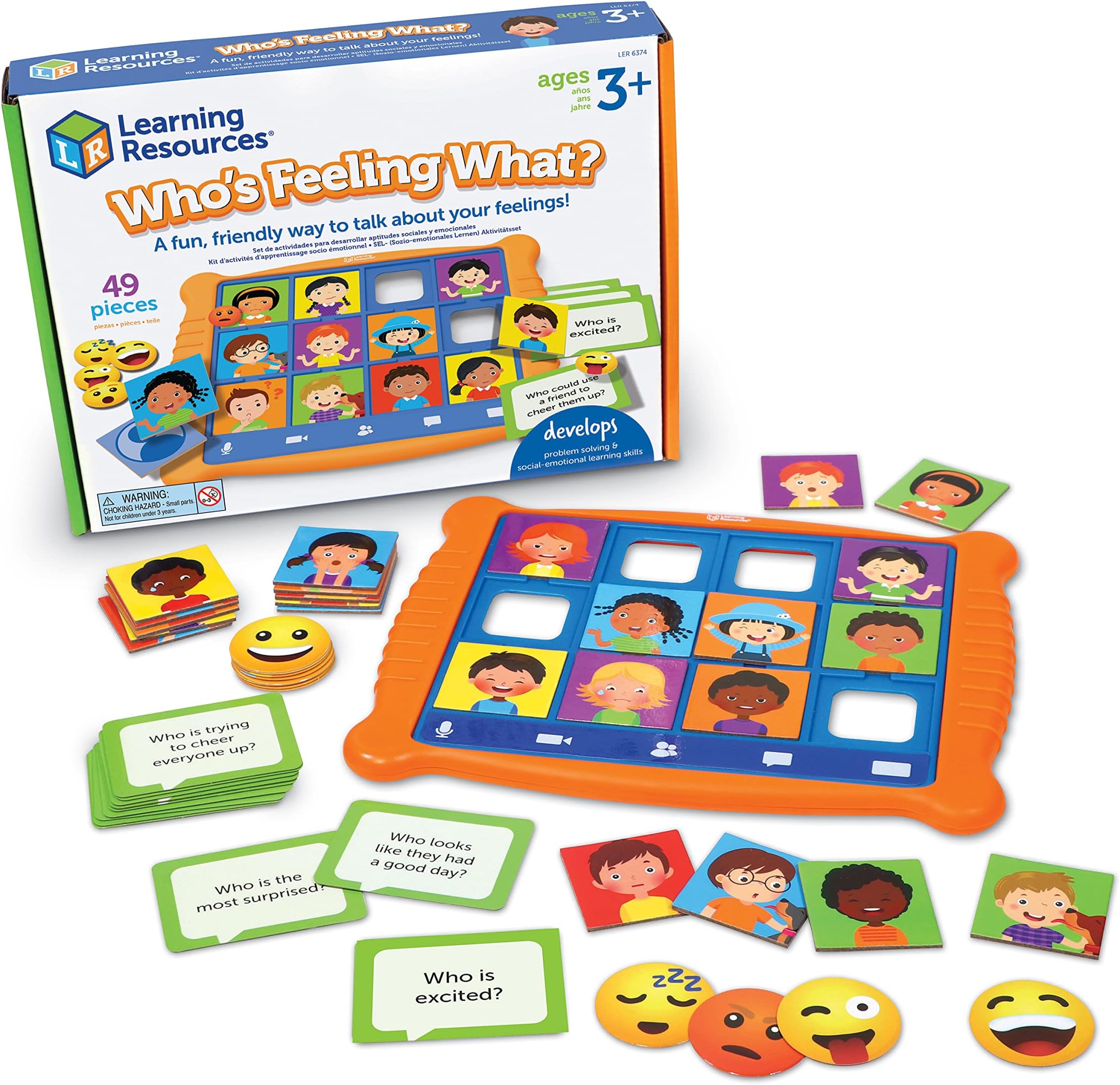
Who's Feeling What? is a 49-piece social-emotional learning game designed for kids aged 3 and up. Featuring 12 double-sided caller cards and 12 double-sided emotion prompt cards, this manual game encourages children to recognize and match emotions through interactive play. Perfect for home or classroom use, it includes an SEL activity guide to facilitate conversations about feelings, helping kids develop empathy, teamwork, and communication skills. Created by Learning Resources, a trusted educational brand since 1984.


| ASIN | B09SQF3PK2 |
| Age Range Description | 3 years |
| Best Sellers Rank | #61,523 in Toys & Games ( See Top 100 in Toys & Games ) #1,469 in Board Games (Toys & Games) |
| Brand Name | Learning Resources |
| Color | Multi |
| Customer Reviews | 4.5 out of 5 stars 393 Reviews |
| Educational Objective | Develop social-emotional learning skills, specifically emotion recognition and understanding |
| Global Trade Identification Number | 00765023063745 |
| Included Components | game board, 12 double-sided caller cards, 12 double-sided emotion prompt cards |
| Item Dimensions | 10.5 x 1.5 x 7.75 inches |
| Item Type Name | Who's Feeling What? |
| Item Weight | 0.12 kg |
| Manufacturer | Learning Resources |
| Manufacturer Maximum Age (MONTHS) | 60 |
| Manufacturer Minimum Age (MONTHS) | 36 |
| Manufacturer Part Number | LER6374 |
| Material Type | Plastic |
| Model Number | LER6374 |
| Number of Players | 2 |
| Operation Mode | Manual |
| Power Source | Manual |
| Set Name | 1 |
| Size | Medium |
| Subject Character | Social Emotional |
| Supported Battery Types | No batteries required |
| Theme | Adventure |
| UPC | 765023063745 |
| Unit Count | 1 Count |
B**A
Emotion Learning
used this for early emotion learning for kids, can be used for kids of all ages. fun game which they enjoyed.
N**S
Great for 2 and up!
Great for helping my 2 year old recognize feelings. She loves to play this
G**A
Great for behavior health
I am in behavior health and love using this to help little ones indentify there emotions. There is also different games you can play with the cards
K**R
Cute game
This is a good learning game, but it doesn't hold my daughters attention very well. Its cute and durable and a great size. Im sure as she gets older she will do better with it, right now we just play around how ever she wants.
A**R
Educational game
It’s a present to my friend’s kid and he loves it very much. My friend said it helps her child to learn while playing
J**I
Cute Idea but Needs Some Adjustments
It's a cute idea but the execution could be better. There are 12 emotions and 24 cards- 2 of each emotion. There is a game board with 12 slots to put the cards in. Then you ask the child "which person is happy?" for example. And then the child points to the card representing whatever emotion you asked them to identify. One problem is that it's a little difficult to differentiate between the different emotions. Frustrated and angry are very similar looking. Same with happy and excited, surprised and scared. The differences aren't very visually obvious. I don't know that I would have chosen emotions that were so difficult to convey visually. Context clues on the card would have helped like a spider coming down next to the scared person or a broken toy next to the frustrated person. The other thing is that some of the emotions are a little complicated for younger kids - embarrassed, worried, confused... are kind of difficult concepts for younger ones. And the one happy card is just poorly done. It doesn't even look happy. It does come with a guide in the instructions booklet so you, as the parent, can reference the guide and know which face is which emotion. But that essentially means that for the first few play throughs, you will need that reference guide next to you. One thing I did like is that the cards have questions on both sides. One side was more straightforward - "who is sad?" And the other side was a little more abstract - "who looks like they could use a friend?" I like that they had a way to make it easy to start with and then make it more challenging as the kids master the skills. I wish they would have done that with other elements of the game. For example - The game board has slots for 12 cards. That was kind of a lot of cards for us. It would be better if the game had another board with only 6 slots so that you could choose either 6 or 12 cards or if you could expand the game board or something. Just some way to make the game better suit the abilities of your kids. Another example - the intended emotion isn't written anywhere on the card. I would expect it to have been on the back. That would have really helped me know what emotions the faces were meant to represent. And then, once the kids show mastery of the skill of identifying the emotions, you could flip the cards so that the faces are covered and just the word is showing. That way they could show you what face they would make if they were feeling that emotion, then flip the card and see if they were right. I'm not necessarily saying that this is a terrible game and you shouldn't order it. Just be aware that not all kids can play this game the way it is intended to be played. You might need to adapt it to better suit the age and skill level of your kids. My son is 4 and in special education to work on this exact skill, so 12 emotions with some of them being very similar just didn't work for us. When we're ready to revisit this, we will probably start with the obvious ones- happy, sad, angry, scared, sleepy, and silly. Then once he's ready, we'll add in the more challenging emotions one at a time. I probably will do it in this order: Confused, embarrassed, surprised (because they're a little bit more visually obvious) and then excited, frustrated, and worried (because they're way more complicated and nuanced). Overall, it wasn't a bad game. It had the potential to be a better game though. It came with easy mode questions vs hard mode questions but it would be better if other elements of the game had an easy mode vs a hard mode. Without adjustment, this game doesn't seem to match the age it was supposedly intended for.
M**L
Great pictures
3 year old boy was easily engaged and has learned the different emotions
G**S
Grwat
Very good
A**R
Arrived quickly, great looking product!
Will be great fun for kids as the learn about emotions
C**B
Excellent outils, adaptations nécessaires pour fluidifier
Outil génial. Les enfants adorent glisser les cartes dans les cases. Certaines émotions ne sont pas évidentes à "décrypter" pour le coup des cartes avec les différentes émotions montrées sur chacun des supports et une petite noté descriptive de l'émotion ne serait pas de trop. Génial pour s'approprier les émotions, dommage que j'ai eu autant de travail à fournir pour l'utiliser facilement.
@**R
PRODUCTO MUY ATRACTIVO
Actividad/ juego para niños de infantil y educación primaria. Para ayudar a trabajar las emociones en inglés.
M**S
Nice product
Nice product
M**E
Perfect for Neurodiverse children such as my own who was struggling with recognising emotions
We love this game in our house. It also helps our Audhd child recongise and build on emotions. Simple, clever adaptation to guess who.
Trustpilot
1 month ago
1 month ago