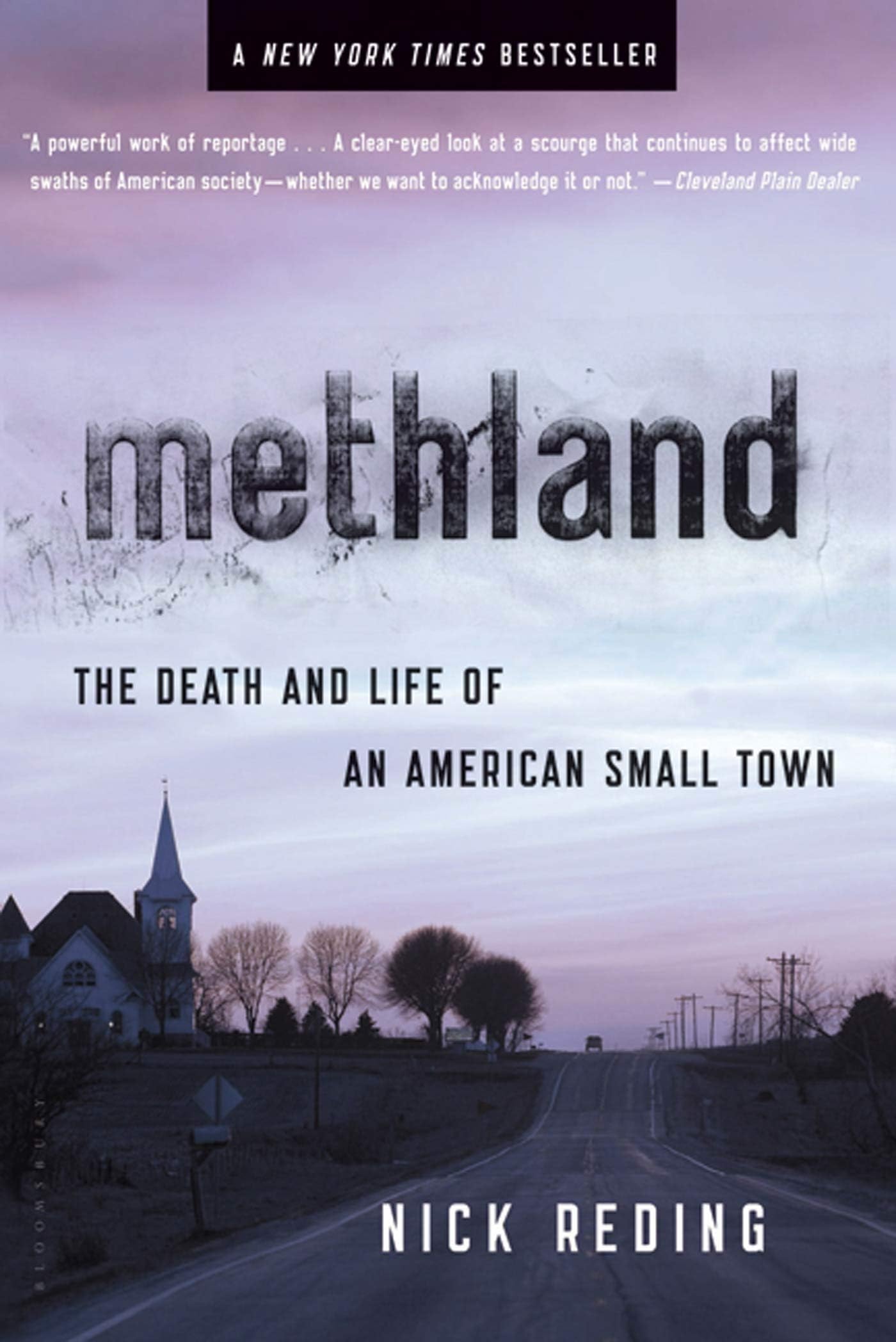
Methland: The Death and Life of an American Small Town (Bloomsbury, 3)
Product ID: 4439788
🏆Award-winning journalism
📈Top 100 rankings in Sociology & Substance Abuse
📚In-depth 4-year investigative reporting
Desertcart purchases this item on your behalf and handles shipping, customs, and support to Senegal.
📖 Uncover the hidden crisis shaping America’s heartland — before it’s too late!
Methland is a critically acclaimed, award-winning investigative book that explores the methamphetamine epidemic in rural America through four years of detailed reporting. It connects the drug crisis to broader economic and social issues, offering a sobering yet essential perspective on the struggles of small-town America. Highly ranked in sociology and substance abuse categories, this bestseller is a must-read for understanding the human and systemic costs behind the headlines.
| Best Sellers Rank | #225,281 in Books ( See Top 100 in Books ) #59 in Sociology of Rural Areas #335 in Substance Abuse Recovery #552 in Criminology (Books) |
| Customer Reviews | 4.3 out of 5 stars 629 Reviews |
B**M
Scary!
I guess the first thing I would say to anyone considering reading this book is: can you stomach a truly scary story, especially knowing it's real? Even though the book is a few years old, I'm sure much of what it portrays is still relevant. As someone who has never had any experience with meth, and whose knowledge comes from what she sees on "Breaking Bad", I found this book to be very well written and very informative about this problem. I live in the Midwest and have read newspaper articles about meth busts, meth cooks and how people behave in the throes of the drug; however, I've never really read much about the depth of the problem. The author did a good job of bringing his research together and presenting it in a very informative, readable way. I do have to say that there were sections that literally gave me chills when I pictured what it would be like to live in a town such as Oelwein and to come face to face with addicts in the course of my daily life. Thanks to the author for his well-written and informative book--it must have taken a great deal of courage to put himself in to those situations in order to get to the real stories.
P**N
One Scary Book
It is the only book I'm aware of that understands at a fundamental level meth isn't a drug problem, it is a symptom of our current societal and economic problems. The meth epidemic isn't about a drug, its about the economy, and so Reding's book is as much about the death of a way of life as the birth of a drug. For those looking for a Breaking Bad experience, or another drug-porn description of whacked-out meth addicts, this is not your book. Instead, Reding, after returning to his hometown of Oelwein, Iowa, chronicles the descent from a thriving agricultural-based economy into a desperate place where cheap, easy to obtain drugs like meth were just waiting to move in. Along the way Iowa's story parallels the changes in our broader national society and economy, focused here on Big Agra moving in, first destroying family farms and local meat packers, then replacing the workers in its new mega-facilities with cheap, disposable labor from south of the border. Such changes, whether wrought by Big Agra businesses, Chinese steel or Walmart, take away the life of the town but leave behind the people. Just like Big Agra destroyed a way of life in Iowa, Big Pharma profited off the remains. Reding details how the pharmaceutical industry spent heavily and lobbied successfully to not limit the import of pseudoephedrine into the U.S. The drug companies needed that chemical to be available and cheap for their cold medicines, and were without care that that same chemical, distilled out of those same cold medicines, fueled the meth epidemic. Hey, it was just business, a perfect metaphor for the rise of profit above all else, the leaving behind of the 99 percent. Reding touches on how easy the drug is to cook up in small batches, although a small mistake in the chemistry can result in horrific burns and explosions. Meth wasn’t a social drug, and so you didn’t need to hang around with old juicers in a dark bar. Meth came to you. Your friends were using it, if not selling it or cooking it, and the angry, speedo high it gave fit the young guys better. Meth wasn’t only for boys, either. Girls liked it too, and because you never thought about eating on a meth cruise, they called it the Jenny Crank diet. As part of research leading to my upcoming book, Ghosts of Tom Joad: A Story of the #99Percent, I spent some time in the Rust Belt of the Midwest, where meth is as popular as in Iowa, and for the same reasons. Reding's descriptions and conclusion ring true. But most importantly, meth just isn't cheap and easy, it is a Midwest drug. Instead of the flighty high of weed or the dulled feeling of alcohol, meth at first offers a powerful feeling of self-worth, of energy, that is the perfect antidote for the crushing depression and lack of hope the space around the user represents. For a world stuck in crap, meth was the answer. This was a drug designed for unemployed people with poor self-images and no confidence. Of course the drug is a false front, as users quickly suffer from the debilitating health problems we are all familiar with. But that's a tomorrow kind of problem, and the lost users in Iowa and elsewhere know they have no tomorrow anyway. Criticisms of the book are few. Reding includes far too much information on the personal lives of the few good people in town trying to better things, and about himself. These do little to support the central ideas and often detour the narrative. The book tries perhaps too hard to end on a positive note, focusing on the progress made but losing sight of how little winning one battle in rural Iowa means in the larger war for our America. But don't let those points stop you from looking into this book. Skim the filler and focus on the important point: People without jobs, without hope, without tomorrows, will turn to things like meth to ease the pain. It's human nature. As Reding writes, rock bottom is not a foundation to build on. And unless we as a nation figure out a better way forward-- jobs that pay a living wage for more Americans, the reining in of big interests that rip apart the fabric of the nation around them-- methland will be our land. We can't fix America's meth problem without fixing America.
S**O
This book will be assigned reading in college classes
I thought I knew a lot about drugs and drug policy, but Methland really expanded my understanding. This is more than a book of facts and opinions. It is original thinking about a terrible problem that doesn't go away. Some of the things the author wrote about months before the book was published are now making news, including a new awareness of the influx of drugs across the Canadian-U.S. border, and increasing drug violence in American towns and cities by vicious Mexican drug dealers. I particularly appreciate that the author is such a fine writer, making the book a pleasure to read, with his ability to personalize the sociology of illegal drugs in small town America. Given the current economic depression, we can expect to see more Methlands in our neighborhoods before long. By the way, the petty complaints of other reviewers about matters like how many stories a building has or whether a location is Cedar Falls or Cedar Rapids, are entirely irrelevant to the story and insights. I never noticed even a typo.
A**R
Informative and important - but needs a good editing job!
This is an important sociological overview of meth in a small town in America's heartland - its production, distribution, abuse, prosecution, "treatment" and the destruction it leaves in its wake (individual, familial and societal). If you are looking for loads of juicy stories about the human tragedy of meth use (as some reviewers here apparently were), this is not the focus of the book. Oelwein could be Anysmalltown, USA, where the bulk of the employment opportunities have dried up or moved away (in the name of progress - giant agribusiness), and where the inhabitants are looking to escape their troubles and feel better and have the opportunity to make a few bucks to boot. One of the great revelations of the book is that meth was formerly widely used, and historically was associated with increased productivity and an increased sense of well-being (although its bad side-effects were well known). Just how Oelwein morphed from a railroad roundhouse/agricultural community into a place where people ride their bikes in the open in order to cook meth is a story well-developed in the book, told from the perspective of the prosecutor, the hospital chief of staff and the mayor. Their views on how Oelwein might be brought right again, and their own personal struggles of being in Oelwein are valuable - the approaches they ultimately take might serve as a model for other communities in dire circumstances. How Oelwein's predicament dovetails with government anti-drug policy (and the incredible power wielded by the pharmaceutical companies lobbyists); the hierarchy of the Mexican drug industry; international regulation of the materials needed to make meth; and the rise of giant agribusiness (both for the low wages and no benefits, as well as the employment of persons of dubious nationality) is a tale of many a small town in America. In many respects, it is also a call to action on all of these fronts. While the book is highly informative, it would have benefitted from much better editing. Written in a conversational tone, I began to be frustrated by so many sentences beginning with, "That's to say....". On page 183, Reding writes, "But I think I was also looking for the meaning of a small town in my own life and in my family's history. And what if anything, had changed so profoundly that when I would tell my father what I was seeing in Iowa, he was made to wonder if he would even recognize the place whence he comes." That second sentence is sorely in need of a rework, and many of its ilk pepper this book. Here's another, on pages 184-5: "In the winter, they market-hunted jackrabbits, by which it is meant that they went out into the fields at night in the backs of trucks and killed the animals as they were temporarily paralyzed by the headlights." And one more, from page 222: "Or rather, it had long ago to him begun needing attention, and he was just now able to see this." Heaven help the reader! Last, Reding comes clean when he reveals that his father had risen through the ranks of Monsanto to become its Vice Chairman, and I applaud him for his honesty. What I really didn't want to know concerned addictions in his own family - and what I really couldn't understand was that he reveals that he moved with his pregnant wife to back to St. Louis, and expresses great concern about raising a family there while nearby Jefferson County was the meth lab capital of the US (in 2005).
A**O
Superbly researched and told tale of meth's impact on one small American community
Author Nick Reding notes that if you search on terms like "meth capital of the world" or "ground zero for the meth epidemic," you'll find those appellations applied to various locales throughout the United States. So, it would be easy to write a drive-by account of meth's impact across the country. What's not so easy is to identify and focus in on one small, representative community and describe meth's impact and that community's transformation...and, along the way to forge lasting, material relationships with the individuals at the vortex of the story: the town's mayor; its assistant prosecutor; and the local general practitioner (MD). That's what Nick Reding has done with the town of Oelwein, IA, and with his story's protagonists, Mayor Larry Murphy (who Reding rightly hails in his Acknowledgments as "what a hero looks and acts like"), prosecutor Nathan Lein and GP Clay Hallberg. That Reding can produce a warts-and-all depiction of Oelwein - and of these three men - and that you can see Nathan Lein's positive spotlight review on these pages...well, that tells you all you need to know about Reding's integrity, the value he places on friendship, and the veracity of his reporting. This book has some added resonance for me: as an IT professional, I've helped put in systems designed to ensure compliance to the Combat Meth Act. Reding does a good job detailing the unintended consequences of that and other legislation. He also makes note of various other missed opportunities to catch the spread of meth early on. The biggest causes of those misses? It wasn't Drug Trafficking Organizations ('DTOs') or other nefarious elements; rather, it's assiduous lobbying by the pharmaceutical industry.
S**7
Quite interesting and compelling
The author writes a compelling thesis: that Big Pharma, Big Agriculture, and Big Drugs swept through small-town Iowa farm districts like a tornado, destroying a culture and individuals in the process. The writing swings from journalistic views of individuals or families to socio-economic and cultural views of changing rural America. I found the writing compelling, and particularly the plight of addicts in a treatment-absent zone. The account reminded me of Barbara Kingsolver's fictional Demon Copperhead--except that this account is real. The story of Roland Jarvis blowing up his mother's home and nearly burning himself to death as a result of his meth addiction was so compelling I had to re-read it a couple of times to make sure I had the details correct. The book is a bit old and thus predates the arrival of the fentanyl from China and the Mexican drug cartels.
C**B
Great journalism
This is journalism at its best. "Methland" is about the methamphetamine attack on rural America. Focusing on Oelwein Iowa, it's about the ordinary people who use meth, and the ordinary people who make it & deal it. And the reasons why they do. Globalisation has meant that the old industries (the farming, the rail work & meat packing) are largely gone, or have been changed beyond recognition. Local unemployment is high. What work there is, being done by low paid immigrant labour. Then a drug turns up (in large quantities) that delivers instant pleasure and relief from depression; it's also the only well paying job around. Who can blame anyone for getting in to it? But then the consequences become apparent. ...the addictiveness, the violence, the hideous self-destruction, the neglected children. And behind the scenes, pulling the strings, is big business (agribusiness, the pharmaceutical industry and the Mexican drug cartels) intent on maximizing their profits, with no or little concern for the lives they're destroying. But "Methland" is much more than this; it's also about the people who fought back to reclaim their lives and their towns. It shows it can be done. Nick Reding has written an important book. On the subject of meth in rural America, also see the documentary "Montana meth" (HBO). On meth in the gay scene, see Todd Ahlberg's superb documentary " Meth" (Babalu Pictures)
R**B
Can change how you think about the USA
This noteworthy book was certainly an eye-opener for me. My vision of midwest small-town America was steeped in the stories of my mother's annual visits in the 1930's from Chicago to her cousins who lived in northeast Iowa--on a farm. Yes, Iowa's small farm towns possessed all that is right and great with America--hard work, simple but worthwhile lives, and a golden goodness. When I traveled to Iowa for family reunions picnics in the '60's, 70's and into the 80's little I saw would tarnish this idyllic picture of small-town American farm life. Well, this book changed all of that. What a tragedy. Reding, in his analysis of why this has happened, spreads the blame around to the usual suspects--big agricultural companies, lobbying of special interest groups, pharmaceutical giants, members of both the Senate and House kowtowing to these lobbyists, and the indifference of both both coasts to the problems of small town middle America. Reding's style is refreshing. He embedded himself into these small towns such as Oelwein IA and weaves his story around the people he meets. He also has researched and writes clearly about the very complicated issue of crystal methamphetamine addiction. He cleverly and accurately labels this egregious drug as the first vocational drug. This book may change how you think about how the USA is run.
S**S
Good reading
Very appalling that USA government can’t stop the urge for consumers to take this drug and stop the production and importation!
K**0
Things I never knew and didn't know to ask
Great book. Full of insights and information about the plague of drug addiction in the mid-west. The book includes some wonderful stories about people impacted by meth... not long dreary stories but insightful and often ironic tales of ordinary people caught up in addictions.
J**N
Informative
Excellent, well researched reportage on the effects of methamphetamine (and other drugs) on societal and personal levels
D**S
The great 'white' drug epidemic that is devastating communities
Great book about the great 'white' drug epidemic. Unlike crack, for which the response was to building endless new prisons, Meth is being treated or ignored. And the amazing thing is that this new epidemic is destroying more communities and lives than crack ever did.
M**K
Five Stars
An excellent book, thought provoking look at the effects of drugs and the war against them.
Trustpilot
3 weeks ago
1 month ago