
Desertcart purchases this item on your behalf and handles shipping, customs, and support to Senegal.
📖 Get lost in a story that’s more than just a book!
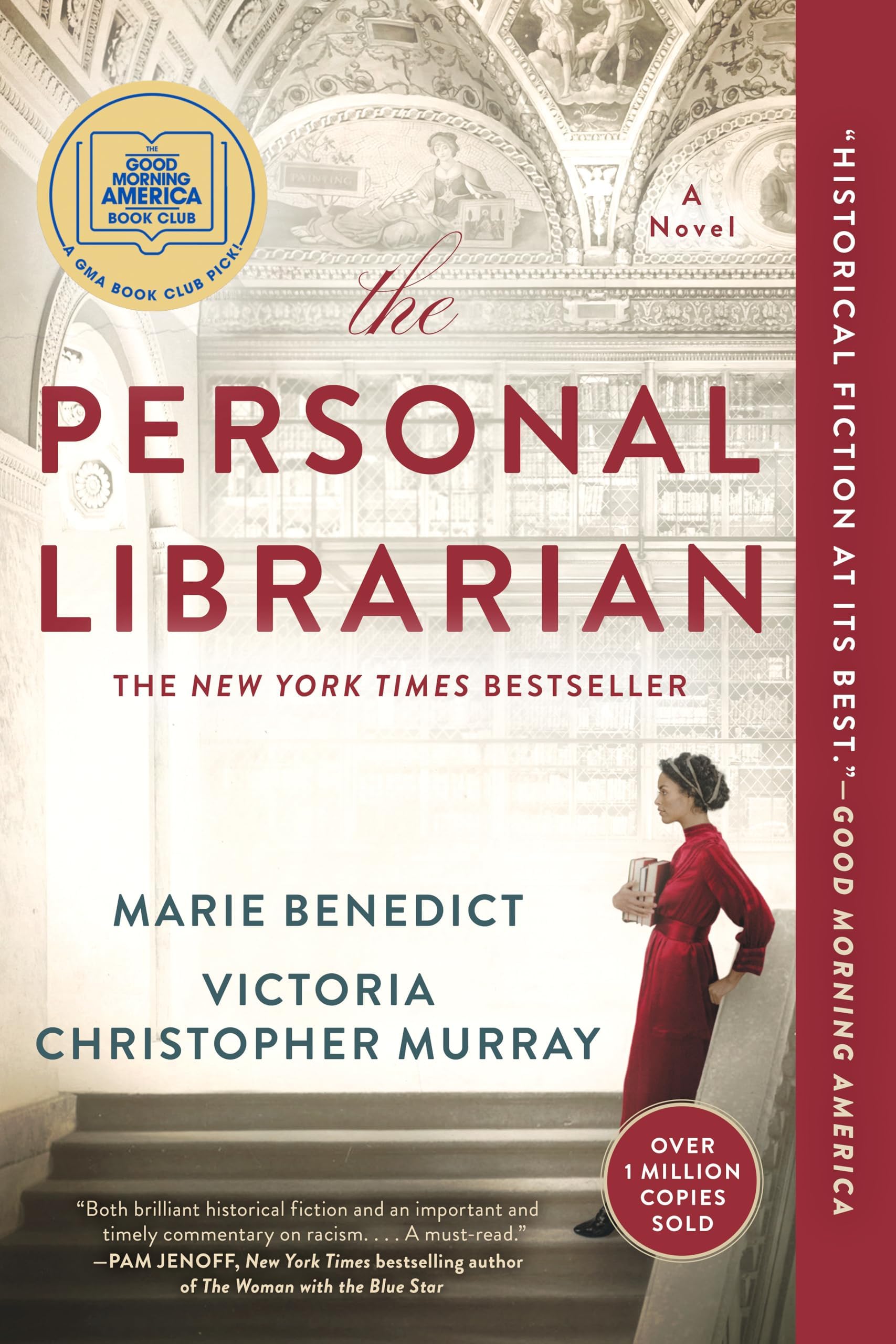
The Personal Librarian is a captivating novel selected by GMA Book Club, featuring over 300 pages of rich storytelling and unforgettable characters that resonate with the millennial experience.


| Best Sellers Rank | #1,522 in Books ( See Top 100 in Books ) #5 in Biographical Historical Fiction #6 in Biographical & Autofiction #27 in Black & African American Women's Fiction (Books) |
| Customer Reviews | 4.5 out of 5 stars 50,849 Reviews |
C**K
An unexpected level of historical accuracy for a novel.
The Personal Librarian is a fictional account of the life of Belle da Costa Greene, who managed the acquisition and collection of books and art for J. P. Morgan - his personal librarian, as it were, continuing with his son until her death in 1950, of cancer. During her life, she was most notable for aggressive style in the acquisition of books and art for Morgan, at a time when doing this as a woman was considered highly unusual. But there was another aspect of her life that only came out 49 years later, when a photographer noted that she had spent her entire life passing for white, while in fact, her father was the first black Harvard graduate, and a leader in the civil rights movement, which had regressed profoundly after the civil war, thanks to The Great Compromise of 1877, which led to Jim Crow. Marie Benedict, upon realizing the implications of this, enlisted a co author for the book, Victoria Christopher Murray, to try and concoct a fictional account of Belle da Costa Greene life, with some level of plausibility. I would say they succeeded admirably, even though of course we will never really know what her thoughts were at the time. I will say, much to my surprise, all the basic plot lines are tied nicely to historical facts. In fact, as historical fiction goes, Greene's thoughts notwithstanding, this book seems to have a historical accuracy that I have not experienced in many decades. What an amazing individual.
D**M
an enjoyable behind the scenes view of Ms Greene
I was very interested to read the story of this amazing woman who was at some point the highest paid woman in America. Loved that she could be fashionable, sassy, and flirty sometimes as well as a serious scholar.
Z**T
Who Built J.P. Morgan’s Wealth?
And at what price did she build it? By choosing to heed her mother’s advice, Belle chose to risk identifying as being a white woman in public, during post the Reconstruction era. To any non-black person, Belle’s light skin, anglicized name, and her love of art history played into the elite white psyche. They blindly decided that she is one of their own. During the time capture in this novel (1905 to 1924), and after the Dyer Bill was filibustered in 1877, blacks who tried to have agency were deemed disrespectful, out of their place and only worthy of being lynched. In particular, the filibuster argument was that they needed to be able to lynch the freed blacks to protect their white women from being raped. So, when Belle’s mother insisted that they all change their name, and identify in every way to the public as having a Portuguese heritage, Belle’s fate was chosen for her. And because a daughter’s first mirror is her mother, Belle studied who she needed to be, how she needed to maintain decorum, and how to talk in a way that black women weren’t and aren’t free to talk amongst wealthy businessmen. She studied how to be coquettish, how to think on her feet, and to deflect whenever necessary. Each successful business transaction and interaction became a cause set in motion towards her simultaneously being more visible to society and more at risk for getting caught. The price of which would impact not only her livelihood, but also that of her mother and siblings. It was interesting to “watch” the struggles that she went through over her question of whether she should have followed her mother’s path, or that of her father, which was the antithesis of her mother’s focus. Her father fought for civil rights, because he believed that some day black folks would be judge by their character. Yet, her mom, based upon witnessing every day blacks being lynched to death for their desire to be integrated socially, politically and economically, in her mind, it was only possible to be successful and free if their entire family takes advantage of looking white by choosing to be white. While reading this book, at first, I wanted to side with Belle’s dad, because to me, owning your voice, being your authentic self gives you peace of mind. Identifying as someone who you are not has always meant to me as lying to myself and destroying the chance of align your personality with your soul. I also saw the pressure Belle lived with when her father left the family because he could no longer live in the dichotomy of “Choose to be white to be successful”, or “Choose to be black to own our right to matter” that existed. Of course, my mindset was based upon living in a freeing society that 1877 to 1924 did not know. Also, we have the benefit born out of the Belle’s in our history, to speak up and be heard. Yet, one hundred years later, June 2024, black women, or any person of color, much modulate their approach to success according to societal unspoken rules. Yes. Belle built the J.P. Morgan wealth by choosing to be white, at the price of her own peace of mind. As a white woman, she could name a price of art, negotiate with old cronies, and close the deal as if she just bent her arm. That wouldn’t have happened had she identified as a black woman, back then. The wealth that she amassed for the Piermont Librarian counted upon her ability to not only study art, network with the best in the business, but also study what it meant to be an influential white woman. If she was going to have to abandon her ethnicity for the sake of her immediate family, she was going have to perpetually study being who she needed to be, and who, as a white woman, she would have licensed to be. She wasn’t free to look a black servant in the eye, for fear that they would report her to the public as being one of them. The only way she saw her biological family was through carefully planned trips that were out of the view of the socially elite. Ultimately, she mastered the public persona, though she struggled with the lie she had to continually nourish and preserve. Like “The First Ladies”, this was an excellently written book that truly helped me to be part of U.S. History. One hilarious moment that reading this book in public was: after waiting a bit for my banker to be available, seeing me reading this book in my hand, she asked, “What are you reading?” My enthusiastic response was, “Oh this is a great historical novel about how a black woman 100 years ago made J.P. Morgan’s wealth.” The look on her face was priceless.
E**I
Interesting and a good read
A good story! Now I have to go see the NYC library. It sounds facinating.
J**F
Admired, Accomplished, And Forced to Hide
The Personal Librarian by Marie Benedict and Victoria Christopher Murray is a compelling and deeply moving novel inspired by the life of Belle da Costa Greene, the brilliant woman who curated J.P. Morgan’s extraordinary library. What struck me most was how admirable she was — intelligent, cultured, strategic, and fiercely competent in a world dominated by powerful men. She did not merely survive in that world; she excelled in it. Belle was clearly a woman far ahead of her time — sharp, ambitious, and unafraid to assert her expertise — yet she had to constantly measure her words, her movements, even her identity. What makes her story both inspiring and heartbreaking is the secret she carried. Because of the rigid racial realities of her time, she chose to pass as white, hiding her Black heritage in order to protect her career and family. Whatever reasons she had, the fact remains that she achieved extraordinary success under immense pressure. She was an achiever in every sense of the word — negotiating rare manuscripts, shaping one of the greatest collections in history, and earning respect in elite circles — all while living with the fear that everything could collapse if her true background were exposed. The novel portrays her brilliance with warmth and admiration, and rightly so. Belle’s poise, taste, and intellect are undeniable. Yet there is a lingering sadness throughout the story. The fact that she burned much of her personal correspondence suggests that even toward the end of her life, she feared the repercussions of her skin color being fully known. That act feels symbolic — a final effort to control her narrative in a society that never fully allowed her to live freely in her own identity. It is difficult not to feel sorrow that she did not live to see a time when things would be better — perhaps not perfect, perhaps only slightly improved, but still better than what she endured. Her life is a testament to resilience, ambition, and brilliance under constraint. The Personal Librarian is ultimately a celebration of an extraordinary woman — one who was not only accomplished, but courageous in ways both visible and hidden.
R**S
a fascinating read
it's historical fiction but knowing that the protagonist of this story was a real person, and the mark she made on building the collection of the JP Morgan library, is a great read! there is also sadness that she had to maneuver her life in secret because of her heritage. how stressful it had to have been for her to live in fear of someone finding out her truth, and to live her life without contact with her family. Belle Greene's story is inspiring despite her sacrifice.
A**S
A Romanticized Life Story
Nearly all "romanticized" biographies plunder the works of people who often spent years doing research and writing the first book. And so it is in this case. The real biography of Belle Greene, or what we know of it--An Illuminated Life by Heidi Ardizonne--was published in 2007 and was praised by the critics, but it did not receive the attention that The Personal Librarian is getting today because it had not been embellished with invented side stories. I read The Personal Librarian for a book club, brought this point to those who were there, but nobody cared. And yet the real Belle was much more complex and therefore more interesting than the one we see in this novel. I will have to read An Illuminated Life to get a better picture of what can be known of the life of the mysterious and gifted Belle.
A**Y
Top-Notch Historical Fiction
"The Personal Librarian" by Marie Benedict and Victoria Christopher Murray continues the tradition of "Gentleman's Agreement," "Focus," or the underrated "The Human Stain," in which a character hides their ethnicity in a discriminatory environment. For anyone tired of race as a topic, we have an educated bibliophile who certainly wishes that people would focus on her skill and not her complexion. Belle, our hero, has her character development based on two key features: she has keen negotiating skills and an eye for quality in literature and art. But, would her boss, the wealthy (and authentic) J.P. Morgan, still acknowledge her prowess if he knew of her true ancestry? On the other end, can we blame her Black relatives for turning their collective backs on her family since the group has chosen to live as white folks? The most challenging part of reading lies in accepting the new universe's rules into which the author tries to engross me. Of course, with infinite money and resources, people like J.P. Morgan do not qualify as relatable, but Belle's struggle with her racial identity packs a punch. As she infiltrates high society, the element of intrigue always exists under the surface about whether the dignitaries know her secret or, in 1919, how much it would matter. As historical fiction, the book describes a specific time post-Reconstruction and pre-Suffrage. Belle more than holds her own in her discussions and negotiations with wealthier and more powerful men, but she cannot escape the fears in the back of her mind. The inevitable happens when a subplot of romance appears; nonetheless, I was captivated enough with the story not to see it coming. I cared enough about the characters to feel sorry for them. When you reach the end and figure out the author's message, you will want to know more about our heroine. How did she achieve deception for so long, and, more importantly, why was it necessary in 1910? As the story progresses and the "big reveals" do not happen or occur differently than you anticipated, you recognize this as a singular work by one of Upper St. Clair's most excellent alumnae, Marie Benedict. (Note: I usually enjoy stories that create fiction from the kernels of truth in history. The story in the Author’s Notes of how both writers united to make this happen is inspiring and not to be missed.
C**R
Interesting
A very interesting story, which was very inspiring. Although fiction, it was based on true life. Loved it and highly recommend this great read.
R**N
Fascinating read
Loved this book, inspirational and full of interesting facts! In some ways we have come so far but some of the same issues are still present today.
B**H
Wonderful book!
I loved this book. What a wonderful way to get to know the real Belle Da Costa Green, the amazing true story about a truly impressive career of the personal librarian of Piermont Morgan and his legendary Morgen Library in New York. I wish I could go and visit the real library! A true story about a black women who passed as white woman written by a white author and her black co-author! It inspired me to go online to read a couple of Greens letters to her lover. All !! these letters are in the Morgan Library for everyone to read and research!
B**R
Es un novela histórica fascinate
Muy bien escrito. Muy interesante, mantiene tu interés. No sabía la importancia que tuvo esta mujer.
C**N
A Great Read!
Excellent historical fiction here highlights so many important issues… It explores the art world, women's rights and racism all in elegantly packaged novel that is difficult to put down. Telling the story of Belle da Costa Green's career as JP Morgan's personal librarian, it really brings you back to NYC in the early 20th century. Robert my eyes not only to this impressive historical figure but of the challenges of being a black woman in the early 1900s.
Trustpilot
1 week ago
4 days ago