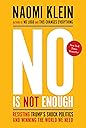
No Is Not Enough: Resisting Trump's Shock Politics and Winning the World We Need
Product ID: 43492518
Desertcart purchases this item on your behalf and handles shipping, customs, and support to Senegal.
New York Times BestsellerNational Book Award LonglistPublishers Weekly Best Books of 2017Donald Trump’s takeover of the White House is a dangerous escalation in a world of cascading crises. His reckless agenda—including a corporate coup in government, aggressive scapegoating and warmongering, and sweeping aside climate science to set off a fossil fuel frenzy—will generate waves of disasters and shocks to the economy, national security, and the environment. Acclaimed journalist, activist, and bestselling author Naomi Klein has spent two decades studying political shocks, climate change, and “brand bullies.” From this unique perspective, she argues that Trump is not an aberration but a logical extension of the worst, most dangerous trends of the past half-century—the very conditions that have unleashed a rising tide of white nationalism the world over. It is not enough, she tells us, to merely resist, to say “no.” Our historical moment demands more: a credible and inspiring “yes,” a roadmap to reclaiming the populist ground from those who would divide us—one that sets a bold course for winning the fair and caring world we want and need. This timely, urgent book from one of our most influential thinkers offers a bracing positive shock of its own, helping us understand just how we got here, and how we can, collectively, come together and heal. Review: If you read one book on our present political crisis, make it this! - If you are looking to understand how we get out of our current political crisis, read this book. If a friend is looking to understand what Trump's election means, give them this book. If you know an organizer unsure about how to effectively resist the Trump administration, give them this book. 'No Is Not Enough' is a clear, accessible distillation of the long-term problems in our political system that produced Trump. The first half of the book outlines a basic reality that needs to constantly be driven home: Trump is a symptom, not the disease. If Trump was removed from office today, right-wing extremism would still threaten our environment and an oligarchy disinterested in the public good would still control our political system. Corporations and far-right billionaires have spent decades buying control of local, state, and national politics, government agencies, and the media. Democracy has been eroding for a long time, and Trump is a symptom of a political system that is fundamentally broken. Because of that, effectively resisting Trump means we have to move beyond just rejecting the Trump administration's destructive policies. Klein spends the second half of the book outlining why we need to develop a bold, positive agenda that directly confronts the institutional crises that produced Trump; we have to propose reforms that would prevent future Trump-like figures from rising to power. These reforms include: ending gerrymandering, automatic voter registration, expanding early voting, publicly financed elections, ranked-choice voting, a ban on all new fossil fuel infrastructure, 100% renewable energy by 2030, ending 'right-to-work' and empowering unions, massive public works projects that create millions of new jobs rebuilding our infrastructure to make it 100% renewable and able to withstand rising sea levels/stronger storms, Medicare-for-All, public banks, creating a carbon tax, establishing a global wealth tax, a $15 minimum wage tied to inflation, tuition free public colleges and universities, etc. Such reforms won't happen overnight. There will have to be compromises and there will be setbacks. But creating a clear, bold agenda is a North Star that guides organizing; it inspires people new people to get involved in the political process, increases voter turnout, and lets ordinary people understand how politics can actually change their lives for the better. Movements have to demand reforms that can't currently happen in order to shift the political landscape and actively *change* what is possible rather than accept the existing status quo as a static reality that can't change. Without a positive agenda, people burnout and assume politics can never improve their lives. That results in people disengaging from politics, reduces voter turnout, and creates widespread cynicism and despair -- conditions that empower demagogues like Trump (after all, Trump is widely unpopular and not supported by the majority of Americans; it was voter apathy that allowed him to rise to power despite the majority of Americans opposing him). In addition, Klein convincingly argues that an internal shock will cause the Trump administration to impose huge restrictions on civil liberties and attempt crackdowns on progressive organizers and free press (think the PATRIOT Act on steroids). To stop that, what's needed is massive popular mobilizations that enter the streets to reject Trump's attempts to suspend civil liberties -- but that movement *also* needs to couple their rejection of Trump with a clear positive, popular agenda in order to inspire people to join the movement and show that a positive alternative to Trump's authoritarian pro-corporate politics *does* exist and that we *do* have the collective power to bring that reality into existence. 'No Is Not Enough' is a succinct reminder that all of history is new, infinitely improbable realities emerging despite all expectations; indeed, if everything was routine and predictable, we wouldn't need history. Progress has always been driven by popular movements. These movements never had the active participation of more than 1-3% of the population, but their sustained organizing and positive vision for the future has abolished slavery, won women the right to vote, created unions and the 40 hour work week, overthrown dictators and established democracies, cleaned up polluted rivers, and imposed restrictions on corporate power. We are living through another movement moment. The time to unite existing movements and organize around a positive, transformative vision for the future is now. The stakes have never been higher. Let's get to work. Review: probably the most important book you will read this year - for anyone even the slightest bit concerned about the state of u.s. politics and way of life today--as well as about the fate or our planet--please read this book ASAP. Klein is the perfect person to have written this book. she's spent years writing about super brands and globalization. one main point of the book is that the president himself is the ultimate super brand. she highlights political and cultural trends that led to the rise of our current leader, as well as points out that resistance is not enough. one has to envision a world we want to live in, and propose concrete policies that counter the ones currently being put forth by our leader(s). I would've liked notes in the physical book itself, but the intro states there are notes/annotations online that accompany the book. This book is a fast read, and a jolt of inspiration for anyone feeling thoroughly defeated and/or overwhelmed by the direction the country's headed.
| Best Sellers Rank | #1,040,396 in Books ( See Top 100 in Books ) #269 in Civics & Citizenship (Books) #386 in Political Advocacy Books #445 in Political Commentary & Opinion |
| Customer Reviews | 4.6 out of 5 stars 1,617 Reviews |
G**E
If you read one book on our present political crisis, make it this!
If you are looking to understand how we get out of our current political crisis, read this book. If a friend is looking to understand what Trump's election means, give them this book. If you know an organizer unsure about how to effectively resist the Trump administration, give them this book. 'No Is Not Enough' is a clear, accessible distillation of the long-term problems in our political system that produced Trump. The first half of the book outlines a basic reality that needs to constantly be driven home: Trump is a symptom, not the disease. If Trump was removed from office today, right-wing extremism would still threaten our environment and an oligarchy disinterested in the public good would still control our political system. Corporations and far-right billionaires have spent decades buying control of local, state, and national politics, government agencies, and the media. Democracy has been eroding for a long time, and Trump is a symptom of a political system that is fundamentally broken. Because of that, effectively resisting Trump means we have to move beyond just rejecting the Trump administration's destructive policies. Klein spends the second half of the book outlining why we need to develop a bold, positive agenda that directly confronts the institutional crises that produced Trump; we have to propose reforms that would prevent future Trump-like figures from rising to power. These reforms include: ending gerrymandering, automatic voter registration, expanding early voting, publicly financed elections, ranked-choice voting, a ban on all new fossil fuel infrastructure, 100% renewable energy by 2030, ending 'right-to-work' and empowering unions, massive public works projects that create millions of new jobs rebuilding our infrastructure to make it 100% renewable and able to withstand rising sea levels/stronger storms, Medicare-for-All, public banks, creating a carbon tax, establishing a global wealth tax, a $15 minimum wage tied to inflation, tuition free public colleges and universities, etc. Such reforms won't happen overnight. There will have to be compromises and there will be setbacks. But creating a clear, bold agenda is a North Star that guides organizing; it inspires people new people to get involved in the political process, increases voter turnout, and lets ordinary people understand how politics can actually change their lives for the better. Movements have to demand reforms that can't currently happen in order to shift the political landscape and actively *change* what is possible rather than accept the existing status quo as a static reality that can't change. Without a positive agenda, people burnout and assume politics can never improve their lives. That results in people disengaging from politics, reduces voter turnout, and creates widespread cynicism and despair -- conditions that empower demagogues like Trump (after all, Trump is widely unpopular and not supported by the majority of Americans; it was voter apathy that allowed him to rise to power despite the majority of Americans opposing him). In addition, Klein convincingly argues that an internal shock will cause the Trump administration to impose huge restrictions on civil liberties and attempt crackdowns on progressive organizers and free press (think the PATRIOT Act on steroids). To stop that, what's needed is massive popular mobilizations that enter the streets to reject Trump's attempts to suspend civil liberties -- but that movement *also* needs to couple their rejection of Trump with a clear positive, popular agenda in order to inspire people to join the movement and show that a positive alternative to Trump's authoritarian pro-corporate politics *does* exist and that we *do* have the collective power to bring that reality into existence. 'No Is Not Enough' is a succinct reminder that all of history is new, infinitely improbable realities emerging despite all expectations; indeed, if everything was routine and predictable, we wouldn't need history. Progress has always been driven by popular movements. These movements never had the active participation of more than 1-3% of the population, but their sustained organizing and positive vision for the future has abolished slavery, won women the right to vote, created unions and the 40 hour work week, overthrown dictators and established democracies, cleaned up polluted rivers, and imposed restrictions on corporate power. We are living through another movement moment. The time to unite existing movements and organize around a positive, transformative vision for the future is now. The stakes have never been higher. Let's get to work.
C**R
probably the most important book you will read this year
for anyone even the slightest bit concerned about the state of u.s. politics and way of life today--as well as about the fate or our planet--please read this book ASAP. Klein is the perfect person to have written this book. she's spent years writing about super brands and globalization. one main point of the book is that the president himself is the ultimate super brand. she highlights political and cultural trends that led to the rise of our current leader, as well as points out that resistance is not enough. one has to envision a world we want to live in, and propose concrete policies that counter the ones currently being put forth by our leader(s). I would've liked notes in the physical book itself, but the intro states there are notes/annotations online that accompany the book. This book is a fast read, and a jolt of inspiration for anyone feeling thoroughly defeated and/or overwhelmed by the direction the country's headed.
J**T
Now outdated, but no less relevant
This was written during Trump’s 1st term, so many of the details are now outdated. However, the big picture and many components of it are now more relevant than ever. Naomi Klein does a great job breaking down neoliberalism, “shock politics,” and the how/why of what Trump does. It helps you see through all the BS and understand the games being played. The only real shortcomings holding it back from 5 stars (aside from the outdatedness, which is minor) are that there could be a bit more insight into what we can do about it. The title of the book suggests that’s the whole point of the books. We certainly need to understand “shock politics” and the how/why of what Trump does in order to understand what to do about it, but that transition is a little thin and lacking. Still an overall great read for anyone who is pissed off about the state of the world and wants to better educate themselves on what they can do about it.
D**N
An insightful book of the path forward
This book is super important right now. If you haven't read any of Klein's previous works this one is a nice compilation of her previous works. It's central theme is that while we are saying "No" to unsustainable, cruel, and short sighted practices which of course we don't want, we must also have a "yes" to what we do want. We have to not just defend and protest, but all so dare to imagine, and intentionally begin working towards a world that works for all. Other major themes include the shock doctrine, and preparing our communities for the way that many in Trump's administration might try to take advantage of crisis situations to push through dangerous policies that normally wouldn't pass, while stifling protest and democracy. Through the lens of her decades of experience reporting on countries dealing with similar situations, she gives a lens (much based in her early title The Shock Doctrine) by which to prepare and defend. Timely and important, if you're interested, this would be a wonderful read.
J**R
She hit another one out of the park
Just as "Shock Doctrine" to me was a fantastic unified theory about why the world around me seemed to be making no sense. This just released book is a treasure, as is Naomi. Some events in the book are very current, she may have written this quickly, but it is filled with important and new thinking. Anyone interested in what is going on, and how to stop Trump (she clearly point how it is not ONLY Trump, trump is a symptom, we need to strike the system that culminates in Trump) and had a lot of great information as well as excellent points about stopping the left "silo politics" as she ties the different causes together. Hard to explain in a quick review. This book is excellent.
T**O
Eye opening, educational
An excellent writer with interesting ideas. Learn about the Shock politics and compare what you read to what you are experiencing now. I enjoyed reading this book.
S**A
Intriguing book with some frightening, perhaps questionable, predictions
The first part of the book deals with the "No" in the title--no to Trump's greed, lies, and his nefarious plans to destroy our democracy's institutions. Although we have already learned a lot of it through the press, it is beneficial to repeat the danger that Trump poses so that we do not slip and slide--unawares--to normalizing his regime. The core of the book concerns the question that hangs over all of us--how to resist Trump and prevent him from becoming a dictator, and how to challenge "the capitalist ideology" (82) of his cabinet members, who understands that any action that ameliorates global warming endangers their "desperate need" to soak the globe with oil. This is indeed a troubling question, which is for now, at least, unanswerable. The most important task for Americans, according to Kliein, is to become aware of Trump's malicious methods of attempting to control us. The two important words here are "chaos" and "shocks." Klein is exactly on target when she says that "[s]ince taking office [Trump's] never allowed the atmosphere of chaos and crisis to let up. The outrages come so fast and furious that many of are understandably struggling to find their footing…"(135). This kind of attack, Klein says, "has felt a little like standing in front of one of those tennis ball machines" (135). What an apt metaphor! The purpose of the shocks is to so disorient us that we won't be able to respond effectively. Resistance should and has followed Trump's shock treatments. Klein praises the women's march, the scientists march, indivisible.org, and the judiciary, who bravely opposed Trump's travel ban. However, Klein warns, if there is a terrorist attack, the President is likely to override court decisions, round up his enemies, and declare a state of emergency (165). Klein questions whether the courts would muster the courage to stand up to "public hysteria" (165). To my mind, this is an imaginary scenario. I may be proven wrong, but I still believe that the courts are brave and trustworthy and that Trump cannot trump the Constitution so easily. In Klein's darkest prediction she sees Erik Prince, the founder of Blackwater, who, reportedly, had been in touch with one of Putin's cronies, as Trump's new point person in case Trump has it in mind to create a private militia for the purpose of surveillance and interrogation (167). This is a KGB, or a Stasi nightmare. Again, I think this is a fantasy that fits perhaps some of the Latin America dictatorships Klein visited and wrote about rather than America. But, of course, I may be wrong. What can save us, according to Klein, is the Leap Manifesto her group created in Canada, a platform without a party and without a country, that aims to address the "crises of climate change, inequality, and racism together" (252). I fail to see redeeming power of this Manifesto. Of course, it consists of noble ideas of fairness, justice, decency, and compassion, but many across America, across the globe, and across the centuries have expressed these ideas with clarity and eloquence. It is always good and right to remind us of these ideas, but how are they going to help us when Trump unleashes his black tyranny? What is surprising and disappointing is that Klein does not include the press among the resisters. Journalists from the NYT, the Washington Post, the Atlantic, MSNBC, CNN, and other organizations are now doing a remarkable, painstaking work as watch dogs over Trump's presidency. They are investigating his every move and mood, revealing his secret plans, exposing his lies, and upending some of his schemes. Why doesn't Klein give them credit? To fight Trump we need everything Klein mentions--protests, platforms, the judiciary. But we also need the press and brave leaders. It was Mandela who alone stood up to the government of Apartheid. It was Gobachov (with Reagan's help) who brought down the Berlin Wall and thus put an end to the communist dictatorship in East Germany. And it was Churchill who, with eloquence and courage, faced up to Hitler when many in the British cabinet supported appeasement. Here's a quandary for all of us.
B**K
No to Trump, but is there a unifying Yes
What stands out about her new book, No is Not Enough: Resisting Trump’s Shock Politics and Winning the World We Need, is not only her analysis and documentation of the dynamics and characteristics of US capitalism over the past 40 years, but also of what explains the election of Trump, how Trump and his administration are consolidating control of the executive branch of the federal government, how current economic trends and policies are making things even worse than they’ve been. Nevertheless, Klein also optimistically writes of “how things could get better.” In her final chapter, she outlines a program for the transformative change of our capitalist system, here and everywhere, and argues optimistically that “more and more people are arriving at the same conclusion: it’s time to unite around a common agenda that can directly battle the political poison spreading through our countries” (234). She spends the last chapters of her book considering the conditions transformative changes require and an agenda around which liberal and leftist forces can and must unite. In the meantime, Trump and his corporate and Republican co-conspirators want to take advantage of the chaotic political situation and Republican political dominance to advance their right-wing agenda. So, the Trump administration is acting with speed, hoping that “if dozens of changes come from all directions at once,” the “populations will rapidly become exhausted and over-whelmed, and will ultimately swallow their bitter medicine” (137). Their approach represents in part, Klein thinks, the exploitation of crises and the shocks that accompany them. She refers to it as “the shock doctrine,” a concept that provided the title of one of her previous books (140). The more crises, the better for the Republican agenda and corporate interests. What is needed now? Klein’s position is that there must be two developments if the variegated opposition to Trump has any hope of being successful in toppling Trump and replacing him and the Republicans with progressive candidates. The opposition must become united if it is to stop Trump and his allies from implementing its pro-corporate, anti-democratic, anti-environmental agenda, and it must have a convincing alternative vision and agenda of the kind of economy, polity, and society it wants. Realize that we are in it together and that we share certain values, including “generosity, hospitality, warmth, and wisdom” (243). What do these values look like in policy terms? They point to “a culture that welcomes those in need, rather than greeting strangers with fear and suspicion; that values elders and the knowledge they have accumulated over lifetimes….” (243). We want an energy system that is “owned by ordinary citizens, and controlled democratically, involving perhaps “energy cooperatives.” Klein refers to how Denmark has pioneered in encouraging and subsidizing cooperatively owned wind farms (244). We must also envision an economy in which “no worker is left behind” (245). We must redefine what happiness means, so that we can be “liberated from the endless cycle of ever-escalating consumption” (246). We must end subsidies for fossil fuels, support a carbon tax, raise taxes on the rich and corporations, make cuts in military spending, shut down tax havens (246). Klein and her colleagues in Canada put together a platform called Leap that includes these and other proposed changes and that has the goal of uniting communities and movements and giving them reason to be optimistic about the prospect of a practical alternative to corporate capitalism and its neoliberal political agenda. Klein’s book is strongest in its analysis of the ascendance of Trump, what it represents, why it has happened, and the threats to democracy and justice that it poses. Her marshalling of information on the opposition to Trump is excellent. However, it remains to be seen whether this opposition will become strong enough not only to stop some of Trump’s most egregious policies and bring an end to his presidency and Republican domination of the federal government, but do so based on a progressive alternative that reflects in society’s institutions and culture the values Klein identifies. One of the big obstacles to the coming together of an overall unified opposition is that there are indeed a multiplicity of important issues that require and are getting the attention of progressively minded activists and citizens. But each issue demands so much time and energy that it will be a monumental challenge to create an organization big enough and influential enough to achieve overall unity. Just think of the time and effort being given now to defeating the Republican health care legislation, while Trump and his generals at taking reckless military steps in Syria. Where is the unity? In the US political system, a kind of unity of desperate interests and movements has been provided by political parties. Klein is skeptical of the Democratic Party in providing such leadership and integrative outcomes. If the Democratic Party cannot be transformed adequately, what is the alternative? Third parties in this country have only marginal impact on voter mobilization, education, and voting.
A**N
Hope for the future?
Insightful as always, Naomi Klein’s reaction to Trump’s presidency is both thought-provoking and provocative. Written in just months after the election it’s a powerful call-to-arms and a synthesis of much of her earlier work, in particular The Shock Doctrine, where she analysed the use of crises to further political agendas. In No Is Not Enough she brings together all her previous targets (brands, corporate hegemony, climate change and so on) and warns the reader that we should be aware of and vigilant about the shock tactics employed by Trump in which he exploits crises in order to impose his policies. She points out that Trump’s victory shouldn’t have been a surprise to anyone as it was the logical conclusion to America’s love affair with celebrity and wealth. But just saying no is not enough, merely resisting is not enough. The opposition needs a viable agenda to fight back and in the latter part of the book she expounds her vision of what a united opposition with clear and achievable policies could do for our world. I found this an absorbing and convincing book and even took away from it a shred of hope for the future. Maybe all is not completely lost. A must-read for anyone who cares about the mess we seem to be in and who wants to do something about it.
P**S
Interpretação rápida e consistente da ascensão de Trump e das alternativas à esquerda
Naomi Klein foi rápida ao lançar um livro que chega ao ponto de citar a demissão de James Comie do FBI e os conflitos entre os nacional-fascistas como Stephen Bannon e os globalistas do Goldman Sachs no governo Trump. Convincentemente, mostra como Trump é um frankenstein que reúne o conjunto de temas abordados nos seus três principais livros: a importância da marca e sua fusão com o poder (No Logo); a doutrina de choque como meio de impor reformas neoliberais a sociedades traumatizadas por crises (Shock Doctrine); a vinculação desastrosa entre capitalismo e meio-ambiente (This Changes everything). Além de mostrar como o projeto Trump é desmontar o "Estado administrativo" (as regulações que protegem a sociedade e o meio-ambiente dos cálculos de custo-benefício das grandes empresas), Naomi aponta que não basta dizer Não, mas que uma alternativa ao neoliberalismo depende do entendimento de seu projeto, de uma narrativa poderosa para explicá-lo e de um programa que recupere a esperança e a solidariedade (algo para o que apenas oferece o delineamento geral). Naomi é uma das maiores intelectuais públicas de nossa época, e a leitura de "No Is Not Enough: Defeating the New Shock Politics" indispensável para entender o mundo atual.
J**O
Dare to read it!
An intelligent analysis that breaks the isolationism of the traditional political game. Dare to question the dogmas of economic development and the so called democratic model manipulated by the 1% elite. Imagine no need for greed or hunger Nothing to kill or die for Living life in peace. You may say I'm a dreamer.....
A**L
Más claro y preciso imposible
Porqué todavía hay gente que no se da cuenta de la realidad, este libro debería ser de lectura obligatoria, aunque cada vez hay más gente que no sabe leer...
N**H
Five Stars
a good book. good paper quality and big font size makes reading more pleasurable.
Trustpilot
2 weeks ago
2 months ago