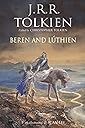
Beren And Lúthien: An Epic High Fantasy Love Story of Middle-earth and the First Age
Product ID: 42959293
Desertcart purchases this item on your behalf and handles shipping, customs, and support to Senegal.
Painstakingly restored from J.R.R. Tolkien’s manuscripts and presented for the first time as a continuous and standalone story, the epic tale of Beren and Lúthien will reunite fans of The Hobbit and The Lord of the Rings with Elves and Men, Dwarves and Orcs and the rich landscape and creatures unique to this high fantasy world of Tolkien’s Middle-earth. The tale of Beren and Lúthien was, or became, an essential element in the evolution of The Silmarillion , the myths and legends of the First Age of the World conceived by J.R.R. Tolkien. Returning from France and the battle of the Somme at the end of 1916, he wrote the tale in the following year. Essential to this epic romance, and never changed, is the fate that shadowed the love of Beren and Lúthien: for Beren was a mortal man, but Lúthien was an immortal Elf. Her father, a great Elvish lord, in deep opposition to Beren, imposed on him an impossible task that he must perform before he might wed Lúthien. This is the kernel of the legend; and it leads to the supremely heroic attempt of Beren and Lúthien together to rob the greatest of all evil beings, Melkor, called Morgoth, the Black Enemy, of a Silmaril in a legendary quest. In this book Christopher Tolkien has attempted to extract the story of Beren and Lúthien from the comprehensive work in which it was embedded; but that story was itself changing as it developed new associations within the larger history. To show something of the process whereby this legend of Middle-earth evolved over the years, he has told the story in his father's own words by giving, first, its original form, and then passages in prose and verse from later texts that illustrate the narrative as it changed. Presented together for the first time, they reveal aspects of the story, both in event and in narrative immediacy, that were afterwards lost. Review: Not What I Expected, But Fantastic Nonetheless! - This book was not what I expected. I must not have read the pre-order description carefully enough. I was expecting another “Children of Hurin”. A narrative built from existing Beren and Luthien sources. But it was not that. It was several versions of the prose and verse story along with commentary and notes by Christopher Tolkien. Had I understood what was contained in the book I still would have ordered it, I just would have had different expectations. And I still will give it five stars. “The Lay of Leithian” is my favorite of Tolkien’s poems, and the fact that it remained unfinished is, to me, a great tragedy. It is actually my favorite of Tolkien’s posthumously published works. This includes “The Children Of Hurin”, which I thought was very well crafted from the various sources. That is not to say I didn’t enjoy “The Children Of Hurin”, I did. But I just liked “The Lay of Leithian” better, both as writing and as a story. But the fact that Christopher Tolkien did such a good job assembling “The Children Of Hurin”, raised my hopes that this new volume would be just like that: a prose story assembled from various sources, including the unfinished “Lay of Leithian”, with minimal editorial commentary. It was not. That is not to say that it wasn’t well done. Because of the story and the material it is certainly going to be a well written and a well plotted story. And that it was. The highlight is the section culled from the “Lay of Leithian” (the 1930s version). These verses are magical to me. Of course I can read this at any time in the previously published “The Lays Of Beleriand”, and I do periodically read through it. The original story, where Beren is an elf, is nice to read, since I was not as familiar with it. And it was interesting to see how many changes the story went through over the various versions. Tolkien seemed to have it in for cats, at least based on this early version of the story. But Tevildo was not quite as menacing as Thu (Sauron). Nonetheless, it was very entertaining. The main characters, Beren and Luthien, are fairly well fleshed out in the poem, at least with respect to their personalities. There’s very little in the way of physical description of Beren, but Luthien is described a little more fully, usually referred to as “the most beautiful” elf-maid ever. But her determination comes through much more than Beren’s. She is the one with the magic and ability to mesmerize even Morgoth. Luthien Tuniviel is just as much a hero in this story as Beren. The characters of the hound Huan and his evil counterpart the wolf Carcharoth, were well developed in the limited space. The description of Carcharoth’s whelping and growth were sufficiently grim and greatly added to the atmosphere around the Gate of Angband. It is a much fuller description than the one in the Silmarillion. And the fact that we occasionally seem to get in to Carcharoth’s head is a nice touch. The ending, as we know it from various notes or short narratives, is possibly the most happy of any of the major First Age stories. Certainly there is tragedy, but nothing on the scale of Turin’s tragic story or the fall of Gondolin. And Beren and Luthien, after their tragedy, explicitly get to live out their days in relative happiness. In spite of the curse of the Oath of Feanor. In Middle-Earth terms this is a very happy ending indeed! As I mentioned above, the story is one of Tolkien’s major stories of the First Age of Middle-Earth. It is foundational to much of what we glimpse in “The Lord Of The Rings”, especially the Aragorn/Arwen love story, which it somewhat parallels. This makes the new volume a very good addition to any Tolkien library. So now the whole story (as it exists) is available in one book, rather than searching through various other volumes. And then there are the Alan Lee illustrations. Starting with the cover, which is a great depiction of Luthien riding Huan with Beren at their side, they are very evocative of the First Age of Middle-Earth. Everything is grim and grey – which is to be expected throughout most of the journey. Though I would have hoped for a little more color in Doriath. But these compare favorably to the illustrations in “The Children Of Hurin”. I would say that this is a worthwhile purchase, if you are looking for a single source for all versions of the story. It is not, however, a stand-alone narrative like “The Children Of Hurin”, which is what I was expecting and hoping for. But that’s on me and doesn’t prevent this from earning five stars. One thing I would point out as a shortcoming (to me) is the lack of a map. It's not like there doesn't exist a map of Beleriand that could easily have been inserted in the back of the book. It would have made the journey of Beren and Luthien that much more real to me. This is apparently going to be the last of his father’s work that Christopher Tolkien publishes, so unless there is a new literary executor, this may be the last we get from JRRT Tolkien. Perhaps what I was expecting, a completed prose narrative, is impossible to do with the writings that are left. Review: Continuing the grand mythology of Middle Earth - Christopher Tolkien, the youngest of J.R.R. Tolkien’s three sons, will be 93 this year. He is his father’s literary executor, and he has spent the years since his father’s death in 1973 poring over papers and files, considering an array of various texts, different versions of stories and poems, staying true to his father’s vision and helping publish a considerable number of books that represent both wonderful stories and insights into The Hobbit and The Lord of the Rings. It is because of Christopher that we have The Silmarillion, The Children of Hurin, many of the lost tales, the elder Tolkien’s translation of Beowulf, and many other works. The latest, and possibly the last, is “Beren and Luthien,”a love story between Beren, a mortal man in exile after his father and clanare killed, and Luthien, an Elf princess (the idea of which was carried over into “The Lord of the Rings”). Luthien is also called Tinuviel by Beren, and it is by that name we see her part in the story. Beren sees Luthien dancing in the woods and falls in love with her. Her father isn’t exactly pleased, and he agrees to the marriage only if Beren can steal a Silmaril, a jewel in the crown of Melkor, the Black Enemy, also known as Morgoth – and a forerunner of Sauron in the trilogy. He’s captured and enslaved in the kitchen, and Luthien travels to his rescue. With the help of a giant dog (who tricks an evil cat), she succeeds in Beren, and then more adventures happen. Tolkien wrote “Beren and Luthien” when he returned to England to recover from illness after the Battle of the Somme in World War I, the longest battle (July 1 – November 18, 1916) and the bloodiest battle (one million men killed or wounded) of the war. The story was written and rewritten many times, in prose and verse forms. Numerous ideas found their way into his other works, and especially the trilogy and “The Hobbit.” What Christopher Tolkien has done with this publication is something special. He includes the original story, and he also includes various prose and verse sections that his father worked on over a period of some 14 years. This is an insider’s view of the working of a story by one of the most creative minds of the 20th century. Here is a section from one of the verse amplifications of the story, which explains the beginning of Beren’s exile. Then Beren walking swiftly sought his sword and bow, and sped like wind that cuts with knives the branches thinned of autumn trees. At last he came, his heart afire with burning flame, where Barahir his father lay; he came too late. At dawn of day he found the homes of hunted men, a wooded island in the fen and birds rose up in sudden cloud – no fen-fowl were they crying loud. The raven and the carrion-crow sat in the alders all a-row; one croaked: “Ha! Beren comes too late’, and answered all: ‘Too late! Too late!’ Then Beren buried his father’s bones, and piled a heap of boulder-stones, and cursed the name of Morgoth thrice, but wept not, for his heart was ice. The prose and the verses are the stuff of myth and legend, of stories told and passed down through the generations. They are full of heroism and courage in the face of insurmountable odds, of heroes using trickery when necessary, of love winning in the end even when it loses. Tolkien had the names “Luthien” and "Beren" inscribed on the tombstone for his wife Edith and himself, which suggests some of the deep personal connections he felt to the story he had written. The volume includes wonderful illustrations by Alan Lee, who has illustrated a number of Tolkien publications. In one sense, the writings we know as Tolkien’s began with “Beren and Luthien,” and it takes its place in the grand mythology of Middle Earth that Tolkien devoted so much of his life to. It is fitting that this first story may also be the last to be published.

| Best Sellers Rank | #34,643 in Books ( See Top 100 in Books ) #77 in Romantic Adaptations #122 in Literary Genre History & Criticism #168 in Historical Fantasy (Books) |
| Customer Reviews | 4.6 out of 5 stars 4,665 Reviews |
C**B
Not What I Expected, But Fantastic Nonetheless!
This book was not what I expected. I must not have read the pre-order description carefully enough. I was expecting another “Children of Hurin”. A narrative built from existing Beren and Luthien sources. But it was not that. It was several versions of the prose and verse story along with commentary and notes by Christopher Tolkien. Had I understood what was contained in the book I still would have ordered it, I just would have had different expectations. And I still will give it five stars. “The Lay of Leithian” is my favorite of Tolkien’s poems, and the fact that it remained unfinished is, to me, a great tragedy. It is actually my favorite of Tolkien’s posthumously published works. This includes “The Children Of Hurin”, which I thought was very well crafted from the various sources. That is not to say I didn’t enjoy “The Children Of Hurin”, I did. But I just liked “The Lay of Leithian” better, both as writing and as a story. But the fact that Christopher Tolkien did such a good job assembling “The Children Of Hurin”, raised my hopes that this new volume would be just like that: a prose story assembled from various sources, including the unfinished “Lay of Leithian”, with minimal editorial commentary. It was not. That is not to say that it wasn’t well done. Because of the story and the material it is certainly going to be a well written and a well plotted story. And that it was. The highlight is the section culled from the “Lay of Leithian” (the 1930s version). These verses are magical to me. Of course I can read this at any time in the previously published “The Lays Of Beleriand”, and I do periodically read through it. The original story, where Beren is an elf, is nice to read, since I was not as familiar with it. And it was interesting to see how many changes the story went through over the various versions. Tolkien seemed to have it in for cats, at least based on this early version of the story. But Tevildo was not quite as menacing as Thu (Sauron). Nonetheless, it was very entertaining. The main characters, Beren and Luthien, are fairly well fleshed out in the poem, at least with respect to their personalities. There’s very little in the way of physical description of Beren, but Luthien is described a little more fully, usually referred to as “the most beautiful” elf-maid ever. But her determination comes through much more than Beren’s. She is the one with the magic and ability to mesmerize even Morgoth. Luthien Tuniviel is just as much a hero in this story as Beren. The characters of the hound Huan and his evil counterpart the wolf Carcharoth, were well developed in the limited space. The description of Carcharoth’s whelping and growth were sufficiently grim and greatly added to the atmosphere around the Gate of Angband. It is a much fuller description than the one in the Silmarillion. And the fact that we occasionally seem to get in to Carcharoth’s head is a nice touch. The ending, as we know it from various notes or short narratives, is possibly the most happy of any of the major First Age stories. Certainly there is tragedy, but nothing on the scale of Turin’s tragic story or the fall of Gondolin. And Beren and Luthien, after their tragedy, explicitly get to live out their days in relative happiness. In spite of the curse of the Oath of Feanor. In Middle-Earth terms this is a very happy ending indeed! As I mentioned above, the story is one of Tolkien’s major stories of the First Age of Middle-Earth. It is foundational to much of what we glimpse in “The Lord Of The Rings”, especially the Aragorn/Arwen love story, which it somewhat parallels. This makes the new volume a very good addition to any Tolkien library. So now the whole story (as it exists) is available in one book, rather than searching through various other volumes. And then there are the Alan Lee illustrations. Starting with the cover, which is a great depiction of Luthien riding Huan with Beren at their side, they are very evocative of the First Age of Middle-Earth. Everything is grim and grey – which is to be expected throughout most of the journey. Though I would have hoped for a little more color in Doriath. But these compare favorably to the illustrations in “The Children Of Hurin”. I would say that this is a worthwhile purchase, if you are looking for a single source for all versions of the story. It is not, however, a stand-alone narrative like “The Children Of Hurin”, which is what I was expecting and hoping for. But that’s on me and doesn’t prevent this from earning five stars. One thing I would point out as a shortcoming (to me) is the lack of a map. It's not like there doesn't exist a map of Beleriand that could easily have been inserted in the back of the book. It would have made the journey of Beren and Luthien that much more real to me. This is apparently going to be the last of his father’s work that Christopher Tolkien publishes, so unless there is a new literary executor, this may be the last we get from JRRT Tolkien. Perhaps what I was expecting, a completed prose narrative, is impossible to do with the writings that are left.
G**G
Continuing the grand mythology of Middle Earth
Christopher Tolkien, the youngest of J.R.R. Tolkien’s three sons, will be 93 this year. He is his father’s literary executor, and he has spent the years since his father’s death in 1973 poring over papers and files, considering an array of various texts, different versions of stories and poems, staying true to his father’s vision and helping publish a considerable number of books that represent both wonderful stories and insights into The Hobbit and The Lord of the Rings. It is because of Christopher that we have The Silmarillion, The Children of Hurin, many of the lost tales, the elder Tolkien’s translation of Beowulf, and many other works. The latest, and possibly the last, is “Beren and Luthien,”a love story between Beren, a mortal man in exile after his father and clanare killed, and Luthien, an Elf princess (the idea of which was carried over into “The Lord of the Rings”). Luthien is also called Tinuviel by Beren, and it is by that name we see her part in the story. Beren sees Luthien dancing in the woods and falls in love with her. Her father isn’t exactly pleased, and he agrees to the marriage only if Beren can steal a Silmaril, a jewel in the crown of Melkor, the Black Enemy, also known as Morgoth – and a forerunner of Sauron in the trilogy. He’s captured and enslaved in the kitchen, and Luthien travels to his rescue. With the help of a giant dog (who tricks an evil cat), she succeeds in Beren, and then more adventures happen. Tolkien wrote “Beren and Luthien” when he returned to England to recover from illness after the Battle of the Somme in World War I, the longest battle (July 1 – November 18, 1916) and the bloodiest battle (one million men killed or wounded) of the war. The story was written and rewritten many times, in prose and verse forms. Numerous ideas found their way into his other works, and especially the trilogy and “The Hobbit.” What Christopher Tolkien has done with this publication is something special. He includes the original story, and he also includes various prose and verse sections that his father worked on over a period of some 14 years. This is an insider’s view of the working of a story by one of the most creative minds of the 20th century. Here is a section from one of the verse amplifications of the story, which explains the beginning of Beren’s exile. Then Beren walking swiftly sought his sword and bow, and sped like wind that cuts with knives the branches thinned of autumn trees. At last he came, his heart afire with burning flame, where Barahir his father lay; he came too late. At dawn of day he found the homes of hunted men, a wooded island in the fen and birds rose up in sudden cloud – no fen-fowl were they crying loud. The raven and the carrion-crow sat in the alders all a-row; one croaked: “Ha! Beren comes too late’, and answered all: ‘Too late! Too late!’ Then Beren buried his father’s bones, and piled a heap of boulder-stones, and cursed the name of Morgoth thrice, but wept not, for his heart was ice. The prose and the verses are the stuff of myth and legend, of stories told and passed down through the generations. They are full of heroism and courage in the face of insurmountable odds, of heroes using trickery when necessary, of love winning in the end even when it loses. Tolkien had the names “Luthien” and "Beren" inscribed on the tombstone for his wife Edith and himself, which suggests some of the deep personal connections he felt to the story he had written. The volume includes wonderful illustrations by Alan Lee, who has illustrated a number of Tolkien publications. In one sense, the writings we know as Tolkien’s began with “Beren and Luthien,” and it takes its place in the grand mythology of Middle Earth that Tolkien devoted so much of his life to. It is fitting that this first story may also be the last to be published.
S**I
I’ll call it 4 stars, but with caveats!
It is a very tough call as to what I feel about this book. On the one hand -- while it IS all stuff that’s been published before -- it’s nice to have the whole story of Beren and Luthien under one cover, which prior to this appeared in pieces over several other other volumes. Oddly enough, this is actually something I had considered doing at one time myself -- that being, pick one Silmarillion tale and read it in all its various incarnations. So Christopher is doing now – and, according to his “Beren and Luthien” introduction, had originally considered doing 35+ years ago – that which I myself had thought might be a fun exercise. Also, for me, to have the Lay of Leithian in a nice new volume is awesome, since I love that poem. And my copy of “The Lays of Beleriand" (in which it appears) is a little old and battered, and I worry about the spine whenever I read it. And for readers to whom “The Lays of Beleriand” is a Tolkien book they will no doubt steer clear of – I mean, it’s poetry and everyone always skips the poetry, right – this is a great opportunity to make it available. Readers WILL be rewarded, because it’s awesome. The same can be said of the original Tale of Tinuviel, which begins this new book. Its appearance in “The Book of Lost Tales vol 2” (the second of the History of Middle Earth series) means it is probably unfamiliar to the casual LOTR fan and to those who have struggled through “The Silmarillion.” It’s a fun tale – bringing in elements of Sleeping Beauty and Rapunzel, as well as a sort of mythological rationale for why cats and dogs hate each other, all blended with the wonderful love story of Beren and Luthien and the stealing of the Silmaril. That people can read it here without necessarily having to take the deep dive into the History series is a nice touch. All that said -- what is Christopher doing with this book? First of all, if he’s going to reprint the Lay of Leithian, reprint the whole thing. Extracts are just that – even though the bulk of the extracts are huge. More to the point, there is a grievous omission here — specifically the texts from which Christopher developed the published Silmarillion version of the story. Frankly their absence is inexcusable. What is his logic in not including them here? He never says. All he does is give passing reference on pages 218-19 to the 2 versions that largely formed the basis of that version. Done. Then he moves on as if it doesn’t matter. For those unfamiliar with the History of Middle Earth series, I direct your attention to volume 5, “The Lost Road and Other Writings,” where Christopher breaks down the various versions thusly (on pages 323-24, in the Del Rey paperback edition). There was: 1) Rough draft A, in which the telling of the tale of Beren and Luthien was very amply conceived, and soon abandoned 2) The Quenta Silmarillion (or QS) manuscript version of the tale was begun, again in a very full form but less so than A and was in turn abandoned (QS I) 3) A rough draft B for the whole story was completed, and was the basis for 4) A second more compressed version (QS II), interrupted toward the end when the QS manuscript was sent to the publisher 5) An intermediate text C, which takes up the story from there 6) Text D, which carries the story into the Battle of Unnumbered Tears and the tale of Turin 7) The conclusion of the tale, written in 1951, and added to QS I would venture a guess that anyone picking up “Beren and Luthien” — and who is in the know as far as Tolkien’s evolution of the story — did so expecting to find the Rough Draft A and QS I versions. They will not — and I want to know why? They would have become the only unpublished items in this text if they were included. That’s the holy grail of this story, yet we get nothing. It’s even weirder given the length of this book. In “The Lost Road,” Christopher says that those 2 versions would have totaled about 6000 words. That would have amounted to 20-25 pages in the current volume. Not a huge increase, in my opinion -- especially since those are things that readers of Tolkien would have killed to see, mostly because we have never seen them! And then when Christopher takes the story into the Ruin of Doriath and Nauglamir business —which admittedly does involve Beren and Luthien —and then Earendil — which only sort of does — you wonder why Christopher wouldn’t include the stuff that is the core of the story. So, to a hardcore Tolkien fan, this is a frustrating book. To a Tolkien reader who would like to see more of what Tolkien did with one of his favorite of all his Silmarillion tales, this is a glorious adventure. I’ll call it 4 stars, but with caveats.
W**D
Wonderful
I truly enjoyed the reading of this work by JRR Tolkien and I definitely believe that bit is one of the most beautiful stories ever told.
J**D
Tolkien's Most Personal Story
One beautiful day in the spring of 1917 a young man and woman went for a stroll through a wood outside the village of Roos in Yorkshire. They wandered into a glade filled with long stemmed flowers bearing white blossoms. The woman danced and sang among the flowers while the man, who was still thin and weak after a severe case of trench fever, stood watching. Shortly after that golden day the man incorporated its memory into a story he was writing that he intended to be part of a "mythology for England," a series of interconnected tales he had been working on since his days at Oxford years earlier. The man was John Ronald Reuel Tolkien and the woman was his wife Edith Bratt Tolkien,whom he had loved for many years before their marriage in the spring of 1916. The story Tolkien wrote and rewrote over many years had several different versions, but the story of a beautiful woman dancing in a forest clearing was always part of it. Eventually it became The Tale of Beren and Luthien. Beren was a mortal Man who after many adventures and hardships wandered through a mysterious wood in Beleriand, a large realm in the West of Middle-earth defended by Elves and Men against the tyranny of the Dark Lord Morgoth and his minions. Beren came across a beautiful woman dancing in a glade filled with white flowers. She was Luthien, daughter of King Thingol of the Elves. They fell in love, but King Thingol refused to allow them to marry unless they brought him a Silmaril, one of three magical gems crafted in Valinor across the Sea but stolen by Morgoth centuries earlier. Their Quest, its fulfillment, and Beren and Luthien's ultimate fate make up the Tale, which became a center piece of Tolkien's mythology. He referred to Beren and Luthien several times in The Lord of the Rings (whose characters Aragorn and Arwen are descendants of and counterparts to Beren and Luthien), and eventually a version of the Tale was included in The Silmarillion, which was completed by Tolkien's son Christopher and published in 1977. Later Christopher Tolkien was to edit and publish the twelve volume History of Middle-earth, which includes several more versions of the Tale in both prose and poetic forms. In this beautiful book we have the Tale itself in several of its versions beginning with the Tale of Tinuviel, which was written in the early years of Tolkien's development of his mythology and which contains some elements which were later discarded or drastically altered. For example,a major villain in The Tale of Tinuviel is Tevildo Prince of Cats, who was later to become Sauron, the chief servant of Morgoth. There are extracts from an early poetic version, The Lay of Leithian as well as from other versions written by Tolkien at various times during his life. Most if not all of this material has already been published in The Silmarillion and The History of Middle-earth, but having it all available in one volume is very valuable. In addition, Christopher Tolkien has provided an extensive Preface, some Notes on The Elder Days, and more introductory material on the Tale itself. These will be invaluable to experienced Tolkien scholars as well as those who might not be as familiar with the wider range of Middle-earth material. An additional pleasure are the nine illustrations in full color plates provided by Alan Lee, one of the most well-known and talented artists at work depicting Tolkien's worlds today. His paintings have an ethereal quality that absolutely befit their subject. Since there is very little previously unpublished material in Beren and Luthien some might wonder whether a separate volume is worthwhile. I can assure them that the careful production and attention to detail in extracting one narrative from a very rich fabric makes this book highly desirable. Additionally, Christopher Tolkien notes in his Preface that as he is now in his ninety-third year this is "presumptively" his last edition of his father's writings after over forty years of labor. He also writes that "the tale is chosen in memoriam" because it played such a strong part in his father's life and marriage, therefore it can be considered one of Tolkien's most personal stories. Tolkien himself made reference to his attachment to this Tale shortly after Edith's death in 1971. He wrote to his son Christopher about that spring day in Roos, saying that she was the "chief source" of what was to become a major part of his legendarium. Today J.R.R. Tolkien and Edith Bratt Tolkien are buried beneath a single headstone carved with their names and dates and "Beren" and "Luthien."
J**N
Another Welcomed Addition to the Legendarium
Tolkien had a dream to gift his beloved England with a national epic mythology. Volumes of criticism have been dedicated to whether he accomplished this, or, resigned from the quest. Judging from the plethora of unfinished epics examined by Christopher Tolkien in his magisterial History of Middle Earth series it would seem Tolkien failed as many of his planned epics never came to fruition (I would disagree with this position); chief among these epics were to be three tales of the First Age, The Children of Hurin, Beren and Luthien and The Fall of Gondolin. As I understand things Guy Gavriel Kay was hired to assist Christopher Tolkien to edit the Silmarillion and make it suitable for publication. Upon completion of that task Kay wanted to complete the unfinished manuscripts that exist while Christopher wanted to publish the History. Needless to say, the History was the chosen path and it seemed the unfinished works contained therein would never see the light of day. Not so. Christopher brought forth a coherent Children of Hurin and now he gives us Bern and Luthien, I can only hope a Fall of Gondolin is sitting there waiting to be published! Not that there are not concerns, if you are expecting an epic addition like Children, you will be disappointed. Tolkien never brought together enough threads to finish this epic and Christopher seems to be reticent to complete what his father didn't, perhaps because of criticism of him doing that to The Silmarillion. If this is so, it's a shame as Christopher not only has real talent, his work in The Silmarillion is some of the (if not the best) writing in the book; but it overlooks one of the true nature of a mythos, it's never the work of just one man. Be it the Greek and Roman myths as we have them, the Irish, or the Finnish, those works are the works of many hands, of many minds. That being so, and given that we have Christopher's HoME, if Christopher had fleshed out a coherent epic with large contributions of his own I feel he would of been following in this tradition and aided in the development of the mythos JRRT wanted to create. Be that as it may, what we have before us is very good, it's pretty much almost all Tolkien has written on B&L (with the qualification, see 2 star review below) with beautiful Alan Lee illustrations throughout. I can only hope that Christopher spent some of the time between the completion of the HoME and the publishing of Children completing some of his fathers other works as he has not only the talent to do so, but he would bring much need beauty into the world. Ignore the gainsayers Christopher, if you have finished other works publish them!
P**A
""But this book does not offer a single page of original and unpublished work. What then is the need, now, for such a book?""
I purchased the special edition in slipcase. The quality of the book is excellent. It is in the same format as, and perfectly compatible on my bookshelf next to, the special edition of The Children of Hurin. If you a collector who reveres books or Tolkien, you should get this edition. I won't belabor that point further. The rest of the this review will focus only on the contents. This is not the book I was expecting. The quote that appears in my headline is straight out of the preface. And indeed the rest of the preface goes on to attempt to answer that question. In short, the goal was to get all of the existing revisions of Beren and Luthien into one place. This is very different from the purpose of The Children of Hurin. And the resulting product is a very different kind of reading. If you have studied the History of Middle Earth series (and if you are considering the purchase of THIS book, you are almost certainly aware of them to some extent) then you already know that the major literary work of Christopher Tolkien's life has been to find a way to get all of the fragments of his father's writing, at all stages of his life, sorted out into chronological order and published with extensive commentary to show how his father's conception of the world, the languages, and the tales themselves changed over time. Regrettably, very few of those tales were ever completed, and fewer still were completed at a stage that was compatible with his final conception of Middle Earth as seen in the Lord of the Rings. Many of us, myself included, were fascinated by the Histories. They served a great purpose. And they curiously straddled an unusual divide: the meticulous level of documentation could be of interest only to scholars and historians, but they also contained the last bits of story that fans desperately wanted to read, even in their incomplete forms. But sometimes.... you just want to read a cohesive story. Isn't that ultimately what we started this journey for? The story moved us. It's a tribute to the power of Tolkien's stories that we also wanted to "see how the sausage was made." Sadly, the last bits of even semi-completed narrative, that were also compatible with the published version of The Lord of the Rings, were published in 1980 in Unfinished Tales. Until, that is - the publication of The Children of Hurin in 2007. It was a gift from above. Finally, we had one of the tales of the Elder Days definitively re-edited into a single, cohesive narrative, simply readable as a story - without constantly being interrupted to explain which folio the next three sentences were taken from, and why they are preferred over the pencil-erased version in the margins of an earlier notepad. I'm sure many of us believed that Beren and Luthien was to follow that model. It does not. This, to put it lightly, dashed my hopes. The book I hoped this would be, does not exist, and will never exist. Apparently the remaining fragments of text needed to complete a long-form prose version of this story were either never written, or Christopher Tolkien does not think them worthy of publication. Frankly, I don't think the marketing material was suitably clear on this. And that is my essential criticism. The contents of the book are themselves wonderful. However, every word of it was taken from the first five volumes of The Histories. If you have those books, then you have no need (other than aesthetic) for this book. If you have not been introduced to those books, then you might be taken aback by the nature of this one. This book really only serves three purposes: 1) It DOES succeed in making it much easier to follow the development of this one particular tale, outside of its possibly-overwhelming context. Yes. Having all of the material from the histories in one place makes researching the transition of Tevildo, Prince of Cats into Sauron, the Dark Lord in training much easier. (For example). It does not however give any new insight, since you've already read it in The Book of Lost Tales II. 2) It DOES look beautiful on a bookshelf full of other special editions of Tolkien's work. This point is not trivial to me, nor to some of you. We are readers. We consider a well-bound book to be a work of art. 3) As with The Children of Hurin, it contains a number of beautiful paintings by Alan Lee. These are worth seeing, and certainly won't be available in the mass market version. tl;dr: I'm happy to have this book. I'm sad that it doesn't contain new material or a final cohesive narrative.
E**E
Awesome
I’m very happy with this purchase! The product arrived as described, works well, and feels like good quality for the price. It’s easy to use, practical, and has met my expectations so far. Shipping was fast and packaging was secure, which I appreciated. Overall, I would recommend this to others and would consider buying from this seller again in the future.
A**E
The great story of Beren and Luthien
This is probably from the most recent version of the story of Beren and Luthien. This story is most complete and detailed version than the one in The Silmarillon. It keeps most of its origin from Tolkien's writing with some edits from his son. Really good book, however its good to note that the writing style of this book is very different from LOTR and The Silmarillon; but still very appealing.
J**.
Great
Great edition for LOTR fans
T**S
You shall not miss this book
Beautiful book, great illustrations and the history of the tale is told magnificently with lots of interesting discarded versions. Pretty neat if you ask me.
B**C
Review Of Deluxe Edition
This review is for the Deluxe Edition and I had it shipped to the U.S. It’s a very high quality edition, printed on very good paper and comes in a slipcase. I also purchased the U.S. standard edition of the book and the rest of this review is from the Amazon U.S. posting I made. This book was not what I expected. I must not have read the pre-order description carefully enough. I was expecting another “Children of Hurin”. A narrative built from existing Beren and Luthien sources. But it was not that. It was several versions of the prose and verse story along with commentary and notes by Christopher Tolkien. Had I understood what was contained in the book I still would have ordered it, I just would have had different expectations. And I still will give it five stars. “The Lay of Leithian” is my favorite of Tolkien’s poems, and the fact that it remained unfinished is, to me, a great tragedy. It is actually my favorite of Tolkien’s posthumously published works. This includes “The Children Of Hurin”, which I thought was very well crafted from the various sources. That is not to say I didn’t enjoy “The Children Of Hurin”, I did. But I just liked “The Lay of Leithian” better, both as writing and as a story. But the fact that Christopher Tolkien did such a good job assembling “The Children Of Hurin”, raised my hopes that this new volume would be just like that: a prose story assembled from various sources, including the unfinished “Lay of Leithian”, with minimal editorial commentary. It was not. That is not to say that it wasn’t well done. Because of the story and the material it is certainly going to be a well written and a well plotted story. And that it was. The highlight is the section culled from the “Lay of Leithian” (the 1930s version). These verses are magical to me. Of course I can read this at any time in the previously published “The Lays Of Beleriand”, and I do periodically read through it. The original story, where Beren is an elf, is nice to read, since I was not as familiar with it. And it was interesting to see how many changes the story went through over the various versions. Tolkien seemed to have it in for cats, at least based on this early version of the story. But Tevildo was not quite as menacing as Thu (Sauron). Nonetheless, it was very entertaining. The main characters, Beren and Luthien, are fairly well fleshed out in the poem, at least with respect to their personalities. There’s very little in the way of physical description of Beren, but Luthien is described a little more fully, usually referred to as “the most beautiful” elf-maid ever. But her determination comes through much more than Beren’s. She is the one with the magic and ability to mesmerize even Morgoth. Luthien Tuniviel is just as much a hero in this story as Beren. The characters of the hound Huan and his evil counterpart the wolf Carcharoth, were well developed in the limited space. The description of Carcharoth’s whelping and growth were sufficiently grim and greatly added to the atmosphere around the Gate of Angband. It is a much fuller description than the one in the Silmarillion. And the fact that we occasionally seem to get in to Carcharoth’s head is a nice touch. The ending, as we know it from various notes or short narratives, is possibly the most happy of any of the major First Age stories. Certainly there is tragedy, but nothing on the scale of Turin’s tragic story or the fall of Gondolin. And Beren and Luthien, after their tragedy, explicitly get to live out their days in relative happiness. In spite of the curse of the Oath of Feanor. In Middle-Earth terms this is a very happy ending indeed! As I mentioned above, the story is one of Tolkien’s major stories of the First Age of Middle-Earth. It is foundational to much of what we glimpse in “The Lord Of The Rings”, especially the Aragorn/Arwen love story, which it somewhat parallels. This makes the new volume a very good addition to any Tolkien library. So now the whole story (as it exists) is available in one book, rather than searching through various other volumes. And then there are the Alan Lee illustrations. Starting with the cover, which is a great depiction of Luthien riding Huan with Beren at their side, they are very evocative of the First Age of Middle-Earth. Everything is grim and grey – which is to be expected throughout most of the journey. Though I would have hoped for a little more color in Doriath. But these compare favorably to the illustrations in “The Children Of Hurin”. I would say that this is a worthwhile purchase, if you are looking for a single source for all versions of the story. It is not, however, a stand-alone narrative like “The Children Of Hurin”, which is what I was expecting and hoping for. But that’s on me and doesn’t prevent this from earning five stars. One thing I would point out as a shortcoming (to me) is the lack of a map. It's not like there doesn't exist a map of Beleriand that could easily have been inserted in the back of the book. It would have made the journey of Beren and Luthien that much more real to me. This is apparently going to be the last of his father’s work that Christopher Tolkien publishes, so unless there is a new literary executor, this may be the last we get from JRR Tolkien. Perhaps what I was expecting, a completed prose narrative, is impossible to do with the writings that are left.
D**N
Classic!
One of the great tales of the First Age, some 6500 years before The Lord of Rings era. Romance, fantasy, questing & gothic horror. High Elves, Sauron, Morgoth & the protagonists, Beren & Luthien. Tolkien at his best.
Trustpilot
1 month ago
3 weeks ago