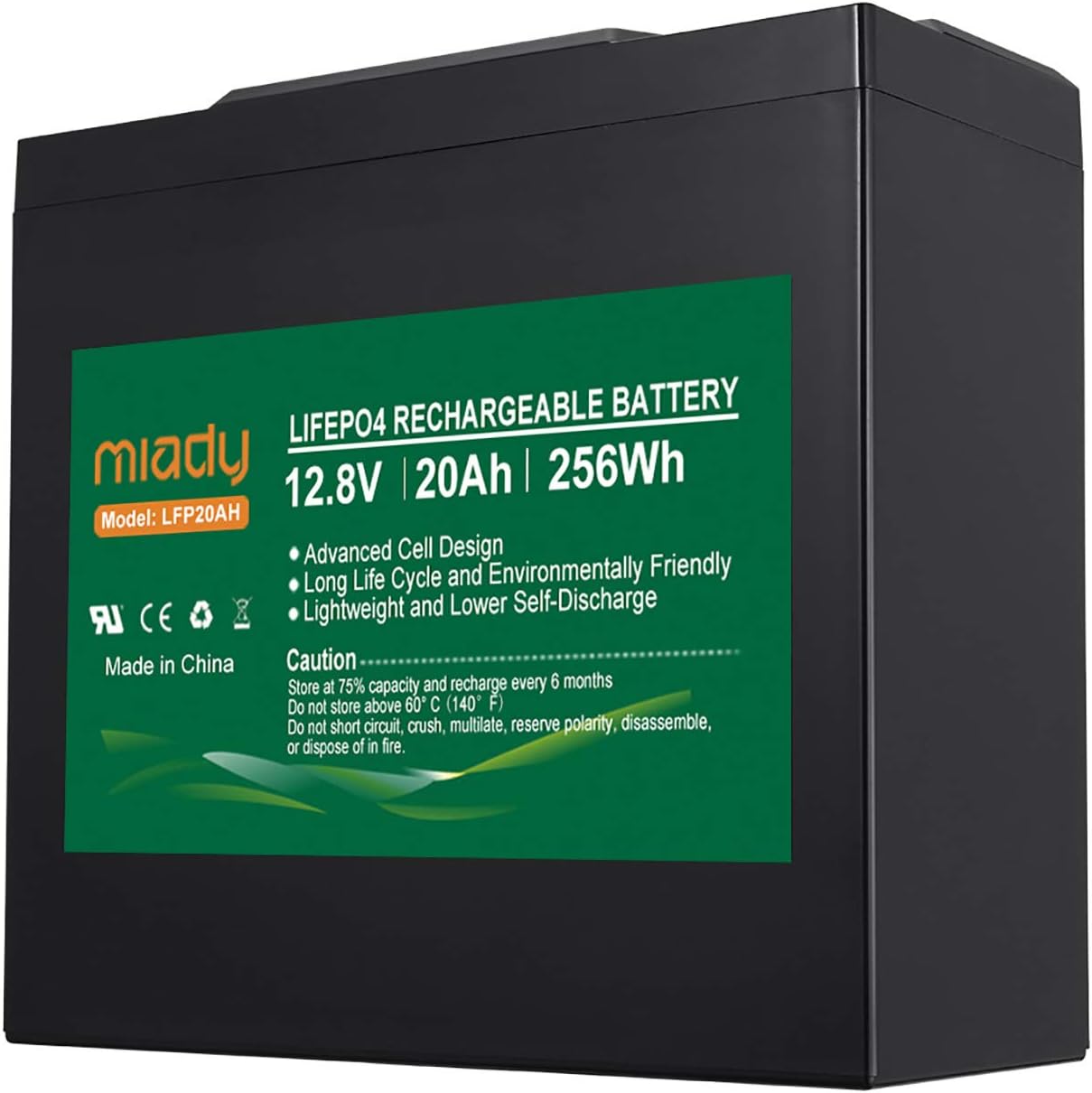



Miady 12V 20Ah Deep Cycle LiFePO4 Battery, 2000 Cycles LFP16AH Rechargeable Battery, Maintenance-Free Battery for Golf Cart, Boat, Solar System, UPS and More
Product ID: 420431758
⚡12V 20Ah
🔋2000 cycles
🛡️Impact resistant
🔋 Power Up Your Life with Reliability!
The Miady 12V 20Ah Deep Cycle LiFePO4 Battery is a high-performance, maintenance-free battery designed for various applications, including golf carts, boats, and solar systems. With an impressive lifespan of 2000 charging cycles and a lightweight design, it offers consistent power output and exceptional durability.
| ASIN | B089VXSBC6 |
| Battery Capacity | 20 Amp Hours |
| Battery Type | Lithium-Phosphate |
| Battery cell composition | Lithium-Phosphate |
| Brand | Miady |
| Brand Name | Miady |
| Compatible with Vehicle Type | Golf Cart |
| Customer Reviews | 4.4 out of 5 stars 428 Reviews |
| Included Components | battery |
| Item Weight | 1.8 kg |
| Item weight | 1.8 kg |
| Manufacturer | Miady |
| Manufacturer Part Number | LFP20AH |
| Model Number | MI-LFP |
| Number Of Cells | 4 |
| Size | 1 Count (Pack of 1) |
| Unit Count | 1.0 Count |
| Vehicle service type | Golf Cart |
| Voltage | 12 Volts |
A**M
Using in an APC Smart-UPS 1400
Or perhaps I should say "using them ON a UPS", since the 20Ah size don't fit inside. There are caveats to using these for a UPS. For one thing, only commercial UPS units are designed to run on batteries for extended periods (personal models can overheat). Also, my Smart-UPS cannot understand their voltage curve, so I had to disable low-battery shutdown and all alarms altogether. It works fine, but it thinks the world is ending. I wrote a blog post about it on tech.akom.net if anyone wants the details. Also note that if these have a 1C (20A) max discharge rate, they are not adequate for my UPS at even a 50% load. Mine normally runs at only 6% load (that's about 5A) so these are perfect. The batteries arrived at 13.20v each, exactly. I ran a load test with UPS at 42% load (which is about 23A from the batteries and about 450 watts at the UPS output), and they held up fine, never dropping lower than 12.1v. They didn't get hot, though the 10 gauge wires did a tiny bit. After 30 minutes of this, their no-load voltage was 13.0 (3.25v per cell), and that's starting from a voltage of 13.95v per battery (UPS charge voltage). That's still quite high. Since I only intend to run at 6%, I should have about 7 hours of battery life, which is insane. With 2000 charge cycles (as opposed to about 5 that I seem to get with Lead-Acid), this is a worthwhile investment, and it's only about 1.8x the cost of lead-acid batteries. Note that since I'm using them in series, they can become unbalanced over time. I haven't had them long enough to know. If this is the case, I may need to balance them manually (maybe once a year?). I'll update if there are any developments.
M**.
Fantastic light battery for scooters.
Bought these to convert our 24 volts scooters from lead acid to incredibly light lithiums. They hold their voltage all day at Walt Disney World. I just cratered one of them because I used one of the two batteries combined to produce 24 volts. Using it as a 12 volt battery to run a test on another device I manageg to run the battery down to nearly zero volts. That is suicide and abuse, not the battery fault. The scooters will actually shut down if the voltage gets below a certain point so will not damage the batteries. Using one as I did was my fault. I had a charger on it but the charger could not keep up with the load. I have had this set of batteries in my scooter exactly one year. One of the batteries that was not abused seems to be fine and is charging great. I am going to replace just one for grins to see how long I can get out of these. I like these so much I bought a set for my daughters scooter. We now have three scooters running with these. They are amazingly light. Less than a third of the weight of lead acid. Most batteries in the past survive just a few months. If we got six months out of them we were lucky. We tried all kinds too. AGM's, etc. These just peg the voltmeter without a load, that is driving them because the voltage is just a bit higher than lead acids. Amazon is selling them at a decent price but it would be less painful at around $50 each. So try not to kill your batteries. I know, batteries are never really owned, just rented. All of them die.
P**T
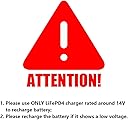
Working well so far. 14.2V BMS disconnect issue appears to be fixed
Some online reviews (on Youtube, etc.) mention this Miady 20Ah battery's BMS high-voltage-disconnect being set for an unusually low value of 14.2V, causing most LiFePO4 chargers to cut off prematurely. I bought it expecting this, planning to charge at <14.2V anyway and stopping at maybe 95% SOC to help the cells last longer, but during initial testing I found the battery I received was happy to accept at least a 14.5V charge voltage. I didn't try to take it higher, but if all units shipping now are set up this way, common LiFePO4 chargers should work as expected. After a few shallow cycles, then a full charge to <0.2A cutoff, I kept it at 14.15V overnight (charge current <10mA) to hopefully let the BMS top-balance any cells that were out of balance (common on cheap LiFePO4 packs). I then ran a deep-discharge test at 55-70W draw (4.2-5.5A, 0.2-0.3C), powering a mix of 12V lighting, fans, computers, and small electronics for 3.75 hours, stopping at 17.76Ah (224Wh) discharge, when battery voltage under load reached 11.5V. Its no-load resting voltage then rose to 11.93V after 5m, 12.04V after 30m, and 12.34V after 8 hours. Per an LiFePO4 resting-voltage table, this equates to approx. 8% charge remaining, 92% consumed. If so, 100/92*17.76 = 19.3Ah, or 100/92*224 = 243Ah had I run it down to zero, which is between 95-97% of rated capacity - perhaps a slight underperformance, but for the price I'm happy enough with these figures if it holds up. Also, that was my first deep discharge, and some LiFePO4 packs will show a little extra capacity after a few cycles. I've only had this a few days so far, so can't speak to longevity at all, but will update the review if anything unexpected happens.
M**T
Light powerful handy! All tested slightly under the rated 256Wh.. average I measured is 240Wh
Ordered 20.. 19 of these batteries performed well.. however none met the specification of 256Wh. Average performance is around 240Wh One of the batteries failed and could not be charged. I opened the battery up for examination. Has 40 2000mah LiFePO4 can type batteries inside. 10 batteries in parallel then 4 series to make 12.8v. Measured voltage.. 3 parallel groups are Dead. One parallel group still okay at 3.6 volts.. hummm maybe bms failed draining these to basically 0.0v? Anyway overall they are very light.. powerful and function well. Im using for camping and outdoor remote power needs and they are a million times better than a 50lb lead acid! For special needs.. look pretty dang good.
J**F
Good value but don't let it get rained on.
I had one of 4 batteries go bad on me and the company promptly replaced it on warranty. Great job! They let me keep the old one so I thought I would take it apart and what I found was water had leaked in. I had used these on an electric bike and we had been caught out in the rain. The batteries look like they are sealed so I wasn't worried about the water. Apparently they are not sealed so DO NOT LET THEM GET RAINED ON! The company should warn you about the water problem. Otherwise they have been great and I have had no other problems. I have a total of 8 Miady batteries that I use on a bike and a Kayak.
Trustpilot
2 months ago
3 weeks ago