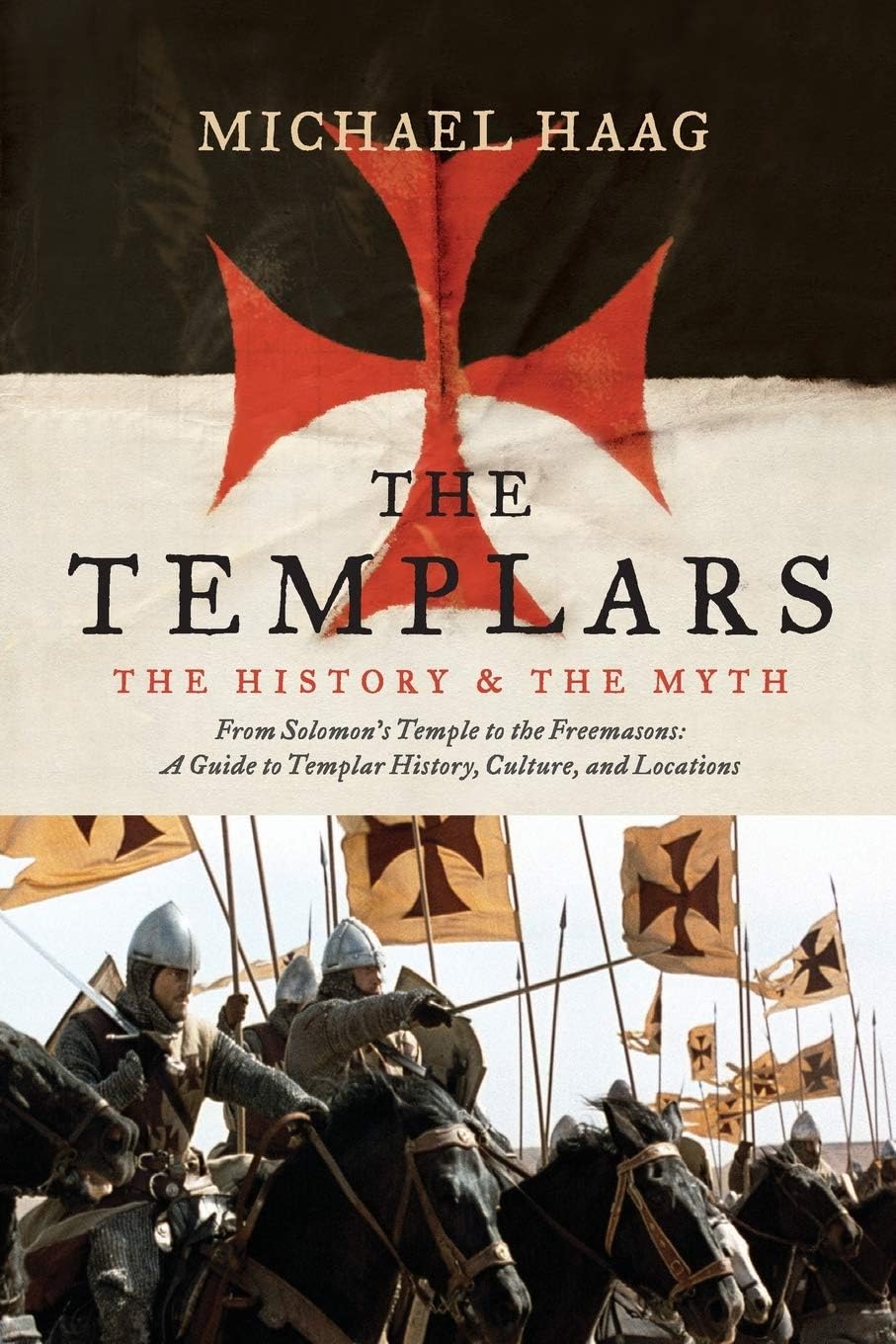
The Templars: The History and the Myth: From Solomon's Temple to the Freemasons
Product ID: 4020814
Desertcart purchases this item on your behalf and handles shipping, customs, and support to Senegal.
Arguably one of the most provocative, puzzling, and misunderstood organizations of medieval times, the legendary Knights Templar have always been shrouded in a veil of mystery, while inspiring popular culture from Indiana Jones to Dan Brown. In The Templars , author Michael Haag offers a definitive history of these loyal Christian soldiers of the Crusadessworn to defend the Holy Land and Jerusalem, but ultimately damned and destroyed by the Pope and his church. A bestseller in the United Kingdomthe first history of the enigmatic warriors to include findings from the Chinon Parchment, the long-lost Vatican document absolving the Knights of heresy The Templars by Michael Haag is fascinating reading. Review: Templar Fact, Templar Legend, Templar Paranoia - "If you'll allow me," says a conspiracy-inciting character in Umberto Eco's novel _Foucault's Pendulum_, "I'll add a fundamental axiom: The Templars have something to do with everything." They certainly have something to do with popular books and movies. It didn't start with _The Da Vinci Code_; the Templar knights play a role in _Ivanhoe_. They are the origin of the ornament so earnestly sought in _The Maltese Falcon_. They are reputed to be involved in every secret organization from the Masons to the New World Order promoted by the Skull and Bones at Yale. It's a stretch to imagine that Crusader knights, disbanded in 1312, would still be exerting their mystic influence, but plenty of people are ready to make that stretch. They aren't the sort to read _The Templars: History and Myth_ (Profile Books), a wide-ranging, fact-filled, and lively account by Michael Haag, but this history provides enough stuff to wonder at. There are wonders within the history of the Templars, to be sure, and mysteries about how they came to be destroyed and then came to be deployed as a cornerstone of the world's conspiracy theories. Haag, who has written a guide to _The Da Vinci Code_, as well as serious classical and medieval histories, handles the confusion of the time of the Crusades with particular clarity, but it has to be said he doesn't clear all the Templar mysteries away; there are too many of them, from a time that lacks documentation, and we can count on conspiracy theorists to continue to fill in the blanks. Pilgrims going to the Holy Land were more-or-less safe in the cities, but not on the roads between. When Hugh of Paynes, a knight from Champagne, proposed that the knights form a contemplative, monastic order in the region, King Baldwin II of Jerusalem proposed instead that the knights take their vows of chastity, poverty, and obedience, but also retain their weapons to defend pilgrims against brigands and rapists. The first vows were taken in 1119, and headquarters were on Temple Mount in Jerusalem (hence Templars). Beside the troops needed to support knights and horses in the field, there were plenty of administrators for the enormous donations the Templars received. The Templars established financial networks everywhere there were Christians, and became hugely wealthy. With the failure of the Crusades, the Templars became a target for resentment. There were also those who resented, or coveted, their wealth. Chief among these were King Philip IV of France. With the loss of the Holy Land, Philip, who owed the order money, ordered the arrest of Templars in France. He took advantage of rumors about the scandalous secret initiation ceremony, and he tortured the knights to give false confessions and then burned them at the stake. He pressured Pope Clement V to disband the Templars, and Clement did so in 1312. The Pope, however, had cleared them of heresy charges; this was discovered when a document from the times turned up in the Vatican archives only in 2005. Clement's decision, however, did not become broadly known, and Philip continued to persecute Templars and take their possessions. The abrupt removal of a powerful military and economic force from Europe, and the lack of archival documentation about the Templars and their heresy charge, meant that they were to be a fanciful explanation for events long after they had been disbanded. Templar enthusiasts maintain a lot of contradictory claims. Templars, some say, were the first Europeans to get to America. Templars had possession of the Ark of the Covenant. They even had the Holy Grail, which only started as a legend in a book from the thirteenth century, having no previous history. They helped Robert the Bruce in his fourteenth-century battles against the British, although no one knew of this until Scottish Masons wrote up the romantic story in 1843. The Masons in general have been happy to draw on Templar lore. Thus the Templars weave themselves into many areas where conspiracy experts (or sensational novelists) see them plainly and where historians cannot find them. Haag's entertaining book is good on both the history (going back to David and Solomon) and on the many uses to which the Templar legend has been put in novels, films, and paranoia. You can even find here a website entirely devoted to Templar history, selling Templar shirts, hats, mugs, and teddy bears. And you can wonder just where those profits are going. Review: Fact and fiction - What is what? - It was an interesting read. I thought the author did a good job overlaying the historical events with other contemporaneous events as well as the survey of the historical locations. The discussion of how Templars appear in literature was very interesting. i also enjoyed the author's view on separating historical fact from myths, legends and fiction. It was a little bit of a dry read, but I felt it was an informative book.
| Best Sellers Rank | #169,276 in Books ( See Top 100 in Books ) #229 in History of Religions #313 in History of Christianity (Books) #613 in Christian Church History (Books) |
| Customer Reviews | 4.3 out of 5 stars 1,174 Reviews |
R**Y
Templar Fact, Templar Legend, Templar Paranoia
"If you'll allow me," says a conspiracy-inciting character in Umberto Eco's novel _Foucault's Pendulum_, "I'll add a fundamental axiom: The Templars have something to do with everything." They certainly have something to do with popular books and movies. It didn't start with _The Da Vinci Code_; the Templar knights play a role in _Ivanhoe_. They are the origin of the ornament so earnestly sought in _The Maltese Falcon_. They are reputed to be involved in every secret organization from the Masons to the New World Order promoted by the Skull and Bones at Yale. It's a stretch to imagine that Crusader knights, disbanded in 1312, would still be exerting their mystic influence, but plenty of people are ready to make that stretch. They aren't the sort to read _The Templars: History and Myth_ (Profile Books), a wide-ranging, fact-filled, and lively account by Michael Haag, but this history provides enough stuff to wonder at. There are wonders within the history of the Templars, to be sure, and mysteries about how they came to be destroyed and then came to be deployed as a cornerstone of the world's conspiracy theories. Haag, who has written a guide to _The Da Vinci Code_, as well as serious classical and medieval histories, handles the confusion of the time of the Crusades with particular clarity, but it has to be said he doesn't clear all the Templar mysteries away; there are too many of them, from a time that lacks documentation, and we can count on conspiracy theorists to continue to fill in the blanks. Pilgrims going to the Holy Land were more-or-less safe in the cities, but not on the roads between. When Hugh of Paynes, a knight from Champagne, proposed that the knights form a contemplative, monastic order in the region, King Baldwin II of Jerusalem proposed instead that the knights take their vows of chastity, poverty, and obedience, but also retain their weapons to defend pilgrims against brigands and rapists. The first vows were taken in 1119, and headquarters were on Temple Mount in Jerusalem (hence Templars). Beside the troops needed to support knights and horses in the field, there were plenty of administrators for the enormous donations the Templars received. The Templars established financial networks everywhere there were Christians, and became hugely wealthy. With the failure of the Crusades, the Templars became a target for resentment. There were also those who resented, or coveted, their wealth. Chief among these were King Philip IV of France. With the loss of the Holy Land, Philip, who owed the order money, ordered the arrest of Templars in France. He took advantage of rumors about the scandalous secret initiation ceremony, and he tortured the knights to give false confessions and then burned them at the stake. He pressured Pope Clement V to disband the Templars, and Clement did so in 1312. The Pope, however, had cleared them of heresy charges; this was discovered when a document from the times turned up in the Vatican archives only in 2005. Clement's decision, however, did not become broadly known, and Philip continued to persecute Templars and take their possessions. The abrupt removal of a powerful military and economic force from Europe, and the lack of archival documentation about the Templars and their heresy charge, meant that they were to be a fanciful explanation for events long after they had been disbanded. Templar enthusiasts maintain a lot of contradictory claims. Templars, some say, were the first Europeans to get to America. Templars had possession of the Ark of the Covenant. They even had the Holy Grail, which only started as a legend in a book from the thirteenth century, having no previous history. They helped Robert the Bruce in his fourteenth-century battles against the British, although no one knew of this until Scottish Masons wrote up the romantic story in 1843. The Masons in general have been happy to draw on Templar lore. Thus the Templars weave themselves into many areas where conspiracy experts (or sensational novelists) see them plainly and where historians cannot find them. Haag's entertaining book is good on both the history (going back to David and Solomon) and on the many uses to which the Templar legend has been put in novels, films, and paranoia. You can even find here a website entirely devoted to Templar history, selling Templar shirts, hats, mugs, and teddy bears. And you can wonder just where those profits are going.
C**E
Fact and fiction - What is what?
It was an interesting read. I thought the author did a good job overlaying the historical events with other contemporaneous events as well as the survey of the historical locations. The discussion of how Templars appear in literature was very interesting. i also enjoyed the author's view on separating historical fact from myths, legends and fiction. It was a little bit of a dry read, but I felt it was an informative book.
H**E
The Templars: Well done!
This book by Michael Haag is a very comprehensive balanced text on a complicated topic of the Knights Templar. The book written after the Vatican revelation of the Chinon Papers in 2007 regarding the Knights Templar trial and exoneration of 1309. Haag is a master chronicler and has obtained and presented his information that is totally understandable for the novice and expert alike. He reveals information not previously understood or questioned. This work appears to be the first writing of the Knights Templar since the discovery and Vatican release of the records of their trial and exoneration by Clement V in 1309. Although there is no reference section in the book, Haag has interwoven his sources in the text while discussing various topics regarding the Knights. Due to the secrecy regarding this very unique monastic order much of the history is unavailable. I find Haag maybe very close to the true history, culture and locations of the order. I high recommend this book to anyone interested in this topic.
R**N
Great read
The Templars is a truely great addition to any Templar-heads library. The best thing about the book is that almost every detail can be researched & corraborated on numerous levels. For anyone presuming to write about the "facts", this to me is the most important element. Haag begins by going into quite an indepth study of religion, politics, geography & monarchical formation leading up to the formation of the Templars. And there a lot more. This foundation is extensive & some may find it exhaustive but I believe it's necessary to understand how we get to 25 December 1119 A.D. From there the book is highly detailed (Kindle users will wear out the Notes section) systematically formatted & chronologically explicite almost as if it were a day by day diary. Not much is wasted in the wording & themes that seem a little irrelevant soon come full circle without the reader having to slog thru 25 chapters before the point is made. Haag takes us thru the evolution of the Templars quite easily, never straying off subject & making the reader mentally weary trying to figure out which path he's going down. You don't have to worry about leaving bread crumbs because Haag will lead you straight thru the concept he's trying to explain. Each element of the Templars existence is examined equally, including a quite impressive section that details where the more "debatable" subjects are discussed such as the Shroud, Ark of the Covenent, Holy grail, etc. No, Haag doesn't reveal where the REAL anything is kept. That's for the conspiracy buffs & it's actually refereshing to see the author avoid diving into a pool of speculation simply to sell the product. Haag's last section goes, again in great detail, into the aftermath of the Templar legacy, including where you can visit Templar ruins/castles, how many countries were affected & influenced by them, how the banking system of today was built on their business savvy & actual organizations that exist & function even today from Templar influence. My only minor complaint is that Haag doesn't really go into great depth on the languages, communications, feelings, etc. of the Templars. In other words the real psyche of the individual people involved, of which there are many. I will assume this is very difficult to do for the modern author for obvious reason so I can't really fault Haag for that. All in all, heavy reading but truely interesting enough that you won't really notice. The book will take you on a journey & leave you searching for more on arguably one of the most fascinating orders you'll ever come to know.
B**O
The Templars
Very well done, I appreciate the research and the hard work putting it all together, One of my favorite subjects thanks for a job well done,
R**R
Looks like a good read
Haven’t read it yet but it looks really interesting
L**N
Mystery of the Templars Unravelled
Mr Haag does an expert job of retelling the age old story of the Pauperes commilitones Christi or as their commonly called The Knights Templar. The book attempts to tell the story from the foundation of the Temple of Solomon until modern day and the origins of the Templars is not fully visited until page 89 so this might discourage someone who is looking for a book about the Templars outright. I, however, enjoyed the backstory as it gave insight to the causes of the Crusades and the original need for the Poor Fellow-Soldiers of Christ. This book is also slanted towards the academic or student in that is contains fact and doesn't attempt to overplay or dramatise moments that need not be. Mr Haag also fills the last portion of his book which a vast catalogue of references for other books, films, etc that deal with all the subjects covered in this book. It is because of his recommendations I was able to find Malcolm Barber who is THE academic authority on the Templars and for that I am grateful.
J**S
Serious students of Templar history only
Allow me to address my dislike first. It is wordy and very comprehensive, at times I felt like I was having a tooth pulled. Expect to take about 8 hours to read through this book. Now for the likes. It is comprehensive with plenty of backbone to sink your teeth into. He does an excellent attempt to bring the Templars to life with documented historical facts. He addresses how and when much of the fantasy, myth, and mystery around the Templars were created. In the final portion of the book you will find details of books, sources, and online sources that will bring you back to this book as a reference for many months if not years to come.
A**L
The REAL history of the Templars. This is the book you want to read..
A lot popular fictional accounts like the DaVinci Code misrepresent the Templars as all about power and wealth. This book dispels all the myths and shows the origins of order as ascetic warriors who protected pilgrims in the Holy Land. They were devoted to the popes who over the years gave them land and money.King Philip IV of France ordered a mass arrest of them on Friday October 13, 1307. He owed the Templars a massive amount of money so had them tortured into false confessions burning them at the stake. This book is a very scholarly comprehensive study but always so interesting. I loaned the book to a friend who told me he liked it so much he read it twice. He always seemed to forget to return it so finally I told him to keep it as a gift. Read it and learn a lot.
O**O
Le livre va bien plus loin que les Templiers
La première grande partie du livre donne un portrait très complet de l'époque, avant et après Jésus : les Gnoses, la naissance de l'Islam, ce qui explique pourquoi Jérusalem fut disputée par les ultras des trois religions. L'arrivée sur scène des Templiers - et des autres ordres de moines-soldats - devient alors presque naturelle. La troisième partie traite des mythes autour des chevaliers du Temple et de la plupart de sociétés qui revendiquent un héritage… c'est la partie la plus faible du livre. Ouvrage recommandé
B**H
perfect !!
Alles is perfect gelopen :-)
湯**き
中世史跡を旅する気分になれます
文章が綺麗。挿入された写真や挿絵も綺麗。著者は写真家で歴史家ということなんですが、特に英語の文章が、私の様に英語を外国語として読む者にとっても、秀逸だと思いました。ヒストリーチャネルの歴史物のナレーションみたいな感じもする。内容は、テンプラー騎士団の名前の由来となったソロモン宮殿の話から、十字軍、騎士団のその後、現代におけるフリーメイソンまで書かれてる。たぶん、テンプラー騎士団の細かい歴史だけを知りたい人は、ダン・ジョーンズの「テンプラー騎士団」とかを読んだ方がいいと思いまが(私は、ジョーンズのは読んでないので推測ですが)、のこの本を読む事で、中世史跡を旅する気分になれます
C**Y
Well written book with a wealth of information.
THE TEMPLARS – HISTORY & MYTH by Michael Haag I have been interested in the history of the Knights Templar for years and have read many books about them, both fiction and non-fiction. A friend recommended The Templars – History and Myth, by Michael Haag, and I found this to be the most comprehensive and interesting book on the topic. Just as the author states – it covers from the building of Solomon’s Temple to the Freemasons, a guide to Templar history, culture and locations. I learned a lot from this book about the Templars, the vast history that led to their existence, and their legacy. I liked that the author offered different accounts of what was recorded at the time. I also enjoyed his style of writing, which helped me understand the considerable amount of information provided, and made it easy to imagine the places and people. I greatly appreciated the chronology at the end, the extensive reference list, and his opinions on many of the fiction and non-fiction books and movies on the subject. I have just finished reading one of his fiction recommendations which I thoroughly enjoyed. Because of the amount of information contained in this book, I will be making time to read it again.
Trustpilot
1 month ago
1 day ago