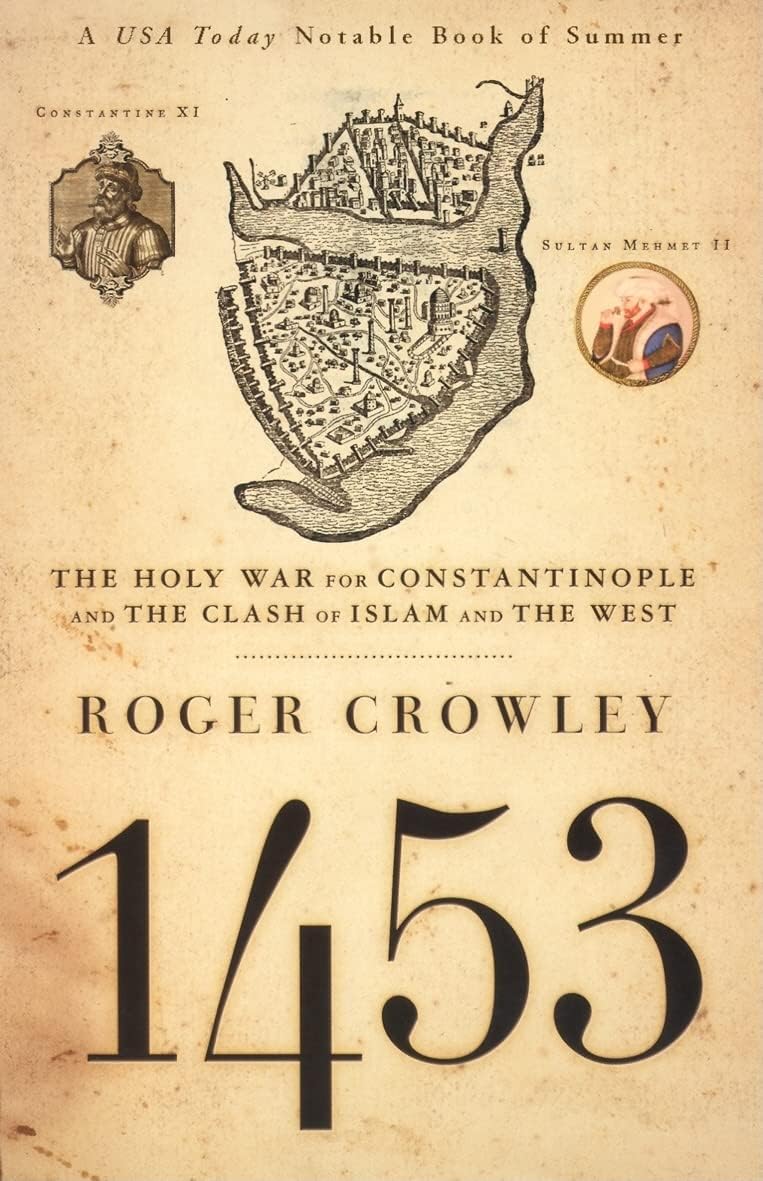

1453: The Holy War for Constantinople and the Clash of Islam and the West
Product ID: 3876717
Desertcart purchases this item on your behalf and handles shipping, customs, and support to Senegal.
A gripping exploration of the fall of Constantinople and its connection to the world we live in today. The fall of Constantinople in 1453 signaled a shift in history and the end of the Byzantium Empire. Roger Crowley's comprehensive account of the battle between Mehmet II, Sultan of the Ottoman Empire, and Constantine XI, the 57th emperor of Byzantium, illuminates the period in history that was a precursor to the current conflict between the West and the Middle East. For a thousand years Constantinople was quite simply "the city": fabulously wealthy, imperial, intimidating―and Christian. Singlehandedly it blunted early Arab enthusiasm for Holy War. When a second wave of Islamic warriors swept out of the Asian steppes in the Middle Ages, Constantinople was the ultimate prize: "The Red Apple." It was a city that had always lived under threat. On average it had survived a siege every forty years for a millennium―until the Ottoman Sultan, Mehmet II, twenty-one years old and hungry for glory, rode up to the walls in April 1453 with a huge army, "numberless as the stars." 1453 is the taut, vivid story of this final struggle for the city, told largely through the accounts of eyewitnesses. For fifty-five days a tiny group of defenders defied the huge Ottoman army in a seesawing contest fought on land, at sea, and underground. 1453 is both a gripping work of narrative history and an account of the war between Christendom and Islam that still has echoes in the modern world. Review: A year to be remembered - The city of Constantinople was the greatest defensive structure of the medieval world. In the course of its 1,123 year history up to the year 1453 it had been besieged 23 times, and only once successfully, ironically by the Christian knights of the Fourth Crusade in 1204. Muslim armies made only a handful of attempts, beginning in 669, just 40 years after the death of Muhammad, and were decisively defeated by a new war technology, “Greek Fire.” After another attempt in 717, the Muslims would not try again for another 650 years. “Constantinople had survived through a mixture of technological innovation, skillful diplomacy, individual brilliance, massive fortifications – and sheer luck: themes that were to be endlessly repeated in the centuries ahead,” the author concludes. The fall of Constantinople was a half-millennium in the making, according to Crowley. The arrival of the mobile and relentless fighting force of the Turks in 1000 and their conversion to Islam was a major turning point in world history, punctuated by the Roman defeat at Manzikert in 1071. The Turks, Crowley writes, were “quick-witted, flexible, and open.” The Byzantines, on the other hand, were sedentary, heavy-handed in their imperial administration, and deeply divided among themselves and their Christian co-religionists in the West. The Venetians, for instance, “worried about pirates more than theology, about commodities rather than creeds.” By the 1400s, the decline of Byzantium appeared inexorable; the rise of the Ottoman Empire inevitable. The principle actors in the drama – Constantine XI and Mehmet II – are both described as talented men, although possessing vastly different inheritances. Constantine inherited “bankruptcy, a family with a taste for civil war, a city divided by religious passions, and an impoverished and volatile proletariat.” Mehmet, “self-reliant, haughty, distant from human affection, and intensely ambitious,” meanwhile, had inherited a well-organized army, efficient administration, and a people welded together by pious commitment to jihad. In 1453, Constantine was 48-years-of-age, Mehmet just 21. Crowley claims that the young Sultan was obsessed by the capture of Constantinople. It was a “bone in the throat of Allah.”…”psychological as much as a military problem for the warriors of the Faith.” His first act upon ascending to the throne was to build a vast fortress six miles up river from Constantinople on the Bosporus. Called Rumeli Hisari (The Throat Cutter), it ensured that the Turks had unimpeded access to Europe across the narrow waterway and also could control the flow of materials from the Black Sea to Constantinople and beyond. And Mehmet had another trick up his sleeve, “a technical revolution that would profoundly change the rules of siege warfare.” Greek Fire had proven decisive against the Muslim besiegers in 678; gunpowder and heavy artillery would turn the technical balance of power in their favor in 1453. Mehmet hired the best gun masters in the world, including “the know-how and advice of perfidious Europeans,” to design a “super gun,” a cannon 27 feet in length that could hurl 1,000 pound marble balls a mile or more. The once impregnable land walls of Constantinople were suddenly vulnerable. The author stresses several points throughout his narrative. First, the Ottoman army was extraordinarily efficient and well organized, especially compared to the Christians. In short, “no army in the world could match the Ottomans in the organization of a military campaign.” Second, Mehmet could draw on a huge reserve of manpower, many of which were genuinely motivated to serve in his armies, either because of the attraction of war booty or holy war – or both. Third, Christians were seriously outnumbered. Crowley claims that the order of battle was something like 200,000 Muslims against perhaps 5,000 effective Christian defenders. Bombardment began after Easter in early April 1453. Mehmet had some 70 cannons trained on the land wall, firing some 120 shots every day, including from the super gun. The walls began to disintegrate under the onslaught. Meanwhile, Mehmet had collected an armada of roughly 140 ships on the waters around the city. The fleet’s objectives were threefold: 1) blockade the city; 2) force entry into the Golden Horn (thus compelling the over-stretched Christian forces to man those walls, too); and 3) prevent any Christian relief force from reaching the city as “their only hope lay in holding on long enough for some relieving force from the West to muscle its way through the blockade.” After it became clear that forcing their way past the chain and tall merchant ships protecting the Golden Horn was not practical, Mehmet ordered his ships to be carried overland around the chains and the independent Genoese city of Galata, and into the smooth waters of the Horn, “a strategic and psychological masterstroke, brilliantly conceived and executed,” according to the author. It was just one of Mehmet’s many effective improvisations. In addition, he had mortars crafted that could send in-direct fire over Galata and onto the Byzantine ships in the Horn; he built large, moving towers to approach the moats and land walls; he directed significant mining operations under the walls of the city. The siege lasted just 53 days. Some 5,000 shots were fired on the city, reducing the effective defending force by as much as 50%. Mehmet decided to press home a final, all-out offensive for May 29, 1453, an attack that succeeded after 6 hours of non-stop carnage. News of the fall of Constantinople was a thunderclap across Europe, a flashbulb memory for those that experienced it, like news of the Kennedy assassination or 9/11. It would fan the flames of anti-Islamic writings for centuries, despite Mehmet’s policy of “remarkable tolerance” toward Christians and other minorities after the city fell. The young Sultan had won an amazing victory, capping the Ottoman Turks “breathtaking ascent from tribe to empire in two hundred years.” “1453” is a great popular history of a remarkable event in world history. I have no doubt that academic historians would recommend other dusty works of historiography over this one, but Crowley is a credible and incredibly readable historian. For those looking to learn more about the modern Middle East or simply hoping to bone up on local history before taking a trip to Instanbul, this is a great place to start. Review: When Cannons, Politics, and Destiny Collide in Constantinople - Roger Crowley’s 1453 is one of those history books that pulls off a neat trick. It makes you feel like you are learning something profound while also giving you quiet permission to chuckle at the wonderfully predictable mixture of ambition, faith, and human stubbornness that shaped the fate of empires. Crowley moves through the religious, political, and military elements of the siege of Constantinople with the confidence of an author who understands that history’s drama is more than enough on its own. The religious and political buildup is handled with admirable balance. Crowley shows the Byzantine Empire attempting to maintain dignity with limited resources and unlimited theological disputes, while the Ottomans bring energy, purpose, and a rather enviable sense that destiny is on speed dial. Crowley never caricatures either side, yet he subtly reminds the reader that people have always argued over divine favor and imperial right with absolute certainty, even when standing on crumbling walls. One of the strengths of the book is its willingness to acknowledge that conquest, colonization, and imperial expansion are not exclusively European inventions. Crowley does not shy away from the reality that Muslim conquests outside the Arabian Peninsula were frequently brutal. The Ottoman expansion was neither polite nor restrained, and the rise of a powerful empire in Anatolia and the Balkans came with its share of forced conversions, political purges, and good old fashioned military violence. The reminder lands effectively, partly because Crowley presents it without panic or polemic. He simply lets the historical record speak, which is usually more than enough to clarify that the story of global conquest is complicated and shared by many civilizations. When the narrative shifts to the military stage, the book hits full stride. The Ottoman war machine is described with precision and vivid detail, yet without the tedious technical bloat that often clutters siege histories. Crowley gives attention to the famous bombard that shook the Theodosian Walls, the clever naval maneuvers that circumvented Byzantine defenses, and the desperate last efforts of a city that had already outlived several historical lifetimes. It is military storytelling with clarity and just enough dry humor to highlight the absurdity of trying to hold an empire together with frayed manpower and fading prestige. Crowley also treats the aftermath with respect and insight. The fall of Constantinople did more than end a chapter, it rewrote the geopolitical script. The Ottomans transformed the city into a thriving imperial capital, the Orthodox world reeled as it recalibrated its spiritual bearings, and Western Europe responded with a predictable mix of outrage, religious fear, and deeply inconvenient self reflection. Crowley captures all of it without sermonizing, allowing the reader to absorb a turning point that still shapes global politics, culture, and identity. What makes 1453 memorable is Crowley’s ability to weave together the political, religious, and military dimensions of the story while maintaining a tone that is scholarly, humane, and occasionally amused. He respects the magnitude of the fall, yet he also seems aware that history’s greatest moments often hinge on a combination of innovation, miscommunication, optimism, and sheer fatigue. The result is a narrative that feels both intimate and sweeping, with the added benefit of reminding readers that no civilization owns the patent for conquest or cruelty. If you want a book that explains why Constantinople fell, why it mattered, and why history is best understood without romanticism or selective memory, 1453 is a compelling and remarkably enjoyable read. It offers clear analysis, sharp storytelling, and just enough sardonic commentary to keep you grounded while the walls come down.
| Best Sellers Rank | #53,228 in Books ( See Top 100 in Books ) #4 in Turkey History (Books) #9 in History of Islam #181 in European History (Books) |
| Customer Reviews | 4.6 out of 5 stars 1,053 Reviews |
T**I
A year to be remembered
The city of Constantinople was the greatest defensive structure of the medieval world. In the course of its 1,123 year history up to the year 1453 it had been besieged 23 times, and only once successfully, ironically by the Christian knights of the Fourth Crusade in 1204. Muslim armies made only a handful of attempts, beginning in 669, just 40 years after the death of Muhammad, and were decisively defeated by a new war technology, “Greek Fire.” After another attempt in 717, the Muslims would not try again for another 650 years. “Constantinople had survived through a mixture of technological innovation, skillful diplomacy, individual brilliance, massive fortifications – and sheer luck: themes that were to be endlessly repeated in the centuries ahead,” the author concludes. The fall of Constantinople was a half-millennium in the making, according to Crowley. The arrival of the mobile and relentless fighting force of the Turks in 1000 and their conversion to Islam was a major turning point in world history, punctuated by the Roman defeat at Manzikert in 1071. The Turks, Crowley writes, were “quick-witted, flexible, and open.” The Byzantines, on the other hand, were sedentary, heavy-handed in their imperial administration, and deeply divided among themselves and their Christian co-religionists in the West. The Venetians, for instance, “worried about pirates more than theology, about commodities rather than creeds.” By the 1400s, the decline of Byzantium appeared inexorable; the rise of the Ottoman Empire inevitable. The principle actors in the drama – Constantine XI and Mehmet II – are both described as talented men, although possessing vastly different inheritances. Constantine inherited “bankruptcy, a family with a taste for civil war, a city divided by religious passions, and an impoverished and volatile proletariat.” Mehmet, “self-reliant, haughty, distant from human affection, and intensely ambitious,” meanwhile, had inherited a well-organized army, efficient administration, and a people welded together by pious commitment to jihad. In 1453, Constantine was 48-years-of-age, Mehmet just 21. Crowley claims that the young Sultan was obsessed by the capture of Constantinople. It was a “bone in the throat of Allah.”…”psychological as much as a military problem for the warriors of the Faith.” His first act upon ascending to the throne was to build a vast fortress six miles up river from Constantinople on the Bosporus. Called Rumeli Hisari (The Throat Cutter), it ensured that the Turks had unimpeded access to Europe across the narrow waterway and also could control the flow of materials from the Black Sea to Constantinople and beyond. And Mehmet had another trick up his sleeve, “a technical revolution that would profoundly change the rules of siege warfare.” Greek Fire had proven decisive against the Muslim besiegers in 678; gunpowder and heavy artillery would turn the technical balance of power in their favor in 1453. Mehmet hired the best gun masters in the world, including “the know-how and advice of perfidious Europeans,” to design a “super gun,” a cannon 27 feet in length that could hurl 1,000 pound marble balls a mile or more. The once impregnable land walls of Constantinople were suddenly vulnerable. The author stresses several points throughout his narrative. First, the Ottoman army was extraordinarily efficient and well organized, especially compared to the Christians. In short, “no army in the world could match the Ottomans in the organization of a military campaign.” Second, Mehmet could draw on a huge reserve of manpower, many of which were genuinely motivated to serve in his armies, either because of the attraction of war booty or holy war – or both. Third, Christians were seriously outnumbered. Crowley claims that the order of battle was something like 200,000 Muslims against perhaps 5,000 effective Christian defenders. Bombardment began after Easter in early April 1453. Mehmet had some 70 cannons trained on the land wall, firing some 120 shots every day, including from the super gun. The walls began to disintegrate under the onslaught. Meanwhile, Mehmet had collected an armada of roughly 140 ships on the waters around the city. The fleet’s objectives were threefold: 1) blockade the city; 2) force entry into the Golden Horn (thus compelling the over-stretched Christian forces to man those walls, too); and 3) prevent any Christian relief force from reaching the city as “their only hope lay in holding on long enough for some relieving force from the West to muscle its way through the blockade.” After it became clear that forcing their way past the chain and tall merchant ships protecting the Golden Horn was not practical, Mehmet ordered his ships to be carried overland around the chains and the independent Genoese city of Galata, and into the smooth waters of the Horn, “a strategic and psychological masterstroke, brilliantly conceived and executed,” according to the author. It was just one of Mehmet’s many effective improvisations. In addition, he had mortars crafted that could send in-direct fire over Galata and onto the Byzantine ships in the Horn; he built large, moving towers to approach the moats and land walls; he directed significant mining operations under the walls of the city. The siege lasted just 53 days. Some 5,000 shots were fired on the city, reducing the effective defending force by as much as 50%. Mehmet decided to press home a final, all-out offensive for May 29, 1453, an attack that succeeded after 6 hours of non-stop carnage. News of the fall of Constantinople was a thunderclap across Europe, a flashbulb memory for those that experienced it, like news of the Kennedy assassination or 9/11. It would fan the flames of anti-Islamic writings for centuries, despite Mehmet’s policy of “remarkable tolerance” toward Christians and other minorities after the city fell. The young Sultan had won an amazing victory, capping the Ottoman Turks “breathtaking ascent from tribe to empire in two hundred years.” “1453” is a great popular history of a remarkable event in world history. I have no doubt that academic historians would recommend other dusty works of historiography over this one, but Crowley is a credible and incredibly readable historian. For those looking to learn more about the modern Middle East or simply hoping to bone up on local history before taking a trip to Instanbul, this is a great place to start.
H**V
When Cannons, Politics, and Destiny Collide in Constantinople
Roger Crowley’s 1453 is one of those history books that pulls off a neat trick. It makes you feel like you are learning something profound while also giving you quiet permission to chuckle at the wonderfully predictable mixture of ambition, faith, and human stubbornness that shaped the fate of empires. Crowley moves through the religious, political, and military elements of the siege of Constantinople with the confidence of an author who understands that history’s drama is more than enough on its own. The religious and political buildup is handled with admirable balance. Crowley shows the Byzantine Empire attempting to maintain dignity with limited resources and unlimited theological disputes, while the Ottomans bring energy, purpose, and a rather enviable sense that destiny is on speed dial. Crowley never caricatures either side, yet he subtly reminds the reader that people have always argued over divine favor and imperial right with absolute certainty, even when standing on crumbling walls. One of the strengths of the book is its willingness to acknowledge that conquest, colonization, and imperial expansion are not exclusively European inventions. Crowley does not shy away from the reality that Muslim conquests outside the Arabian Peninsula were frequently brutal. The Ottoman expansion was neither polite nor restrained, and the rise of a powerful empire in Anatolia and the Balkans came with its share of forced conversions, political purges, and good old fashioned military violence. The reminder lands effectively, partly because Crowley presents it without panic or polemic. He simply lets the historical record speak, which is usually more than enough to clarify that the story of global conquest is complicated and shared by many civilizations. When the narrative shifts to the military stage, the book hits full stride. The Ottoman war machine is described with precision and vivid detail, yet without the tedious technical bloat that often clutters siege histories. Crowley gives attention to the famous bombard that shook the Theodosian Walls, the clever naval maneuvers that circumvented Byzantine defenses, and the desperate last efforts of a city that had already outlived several historical lifetimes. It is military storytelling with clarity and just enough dry humor to highlight the absurdity of trying to hold an empire together with frayed manpower and fading prestige. Crowley also treats the aftermath with respect and insight. The fall of Constantinople did more than end a chapter, it rewrote the geopolitical script. The Ottomans transformed the city into a thriving imperial capital, the Orthodox world reeled as it recalibrated its spiritual bearings, and Western Europe responded with a predictable mix of outrage, religious fear, and deeply inconvenient self reflection. Crowley captures all of it without sermonizing, allowing the reader to absorb a turning point that still shapes global politics, culture, and identity. What makes 1453 memorable is Crowley’s ability to weave together the political, religious, and military dimensions of the story while maintaining a tone that is scholarly, humane, and occasionally amused. He respects the magnitude of the fall, yet he also seems aware that history’s greatest moments often hinge on a combination of innovation, miscommunication, optimism, and sheer fatigue. The result is a narrative that feels both intimate and sweeping, with the added benefit of reminding readers that no civilization owns the patent for conquest or cruelty. If you want a book that explains why Constantinople fell, why it mattered, and why history is best understood without romanticism or selective memory, 1453 is a compelling and remarkably enjoyable read. It offers clear analysis, sharp storytelling, and just enough sardonic commentary to keep you grounded while the walls come down.
P**R
Pivotal Moment of World History Examined
Over the past year or so, I have been getting in touch with my Crusader interest, particularly the later-stages of the 14th and 15th centuries. While not specifically tied to the Crusades, Crowley's book, 1453 peaked my interest by delving into the obscure nature of the Byzantine Empire and the litany of tumultuous events. Spanning almost a thousand years, Constantinople served as the heart of the Eastern Roman Empire and a bedrock of Christianity on the fringes of Europe. Over hundreds of year, the civilization rose and fall with the times, but hands down its most challenging enemy was that of Islam, which rapidly accelerated its progression through the capable hands of The Ottoman Empire. This story provides an accurate and vivid account of when those two forces collided at Constantinople and the epic siege that followed. Crowley performs yeoman's work in setting the stages adequately, filled with characters like the Sultan, Constantine, and mercenaries who were the central figures of 1453. The descriptions make you fill like you were a bystander in the city, or one of the many soldiers of the sultan scrapping their way toward breaches in the defenses. I highly recommend this book to any student of history and how this one event shaped the future course of events throughout the Middle Ages.
H**1
Excellent and Balanced Book on the Fall of Constantinople
My interest in the Byzantine Empire was piqued from attending a Byzantine Catholic Church - I also spent some time in Venice years ago and got to Istanbul recently on business trips. I was drawn in by Ottoman and Greek history and began to delve into what I now consider to have been the greatest land battle ever fought - the siege and fall of Constantinople to Mehmed II. Crowley has written three books - all excellent - that cover the Ottoman Empire and its clashes with Venice, Genoa, the Papal Fleets, and the remnants of the Byzantine Empire. You should read all three starting with this work - which sets up the state of the Byzantine Empire (what little was left of it) about 20 years prior to the Fall of the City to around the time of Mehmed II's birth. Next, read Crowley's "Empires of the Sea - The Siege of Malta, The Battle of Lepanto and the Contest for the Center of the World" which literally picks up after Constantinople falls and deals with the other great Ottoman Sultans as they clash with Venice and Papal Knights, with this second book ultimately culminating with a riveting account of the Battle of Lepanto which marked the end of large scale Ottoman conquests of Christian lands by sea. The Final book is "City of Fortune: How Venice Ruled the Sea." This changes the perspective because as you will see - Venice was the pivot point for a lot of what happened to Byzantium, the Crusades, Western dealings with the Ottomans, etc. Why this book is good and cutting to the chase - the Greek Christians took some beating at the hands of the Ottomans - they lost their capital, their line of Emperors, and lived under Turkish rule for centuries thereafter - living and dying under the banner of Islam - often giving up their children to the janissary core and being forced to fight for Islam as well. The Greeks hate the Turks and Greek historians have tended to exaggerate everything, or have re-written parts of history to whitewash historical persons, or to further paint the Ottomans as savage, etc. Vice versa, the Ottomans whitewash much of the Real History of their great Sultans and naval captains - the slave taking, Mehmed taking a sea captain's young son into the seraglio, for instance. The result is that a balanced view and accurate portrayals of the players have been historically hard to come by. For instance, the circumstances of the death of Constantine XI - of those historians who agreed he was actually killed in action - there are 10 different versions alone. Crowley has gone through many differing accounts and has used his best effort to give us the most plausible and accurate historical truth. Getting to the book - you get a good breakdown and cross-sectional maps of the City and its defenses, wonderful portraits of those at the battle, and a step by step analysis of how Mehmed II shut off and isolated the City, attacked it, and took it. From his construction of the Throat Cutter further up the Bosphorus; from Orban's great cannon firing the tons of rocks into the walls of the City; to the fact that maybe 20% of Mehmed's army at the walls was in fact made up of Christian conscripts to the point that Mass and Greek chant could be heard by those on the walls of the City; to the Knights on the walls fighting to their last drop of blood; to underground battles between miners. You have Mehmed II riding his horse into the Bosphorus trying to direct a naval battle from shore; to treachery in the Galata tower were the Ottomans were warned of a nighttime sea raid by some traitor whose name is lost to history. You are there with the civilians in Constantinople as they descend into their subterranean cisterns to pass the time praying for a victory. You are in the square in front of Hagia Sophia watching, as a strange fog and illuminated cloud seems to hover over the church - only to then dart up into the sky and disappear. You are present at the last Mass ever held in Hagia Sophia. You are there as Giustiniani takes a bullet through his breastplate armor and, as he is being carried through the doors between the middle wall and inner wall, the soldiers finally falter, turn around and attempt to get through the door - whereupon the City falls as Constantine XI is last (reliably seen) fighting and disappearing in the throngs between the defensive walls. You are then there as everyone makes a mad dash to the shores of the Golden Horn to see if an escape was possible and you get a taste of what happened to the people left in the City as the looting and slave taking began. In some of the reviews - this book is criticized as not providing enough data for a tourist to reliably spot the locations where many of these events happened - this is true but the book is not setup for that type of sightseeing - you must get tour books and good city maps when you get there and be prepared to do a lot of walking. For your tour though - the description Crowley gives of the doors of Hagia Sophia being battered down for the last time and what happened to the people who fled to the church will put you in awe of where you stand should you get to the City. When I passed the security line at Hagia Sophia - you walk forward where the entrance to the church will be on your right. The doors battered down the day the city fell are still there. There is a little tourist coffee café where the old baptistery was across from the entrance. I found myself at first unable to enter the Church - I had to sit there and contemplate over a coffee before I could bring myself to go in. If you read Crowley and study up on Hagia Sophia - you may feel that way too. It's crazy - but I liked just being in the Church's shadow or being able to see the dome every morning on my way to work. Hagia Sophia will play a role in whatever final battles are fought on this Earth between Islam and Christianity. I wonder if Mass will ever be said there again, or will Armageddon come first. One thing is for sure - none of that will be within my lifetime.
I**.
Informative, suspenseful, and entertaining
I came across this book when it was mentioned by another Amazon reviewer in connection with a different book, and thought I'd check it out. I'm glad I did. I'm a fan of this type of popular history, and "1453" is one of the finest I've read. Author Crowley tells the story of the epic siege of Constantinople the way it deserves to be told: With excitement, suspense, and a dose of horror. He manages to work in the complex history of the 1,000-year-old Byzantine Empire and the rise of the Ottoman nation in a lively and informative fashion, and concentrates on what the reader really cares about: Would Sultan Mehmet II be the first to do what no one had done for a millennium, and breach the walls of the greatest Christian metropolis of the Middle Ages? At times the book reads like a spy thriller, and I found myself unable to stop turning the pages, dying to know what happened next. Crowley is a fine storyteller and his grasp of the various aspects of the history -- including military, geographical, navigational, religious and cultural details -- is impressive. I learned more from this book than I have from several more comprehensive histories of the Byzantine Empire, and had more fun along the way. The author also does what so few historical writers remember to do, which is that when he refers back to one of the many hundreds of supporting characters who played a minor role in the story, he reminds the reader who they were and why they were significant, so you don't have to constantly go paging backwards or check the index to figure out who he's talking about. I wish more popular histories were this enjoyable. Highly recommended.
J**N
Compelling, suspenseful, fresh, balanced, and well-written history
Crowley's book is fascinating, gripping, suspenseful, informative, cleanly written, and well-balanced. That is, he depicts the lead up to and long siege and taking of Constantinople by the Ottomans so that even if you know what finally happened in 1453 to the city and the Eastern Roman Empire etc., you'll find it difficult to stop reading and wanting to find out what will happen to the various individual key players in the story. Crowley covers much of the ground that other history books have covered, like Gibbon, but he also adds much from the Ottoman point of view (even though, as he points out, there are surprisingly few documents from Ottoman eye witnesses of the siege, so that the whole thing is an exception in being mostly history being written by the losers). He frankly points out atrocities and heroics by both sides, interestingly explores obscure points like just how and when Mehmet got all those Ottoman ships over the mountain, and convincingly communicates just how contingent the Ottoman victory was, how close the Byzantines came to winning the siege (even though they probably would have lost the next siege). Crowley also interestingly points out how mixed the two mega cultures were, with half-Serbian rulers on either side, etc., and how the rivalries and squabbling of the defenders (Genovese vs. Venetians, Italians vs. Greeks, strict Orthodox believers vs. Catholic appeasers, etc.) harmed their cause. His account of the manufacture, transportation, firing, and effect of the gargantuan Ottoman cannons is compelling, too. I also like how Crowley weaves together various testimonies of the events, synthesizing them or choosing from among them to come up with what seem to be the most reasonable takes on the history. And he works in some great, cool epigraphs to lead into each chapter. Finally, I read the kindle version and found no typos, though of course the pictures and maps and such didn't look so good on my device, which can't be helped with an e-book. In short, I recommend 1453 to any readers interested in the Byzantine Empire, Ottoman Empire, clash of Islamic and Christian cultures, or compelling history books of heroic and horrible battles.
D**R
How to besiege a city successfully
Prompted to read more about the Ottoman Empire from watching a very cheesey movie on TV about the siege and taking of Constantinople by the Islamic army of Mehmet, I found this an excellent introduction to this whole period and especially the way lives were lead and lost in the period. This led to reading Lords of the Horizon by Goodwin and Lost to the West by Brownworth, all excellent reads going over the history of this time, well before and through the early part of the 20th century. Grandiose buildings, law, and real (at least the potential for real) civilization at a time when in Europe, Vikings were trashing England and living in wooden buildings. The difference in life styles between Europe - Italy to England - and the Ottoman Empire was huge. What remains in the memory though is the ceaseless need to wage war by each ruler and the ceaseless grasping for power: brother murders his brothers, gets the throne, gets poisoned by his wife who assumes power and marries an up and coming general, who sends her off to spend her life in a remote area, then gets murdered himself and.... Politics then was not a life for anyone to seriously consider but then again, life itself for anyone then was constant turmoil, war, and plague. As I eat a waffle and have some good coffee for breakfast while reading the morning paper in a warm house, I am thankful to be living now..... Wonderful reads, highly recommended.
D**N
exquisite detail
Good history - the engaging, fascintating kind that speaks to the human condition - is most effective with riveting details written in lively prose. Crowley does this in _1453_. While he is not a trained historian, his account of the seige and conquest of Constantinople in the spring of 1453 is vividly written and historically accurate, drawing from the handful of first-hand accounts and a suprising number of academically sound secondary sources. The drama of the event for both the Islamic world and Christendom is clearly presented - the competing theological, political and economic interests that worked against Constantinople as well as the high stakes the Mehmet II made in his attempt to take the city. The see-saw fighting around the city, at sea and even underneath the city walls puts readers right in the action; the desparate attempts by the vastly outnumbered Byzantines (and a handful of Genoese and Venetian allies) to hold the city make for sympathetic underdogs, while Mehmet's brilliant organization, careful planning and relentless drive makes for a compelling protagonist. Crowley's discussion of the larger importance of the ending of the Byzantine empire and the ascendency of the Ottomans is also excellent, pointing out not only the changes in warfare that the seige demonstrated, but also the tipping of the commercial scales farther west to Italy. His discussion of the way in which the historical narrative changed with the occupation was also interesting - the "Turk" as the new bogeyman for Christian Europe, the Ottoman's westward expansion evidence of their place as a great power. It is a tremendous book rich with interesting details of the battle itself and the principle personalities on either side. Highly recommended.
A**L
Excellent Book
Excellent Book
A**R
An excellent history book that does not read like a history ...
An excellent history book that does not read like a history book. If you are interested in the source material but find history books to be dry or boring then I would recommend this book. It reads like a good historical fiction book, except you are actually learning something. Highly recommended.
E**I
Highly recommended
Love it, I recommend it.
R**O
Año clave
La caída del régimen antiguo y la llegada de España como protagonista de la historia mundial
A**.
PAPEL DE PÉSSIMA QUALIDADE!
Recebi o livro hoje. Ainda não li. Mas a qualidade do papel é semelhante a daqueles livros vendidos em banca de jornal. Uma vergonha para um livro que custos 75 reais.
Trustpilot
2 weeks ago
1 month ago