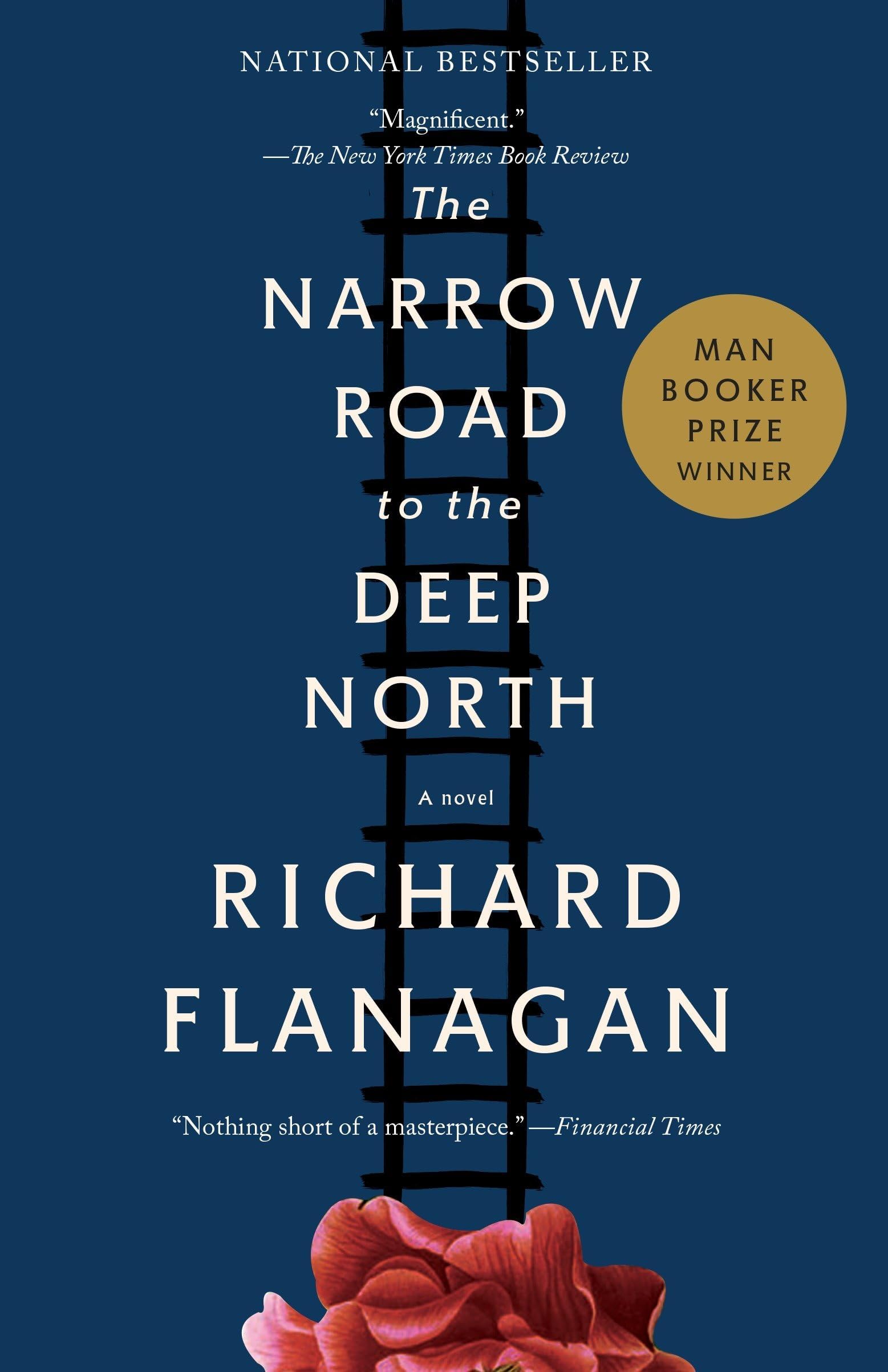
NARROW ROAD TO THE DEEP NORTH: A Novel (Vintage International)
Description
Winner of the Man Booker Prize “ Nothing since Cormac McCarthy’s The Road has shaken me like this.” — The Washington Post In The Narrow Road to the Deep North , Richard Flanagan displays the gifts that have made him one of the most acclaimed writers of contemporary fiction. Moving deftly from a Japanese POW camp to present-day Australia, from the experiences of Dorrigo Evans and his fellow prisoners to that of the Japanese guards, this savagely beautiful novel tells a story of the many forms of love and death, of war and truth, as one man comes of age, prospers, only to discover all that he has lost.


Specifications
| Asin | 0804171475 |
| Country Of Origin | USA |
| Dimensions | 13.13 x 2.29 x 20.32 cm |
| Edition | Reprint |
| Importer | Bookswagon, 2/13 Ansari Road, Daryaganj, New Delhi 110002, [email protected], 01140159253 |
| Isbn 10 | 9780804171472 |
| Isbn 13 | 978-0804171472 |
| Item Weight | 1 kg 50 g |
| Language | English |
| Packer | Bookswagon, 2/13 Ansari Road, Daryaganj, New Delhi 110002, [email protected], 01140159253 |
| Print Length | 397 pages |
| Publication Date | 14 April 2015 |
| Publisher | Vintage Books |
Reviews
User
Read it because you must !
This book is certainly worthy of the Booker. It is essentially a wartime story of love, focussing on the many aspects of war and love thereby revealing how one becomes the other (e.g., when Dorrigo discovers that Amy is alive but fights not to reach her, or she him). The imagery used in the descriptions of the POWs on the Death Railway construction is very vivid and haunting, leaving the reader shocked at both the tragedy of humanity as well as its will to survive in the the most unbelievable torture. A striking feature of this masterpiece is that it focuses on the individual lives of the POWs and the Japanese commanders after the war, knitting it all together in the tragic love of Dorrigo and Amy. Their acceptance of the status quo echoes the tragedy of the Japanese society to accept, unquestionably, the will of their Emperor. Just as the Nakamura does not, even for a moment, entertain the thought that possibly the Japanese spirit is misguided, similarly Dorrigo and Amy refuse to accept how desperately one seeks union with the other.The book is achronological- shuffling back and forth in principally three time domains : Before the War (Dorrigo and Amy are in focus here), During the War (the lives of the POWs), and After the War (the remnants of the POWs lives).The language is rich with expressions defining its prose structure on poetry; each of the five parts of this book start with a haiku by either Basho or Issa. Poetry becomes the life of the good (Dorrigo), the evil (Kota), the good-evil (Nakamura), so much so that each of them have their deaths in poetry, one way or another.Conclusion: Do read this book. Not only does it acquaint you with a forgotten tragedy of World War II but also draws on the important themes of love, megalomania, death, and oblivion.
User
Glorious
I had no words to thank Amazon this time....Last times I got some books from Amazon but due to the bad packaging, I was soo disappointed.....Coming to the book... HARDCOVERThe book is a gem 💎...... Magnificent...Please give it a read 📖
User
Story of the harsh struggle of people during WWII,return journey of civilians of survivors.
Excellent
User
Nice read!!
Opened new perception
User
A Morose Encounter With The Void
Dorrigo Evans is a doctor by profession, life-saver by compulsion. He took the Hippocratic Oath a little too seriously so as to consider it a face; a face that drapes his skin loosely but does never fit quite right. In turn, it makes him feel uneasy. Makes him feel that maybe he isn't how everyone likes him to be. He doesn't match their description. He might as well be the opposite of it. But still, to his surprise, he couldn't open up his grim thoughts. As if he was bound to act in a certain way. Society is a machine and he is the slave that sways with the chain attached to it.Then she came. The girl with a red flower in her hair. Amy was it? Dorrigo sensed a new presence. The presence of something new. Something that cast him out of his shell and filled him up with a new hope. But it didn't stay. In the end it all became just memories of good times and he proceeded to the plot. The great plot of World War II."The Speedo meant that there were no longer rest days, that work quotas went up, and up again, that shifts grew longer and longer. The Speedo dissolved an already vague distinction between the fit and the sick into a vaguer distinction between the sick and the dying, and because of the Speedo more and more often prisoners were ordered to work not one but two shifts, both day and night."He became the leader. The leader of them all, the prisoners who knew only two destinations in their lives: life with strenuous work, or death by gangrene/cholera/deficiency disorders. He sacrificed (though he didn't wish he had) his own food for the sake of his subordinates. But still it wasn't any better. He couldn't save enough of them at the end of it. And whoever came out alive out of it all didn't find a life back home. Everything they knew and believed were gone and replaced. In the end, Dorrigo couldn't save any of them.But what changes the dynamics of this novel is that Richard Flanagan defocuses out of Evans whenever he feels right and shifts gaze towards the little Land of the Rising Sun. Although his protagonist has chosen (or rather was chosen) to face Japan at the war front, still the author managed to stay neutral. He didn't choose any side but just conducted a thorough description of the historical details.And what do we meet while he takes the narrow road to the deep north?A sad feeling of emptiness.
User
There is nothing civil about war..
The book tells the story of Dorigo Evans, an Australian POW and a surgeon by trade during WW2. The core of the story is about Dorigo's work in a POW camp working on the Thailand-Burma Death Railway which claimed the lives of hundreds of thousands of Allied POWs, slaves and forced labourers in service of Imperial Japan's designs for a great empire during WW2. The cruelty, torture, suffering and deprivation experienced by the various men who were put to work on the project is closely examined in this book. The railway was deemed strategically important by Japan in order for the establishment of empire east of Thailand, Burma and to eventually take on the British in India.The narrative isn't told exclusively through Dorigo Evans' point of view. We see various events as they unfold through the Australian POWs, the Japanese officers and their subordinates, the Korean guards serving the Japanese army, and various other characters. The story describes the horrific conditions of the POW camps. Starvation, disease and death were commonplace due to the lack of food and medicines. There is also a love story that forms one of the narrative strands and closely examines the effects of war and harrowing experiences that shapes the lives of the survivors and the many shattered lives that it leaves in it's wake. The events in the book are based on recorded history and events described are based on fact. The novel doesn’t exonerate the war criminals, but it forces us to admit that history conspired to place them in a situation where cruelty would thrive as it invariably does during times of war, where the powerful wield unbridled power over the powerless.The quality of the prose is haunting and very fluid and will remain with the reader for a long while after. The narrative flits between past and present to examine the lives of the survivors from the POW camps, their Japanese masters and the families who lost sons, husbands and fathers who never returned home and how the men who did return were forever traumatized by the the horrors of war.
User
Achingly Beautiful
When I turned the final page, I was relieved and sad at the same instant; relieved to have finally let the fates of POWs take wings to better skies and sad to not be living an alternate life, altogether.This exquisite work of Flanagan is so terrifyingly beautiful that it redefined both the words for me. I was surprised to find my mind working at two levels. One drew shudders; the ulcerated limbs, the beri-beri attacks, the cholera ridden bodies, the visceral lashes, the s***ty camps, the fatal frostbites.. they were so difficult to imagine that I found myself keeping the book away several times to just get my hands and mind steady. To think that those things happened, is one pain; to have someone narrate it in the most vivid way, is another. Its a lot to take, even as a passive reader. However the other drew comfort; keeping relationships, dancing madly, forging friendships, sharing heartbreaks, fighting trivial, crying together, helping gladly, nurturing hope, living another life, elsewhere, far away.When life is killed everyday yet one wishes to live and when hope is crushed every hour yet one continues to hope, we see the greatest example of human courage. That courage, is placed amidst the sheets of this book.
User
The lives of similar people in the aftermath of the war were also beautifully articulated. Totally a great read
I struggled a bit to get into it for the first 50 pages, but then starts the POW's camp story which held my interest in the book. The story of the POW's is heart wrenching and gives an insight of difficulties faced by people during war. The lives of similar people in the aftermath of the war were also beautifully articulated. Totally a great read!
User
Extraordinary. The railway is the crucible, the book is about what remains afterwards.
At this stage of my life, The Narrow Road to the Deep North reads as a study in justification.Richard Flanagan moves through every camp, every mind, every moral universe. Prisoners. Surgeons. Lovers. Japanese officers bound to the Emperor. Each inhabits a logic that makes sense from the inside. Honour. Duty. Survival. Desire.History turns on those private narratives. People act. Then they explain. The explanation hardens into belief. The belief becomes identity.Flanagan’s range unsettles because it removes the comfort of certainty. He shows how lived experience shapes language, posture, allegiance. A man formed by hunger speaks differently from a man formed by command. A nation formed by defeat remembers differently from one formed by empire.The novel widens the frame. It reveals how easily righteousness takes root. It shows how repetition grows from persuasion rather than ignorance.The horror sits in the background. The real force lies in the anatomy of self-justification.I read "The Narrow Road to the Deep North" in the way I now read many war novels, I moved past much of the graphic brutality. I understand what the railway was. I did not need every blow described. I was fascinated by Flanagan’s willingness to enter the minds of the Japanese officers and show how honour, obedience and Emperor worship formed a moral world in which cruelty could be framed as as duty, even virtue, and suffering recast as proof of loyalty.This mythic language, set inside an operating theatre, shifts the scale. A surgeon who once carried himself with absolute command feels the weight of his own humanity. The hand that once cut clean now trembles. The body remembers. The past intrudes.“He had stolen light from the sun and fallen to earth. For a moment he had to turn away from the table and compose himself, so that the rest of the team would not see his scalpel shaking.”The horror in the book becomes more unbearable because the prose is so luminous. Beauty heightens contrast. When a writer can render tenderness, love, memory, even desire with such precision, the brutality feels sharper.You do not need to read every detail of suffering to recognise that power. The architecture of the book carries it. The moral weight is present in the pauses, in the fractured relationships, in the way time folds back on itself.Flanagan writes extremity, yet he also writes longing. He writes shame. He writes the ache of love that never resolves. That is what makes the novel extraordinary.The railway is the crucible, yet the book is about what remains afterwards.I responded to the beauty of the sentences as much as the history.For me that is enough.
User
Graphic portrayal of life in a POW camp
A really enjoyable book although parts of it were quite disturbing especially the descriptions of deprevation and sickness. Also the brutality of the Japanese.
User
Toller 'Roman
Spannend und gut.Der Service top.sehr zufrieden
User
Strong writing well worth its prize winning status. Reread in 2017 confirms this.
Cover 2/5 I heard the cover designer on BBC Radio 4 talking about the cover and her work being praised. I cannot say the cover gave me any incentive to buy and the title is far too long despite the source of the title and cover design being revealed in the book.Contents - Purchased this book as a Christmas present for myself. I usually try to reach 100 pages of any book which comes recommended. After 50 pages I could have put aside but on reaching 100 pages the book starts to find its legs. Some very good images created already of stakes in the ground going into the distance for the proposed route and the beauty of necks to the Japanese psychopath.As a writer I have been told to write with good grammar and punctuation and if I publish to have a good copy writer go over my text in detail for errors. I ask what happened in the production for publishing with this book?. A niggling distraction to some otherwise good writing. I read on ...22 January 2015. I finished the book this morning. Despite the lack of enough punctuation and proof reading I found the book a powerful and strong reading experience even forcing me to stop reading until the following day in a couple of places because his wartime descriptions were so graphic. I regard books like this as semi fiction, the book being based on the war time experiences of the author's father and I suspect much more of his life.Although I have read widely in fiction and non fiction about the WW2 conflict with Japan and generally prefer factual accounts the history told here from several viewpoints was both shocking and interesting in giving a better understanding of the Japanese psyche.My review against my own reading criteria for a good read:-*Engrossing and interesting - Past 100 pages more so becoming a strong page turner one not knowing what would come next or where the story would end up.*Enjoyment and entertainment - Given the subject not a book to score highly under this heading. There was enjoyment in reading the book as a heavy hard cover rather than an e-book.*Emotional - One became bound up with the character's lives in war and in love and marriage pre and post war. Memories of Dr Zhivago sprang into my mind as the book neared its end.*Educational - Much interesting new information about WW2 and the war with Japan.*Ease of reading - The solid strong writing was not the easiest of reads but flowed well, despite some very deep description and different time frames, making the book hard to put down.As mentioned before the book does not get going until after 100 pages. All too often I find good books become ordinary books when given fairy tale endings. To me the ending was well crafted. Given time I will need to reflect whether this book may displace another book in my top twelve lifetime reads.Often Man Booker prize winning books fall short of expectations but for me this was not the case. One to be kept in my bookshelves. Well worth a read ... and for me a reread in due course. Five stars for the writing ... ignoring presentation issues.July 2017. Read the book again. Knowing the ending picked up all the clues to the punch line. Again a very powerful reading experience for a fiction book. Given its origins perhaps more fact than fiction. Included in my top ten books.Alexander of the Allrighters and Ywnwab!
User
“And wouldn’t that put some cream in their coffee…”
This powerful, sensitive and evocative novel on the human condition, in extremis, which was recommended by a fellow Amazon reviewer (not to mention Man Booker), helped me reconnect with Australian literature after an absence of several decades. I had read a substantial amount of Aussie literature, back when down under beckoned as a viable alternative. Yet my knowledge was stuck in the days when “everyone” was reading Patrick White’s Voss (Penguin Classics). White would go on to rightly win the Nobel Prize for Literature in 1973. I’ve been to Australia three times, twice on the American government’s “dime.” And so I was amused when Flanagan had his protagonist, Dorrigo Evans attempting to escape from me (and my kind) since “Sydney was full of American GIs from Vietnam on R&R” (p. 364). Tut, tut. I really was not that unruly; my intentions were easily traced, searching for a mindset that, as Flanagan said much earlier in his novel, wouldn’t object to shocking the patrons of the hotel restaurant, which he said far less banally, and much more suggestively: “And wouldn’t that put some cream in their coffee.”War. Richard Flanagan was never in a war, nor was he apparently ever in the military. But his father was. His father was a prisoner of war who worked on the infamous “death railway” between Thailand (Siam) and Burma. And that experience is the core of this novel. He listened to his father well. And what is depicted is war, in extremis. Virtually no American (or Aussie!) had these experiences in Vietnam. And virtually no Allied troops had these experiences fighting Germany during the Second World War. It was a “perfect storm” of “honor,” “racism,” and the massive collision of the tectonic plates of empires. Flanagan brings all of that out so well. Japan, once so quiet, introspective, simply wanting to be left alone, was dragged onto “the world’s stage” in the 19th century, and assumed it role with a vengeance. The “white man” had no place in Asia. Japan would assume the role of providing “guidance” to the natives there. The last third of the novel is “epilogue,” what happened to the survivors of the Death Railroad after the war was over. Vengeance was dressed up in the robes of judicial proceedings. Nakamura, one of the leaders of the camps who managed to escape that vengeance/justice notes the irony: “they only prosecuted us for what we did to them, never what we did to the Chinese.”This is a novel in “high definition.” There are numerous crisp, searing images that will remain with me for the rest of my life. The structure of the novel, with the foreshadowing of events, and the interconnectivities that resulted from a country/continent which had a population that was less than some of today’s megalopolis, was brilliantly done. The title itself is taken from Matsuo Basho’s work of the same name, a link between the experiences of these two very different countries. And Flanagan’s prose is rich, meaningful, and almost perfectly wrought. Dominant is the theme of personal honor – often a good thing – run amok, to use a word now in English, which was derived from the language of Java, where Dorrigo Evans was captured. The Japanese were intent on building a railway because the white man said it could not be done, all for the glory of the emperor, their own version of the ancient pyramids, an analogy Flanagan makes several times. And there is also the disastrous consequences derived from the personal honor of the ever so mundane attempt to retain one’s own bodily functions.I’ll never be able to look at fish “captured” in an aquarium again, without thinking of this novel. As well as a major betrayal of ethics in the medical field: “Because he thought my white lab coat would help him.” And an issue that seems to unite the survivors of all wars: what to tell the families of the ones who didn’t make it, particularly if they died in futile or foolish circumstances: “What did you say? The right thing. Lies.” Flanagan uses the eternal truths of great literature, so it is no surprise that the homecoming of Ulysses is featured as part of a wedding toast. And medical failures haunt: the repeated grasping for a femoral artery that wasn’t there.It is also a novel about the missed opportunities in love. The book’s cover hints at that also, about a woman who had the “…audacity in wearing a big red flower in her hair…” in the bookstore. She became a haunting obsession. So… if you are going to Sydney… wear a crimson camellia in your hair, though a magnolia blossom might do, along with the pearls, and don’t “walk on by” on that iconic bridge, but stand hand-in-hand, and savor the time that is left. 6-stars.
Common Questions
Trustpilot