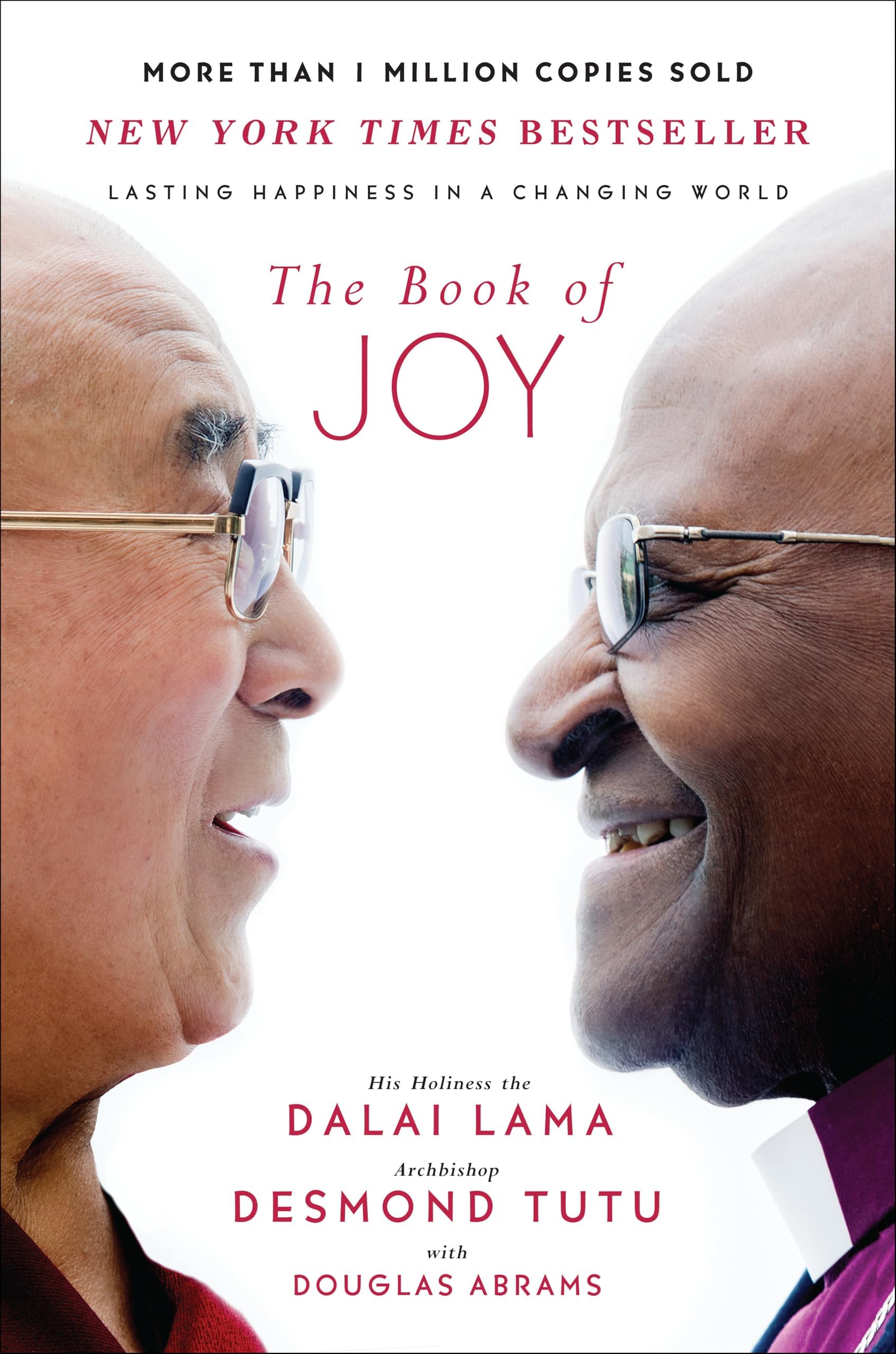
The Book of Joy: Lasting Happiness in a Changing World
Product ID: 33491413
Desertcart purchases this item on your behalf and handles shipping, customs, and support to Senegal.
An instant New York Times bestseller. Over 1 million copies sold! Two spiritual giants. Five days. One timeless question. Nobel Peace Prize Laureates His Holiness the Dalai Lama and Archbishop Desmond Tutu have survived more than fifty years of exile and the soul-crushing violence of oppression. Despite their hardships—or, as they would say, because of them—they are two of the most joyful people on the planet. In April 2015, Archbishop Tutu traveled to the Dalai Lama's home in Dharamsala, India, to celebrate His Holiness's eightieth birthday and to create what they hoped would be a gift for others. They looked back on their long lives to answer a single burning question: How do we find joy in the face of life's inevitable suffering? They traded intimate stories, teased each other continually, and shared their spiritual practices. By the end of a week filled with laughter and punctuated with tears, these two global heroes had stared into the abyss and despair of our time and revealed how to live a life brimming with joy. This book offers us a rare opportunity to experience their astonishing and unprecedented week together, from the first embrace to the final good-bye. We get to listen as they explore the Nature of True Joy and confront each of the Obstacles of Joy—from fear, stress, and anger to grief, illness, and death. They then offer us the Eight Pillars of Joy, which provide the foundation for lasting happiness. Throughout, they include stories, wisdom, and science. Finally, they share their daily Joy Practices that anchor their own emotional and spiritual lives. The Archbishop has never claimed sainthood, and the Dalai Lama considers himself a simple monk. In this unique collaboration, they offer us the reflection of real lives filled with pain and turmoil in the midst of which they have been able to discover a level of peace, of courage, and of joy to which we can all aspire in our own lives. Review: A Buddhist, a Christian, and a Jew Go to a Birthday Party - “I remember when we were in Seattle,” says the Christian. “There were seventy thousand people who wanted to come hear this man, and he can’t even speak English properly.” The Buddhist let out a big belly laugh. “It’s really not nice,” the Christian continues. “You really need to pray that I become a little more popular like you.” And so Archbishop Desmond Tutu, talking to the Dalai Lama, opens one of the most delightful and profound books I’ve read. “The Book of Joy: Lasting Happiness in a Changing World” reveals a week’s visit of face-to-face conversations between the two Nobel Peace Prize laureates. The retired Anglican priest flew thousands of miles to celebrate the Dalai Lama’s 80th birthday in his adopted home of Dharamsala, India; he was exiled from Tibet in 1959. The two, who consider each other “his mischievous spiritual brother,” collaborate with editor and writer Douglas Abrams, who’s worked with a number of spiritual teachers and scientific pioneers and who describes himself as both “secular” and “a Jew.” “From the beginning,” Abrams says, “this book was designed as a three-layer birthday cake.” The first layer: The teachings of the Dalai Lama and Archbishop Tutu on joy. The second layer: The latest science on joy and all the other qualities believed essential for enduring happiness. The third layer: The stories of being in Dharamsala with these two icons throughout this week. "The Book of Joy" is divided into three parts: Day 1—The Nature of True Joy; Days 2&3—The Obstacles to Joy; Days 4&5—The Eight Pillars of Joy. Close friends (“very close,” the Dalai Lama says), the two spiritual masters compare notes on such issues as beauty and suffering; fear, stress, and anxiety; loneliness and despair; frustration and anger; perspective and humility; humor, forgiveness and gratitude; compassion and generosity. This book is no academic dialogue. You see, hear, and feel tears and hugs, joking and teasing, prayer and meditation, and deep insights into life’s most perplexing issues. And there’s little or no discussion of “religious theologies.” Yet a pure, clear stream of mature spiritual experience flows through from front cover to back. This book reveals the ebb and flow of eighteen decades of hard-won, sometimes tragic lessons pressed into one week’s singular encounter. Here are a few teaser quotes that may whet your appetite… On unhappiness: The Dalai Lama says so much of our unhappiness originates within our own mind and heart—in how we react to the events in our life. “Mental immunity is just learning to avoid the destructive emotions and to develop the positive ones. First, we must understand the mind—the diverse thoughts and emotions we experience on a daily basis. Some of these thoughts and emotions are harmful, even toxic, while others are healthy and healing. The former disturb our mind and cause much mental pain. The latter bring us true joyfulness.” On hope vs. optimism: “I say to people I’m not an optimist, because that is something that depends on feelings more than the actual reality,” says Archbishop Tutu. “We feel optimistic, or we feel pessimistic. Now, hope is different in that it is based not on the ephemerality of feelings but on the firm ground of conviction. I believe with a steadfast faith that there can never be a situation that is utterly, totally hopeless. Hope is deeper and very, very close to unshakable. It’s in the pit of your tummy. It’s not in your head. It’s all here,” he says, pointing to his abdomen. On anger: Underlying anger, according to the Dalai Lama, is a fear that we will not get what we need, that we are not loved, that we are not respected, that we will not be included. “Now medical scientists say that constant fear, constant anger, constant hatred harms our immune system.” On suffering and adversity: The Archbishop was asked: So how did Nelson Mandela survive twenty-seven years of impoverishment and imprisonment and emerge as someone of immense magnanimity? Why do you think he was able to see his suffering as ennobling rather than embittering? “He didn’t see it. It happened,” says the Archbishop, who earlier explained that suffering can either embitter us or ennoble us and that the difference lies in whether we are able to find meaning in our suffering. “It seems almost without fail that generosity of spirit requires that we will have experienced, if not suffering then at least frustrations…It is probably something like your muscle. If you want a good muscle tone, you work against it, offering it resistance, and it will grow. You can’t expand the volume of your chest just by sitting. You have to walk up mountains.” On humor and laughter: “It is much better when there’s not too much seriousness,” says the Dalai Lama. “Laughter, joking is much better. Then we can be completely relaxed. I met some scientists in Japan, and they explained that wholehearted laughter—not artificial laughter—is very good for your heart and your health in general. (People who laugh) are less likely to have a heart attack than those people who are really serious and who have difficulty connecting with other people. Those serious people are in real danger.” Adds Abrams: “Having worked with many spiritual leaders, I’m tempted to see laughter and a sense of humor as a universal index of spiritual development. The Archbishop and the Dalai Lama were certainly at the top of that index, and they skewered humbug, status, injustice, and evil, all with the power of humor.” This should give you a taste of “The Book of Joy.” I’ve read it once, and I suspect I’ll read it and refer to it scores of times more. —Carlen Maddux, author of A Path Revealed: How Hope, Love and Joy Found Us Deep in a Maze Called Alzheimer's which was released October 2016. Review: Joy to Live By - Such an inspiratational guide for people of any faith!


| Best Sellers Rank | #11,707 in Books ( See Top 100 in Books ) #2 in Dalai Lama #61 in Spiritual Self-Help (Books) #77 in Happiness Self-Help |
| Customer Reviews | 4.7 out of 5 stars 15,437 Reviews |
C**N
A Buddhist, a Christian, and a Jew Go to a Birthday Party
“I remember when we were in Seattle,” says the Christian. “There were seventy thousand people who wanted to come hear this man, and he can’t even speak English properly.” The Buddhist let out a big belly laugh. “It’s really not nice,” the Christian continues. “You really need to pray that I become a little more popular like you.” And so Archbishop Desmond Tutu, talking to the Dalai Lama, opens one of the most delightful and profound books I’ve read. “The Book of Joy: Lasting Happiness in a Changing World” reveals a week’s visit of face-to-face conversations between the two Nobel Peace Prize laureates. The retired Anglican priest flew thousands of miles to celebrate the Dalai Lama’s 80th birthday in his adopted home of Dharamsala, India; he was exiled from Tibet in 1959. The two, who consider each other “his mischievous spiritual brother,” collaborate with editor and writer Douglas Abrams, who’s worked with a number of spiritual teachers and scientific pioneers and who describes himself as both “secular” and “a Jew.” “From the beginning,” Abrams says, “this book was designed as a three-layer birthday cake.” The first layer: The teachings of the Dalai Lama and Archbishop Tutu on joy. The second layer: The latest science on joy and all the other qualities believed essential for enduring happiness. The third layer: The stories of being in Dharamsala with these two icons throughout this week. "The Book of Joy" is divided into three parts: Day 1—The Nature of True Joy; Days 2&3—The Obstacles to Joy; Days 4&5—The Eight Pillars of Joy. Close friends (“very close,” the Dalai Lama says), the two spiritual masters compare notes on such issues as beauty and suffering; fear, stress, and anxiety; loneliness and despair; frustration and anger; perspective and humility; humor, forgiveness and gratitude; compassion and generosity. This book is no academic dialogue. You see, hear, and feel tears and hugs, joking and teasing, prayer and meditation, and deep insights into life’s most perplexing issues. And there’s little or no discussion of “religious theologies.” Yet a pure, clear stream of mature spiritual experience flows through from front cover to back. This book reveals the ebb and flow of eighteen decades of hard-won, sometimes tragic lessons pressed into one week’s singular encounter. Here are a few teaser quotes that may whet your appetite… On unhappiness: The Dalai Lama says so much of our unhappiness originates within our own mind and heart—in how we react to the events in our life. “Mental immunity is just learning to avoid the destructive emotions and to develop the positive ones. First, we must understand the mind—the diverse thoughts and emotions we experience on a daily basis. Some of these thoughts and emotions are harmful, even toxic, while others are healthy and healing. The former disturb our mind and cause much mental pain. The latter bring us true joyfulness.” On hope vs. optimism: “I say to people I’m not an optimist, because that is something that depends on feelings more than the actual reality,” says Archbishop Tutu. “We feel optimistic, or we feel pessimistic. Now, hope is different in that it is based not on the ephemerality of feelings but on the firm ground of conviction. I believe with a steadfast faith that there can never be a situation that is utterly, totally hopeless. Hope is deeper and very, very close to unshakable. It’s in the pit of your tummy. It’s not in your head. It’s all here,” he says, pointing to his abdomen. On anger: Underlying anger, according to the Dalai Lama, is a fear that we will not get what we need, that we are not loved, that we are not respected, that we will not be included. “Now medical scientists say that constant fear, constant anger, constant hatred harms our immune system.” On suffering and adversity: The Archbishop was asked: So how did Nelson Mandela survive twenty-seven years of impoverishment and imprisonment and emerge as someone of immense magnanimity? Why do you think he was able to see his suffering as ennobling rather than embittering? “He didn’t see it. It happened,” says the Archbishop, who earlier explained that suffering can either embitter us or ennoble us and that the difference lies in whether we are able to find meaning in our suffering. “It seems almost without fail that generosity of spirit requires that we will have experienced, if not suffering then at least frustrations…It is probably something like your muscle. If you want a good muscle tone, you work against it, offering it resistance, and it will grow. You can’t expand the volume of your chest just by sitting. You have to walk up mountains.” On humor and laughter: “It is much better when there’s not too much seriousness,” says the Dalai Lama. “Laughter, joking is much better. Then we can be completely relaxed. I met some scientists in Japan, and they explained that wholehearted laughter—not artificial laughter—is very good for your heart and your health in general. (People who laugh) are less likely to have a heart attack than those people who are really serious and who have difficulty connecting with other people. Those serious people are in real danger.” Adds Abrams: “Having worked with many spiritual leaders, I’m tempted to see laughter and a sense of humor as a universal index of spiritual development. The Archbishop and the Dalai Lama were certainly at the top of that index, and they skewered humbug, status, injustice, and evil, all with the power of humor.” This should give you a taste of “The Book of Joy.” I’ve read it once, and I suspect I’ll read it and refer to it scores of times more. —Carlen Maddux, author of A Path Revealed: How Hope, Love and Joy Found Us Deep in a Maze Called Alzheimer's which was released October 2016.
M**Y
Joy to Live By
Such an inspiratational guide for people of any faith!
C**W
GAIN JOY FROM JUST READING!!!!
Got joy from just reading this!! A Christian and a Buddhist sit down and talk spirituality. They are like little kids!!
B**S
Short and beautiful book
Favorite Quote: No dark fate determines the future. We do. Each day and each moment, we are able to create and re-create our lives and the very quality of human life on our planet. This is the power we wield. Synopsis: The Book of Joy covers a week-long summit between His Holiness the Dalai Lama and Archbishop Desmond Tutu. First published in 2016, the ability to get these two leaders together was unpredictable until the moment they actually met. Given the Archbishop’s health condition at the time and the potential visa issues with the Dalai Lama (and his age), this meeting was recorded for posterity. The wisdom of these two renowned men fills the pages. Not only do they discuss joy, but also how to find joy no matter the circumstances, how to flip negative experiences to less negative ones, and how to build compassion and empathy into your daily life. Why does this book beguile? I was skeptical going when beginning The Book of Joy because I didn’t want to read some topical nonsense about being happier. I was intrigued by the friendship and differences between these men. I was pleasantly surprised by how easily the book flowed and you can really appreciate the special bond these two men have. It’s a short, but delightful book and I hope you get to read it.
R**S
A Profoundly Uplifting and Practical Guide to Joy
The Book of Joy exceeded all my expectations! Written as a beautiful conversation between His Holiness the Dalai Lama and Archbishop Desmond Tutu, this book feels like sitting down with two wise friends who generously share their wisdom, humor, and compassion. The authors tackle some of life's biggest challenges, offering actionable insights on how to find joy amidst hardship, loss, and uncertainty. I particularly appreciated the balance between personal anecdotes, spiritual reflections, and scientific studies. The blend makes the book accessible to anyone, regardless of background or beliefs. The chapters are engaging, and the tone is warm and conversational, often infused with humor (I caught myself smiling multiple times). I loved the emphasis on gratitude, forgiveness, and connection, which resonated deeply with me. If you're looking for a book to inspire, comfort, and remind you of the resilience of the human spirit, this is it. I already know I’ll be revisiting it often! Highly recommend for anyone on a journey to cultivate lasting happiness.
C**K
A Tonic For Toxic Times
My brother commended this book to me with a an irresistible endorsement: "It's like listening to two old geezers swap stories, pondering, laughing, and jostling each other." In tone, that pretty much captures the book's spirit. The title and subtitle of this book—while sure to sell more copies, which is a very good thing—is a bit misleading. It sounds like one of a thousand self-help books, crystallized in the mid-twentieth century with Dale Carnegie and Norman Vincent Peale, perpetuated in our day by every 60-second celebrity with a cable-channel program. "The Book of Joy" is really a book about the joy of two venerable (and venerated), elderly gentlemen in each other's company. Both just happen to be international leaders of two different religious traditions, who have endured unimaginable ugliness and tragedy across their long lives, who have come out at the other end at peace with themselves and with others, and who just happened to have received, among hundreds of other accolades, the Nobel Peace Prize. (Characteristically, neither author mentions that honor in their one-paragraph biographies on the book's dust-jacket.) It is such a delight to overhear these gentlemen's conversations: their gentle ribbing of each other, each free to laugh at his own expense, their generosity of spirit, their temperate complaints about everything from the infirmities of old age to social atrocities, their agreements, their disagreements, and their obvious love and respect for each other. Yes, there are life-lessons here on everything from anger, despair, illness, and grief, but in 354 pages I never heard an autocratic pronouncement, a false note, or a cliché. Instead, I was listening to two well-worn, wise persons who have something to give me, whether or not I choose to accept it. No age is ever settled and altogether happy, but, for me, this book arrived at just the right moment. Instead of despair, here is reason for hope; instead of fury, a reason to laugh; instead of fear, a reason for calm. To paraphrase one of the chapter's titles: by taking a much longer view than our 24/7 world of frenzy permits, we realize "we are fortunate to be alive." Highly recommended.
B**N
a joy to read
Two older gentlemen, leaders in their own right and having experienced great suffering over the years, and they are the best of friends. The kind where respect is profound. Where teasing - even about a person's personal beliefs (Archbishop Tutu's 'reminders to the Dalai Lama that he is a monk) - are accepted with the joy and happiness they are meant. Where silence does not need to be filled with words, because shared companionship is cherished. Even with all the answers and insights they provide to the questions asked by some lucky few, just reading about their friendship and interaction is a joy to read about. Their tales of suffering - the Dalai Lama's flight from Tibet as well as Archbishop Tutu's work under South Africa's apartheid government and restrictions - support their beliefs of generosity, compassion, happiness and joy. Lots of reviews will likely go into detail about their various outlooks - one from Christianity and the other from Buddhism. How relevant their words are in the present day - be it from the day it was published or this review in the midst of the COVID pandemic. But the important part is - the reader can make a difference not only in their own happiness but in others. That we need to change our perspectives from the negatives we may see about us and instead focus on seeing what good can come of our experiences and situations. This is a book that I will read again and again. Especially when I need to be reminded that we humans are social creatures and are - overall - good people. It is the ones that are consumed with fear, anger and greed that make so many things difficult. Natural disasters can not be stopped - but we can prove our inane goodness by providing that helping hand - be it providing cash donations to charities, volunteering with multiple organizations or maybe, just smiling (if it can be seen behind the masks) with a heartfelt 'thank you' to the cashier at your grocery store. It doesn't have to be a big magnanimous gesture to share your joy. You just need to share those good feelings...and more will be given back. This review is the same as posted to GoodReads.com
M**A
Love is more powerful than anything in this world....
When I read the book and saw the compassionate hearts of two nobel prize winners for peace it warms my heart and speaks directly to my spirit and soul. Without love, what are we but nothing. Because Love is actually a gift from Christ Jesus and from almighty God our creator and Holy Father. In times like these today, we should meditate longer and more often on joy and respect for humanity; it does not matter how young, or how old people are; have gratitude for everything we have today; yesterday is but a dream and has passed away; and the future is never promised to anyone; but we are able to plan for it and all we surely do have is "Right Now" Through the readings of great thinkers and people who promote peace, love and joy in difficult times---we should look up always---stop watching the daily news that only shows the horrors globally; and focus more on how we all are able to make a positive difference in the lives of our neighbors, our family members and especially to nurture and show more affection and care for our babies and children and teenagers who need more love---thank you for the writer who is Jewish; The Holy Dali Lama is a Buddist and Desmond Tutu was a Christian Catholic. We must appreciate all our differences; stop huring each other and find ways to co-exist in a peaceful and mature way every day....We are the angels put upon this beautiful earth for a time...Make your time on this earth stand for something great and good in love; always in love....amen
O**U
Nice book
This book is like a warm hug, everybody needs to read it
I**A
Recomendo
Ótima qualidade
A**R
Joyfull
Loved this book. It is good to read about joy and a realistic take on happiness
K**R
A wonderful book about two amazing people
Reading this really helped me to solidify and understand some of the thoughts running around in my own head as my anxiety got worse. I'm still working on implementing the ideas taught in the book, but having them there as a guide or jumping off point for understanding myself and others has helped me to feel much better about myself and my place in this world.
G**A
Inspirador
Dos de los máximos líderes espirituales de nuestros tiempos comparten consejos y sus experiencias para vivir con alegría. Muy inspirador :)
Trustpilot
3 weeks ago
1 month ago