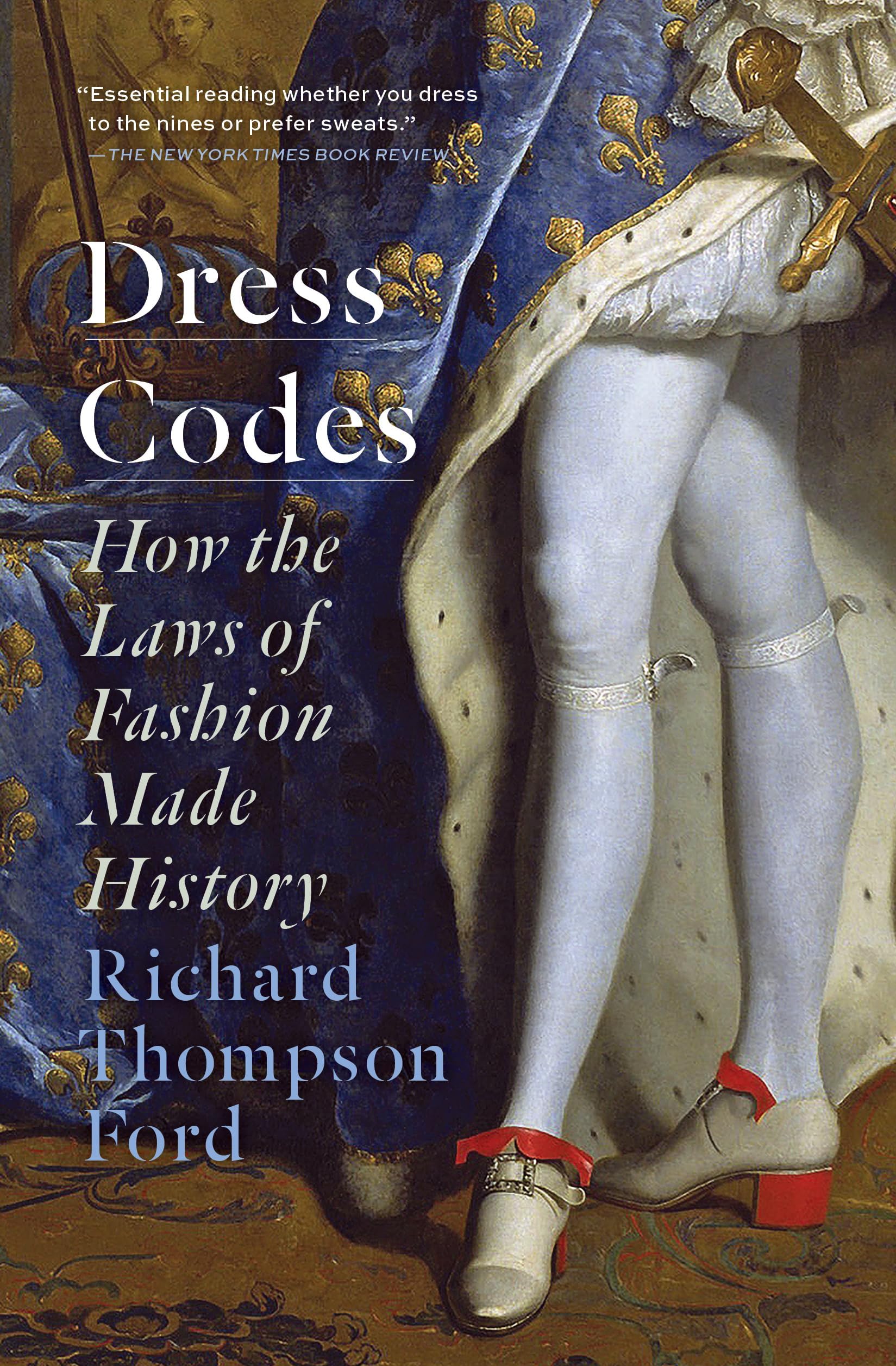
Dress Codes: How the Laws of Fashion Made History
Product ID: 333096523
Desertcart purchases this item on your behalf and handles shipping, customs, and support to Senegal.
A “sharp and entertaining” ( The Wall Street Journal ) exploration of fashion through the ages that asks what our clothing reveals about ourselves and our society. Dress codes are as old as clothing itself. For centuries, clothing has been a wearable status symbol; fashion, a weapon in struggles for social change; and dress codes, a way to maintain political control. Merchants dressing like princes and butchers’ wives wearing gem-encrusted crowns were public enemies in medieval societies structured by social hierarchy and defined by spectacle. In Tudor England, silk, velvet, and fur were reserved for the nobility, and ballooning pants called “trunk hose” could be considered a menace to good order. The Renaissance-era Florentine patriarch Cosimo de Medici captured the power of fashion and dress codes when he remarked, “One can make a gentleman from two yards of red cloth.” Dress codes evolved along with the social and political ideals of the day, but they always reflected struggles for power and status. In the 1700s, South Carolina’s “Negro Act” made it illegal for Black people to dress “above their condition.” In the 1920s, the bobbed hair and form-fitting dresses worn by free-spirited flappers were banned in workplaces throughout the United States, and in the 1940s, the baggy zoot suits favored by Black and Latino men caused riots in cities from coast to coast. Even in today’s more informal world, dress codes still determine what we wear, when we wear it—and what our clothing means. People lose their jobs for wearing braided hair, long fingernails, large earrings, beards, and tattoos or refusing to wear a suit and tie or make-up and high heels. In some cities, wearing sagging pants is a crime. And even when there are no written rules, implicit dress codes still influence opportunities and social mobility. Silicon Valley CEOs wear t-shirts and flip-flops, setting the tone for an entire industry: women wearing fashionable dresses or high heels face ridicule in the tech world, and some venture capitalists refuse to invest in any company run by someone wearing a suit. In Dress Codes , law professor and cultural critic Richard Thompson Ford presents a “deeply informative and entertaining” ( The New York Times Book Review ) history of the laws of fashion from the middle ages to the present day, a walk down history’s red carpet to uncover and examine the canons, mores, and customs of clothing—rules that we often take for granted. After reading Dress Codes , you’ll never think of fashion as superficial again—and getting dressed will never be the same. Review: Completely Engaging. - Being a student of history and fashion (I sew) this was of great interest to me. I fond it engaging, thought provoking, and just entertaining. I read mostly nunfiction, this one is a keeper. I would love to have a coffee and chat with the auther of this book. Review: Well-researched, very interesting, very well thought-out! - Top read! I really appreciate how much time and research went into this. I ended up looking up the word "sartorial" pretty quickly because it is used a bunch. :) A very, very interesting read. I learned a lot that I didn't know, about menswear especially. I particularly appreciated the author's ability to put words to a lot of social subtleties regarding norms of clothing and dress that are difficult to verbalize or even realize consciously at times. This really helped me clarify some of my own thoughts about clothing and social expectations. I would love to see more books like this, since the nuances of clothing and people's responses to it is such a broad topic, and a more important one than most people realize it is, as the author so articulately and convincingly observes. Excellent read!!
| Best Sellers Rank | #137,470 in Books ( See Top 100 in Books ) #55 in Design History & Criticism #71 in Customs & Traditions Social Sciences #74 in Fashion History |
| Customer Reviews | 4.5 out of 5 stars 355 Reviews |
K**N
Completely Engaging.
Being a student of history and fashion (I sew) this was of great interest to me. I fond it engaging, thought provoking, and just entertaining. I read mostly nunfiction, this one is a keeper. I would love to have a coffee and chat with the auther of this book.
A**N
Well-researched, very interesting, very well thought-out!
Top read! I really appreciate how much time and research went into this. I ended up looking up the word "sartorial" pretty quickly because it is used a bunch. :) A very, very interesting read. I learned a lot that I didn't know, about menswear especially. I particularly appreciated the author's ability to put words to a lot of social subtleties regarding norms of clothing and dress that are difficult to verbalize or even realize consciously at times. This really helped me clarify some of my own thoughts about clothing and social expectations. I would love to see more books like this, since the nuances of clothing and people's responses to it is such a broad topic, and a more important one than most people realize it is, as the author so articulately and convincingly observes. Excellent read!!
M**.
History, culture, and psychology all in one book.
I bought this book because, as a former fashion design professor, the topic naturally intrigued me. It is well researched, full of cultural and historical references, and offers great insights about why we dress the way we do. It is not a quick read because it feels a bit more like a textbook and reference guide, but it is well worth the time and I thoroughly enjoyed it.
M**O
Terrific!
This is an entertaining and thorough examination of dress, body, and hair throughout the centuries . the evolution seems logical but maybe not . it does make me wonder what comes next . what Will we all be wearing 50 years from now? what sort of hairdos? Thanks for this book Richard Ford.
S**T
Fun read on fashion!
This was a very interesting history of fashion and how it has shaped our society. I learned a lot about how fashion is used to control people and restrict what they can do. I also learned that fashion is freedom and how people truly express themselves. Definitely recommend this book for anyone interested in history and self-expression
D**K
Trustworthy
as advertised. quick and in good condition
J**K
Very few pictures
I purchased for hubby who was in the clothing business. I thought there would be more pictures. It was almost entirely text. Back it went.
J**B
Really entertaining, with a very slight caveat
I've just started this book and already know I'll finish it quickly. It's smart, insightful, and Richard's language is easy and engaging. My one caveat is that I have already run into four parenthetical phrases that read: (Insert, Image #__). The phrases are in bold and seem to suggest a draft that called for images that were never placed in the text but appear instead in separate collections of color plates. Again, an incredibly small issue and I blame the folks at Simon & Schuster for letting this mixup get to print. Richard's excellent book deserved a better proofreader.
A**R
The power of clothing in a book
I really enjoyed this book it talked about the power of clothing throughout history on a polical, economial and social level.
W**S
A must read
An extremely well-written and researched book, although the author’s preconceived notions detract from it at times. “Well-dressed”? Who dictates what is well-dressed? Fashion companies often change what is “fashionable” with the aim of selling more clothes than people need with the resultant environmental damage. Why does a suit “project competence” and not surrender to the standards of some unknown entity? As I Veblen postulated,, suit jackets, blazers or whatever denoted in the past that you are not a laborer, i.e., earn more money than them and have a higher social standing. While this may no longer be the case, since such clothes have been affordable for many (unfortunately due to the sweat shops and labor camps producing them), Mr. Ford takes it for granted that suits denote “well-dressed.” As Mr. Ford correctly states, some fashions are started by individuals or groups wearing their own style. And he notes that the fashion industry only realizes this afterward and then starts marketing copies of this. I am reminded of the torn jeans that we wore in the 1960s as a protest against consumerism. Madison Avenue soon realized that there was a market for this and starting selling jeans with tears at prices higher than those without. Mr. Ford wrote that Zuckerberg worn a suit when testifying before Congress as a sign of respect. But it was much more than that. His wearing a suit reaffirmed the feeling in those questioning him that they wore the proper attire, their style was the right thing, that they were not just a bunch of fuddy-duddies. It was an antidote to their insecurity. Of course, this is not just limited to clothes; people often want others to like the same books, movies, vacation spots, etc. as they do to give them the feeling that they have the right tastes. Mr. Ford denotes considerable time discussing the hair styles of Black Americans, but there is no mention of that of White Americans. Why and how has short hair become the norm for men and not women in the USA? I also missed references to “colorism” in fashion. Spike Lee dealt with “colorism” among Black Americans in his film “School Daze”. East Asians often have the same kind of prejudice and consider pale while skin to be beautiful. Darker skin is associated with farmers, who work outside, and consequently are poorer. White Europeans and Americans have an opposite opinion, since a good tan means that you have time for outdoor activities and vacations. However, it is a great book that I highly recommend for anyone interested in wondering why we dress as we do and how fashion developed.
A**R
Fascinating but academic
This feels like a collection of MA thesis (thesises? theses?) put together. Not in itself a bad thing but means quite a lot of repetition (albeit from different angles) of the various laws and implications. It was what I wanted and I found it very useful.
C**E
Reseña de la calidad de la impresión
Llegó en el tiempo establecido, compré la versión en pasta blanda, la calidad de la impresión no es buena, las hojas se sienten de mala calidad y el lomo del libro se ve mal pegado.
Trustpilot
2 weeks ago
2 days ago