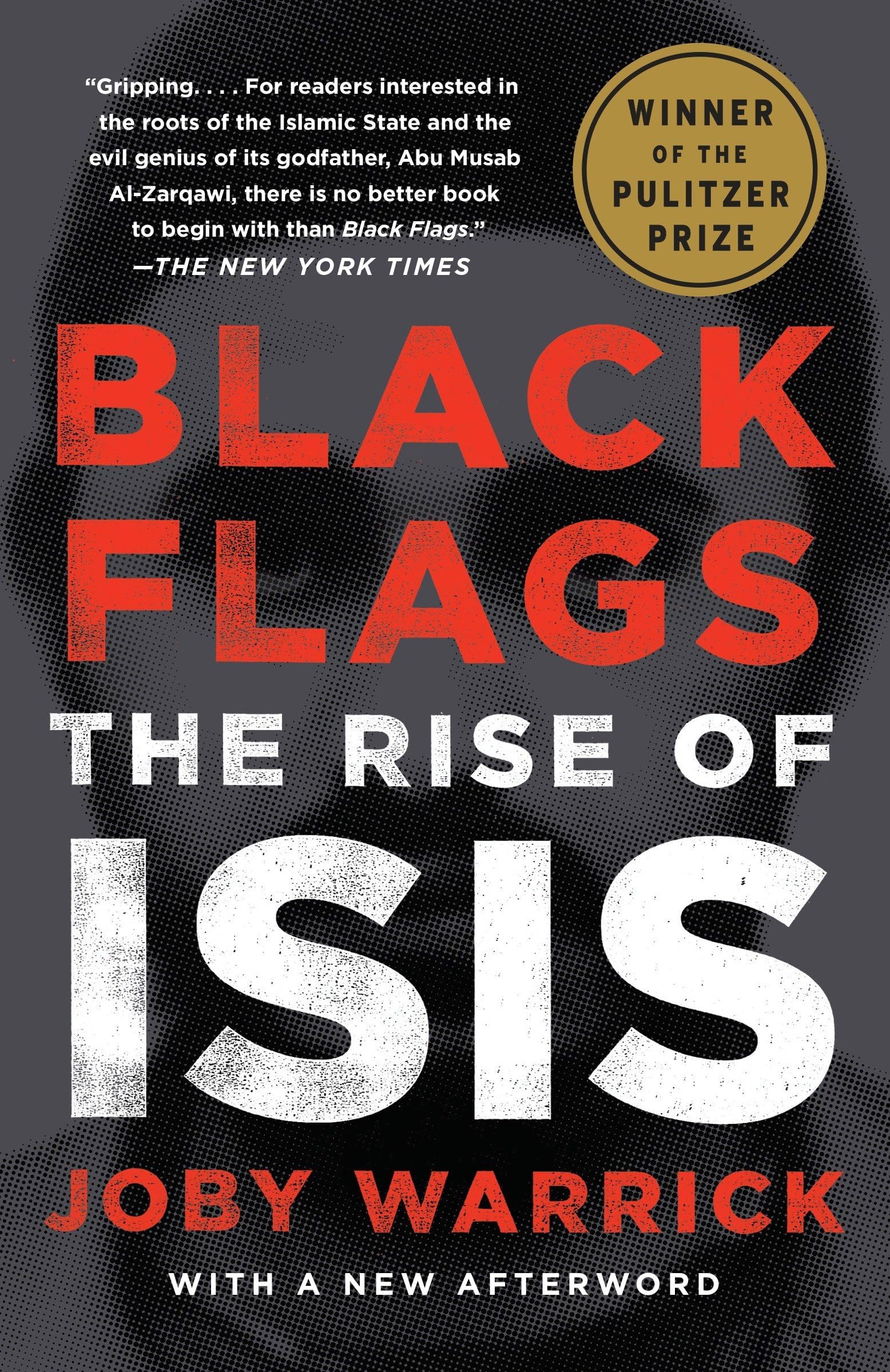
Black Flags (Pulitzer Prize Winner): The Rise of ISIS
Product ID: 32845914
Desertcart purchases this item on your behalf and handles shipping, customs, and support to Senegal.
WINNER OF THE PULITZER PRIZE • In a thrilling dramatic narrative, the award-winning reporter traces how the strain of militant Islam behind ISIS first arose in a remote Jordanian prison and spread with the unwitting aid of two American presidents. “Gripping. . . . For readers interested in the roots of the Islamic State and the evil genius of its godfather, there is no better book to begin with than Black Flags .” —Michiko Kakutani, The New York Times Drawing on unique high-level access to CIA and Jordanian sources, Warrick weaves gripping, moment-by-moment operational details with the perspectives of diplomats and spies, generals and heads of state, many of whom foresaw a menace worse than al Qaeda and tried desperately to stop it. Black Flags is a brilliant and definitive history that reveals the long arc of today’s most dangerous extremist threat. Review: Black Flags is a must read for foreign policy buffs. - The Pulitzer Prize-winning author of The Triple Agent has written an in-depth investigative report on the rise of ISIS and how the United States and the Middle East came to where it is in Iraq, Syria, and neighboring states. He traces the rise of ISIS from Saddam Hussein to the Kings of Jordan, and to George W. Bush's manipulations to sell the Iraq War. Several interviews with former analysts and agents bring the story to life. The central character in the transformation of opposition to U.S. occupation of Iraq was Abu Musab al-Zarqawi, a Jordanian terrorist and founder of al-Qaeda in Iraq. The author traces Zarqawi from an uneducated street thug in Zarqa, Jordan, examines his acquaintances in prison, and describes his journey to becoming the world's preeminent terrorist. He brought the warfare of car bombs, individual explosive devices (IEDs), beheadings, and murder of those not adhering to his radical form of Sunni Islam. His actions were so extreme that even Osama bin Laden disavowed his organization. It was not until several years into the Iraq War that bin Laden accepted Zarqawi, although reluctantly, in a futile attempt to control him. Zarqawi's al-Qaeda in Iraq spawned several acolytes with views as extreme as Zarqawi. After Zarqawi was killed by a US airstrike in 2006, Abu Omar Al-Baghdadi took up the mantle and formed the Islamic State of Iraq. ISI spiritual leader, Abu Bakr Al-Baghdadi, followed after the first Al-Baghdadi's death in 2010 and eventually rose to power. He proclaimed himself caliph of the Islamic State in 2014. The book reads as one would expect from a noted journalist--chocked full of facts with little speculation. It is worthy of a Pulitzer and gives us information about our (disastrous - reviewer's opinion) intervention in Iraq about which two administrations have limited the information made available to the general public. The only complaint I have is that there were no interviews with members of Congress about why or why not they supported the invasion of Iraq. For any interested in foreign affairs, I highly recommend Black Flags. Review: An Important Book for This Dangerous World - This is a very pertinent book about the rise of the terrorist group that we most commonly call ISIS. Much of it focuses on two very important characters in this tragedy, Abu Musab al-Zarqawi (given name Ahmad Fadil al Khalayleh), the founder of al-Qaeda in Iraq, the forerunner to ISIS; and King Abdullah II, the fourth sovereign of the Hashemite Kingdom of Jordan. My treatment will be more on Zarqawi, but Abdullah is definitely the only “hero’ in this tale. Zarqawi was born in Jordan on October 30, 1966. His family was working class, his father a municipal worker and his mother a devoutly religious parent. As a young man Zarqawi was introduced to radical Islamists when he traveled to Afghanistan in 1989, weeks after the Soviets had withdrawn, but just in time to join the assault on the pro-Moscow Afghan government that was left to fend for itself. By the time he left Afghanistan in 1993, he was a combat veteran with a few years of battlefield experience. He had been steeped in the doctrine of militant Islam, learning at the feet of radical Afghan and Arab clerics who would later ally themselves with the Taliban or with Osama bin Laden. He firmly believed that the victory in Afghanistan was granted by God. When Zarqawi returned to Jordan he wanted to continue the jihad he had carried out in Afghanistan, but quickly ran afoul of the Jordanian secret service. He was jailed, and after some time was transferred to a notorious prison that had been recently reopened. He was accompanied by a number of other jihadist, most of whom were common street thugs. However, he was also housed with Abu Muhammad al-Maqdisi, a firebrand preacher who advanced an austere brand of Islam which he had invented. In his view, each Muslim bore a personal obligation to act when confronted with evidence of official heresy. It wasn’t enough for the faithful simply to denounce corrupt rulers. They were compelled by Allah to slaughter them. Maqdisi was the leader, and told the inmates what to think. But he was also a polite intellectual, not the right mix for controlling the hard men he encountered in prison. Maqdisi needed an enforcer. In Zarqawi, he found the perfect helper: a man with the distinction of being at once slavishly devoted and utterly ruthless. Maqdisi may control what the prisoners thought, but Zarqawi controlled everything else. The harsh conditions in the prison may have been meant to break the jihadists, but they instead cemented their devotion to their cause, to each other, and especially to Zarqawi. Although a tough, frightful individual, Zarqawi displayed great loyalty and kindness to his fellow prisoners. He was the man they would follow. Zarqawi seemed destined to a long imprisonment until the death of Jordan’s King Hussein in February of 1999. Surprisingly, the king had named his son, Abdullah, to ascend to the throne, even though it had long been assumed that the king’s brother, Hassan, would be his successor. Abdullah took power determined to continue the good works of his father. One of the first issues facing the young king was a long standing tradition dating back to Jordan’s founding whereby new kings were expected to declare a general amnesty in the country’s prisons, granting pardons to inmates convicted of non violent offenses or political crimes. This was a way to “clean the slate and score points with important constituencies, from the Islamists”, such as the Muslim Brotherhood, “***to powerful East Bank tribes.” Parliament was given the task of nominating release worthy prisoners and drafting the particulars of the amnesty. In the end, the list, now with more than twenty-five hundred names, was endorsed by Parliament and sent to the palace for the final approval. The king, then just six weeks into his new job and still picking his way through a three-dimensional minefield of legislative, tribal, and royal politics, faced a choice of either adopting the list or sending it back for weeks of additional debate. He signed it. Among the names was that of Zarqawi. Zarqawi needed to go where he could advance the radical causes that he had become inculcated with in Afghanistan and in prison. He thus returned to Afghanistan to link up with his prior mentor, Osama bin Laden. But, rather than being accepted, he was snubbed- he was probably too violent and too stubborn to be part of al-Qaeda. Indeed, while bin Laden had sought to liberate Muslim nations gradually from corrupting Western influences so they could someday unify as a single Islamic theocracy, or caliphate, Zarqawi, by contrast, insisted that he would create his caliphate immediately. Zarqawi also saw a future when not only would ancient Muslim lands be reclaimed, but he and his followers would also be the instigators of a final cataclysmic struggle ending in the destruction of the West’s great armies at a grand battle in northern Syria. But, rejected by bin Laden, where could Zarqawi find the environment for his revolution? The event following the attack of 9/11 provided the answer-Iraq. Secretary Powell’s speech to the UN linked Zarqawi and Saddam, saying that the dictator “harbored” Zarqawi, an associate of bin Laden. The CIA intelligence expert who had studied Zarqawi cringed at the statement, knowing that although there may be some technical element of truth- Zarqawi was hiding in a remote area of Iraq- there was no evidence that Saddam was aiding him in any way. Indeed, Saddam despised Islamists and had tortured and killed many. With Powell’s statement, he tried to link al-Qaeda to Iraq, but unwittingly transformed Zarqawi from an unknown jihadist to an international celebrity and the toast of the Islamist movement. In deciding to use the unsung Zarqawi as an excuse for launching a new front in the war against terrorism, the White House had managed to launch the career of one of the century’s great terrorists. We thus initially empowered Zarqawi and then, in the environment following the tragic invasion of Iraq, provided him with the turmoil necessary for his movement to thrive. Al-Quaeda in Iraq became a reality and a grave threat to American troops, and to any hope of peace in he region. The subsequent invasion of Iraq began a series of blunders that Zarqawi was able to exploit to the fullest. The Americans were in fact treated well immediately after the fall of Saddam. However, that warm welcome quickly cooled for at least two reasons. One was the failure of the US to anticipate the breakdown of civil authority that followed the invasion, This was a serious planning omission that caused a great deal or resentment in the Iraqi people as they watched the looting and plunder that followed the invasions. The second was an act of commission when the Bush administration decided to disband the Iraqi army and ban all Baath party members from positions of authority. Since anyone seeking a management job under Saddam was required to join the Baath party, excluding all such trained individuals from the new government essentially removed the pool of qualified applicants from any significant jobs, including those in the security agencies best equipped to preserve order. Disbanding the army essentially left thousands of disgruntled soldiers who were ripe for recruitment, many of whom rose to positions of leadership in Zarqawi’s army. As the author so aptly pointed out: “If Abu Musab al-Zarqawi could have dictated a U.S. strategy for Iraq that suited his own designs for building a terrorist network, he could hardly have come up with one that surpassed what the Americans themselves put in place over the spring and summer of 2003.” Zarqawi was able to inflame sectarian violence between Shiite and Sunni factions in Iraq and place the Americans in the midst of a three sided war. Zarqawi approached the insurgency in Iraq with ruthless intensity. Not being an Iraqi, he had no qualms about the country being essentially destroyed by violence. If fact, such turmoil was consistent with his objective to raze and tear down the country, leaving it too depleted to support the return of a secular country called Iraq. He countenanced and encouraged violence against other Muslims, especially Shiia’s. Meanwhile, the internal insurgency saw Shiias rising against the minority Sunnis who had long dominated under Saddam. Many Iraqis saw the foreign Islamists as preferable to the Americans, especially as the US soldiers became more and more disenchanted with their role, and, perhaps more significantly, after the debacle at Abu Ghraib. But Zarqawi would ultimately be a victim of his own bloodthirsty tactics. Killing other innocent Muslims is, for most Muslims, inconsistent with the Koran, regardless of whether they be Sunni or Shia. Nor could the destruction of Mosques be countenanced. However, Islam has no centralized religious hierarchy to settle theological disputes. Instead, Muftis, Sunni clerics of a certain rank, can issues religious edicts called fatwas, even though they may disagree wildly on the same topic. Thus, Zarqawi was able to enlist such clerics to justify his barbarity against other Muslims. To combat this heresy, King Abdullah brought together more than two hundred Islamic scholars, representing more than fifty countries, to gather in Jordan and craft an expansive statement declaring that it was impossible to “***declare as apostates any group of Muslims who believes in God.” The King then called on all moderates, of all religions, to speak out against the barbarity of the extremists. Despite such warnings, and the disenchantment of Muslims, Zarqawi continued this attacks, perhaps culminating, at least for Jordanians, in the bombing of a wedding party at the Raddison Hotel in Amman. Thereafter, the Jordanian secret police began to cooperate with the American special forces in gaining intelligence and conducting raids against terrorist cells in Iraq. One such bombing raid killed Zarqawi in June of 2006. But he left behind a dangerous legacy. Indeed, Zarqawi’s foreign-led terrorist network had morphed into something more insidious and homegrown, as scores of jihadists stood ready to take up his mantle. But these forces were not unchallenged at the time of and after Zarqawi’s death. The Muslim world had tired of the barbarity of Zarqawi’s tactics as videotaped suicide bombings and beheadings became more commonplace. More importantly, as described above, “fusion cells” comprised of US special forces, largely teams of Navy SEALS and Army DELTA Force, were becoming more and more successful in their pursuit of Islamist militants. Their tactics had been honed to a fine edge enabling small units of a half dozen commandos to carry out multiple raids on a single night. These operations worked on many levels. The accelerated tempo of the nightly operations kept the terrorists off balance, unable to coordinate or plan sophisticated attacks. The raids also produced torrents of fresh intelligence, including insights into the recruitment and training of suicide bombers. The US forces also discovered that, although the jihadists were skilled butchers, they were not good soldiers. By the end of 2008 Zarqawi’s old organization was significantly weakened. By then it had transformed into the Islamic State of Iraq, and would ultimately be what we now know as ISIS. The first leader was one Abu Omar al-Baghdadi, who headed the organization form 2006-2010. His successor was Abu Bakr al-Baghdadi. This second Baghdadi had the same soaring ambitions as Zaqawi, foreseeing a caliphate stretching through much of Syria and Iraq, and envisioning the apocalyptic defeat of the West in a grand battle in northern Syria. However, in late 2011 his boasts were as empty as the group’s coffers. The Islamic State of Iraq lacked resources, fighters, and sanctuary. And, perhaps most critically, it lacked a cause—a single big idea with which it could rally its depleted forces and draw other Muslims into the fold. As Zarqawi found a fertile ground for his jihad in war torn Iraq, Baghdadi would find a similar environment in the ascending turmoil in Syria. The much heralded “Arab Spring” had spread from Tunisia to Egypt and threatened other parts of the Middle East and beyond. It first appeared as if Syria, led by Bashar al-Assad, might escape its reach. The country’s economic and political elite was solidly behind the ruling family, and the government’s officially secularist policies and brutal secret police kept ethnic and sectarian tensions bottled up. But as tensions rose elsewhere, they finally spread to Syria. By March of 2011 protests sprung up in many cities throughout the country. They seemed genuinely peaceful at the start, but Assad, contrary to what he viewed as failed attempts at appeasement in other countries, decided not to accommodate the protester’s demands for political and economic reforms. He would instead try to “***bludgeon, gas, and shoot his way out of the crisis.” Similar protests had arisen in Jordan, but King Abdullah quickly instituted reforms that quelled the uprising. Seeing the danger with the pending violence in his Syrian neighbor, and the threat to both his country and the entire Middle East, Abdullah tried to convince Assad to consider similar actions, but to no avail. Assad would fight on. Throughout 2011 the US refrained from intervening in the conflict, not only because of the limited options, but also because the conventional wisdom predicted Assad’s impending fall. Attempting to gain support against the opposition, Assad painted them as terrorists. This was initially not true, but, by early 2012, became more credible as Baghdadi and ISIS flowed into Syria to oppose Assad. Its goal was not to save Syria, but to rekindle the ambition for a new Caliphate in the region. Now there was a credible force aligned against Assad. Baghdadi had fighters, and now money came flowing into his coffers from wealthy Sunni Arabs and governments who saw a chance to dethrone the Shia regime of Assad. But Assad also had powerful allies in Iran and Russia, as well as Hezbollah fighters. The stage was set for the bloody stalemate that has devastated the country. As the conflict wore on, there were more calls for intervention by the US, including requests from Abdullah of Jordan. However, President Obama continued to be wary of being drawn into another Middle Eastern war, an attitude held by most of Congress and the electorate. The threat from ISIS became more telling as it made significant gains in IRAQ in 2014. In the late spring, the troops of the Islamic State surged across western Iraq and into the consciousness of millions of people around the world. Moving with remarkable speed, ISIS vanquished four Iraqi army divisions, overran at least a half-dozen military installations, including western Iraq’s largest, and seized control of nearly a third of Iraq’s territory. These rather recent events are fresh in many memories, especially as we saw the Iraqi army, trained and equipped by the United States, swiftly defeated by what seemed a rather comparatively ill-equipped and trained adversary. ISIS’s capture of Mosul, Iraq’s second largest city, was especially troublesome, as a small rebel column of reportedly 1500 men quickly defeated an Iraqi force estimated at 25,000. But the author points out that the Iraqi forces were actually much smaller, perhaps no more than 10,000, and terribly ill equipped. The loss of men was largely due to desertion, and most of the heavy arms and equipment had been moved back to defend the threats to Baghdad. ISIS quickly took the city and with it, control of a great deal of resources. But there was another story behind these successes. The sectarian problems in Iraq had never been resolved after the withdrawal of the Americans. The Shias now in power were “settling scores” with the Sunni minority who had controlled the country under Saddam. This split was not only religious, but also tribal. The author points out that, not only in Iraq, but also throughout the region, tribalism is still a strong unifier, and thus also a divider. The Sunni tribes were especially resistant and opposed to the Shia government. Their cooperation with ISIS was a major factor in much of its success. Indeed, the author noted that “in the end, the movement’s greatest military success was less a statement of ISIS’s prowess than a reflection of the same deep divides that had roiled Iraq since the U.S. invasion in 2003.” But the tribes had no intention of being subjugated to the type of governance that ISIS envisioned. They saw the rebels’ gains as more temporary But ISIS, once entrenched, gained a great deal of traction. It’s expansionist ambitions continued, matched by its continued savagery that had already worn thin with most of the Muslim world. Continued attacks on Jordan steeled the resolve of the people and of Abdullah, who joined with the US and other allies in conducting bombing strikes against ISIS. During a raid a Jordanian pilot, a Sunni Muslim, was shot down and captured. In a horrific display of violence ISIS burned him alive as videos streamed their cruelty across the globe. This may well have been a momentous point in the conflict. The author notes that “ it was the death of the young pilot that sparked a change among ordinary Arabs. From Jordan’s cosmopolitan capital to the conservative Wahabi villages of Saudi Arabia came howls of condemnation and rage. The beheading of prisoners, brutal though it was, was specifically countenanced by the Koran and regularly practiced by the Saudi government as an official means of execution. But with the burning of a human being—and, in this case, a practicing Sunni Muslim—the Islamic State had broken an ancient taboo.” Whether this change of attitude signals a change in the turmoil is something that is far from clear. This book is an exhaustive, informative, and compelling work about a subject that occupies much of the public forum here and abroad. There are many facts revealed and questions raised and perhaps answered. I have always wondered what exactly ISIS wants, and if it can somehow be mollified. It’s goal as expressed by the author is the establishment of a caliphate and the ultimate defeat of Western forces in a grand battle in the lands now a part of Syria. This seems to lead one to the conclusion that, as has been said so often by the President and others, “ISIS must be destroyed”- not an easy task. Another question that I have asked is why Muslims are not more vocal in their opposition to ISIS, or do we not hear such news when they are. This book delves into the first by revealing the tribal and sectarian divides that underlie this entire region as perhaps lessening Arab protests. But she also reveals that the opposition by most Muslims, and particularly by Abdullah, is shown to be quite strident, at least in the author’s reporting. (Abdullah seems to be the only rational and thoughtful player on this stage of horrors.) Yet this is a story that is ignored by American media. We certainly hear of every bombing or other savage act– what not the condemnation by Muslim scholars? Another strong conclusion that one reaches from the book is that we do not, and can not fully understand the complex social, ethnic, religious, and tribal divides within the region. The author points out how such divides have been often exacerbated by a history of conquest by other Arabs, and, of course, by the Western colonialism that only ended after WWII. When one throws Israel into the mix, it only demonstrates how very complex the situation is. It also emphasizes the need for local remedies and the limits to the exercise of American power. In my opinion, we can do very little in the short term, and perhaps even less in the long term. The players in the region will have to resolve how they are going to live together, if they choose co-exist at all. All that we can do it make all possible efforts to protect our own country and people from a threat that, although small is scope, is real. ISIS is not, and could never be a force that could challenge us in a national sense, but, as we have seen, their brand of fanatic terrorism can inflict terrible individual carnage. The always present threat of apocalypse lies with possession of a nuclear weapon. God forbid!


| Best Sellers Rank | #38,093 in Books ( See Top 100 in Books ) #6 in Iraq History (Books) #13 in Terrorism (Books) #14 in Middle Eastern Politics |
| Customer Reviews | 4.6 out of 5 stars 4,475 Reviews |
S**1
Black Flags is a must read for foreign policy buffs.
The Pulitzer Prize-winning author of The Triple Agent has written an in-depth investigative report on the rise of ISIS and how the United States and the Middle East came to where it is in Iraq, Syria, and neighboring states. He traces the rise of ISIS from Saddam Hussein to the Kings of Jordan, and to George W. Bush's manipulations to sell the Iraq War. Several interviews with former analysts and agents bring the story to life. The central character in the transformation of opposition to U.S. occupation of Iraq was Abu Musab al-Zarqawi, a Jordanian terrorist and founder of al-Qaeda in Iraq. The author traces Zarqawi from an uneducated street thug in Zarqa, Jordan, examines his acquaintances in prison, and describes his journey to becoming the world's preeminent terrorist. He brought the warfare of car bombs, individual explosive devices (IEDs), beheadings, and murder of those not adhering to his radical form of Sunni Islam. His actions were so extreme that even Osama bin Laden disavowed his organization. It was not until several years into the Iraq War that bin Laden accepted Zarqawi, although reluctantly, in a futile attempt to control him. Zarqawi's al-Qaeda in Iraq spawned several acolytes with views as extreme as Zarqawi. After Zarqawi was killed by a US airstrike in 2006, Abu Omar Al-Baghdadi took up the mantle and formed the Islamic State of Iraq. ISI spiritual leader, Abu Bakr Al-Baghdadi, followed after the first Al-Baghdadi's death in 2010 and eventually rose to power. He proclaimed himself caliph of the Islamic State in 2014. The book reads as one would expect from a noted journalist--chocked full of facts with little speculation. It is worthy of a Pulitzer and gives us information about our (disastrous - reviewer's opinion) intervention in Iraq about which two administrations have limited the information made available to the general public. The only complaint I have is that there were no interviews with members of Congress about why or why not they supported the invasion of Iraq. For any interested in foreign affairs, I highly recommend Black Flags.
J**R
An Important Book for This Dangerous World
This is a very pertinent book about the rise of the terrorist group that we most commonly call ISIS. Much of it focuses on two very important characters in this tragedy, Abu Musab al-Zarqawi (given name Ahmad Fadil al Khalayleh), the founder of al-Qaeda in Iraq, the forerunner to ISIS; and King Abdullah II, the fourth sovereign of the Hashemite Kingdom of Jordan. My treatment will be more on Zarqawi, but Abdullah is definitely the only “hero’ in this tale. Zarqawi was born in Jordan on October 30, 1966. His family was working class, his father a municipal worker and his mother a devoutly religious parent. As a young man Zarqawi was introduced to radical Islamists when he traveled to Afghanistan in 1989, weeks after the Soviets had withdrawn, but just in time to join the assault on the pro-Moscow Afghan government that was left to fend for itself. By the time he left Afghanistan in 1993, he was a combat veteran with a few years of battlefield experience. He had been steeped in the doctrine of militant Islam, learning at the feet of radical Afghan and Arab clerics who would later ally themselves with the Taliban or with Osama bin Laden. He firmly believed that the victory in Afghanistan was granted by God. When Zarqawi returned to Jordan he wanted to continue the jihad he had carried out in Afghanistan, but quickly ran afoul of the Jordanian secret service. He was jailed, and after some time was transferred to a notorious prison that had been recently reopened. He was accompanied by a number of other jihadist, most of whom were common street thugs. However, he was also housed with Abu Muhammad al-Maqdisi, a firebrand preacher who advanced an austere brand of Islam which he had invented. In his view, each Muslim bore a personal obligation to act when confronted with evidence of official heresy. It wasn’t enough for the faithful simply to denounce corrupt rulers. They were compelled by Allah to slaughter them. Maqdisi was the leader, and told the inmates what to think. But he was also a polite intellectual, not the right mix for controlling the hard men he encountered in prison. Maqdisi needed an enforcer. In Zarqawi, he found the perfect helper: a man with the distinction of being at once slavishly devoted and utterly ruthless. Maqdisi may control what the prisoners thought, but Zarqawi controlled everything else. The harsh conditions in the prison may have been meant to break the jihadists, but they instead cemented their devotion to their cause, to each other, and especially to Zarqawi. Although a tough, frightful individual, Zarqawi displayed great loyalty and kindness to his fellow prisoners. He was the man they would follow. Zarqawi seemed destined to a long imprisonment until the death of Jordan’s King Hussein in February of 1999. Surprisingly, the king had named his son, Abdullah, to ascend to the throne, even though it had long been assumed that the king’s brother, Hassan, would be his successor. Abdullah took power determined to continue the good works of his father. One of the first issues facing the young king was a long standing tradition dating back to Jordan’s founding whereby new kings were expected to declare a general amnesty in the country’s prisons, granting pardons to inmates convicted of non violent offenses or political crimes. This was a way to “clean the slate and score points with important constituencies, from the Islamists”, such as the Muslim Brotherhood, “***to powerful East Bank tribes.” Parliament was given the task of nominating release worthy prisoners and drafting the particulars of the amnesty. In the end, the list, now with more than twenty-five hundred names, was endorsed by Parliament and sent to the palace for the final approval. The king, then just six weeks into his new job and still picking his way through a three-dimensional minefield of legislative, tribal, and royal politics, faced a choice of either adopting the list or sending it back for weeks of additional debate. He signed it. Among the names was that of Zarqawi. Zarqawi needed to go where he could advance the radical causes that he had become inculcated with in Afghanistan and in prison. He thus returned to Afghanistan to link up with his prior mentor, Osama bin Laden. But, rather than being accepted, he was snubbed- he was probably too violent and too stubborn to be part of al-Qaeda. Indeed, while bin Laden had sought to liberate Muslim nations gradually from corrupting Western influences so they could someday unify as a single Islamic theocracy, or caliphate, Zarqawi, by contrast, insisted that he would create his caliphate immediately. Zarqawi also saw a future when not only would ancient Muslim lands be reclaimed, but he and his followers would also be the instigators of a final cataclysmic struggle ending in the destruction of the West’s great armies at a grand battle in northern Syria. But, rejected by bin Laden, where could Zarqawi find the environment for his revolution? The event following the attack of 9/11 provided the answer-Iraq. Secretary Powell’s speech to the UN linked Zarqawi and Saddam, saying that the dictator “harbored” Zarqawi, an associate of bin Laden. The CIA intelligence expert who had studied Zarqawi cringed at the statement, knowing that although there may be some technical element of truth- Zarqawi was hiding in a remote area of Iraq- there was no evidence that Saddam was aiding him in any way. Indeed, Saddam despised Islamists and had tortured and killed many. With Powell’s statement, he tried to link al-Qaeda to Iraq, but unwittingly transformed Zarqawi from an unknown jihadist to an international celebrity and the toast of the Islamist movement. In deciding to use the unsung Zarqawi as an excuse for launching a new front in the war against terrorism, the White House had managed to launch the career of one of the century’s great terrorists. We thus initially empowered Zarqawi and then, in the environment following the tragic invasion of Iraq, provided him with the turmoil necessary for his movement to thrive. Al-Quaeda in Iraq became a reality and a grave threat to American troops, and to any hope of peace in he region. The subsequent invasion of Iraq began a series of blunders that Zarqawi was able to exploit to the fullest. The Americans were in fact treated well immediately after the fall of Saddam. However, that warm welcome quickly cooled for at least two reasons. One was the failure of the US to anticipate the breakdown of civil authority that followed the invasion, This was a serious planning omission that caused a great deal or resentment in the Iraqi people as they watched the looting and plunder that followed the invasions. The second was an act of commission when the Bush administration decided to disband the Iraqi army and ban all Baath party members from positions of authority. Since anyone seeking a management job under Saddam was required to join the Baath party, excluding all such trained individuals from the new government essentially removed the pool of qualified applicants from any significant jobs, including those in the security agencies best equipped to preserve order. Disbanding the army essentially left thousands of disgruntled soldiers who were ripe for recruitment, many of whom rose to positions of leadership in Zarqawi’s army. As the author so aptly pointed out: “If Abu Musab al-Zarqawi could have dictated a U.S. strategy for Iraq that suited his own designs for building a terrorist network, he could hardly have come up with one that surpassed what the Americans themselves put in place over the spring and summer of 2003.” Zarqawi was able to inflame sectarian violence between Shiite and Sunni factions in Iraq and place the Americans in the midst of a three sided war. Zarqawi approached the insurgency in Iraq with ruthless intensity. Not being an Iraqi, he had no qualms about the country being essentially destroyed by violence. If fact, such turmoil was consistent with his objective to raze and tear down the country, leaving it too depleted to support the return of a secular country called Iraq. He countenanced and encouraged violence against other Muslims, especially Shiia’s. Meanwhile, the internal insurgency saw Shiias rising against the minority Sunnis who had long dominated under Saddam. Many Iraqis saw the foreign Islamists as preferable to the Americans, especially as the US soldiers became more and more disenchanted with their role, and, perhaps more significantly, after the debacle at Abu Ghraib. But Zarqawi would ultimately be a victim of his own bloodthirsty tactics. Killing other innocent Muslims is, for most Muslims, inconsistent with the Koran, regardless of whether they be Sunni or Shia. Nor could the destruction of Mosques be countenanced. However, Islam has no centralized religious hierarchy to settle theological disputes. Instead, Muftis, Sunni clerics of a certain rank, can issues religious edicts called fatwas, even though they may disagree wildly on the same topic. Thus, Zarqawi was able to enlist such clerics to justify his barbarity against other Muslims. To combat this heresy, King Abdullah brought together more than two hundred Islamic scholars, representing more than fifty countries, to gather in Jordan and craft an expansive statement declaring that it was impossible to “***declare as apostates any group of Muslims who believes in God.” The King then called on all moderates, of all religions, to speak out against the barbarity of the extremists. Despite such warnings, and the disenchantment of Muslims, Zarqawi continued this attacks, perhaps culminating, at least for Jordanians, in the bombing of a wedding party at the Raddison Hotel in Amman. Thereafter, the Jordanian secret police began to cooperate with the American special forces in gaining intelligence and conducting raids against terrorist cells in Iraq. One such bombing raid killed Zarqawi in June of 2006. But he left behind a dangerous legacy. Indeed, Zarqawi’s foreign-led terrorist network had morphed into something more insidious and homegrown, as scores of jihadists stood ready to take up his mantle. But these forces were not unchallenged at the time of and after Zarqawi’s death. The Muslim world had tired of the barbarity of Zarqawi’s tactics as videotaped suicide bombings and beheadings became more commonplace. More importantly, as described above, “fusion cells” comprised of US special forces, largely teams of Navy SEALS and Army DELTA Force, were becoming more and more successful in their pursuit of Islamist militants. Their tactics had been honed to a fine edge enabling small units of a half dozen commandos to carry out multiple raids on a single night. These operations worked on many levels. The accelerated tempo of the nightly operations kept the terrorists off balance, unable to coordinate or plan sophisticated attacks. The raids also produced torrents of fresh intelligence, including insights into the recruitment and training of suicide bombers. The US forces also discovered that, although the jihadists were skilled butchers, they were not good soldiers. By the end of 2008 Zarqawi’s old organization was significantly weakened. By then it had transformed into the Islamic State of Iraq, and would ultimately be what we now know as ISIS. The first leader was one Abu Omar al-Baghdadi, who headed the organization form 2006-2010. His successor was Abu Bakr al-Baghdadi. This second Baghdadi had the same soaring ambitions as Zaqawi, foreseeing a caliphate stretching through much of Syria and Iraq, and envisioning the apocalyptic defeat of the West in a grand battle in northern Syria. However, in late 2011 his boasts were as empty as the group’s coffers. The Islamic State of Iraq lacked resources, fighters, and sanctuary. And, perhaps most critically, it lacked a cause—a single big idea with which it could rally its depleted forces and draw other Muslims into the fold. As Zarqawi found a fertile ground for his jihad in war torn Iraq, Baghdadi would find a similar environment in the ascending turmoil in Syria. The much heralded “Arab Spring” had spread from Tunisia to Egypt and threatened other parts of the Middle East and beyond. It first appeared as if Syria, led by Bashar al-Assad, might escape its reach. The country’s economic and political elite was solidly behind the ruling family, and the government’s officially secularist policies and brutal secret police kept ethnic and sectarian tensions bottled up. But as tensions rose elsewhere, they finally spread to Syria. By March of 2011 protests sprung up in many cities throughout the country. They seemed genuinely peaceful at the start, but Assad, contrary to what he viewed as failed attempts at appeasement in other countries, decided not to accommodate the protester’s demands for political and economic reforms. He would instead try to “***bludgeon, gas, and shoot his way out of the crisis.” Similar protests had arisen in Jordan, but King Abdullah quickly instituted reforms that quelled the uprising. Seeing the danger with the pending violence in his Syrian neighbor, and the threat to both his country and the entire Middle East, Abdullah tried to convince Assad to consider similar actions, but to no avail. Assad would fight on. Throughout 2011 the US refrained from intervening in the conflict, not only because of the limited options, but also because the conventional wisdom predicted Assad’s impending fall. Attempting to gain support against the opposition, Assad painted them as terrorists. This was initially not true, but, by early 2012, became more credible as Baghdadi and ISIS flowed into Syria to oppose Assad. Its goal was not to save Syria, but to rekindle the ambition for a new Caliphate in the region. Now there was a credible force aligned against Assad. Baghdadi had fighters, and now money came flowing into his coffers from wealthy Sunni Arabs and governments who saw a chance to dethrone the Shia regime of Assad. But Assad also had powerful allies in Iran and Russia, as well as Hezbollah fighters. The stage was set for the bloody stalemate that has devastated the country. As the conflict wore on, there were more calls for intervention by the US, including requests from Abdullah of Jordan. However, President Obama continued to be wary of being drawn into another Middle Eastern war, an attitude held by most of Congress and the electorate. The threat from ISIS became more telling as it made significant gains in IRAQ in 2014. In the late spring, the troops of the Islamic State surged across western Iraq and into the consciousness of millions of people around the world. Moving with remarkable speed, ISIS vanquished four Iraqi army divisions, overran at least a half-dozen military installations, including western Iraq’s largest, and seized control of nearly a third of Iraq’s territory. These rather recent events are fresh in many memories, especially as we saw the Iraqi army, trained and equipped by the United States, swiftly defeated by what seemed a rather comparatively ill-equipped and trained adversary. ISIS’s capture of Mosul, Iraq’s second largest city, was especially troublesome, as a small rebel column of reportedly 1500 men quickly defeated an Iraqi force estimated at 25,000. But the author points out that the Iraqi forces were actually much smaller, perhaps no more than 10,000, and terribly ill equipped. The loss of men was largely due to desertion, and most of the heavy arms and equipment had been moved back to defend the threats to Baghdad. ISIS quickly took the city and with it, control of a great deal of resources. But there was another story behind these successes. The sectarian problems in Iraq had never been resolved after the withdrawal of the Americans. The Shias now in power were “settling scores” with the Sunni minority who had controlled the country under Saddam. This split was not only religious, but also tribal. The author points out that, not only in Iraq, but also throughout the region, tribalism is still a strong unifier, and thus also a divider. The Sunni tribes were especially resistant and opposed to the Shia government. Their cooperation with ISIS was a major factor in much of its success. Indeed, the author noted that “in the end, the movement’s greatest military success was less a statement of ISIS’s prowess than a reflection of the same deep divides that had roiled Iraq since the U.S. invasion in 2003.” But the tribes had no intention of being subjugated to the type of governance that ISIS envisioned. They saw the rebels’ gains as more temporary But ISIS, once entrenched, gained a great deal of traction. It’s expansionist ambitions continued, matched by its continued savagery that had already worn thin with most of the Muslim world. Continued attacks on Jordan steeled the resolve of the people and of Abdullah, who joined with the US and other allies in conducting bombing strikes against ISIS. During a raid a Jordanian pilot, a Sunni Muslim, was shot down and captured. In a horrific display of violence ISIS burned him alive as videos streamed their cruelty across the globe. This may well have been a momentous point in the conflict. The author notes that “ it was the death of the young pilot that sparked a change among ordinary Arabs. From Jordan’s cosmopolitan capital to the conservative Wahabi villages of Saudi Arabia came howls of condemnation and rage. The beheading of prisoners, brutal though it was, was specifically countenanced by the Koran and regularly practiced by the Saudi government as an official means of execution. But with the burning of a human being—and, in this case, a practicing Sunni Muslim—the Islamic State had broken an ancient taboo.” Whether this change of attitude signals a change in the turmoil is something that is far from clear. This book is an exhaustive, informative, and compelling work about a subject that occupies much of the public forum here and abroad. There are many facts revealed and questions raised and perhaps answered. I have always wondered what exactly ISIS wants, and if it can somehow be mollified. It’s goal as expressed by the author is the establishment of a caliphate and the ultimate defeat of Western forces in a grand battle in the lands now a part of Syria. This seems to lead one to the conclusion that, as has been said so often by the President and others, “ISIS must be destroyed”- not an easy task. Another question that I have asked is why Muslims are not more vocal in their opposition to ISIS, or do we not hear such news when they are. This book delves into the first by revealing the tribal and sectarian divides that underlie this entire region as perhaps lessening Arab protests. But she also reveals that the opposition by most Muslims, and particularly by Abdullah, is shown to be quite strident, at least in the author’s reporting. (Abdullah seems to be the only rational and thoughtful player on this stage of horrors.) Yet this is a story that is ignored by American media. We certainly hear of every bombing or other savage act– what not the condemnation by Muslim scholars? Another strong conclusion that one reaches from the book is that we do not, and can not fully understand the complex social, ethnic, religious, and tribal divides within the region. The author points out how such divides have been often exacerbated by a history of conquest by other Arabs, and, of course, by the Western colonialism that only ended after WWII. When one throws Israel into the mix, it only demonstrates how very complex the situation is. It also emphasizes the need for local remedies and the limits to the exercise of American power. In my opinion, we can do very little in the short term, and perhaps even less in the long term. The players in the region will have to resolve how they are going to live together, if they choose co-exist at all. All that we can do it make all possible efforts to protect our own country and people from a threat that, although small is scope, is real. ISIS is not, and could never be a force that could challenge us in a national sense, but, as we have seen, their brand of fanatic terrorism can inflict terrible individual carnage. The always present threat of apocalypse lies with possession of a nuclear weapon. God forbid!
R**D
A Fast and Furious History Lesson
So far there are two really superb books on the rise of the ISIS menace. One is Will McCants's ISIS Apocalypse (reviewed by me a couple of months ago. See "Apocalypse Now" in the reader reviews for that fine work.) Black Flags--The Rise of ISIS by Jody Warrick is the other. Surely there will be a third great book detailing the American-supported effort to crush these vermin, but that story has not been told because it has not yet occurred. But mark my words--it will. Warrick's narrative arc begins in Jordan, and centers on the prison where terrorists and suspects are held. The lead characters are Jihadist activists who will go on to play pivotal roles in Iraq and Syria, the redoubtable (if reluctant) King Abdullah II, and the principal figures of the Jordanian intelligence service. Cruel but not sadistic, hard-nosed but still human, dogged but not dogmatic, it is the Jordanian intelligence officials who come across as some of the real heroes of the piece. Warrick's access to them is a true journalistic tour de force. The main Jihadist character is Abu Musad al-Zarqawi, leader of something of a break-away faction of Al Qaeda in Iraq and founder of ISIS. A true religious fanatic (there is simply no other word for him), Zarqawi traveled to Afghanistan to fight the infidel Americans and curry favor with Osama Bin Laden. Although his battlefield exploits showed extraordinary courage, Bin Laden and his cohorts disliked and distrusted him and kept him at a far remove. As the Taliban strongholds were wrested free by the Americans, Zarqawi retreated to a lawless enclave of Iraq not controlled by Saddam Hussein's government, From that inauspicious backwater in 2002 Zarqawi put together the skeleton of a Jihadist militia that would ultimately lead the insurgency against the Americans in Iraq. With unprecedented access to primary sources, Warrick has been able to produce a detailed profile of Zarqawi's rise to power--his character, his murderous message, and why that message fell on such receptive ears. (Spoiler alert: It had a lot to do with American missteps in the occupation, but such missteps occurred in a context that was hardly America's making. Underlying the insurgency, and the subsequent rise of ISIS, is the 1000-year-old Sunni-Shiite sectarian conflict. The Iraqi Shi'ites, long suppressed by the majority Sunnis, were only too thrilled to settle ancient scores. That's what they were in the midst of doing when Zarqawi's group essentially rallied them under the banner of "Kill every Shia you can find." Ultimately Zarqawi would die in his "safe house" when it was hit by American 500-pounders. But the bones of his Jihadist organization and its revolting ideology would survive. The best analysis of his successor, Abu Bakr Al-Baghdadi (the self-styled Caliph) is found in McCants's ISIS Apocalypse, mentioned above.) In a delicious irony, Zarqawi's ragtag bunch of AK-toting thugs was under the watchful eye of a CIA team that had smuggled themselves into Iraq to get a handle on Saddam's military and its possible links to radical Islamists back in 2002. It was soon obvious that the only only thing that Saddam and the Islamists shared was mutual hatred. (Indeed, Charles "Sam" Fadis, the 47-year-old leader of the CIA team of soldier-spies, realized that a team of under cover Iraqi military men camped nearby were doing the same as he was--spying on the militants to assess how much of a threat they were.) For six months Fadis begged and pleaded with his superiors for a strike that would have wiped out Zerqawi's whole troop, then numbering just a few hundred at most. In irony bordering on paradox, his requests were turned down. Initially, Stan McCrystal at the Pentagon proposed a large, complex strike (which Rumsfeld, to his credit, supported), but which Condoleza Rice opposed on political grounds and others felt was just too complex. Fadis proposed a variety of simpler approaches (any one of which could have been decisive), but these too were turned down. The last turn-down came in January 2003. Among the arguments against an assault at this point was that the decision to invade Iraq had been made, but the public rationale had not been. In that a main pillar of the argument was that Saddam was supporting Islamic terrorists (the reality was just the opposite), it would ruin our argument for invading Iraq if the terrorists were eliminated in a pre-emptive strike before the war began. In other words, having terrorists in Iraq was just too good a pretext for an invasion to let it go to waste by actually solving that problem before it got out of hand, the rationale being that since we were invading anyway, we could wipe them out more publicly once we got there. What the White House war planners failed to appreciate, of course, was that these guys did not have their feet nailed to the sand, and were free to disband and relocate once the invasion occurred. That is what they did, and in the chaos that ensued from our abject failure to plan for post-invasion government, they were well-entrenched in urban areas before we knew they'd left the countryside. Many tens of thousands of lives were lost in consequence, and the ISIS threat emerged from the ruins. It would be too cynical to suggest that everyone in the White House knew that there was no link between Saddam and the Islamo-terrorists. Some did, but some didn't, and the loudest voice of denial came from Dick Cheney (misadvised by the equally misguided Douglas Feith). Dick Cheney's apparent faith in the veracity of this fictional linkage is almost a thing of beauty--if the consequences had not been so ugly and so vastly at variance with America's best interests. While Cheney plays a very small role in Warrick's narrative, and is never singled out for any kind of special criticism, it is hard not to see him as either a bullying imbecile or a pathological liar or both. (In truth, Cheney probably saw Saddam as unfinished business from his time as Secretary of Defense in the first Iraq War in 1991. He longed to finish that business, but there was no serious legal basis for starting another war. In that context, 9-11 came like a gift from the Almighty, providing a rare opportunity for an historic do-over. If, that is, Saddam was somehow instrumental in 9-11. Hence Cheney's pathological need to connect the dots, even when it was manifest that the dots were on completely different pages and written in different books. To the degree that Islamic extremists are a threat to Western values, Saddam's secularist regime was one of the better allies we could have had, but such was the prevailing arrogance and almost willful blindness, this practical political reality was rejected out of hand.) For Warrick there are definitely some heroes in this page-turning tale. One is Nada Bakos, the 20-something CIA analyst who made a specialty of profiling and tracking Zarqawi. How a farm girl from Montana (there were only nine boys and girls in her high school class) has the chops to sift thousands and thousands of pages of raw intelligence to limn an accurate picture of a major terrorist about whom no one else in the Agency had any inkling is something of an enduring mystery. But there it is, and it says something good about the CIA that it could still find and cultivate talent of that ilk. (Cheney tried unsuccessfully to bully her into silence, and was still badgering her to establish an Iraqi link to the terrorists of 9-11 two years after the invasion of Iraq!) In yet another irony of history's turning wheel, numbers of Baathist soldiers whom we stripped of all power and prestige after the invasion have now re-emerged among the ranks of ISIS, giving ISIS a level of military competence they never would have had if we had just left things alone.) Another hero (not dwelt on but certainly of serious note) is Gen Stan McCrystal, who led the Special Forces in Iraq. This was urban fighting at its toughest and dirtiest--house to house, room by room, usually in the dark of night. Maybe it was atonement for not coming up with a better plan to kill Zarqawi in 2002, but McCrystal led numbers of these urban attack squads personally.There aren't many in the Pentagon with such a valid claim to gallantry. President Bush does not come off that badly. While Rumsfeld is locked in denial that an insurgency is even occurring, Bush sadly realizes that everything has gone terribly, terribly wrong and does his level best to right the ship that he has inadvertently steered onto the rocks. President Obama comes off less well, hoping that diplomacy and some sort of mythical public pressure will force Assad of Syria from office without his having to commit American troops. Most particularly grievous was (and remains) the failure to arm the Free Syrian Army (the non-Islamist Sunni opponents of Assad) in a timely manner. Such an opportunity was presented, and rejected by Obama, in the summer of 2012. I thought Warrick was a bit one-sided in his argument in this section, failing (as he did) to mention that the President was locked in a tight re-election race at the time. In that getting our troops out of war in the Middle East was a central tenet of his campaign message (as it had been in 2008), it struck me as a tad unreasonable to expect the man to completely reverse himself in the middle of a campaign and fan the winds of war. The exigencies of politics aside, the President's continuing refusal to get involved a year later, in 2013, is something else again. The facts on the ground had changed, and seriously worsened, and by then he would have had enough political cover to change course and do something constructive (meaning destructive, where ISIS is concerned). Interestingly, among those arguing unsuccessfully for a more aggressive approach was Hillary Clinton. Consequently, I would surmise that no matter who wins the 2016 Presidential sweepstakes, U.S. forces will be taking a more active role in Syria in 2017. But I digress. The arc of Black Flags takes us back to Jordan where it began. And Warrick argues convincingly that that's where our key alliance must begin. That King Abdullah was in Washington in mid-January 2016 and did not get to meet with the President, signals to me that he is still substituting hope for experience, which may make the next President's job--and the lives of Syrians and Iraqis both--a lot tougher than they absolutely need to be. It will not be easy. It is not simply a matter of dropping a bunch of bombs and then walking away triumphant, as some simple minded souls seem to believe. The lesson of the Iraq fiasco is that once the bombs stop falling, you need to pick up the pieces: Restart the water and food supplies, provide at least basic medical care, get electricity and phones working, provide a police force that is at least reasonably honest, courts of justice, and prisons that aren't training grounds for the next generation of terrorists. We are talking about the work of years, not weeks or months. Obama doesn't think that the American people wish to bear that burden. For all I know, he's right. But we really ought to talk about it. In conclusion. Black Flags reads like a fast-paced novel: part spy thriller. part war story, part political intrigue. I really wish it were fiction, but it's not. It is the sad and tragic history of our immediate past and present, with insights into our future.
J**A
The best of several books reviewed on the rise of ISIS.
(I finished this book concurrently with other books examining Al Qaeda and the rise of ISIS in the Middle East and this review should be read in the context of the other books. A list of many of the books is at the bottom of this post.) This is the best of the books on the origins of ISIS. There are articles on Abu Bakr al-Baghdadi with more recent and useful information than this book, but it's hard to understand Baghdadi without understanding his forerunner Abu Musab al-Zarqawi, and this book tells Zarqawi's story well. There have been several long-form articles on ISIS and what is known of their leadership over the years, the one that maybe gives a synopsis of Baghdadi closest to this book is Graeme Wood's "What ISIS Really Wants" I highly recommend the interview with Nada Bakos by PBS Frontline. Also helpful are the sections of Gen. Stanley McChrystal's memoir on hunting Zarqawi, which I reviewed last year. What I liked about Warrick's perspective is that he begins and ends in Jordan and highlights the difficulties that the new King Abdullah faced when he assumed the Hashemite throne. Jordan maintains a rather secular society by housing an intelligence aparatus that is notorious for its methods but effective at stopping terrorists; King Hussein had survived 18 assassination attempts. Abdullah's initial amnesty to potential enemies included the pardoning of Abu Musab al-Zarqawi's associates. Zarqawi had been a high school dropout, a dissident who was harsh and never smiled but would become like a little boy when his mother was around. Zarqawi's parents signed him up for Islamic training after his rebellious youth, in which he perfomed many sadist acts including raping boys. His gang wanted to relive the glory days of Afghan jihad. By the time of Zarqawi's release from prison, he'd been both well-radicalized and interrogated/tortured many times. From Jordan, Zarqawi fled to Pakistan and Afghanistan, where he was initially snubbed by Osama bin Laden. After 9/11, Zarqawi goes mostly independently to Iraq to try and impress Al Qaeda by setting up a mini-Afghan training camp but kept his distance from Baghdad. Zarqawi's focus was on operations in the Levant rather than trying to strike the US. While the US would later claim Hussein was harboring Zarqawi, Saddam was scouting for intelligence on his operations just as the CIA was. Those operations included experimenting with poison gas, among other things. Colin Powell's speech at the UN mentioning Zarqawi gave him more publicity than he would have had otherwise; recruits flooded in and preparations were made to fight a prolongued struggle against the US and its allies. A CIA analyst that kept tabs on Zarqawi, Nada Bakos, fits an interesting profile. She grew up in the continental US and was hired right out of college with an economics degree; she applied for the CIA on a whim. She had no intelligence background but became an excellent analyst. Sam Faddis, analyst operating in northern Iraq (probably living among the ethnic Turkmen) scouts Zarqawi's activities and passes word that there are chemical operations, and a lot of terrorists, and the US should consider a strike on the camp. President Bush, however, turned down the idea of a strike before the US' deadline for Saddam to surrender. He doesn't want to look like he's striking before he said, or start the war before he said he would. Bakos maintains that the problem of ISIS could have been nipped in the bud then, but the US missed a golden opportunity and thousands of lives have been needlessly lost as a result. The author writes that King Abdullah hated Saddam Hussein but felt the American invasion was a grave mistake and would only lead to an outcome that would favor Al Qaeda and the other extremists. VP Dick Cheney, on the other hand, violated protocol by calling CIA agents individually to try and sway their analysis to show an Al Qaeda-Hussein link to help persuade Congress and the world that Iraq itself was a threat. Once the invasion ws on, Defense Secretary Rumsfeld and Cheney did not want to hear about an insurgency. The CIA warned that Zarqawi's network was growing and beginning an insurgency but it fell on deaf ears; this is remarkable since Zarqawi was listed as a reason for justifying the invasion in the first place. Many CIA officers actually lost their jobs. (Reading Left of Boom and other books about CIA incompetence and gross violation of US law makes me unsympathetic to the CIA on these points.) While the war spirals downward, Zarqawi writes a raving plea to Bin Laden to endorse his war, including the large-scale killing of Shia. Al Qaeda rejects the targeting of Shia and other Muslims who might turn against Zarqawi and Al Qaeda. Zarqawi uses his own suras and hadith passages to justify his suicide attacks and other measures. Some scholars furiously debated Zarqawi's positions. The author points out the apocalyptic beliefs about the mahdi and the caliphate that some hadiths indicate will be set up in Syria. Sunni Islam is often compared to Protestantism in Christianity-- there is no central authority which determines correct doctrine. Sunni imams can issue contradicting fatwas and rulings. But Al Qaeda was critical of Zarqawi's alienation of a majority population in Iraq and this led to conflict. Warrick chronicles the battle of Gen. Stan McChrystal and JSOC against Zarqawi, and the long road to Zarqawi's death. Task Force 626 works 18 hour days and ride a series of small victories toward their overall objective of capturing or killing Zarqawi. Meanwhile, Shiia reprisal militias also fight against Zarqawi-backed Sunni insurgents. Jordanian intelligence picks up a large plot to bomb a target in Jordan, but King Abdullah's concerns are only met with a rebuke from USVP Cheney. Throughout the book, Warrick weaves in a story about a would-be female suicide bomber in Jordan who came in from Iraq. Prior to the war, Zarqawi had succeeded in killing a USAID worker but had failed to do anything larger in Jordan. (Zarqawi's group succeeded in blowing up the Jordanian embassy in Baghdad in 2003.) The woman was arrested in 2005 after arriving at a hotel with her husband intent on blowing it up. Her husband's bomb worked and killed 60 people, while hers did not. The woman allegedly claimed she did not intend to kill innocents, had been duped in Iraq, and had never met Zarqawi. Her story is relevant because ISIS demanded her release in 2015, shortly after which she was executed. The February 2006 bombing of the Samarra mosque, which the US claimed was an Al Qaeda plot, prompted hundreds of reprisal killings which might mark the peak of the insurgency. The Jordanian government set up successful traps for Zarqawi soldiers. Task Force 626 was able to launch pre-emptive raids and finally succeeded in killing Zarqawi by aerial bomb in June. Nada Bakos had mixed feelings on his death. On the one hand, he was dead; on the other, the US had missed the earlier opportunity to eliminate him and now Zarqawi was a martyr with many disciples. Iraq might be pacified for a time, but disgruntled and fearful Sunni would take up arms again if they felt threatened and Zarqawi's network was still out there. Meanwhile, a parallel set of events was unfolding in Syria. Future Ambassador to Syria Robert Ford was stationed in Iraq from 2004-2006 where he witnessed US policy ramifications first-hand. Syria had been strongly opposed to the US-led war and its porous border with Iraq allowed a an easy way for fighters to come in easily and refugees to go out. Syria re-established formal diplomatic ties with Iraq in 2006 just as Ford was departing for a position in Algeria. The Syrian government would later be implicated in pro-Sunni attacks within Iraq. As a college student in the 1980s, Ford had spent time in Syria and enjoyed Syrian hospitality there, and President Obama appointed him US Ambassador in 2010. Warrick notes that King Abdullah in Jordan began to implement modest reforms to placate any nascent protest movement and encouraged Assad to do likewise. (PM Erdoğan of Turkey supposedly encouraged him likewise) On the eve of the Arab Spring, Ford had angered Syrian President Bashar al-Assad by lecturing him on human rights. During the early days of the protest movement, Ford visited Hama which was interpreted as a tacit backing by the US of a rebellion against Assad. Assad responded to protests with force and by releasing hundreds of Zarqawi-style extremists from prison in order to prove his point that there were indeed an extremist threat within Syria, and Ford was forced to leave in 2011. Pandora's box was now open as the Arab Spring freed many other extremists to operate across the Middle East and North Africa. The least-known character in the story is Abu Bakr al-Baghdadi, who would rise to a prominence Zarqawi would have envied by adopting many of his tactics. Warrick recounts what was known of Baghdadi at the time of authorship: He was 32 and working on his doctorate when the US invaded Iraq. He was released from an American-controlled prison because he came across as a scholarly figure and not seen as a threat; he got his doctorate in 2007. His time in prison with other jihadis allowed him to form a network and as Sunni felt threatened by an increasingly vengeful Shiia-led government, and events unfolded in Syria in the wake of the Arab Spring, there was a chaos that Baghdadi was able to tap into. Baghdadi's group attacked Iraqi prisons, freeing people they could immediately employ. While the CIA warned the White House that ISIS was headed toward Baghdad, everyone was surprised by the rapidity at which the larger US-equipped Iraqi army abandoned entire regions of the country to a few head-strong fighters. Warrick also tells the story of a Syrian-American lobbyist who looks for aid for the Free Syrian Army and the frustrations he experiences as Syria is torn apart. As the radical Al-Nusra Front forms to fight Assad, King Abdullah allegedly opposes Gulf state money going to arm them, forseeing a worsening of the problem. Warrick recounts the debate in the White House about arming the FSA and quotes from Leon Panetta and Hillary Clinton's memoirs (both of which I have reviewed here), which Obama would not back, especially during the 2012 election season. Mustafa had a hard time helping the Syrians, but his group are the ones who captured samples of Assad's chemical weapons attacks. Robert Ford resigns from the State Department in 2014 because he can no longer support US policy. Warrick's account ends as ISIS is in full control of the situation. While there are calls for introspective Islamic reform from Egypt's President Fattah al-Sisi, it remains to be seen if influential Muslims worldwide follow. I give this book 4.5 stars out of 5. Warrick does a great job telling the stories of those who saw the precursor to ISIS and understood best how it was formed. He also does a good job showing the perilous position of Jordan who has to live with the consequences. This is a very informative book, the best of four I have finished thus far on the origins ISIS. Warrick does not focus as much on the methods and operations of ISIS itself. -------- Al Qaeda and ISIS books reviewed in 2016: The Siege of Mecca - Yaroslav Trofimov (5 stars) The Bin Ladens - Steve Coll (4 stars) Growing Up Bin Laden - Najwa and Omar Bin Laden (4.5 stars) Guantanamo Diary - Mohamedou Ould Slahi (4.5 stars) The Black Banners - Ali Soufan (5 stars) Black Flags - The Rise of ISIS - Joby Warrick (4.5 stars) ISIS - Jessica Stern (4 stars) ISIS Exposed - Eric Stakelbeck (2.5 stars) The Rise of ISIS - Jay Sekulow (1 star)
C**J
Excellent Read - Just don't lose this book at the Airport
Excellent, detailed, and thorough break down of how things went from bad to worse. Great description of the characters and actions surrounding the rise of ISIS. Funny story about this book - I was on travel to a conference and lost this book at the airport. I thought that I'd left it at the security check point so I went back there to ask if they had found a book. The TSA employee asked me the name of the book...it is Black Flags - The Rise of ISIS. You should have seen the look he gave me! Well the book wasn't there and I realized that I left it at the ticket counter on the other side of security. I had the gate attendant call back to the ticket counter and ask if they found the book and they said yes they have a book on ISIS and they'll hold it for me...again the look I got from the gate attendant was priceless. So now she tells me that they don't have anyone available to bring it to the gate so if I want the book I have to go outside of security and get it myself and then go back through security again. So I do, I retrieve my ISIS book from the ticket counter...and get more priceless looks and make it back to the gate just in time to board. It was worth it. Great book!
R**L
Excellent, Easy-to-Read Work on the Origins of ISIS
After reading "Rise of ISIS: A Threat we Can Not Ignore", I was sorely disappointed to end up with hard-sell propaganda about Hamas instead of a scholarly work. "Black Flags", on the other hand, is a fantastic, easy-to-read narrative that actually focuses on the origins of ISIS for those of us interested in really understanding where the movement originated. Sure, you can see their recruiting techniques and activities any day on the news. This book is not heavily focused on that, but really what brought us to this moment: The collapse of post-Saddam Iraq, civil war in Syria, simmering ethnic and religious sect rivalries and two key figures who we get a first-hand look at through a prison doctor. Warrick is a good story-teller and it was easy to follow along with the facts and individuals who make up this story and really put together all of the factors at play on how ISIS has become so powerful, and to also really understand why we shouldn't simply label it is just another Al-Qaeda, Hezbollah, Hamas, etc...because the goal of this book is to tell you - it really isn't at all. What the book does not get into is every single detail about the war ISIS has unleashed against Iraq, Syria, the West and a number of other civil societies, but the author picks some good illustrations, such as the invasion of Ramadi and how it reflects the ISIS style of governance. As I said, this is really historic background and a relatively short book for those of us fascinated by the topic.
A**R
Phenomenal read
I have read a lot of books on the war on terror -- over 30+ books on anything related to this from 2001 to 2017. Simply put, this book does the best job of tying it all together and wrapping a bow on how ISIS came to be...sadly. This isn't an easy read as it is very in depth but the way the author has written it is masterful. It reads much like a story and almost as if he was there to be a part of it. The quality of the sources and those who were involved is impeccable. The author divides this book into 3 parts and shows how ISIS came to be. As I said before, I have read a lot about this subject and something you don't quite realize is the different factions and groups of terrorists. Unfortunately, our sensationalist and headline related media just lumps "terrorists" all together. This book explains al-Qaeda and its relation to Pakistan and transitions into how this relates to Zarqawi, the mastermind behind the rise of ISIS in Iqar and eventually Syria and beyond. It explains the relationship between Zarqawi and Bin Laden as well as their disciples. Another outstanding thing this book does is detail the issues in Syria and their leader. Again, our media does a horrific job of explaining why Syria is a very real problem and the author goes into great detail about how and why Syria became such a concern. Something else that I find very important with this book...he doesn't pull punches. Much of the rise of ISIS has to do with the US -- what I mean is, we had a very poor understanding of the group, what they stood for, and what they were trying to do. Our inaction allowed them to foster. While I staunchly support our troops, our government, and the USA, it is fair to say that we helped create an environment that allowed ISIS to flourish. This wasn't intentional but we just did a very poor job of ushering in new leadership and trying to understand the different religious groups. And then we left. Thank god for our troops and especially the special forces! One thing that I found very comforting is that just like our misunderstandings partially allowed this to happen, our in depth and detailed knowledge since, new leadership, and a whole new breed of warriors who intimately understand urban warfare will bring them down!
I**N
Best non-fiction book
Best non-fiction book I have read this year; narrative even more intriguing as the story is still unfolding. I was introduced to this book by Bill Gates - 5 Best books I have read 2017. Insightful, gripping and nuanced narrative on genesis of ISIS. As an American Muslim, in the beginning I was looking askance, but was not disappointed. John Warrick details how mistakes and missed opportunities led thugs and bandits to become the inexorable force today. Book has 2 parts focusing on 2 psychotic leaders of the ISIS insurgency - - Abu Musab Zarqawi in Iraq and Abu Bakr Baghdadi when ISIS expanded into Syria. Mistakes - --World's deadliest and psychotic terrorist--Abu Zarqawi-- walked free, mistakenly, through the gates of Jordanian prison as part of amnesty program. A regret that is still resounding by it's implication. King Hussein exhorted --"Why, didn't someone check ?" --Bush's unjustified Iraq war and disbandment of the Iraqi army, led to free flow of former Saddam's Bathist party soldiers and Al-Aqaeda operatives running a deadly and virulent organization. ISIS leaders tapped into this energy. --President Obama's feckless and pacifist early departure policy and refusal to provide material support to the ISIS rebels led to ISIS further forays into Syria. At the heart of the struggle is the age-old power struggle between Shia and Sunni and this balance was destroyed by Iraq war wheresoever majority became vindictive against the Saddam-favored Sunni government. To add to the mix, Basher Al-Assad, a western educated, moderate Muslim confounded many by forcefully standing up against the Arab spring rebels who were simply demanding better jobs, change of few government leaders and better educations. He should have listened to the protesters like Morocco and Jordan instead of forcefully controlling it by inhuman bombing. The only sound of reason in this chaos was King Abdullah he had the finger on the pulse. His impassioned pleas to President Bush not to invade Iraq or to Basher Al-Assad to meet the demands of the protesters fell on deaf ears. Warrick writing was very nuanced and balanced and several parts he highlights how ISIS's propaganda is against teachings of Islam; that Quran forbids suicide and killing of innocent people.
S**V
Riveting & educational
If you are confused about ISIS, ISIL, al Qaeda, bin Laden, Sunnis, Shiites etc., what it all means and how it’s all connected, this book gives a great insight into the history of the tale of woes from the Middle East.
J**D
and in this brilliantly written and thrilling narrative he traces the origins of ...
Names such as Abu-Musad al-Zarqawi, ISIS, al-Qaeda, Osama bin Laden, Abu Bakr al-Baghdadi and al-Nusra have become very familiar to anyone keeping abreast of world affairs. They are all players within the seemingly evermore turbulent and violent landscape of the Middle East. Yet, I suspect that very few of us understand the relationship between the various factions and key players of these Islamist groups, how they have come into being and what their distinctive ideologies are. Joby Warrick is a Pulitzer Prize winning, American journalist who is the national security reporter for The Washington Post, and in this brilliantly written and thrilling narrative he traces the origins of ISIS from the brutal activities of the sadistic Jordanian, al-Zarqawi who established Jama’at al-Tawhid wal-Jihad, the first incarnation of the ISIS we are so familiar with today. As well as describing the rise and spread of ISIS and the other militant groups, Warrick remorselessly reveals how western action, or often inaction, contributed to the flourishing of this vile regime. Reading it, as I did, very soon after the Chilcott report on the war in Iraq, was timely to say the least. Warrick’s research and inside knowledge is remarkable and expansive, but in no way does it make the account turgid. In fact, I had to keep reminding myself that this was a work of non-fiction and not an action-packed novel. It is, to use an old cliché, a page-turner, and, from the very first page, when he recounts the order for the execution for the female bomber involved in the carnage of Amman’s Raddison Hotel in 2006, I found it utterly compelling as a read. It has made me much more enlightened about the context of current affairs and I strongly and unreservedly commend this book to anyone who wants to get a better handle on these world-shaping events and people. Indeed, I would go so far as to describe it as indispensable.
M**I
Wow.
Best book ever about ISIS. An incredible journey!
A**A
Muy informativo
Muy bien escrito. Narra el ascenso de al-Zarqawi, precursor de un movimiento que se convertiría en la rama Iraquí de Al-Qaeda y que tras su muerte, y tras unos años de decadencia, acabaría convirtiéndose en Isis. Zarqawi es originario de Jordania, así que también se mezcla un poco con la historia de Jordania y trata con especial detalle los atentados del movimiento en ese país. Muy informativo, diría que bastante neutral y tras una lectura una obtiene una visión más objetiva de lo sucedido en la región.
M**H
Must Read
One of those books which you can read without taking any break. Some eye opening decisions by leaders of few countries which led to the rise of ISIS and created miseries in the Middle East. This is a must read book if one wants to understand what went wrong in Iraq & Syria.
Trustpilot
2 months ago
2 weeks ago