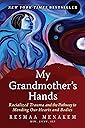
My Grandmother's Hands: Racialized Trauma and the Pathways to Mending Our Hearts and Bodies
Product ID: 296303576
Desertcart purchases this item on your behalf and handles shipping, customs, and support to Senegal.
The body is where our instincts reside and where we fight, flee or freeze and it endures the trauma inflicted by the ills that plague society. In this ground-breaking work, therapist, Menakem, examines the damage caused by racism in America from the perspective of body-centred psychology. He argues this destruction will continue until Americans learn to heal the generational anguish of white supremacy, which is deeply embedded in all American bodies. This collective agony doesn't just affect African Americans. White Americans suffer their own secondary trauma as well. So do blue Americans - the police. MY GRANDMOTHER'S HANDS is a call to action for everyone to recognise that racism is not about the head, but about the body and introduces an alternative view of what everyone can do to grow beyond this entrenched racialised divide. · Paves the way for a new, body-centred understanding of white supremacy - how it is literally in the blood and the nervous system. · Offers a step-by-step solution - a healing process - in addition to incisive social commentary. Review: Best read on trauma, body and race - Brilliant book on trauma, body and race Review: A must read for therapists and everyone else - As a psychologist who works primarily with individuals in marginalized communities, I see a lot of clients who have experienced historical, intergenerational, developmental and ongoing current trauma, often as a result of systems of oppression (racism, sexism, homophobia, transphobia, etc.). I was very excited to dive into training in somatic experiencing (SE), a "bottom up" approach to trauma treatment that recognizes the ways that traumatic experiences get stored in the body, and therefore need to be healed through the body. However, I was disappointed to find that most of the books on SE, as well as the trainings themselves, rarely if ever mention racism or other systems of oppression and the trauma they cause. This was such a disappointment to me, especially given that racial trauma is so prevalent in the everyday lives of my clients and perpetuated daily by the current political climate. Therefore I was thrilled to discover this book. Resmaa Menakem filled in the gap I was feeling in the SE literature, applying somatic experiencing to racial trauma and the ways that racism impacts the bodies of white people, black people (and all people of color), and those who are charged with "serving and protecting" us, the police. This book was a huge eye opener for me. Not only did it give me compassion for my own white body and the ways that trauma has been metabolized and passed on from white folks to POC through the mechanisms of white supremacy, but it gave me new and more embodied ways to understand the lives of people of color and work effectively with my POC clients. It also gave me new compassion for cops, who, through their own trauma responses and the effects of white supremacy, are now more like soldiers whose mission is to control and suppress black and brown bodies. Although I will continue to feel outrage and grief at every unnecessary police killing of an innocent man or woman of color, this book helped me to remember that we are all impacted by centuries of white supremacy conditioning and that cops need and deserve healing around racial trauma too. I highly recommend this book to therapists and healers, especially those who work with individuals in marginalized communities. Each chapter provides exercises to embody the learning in the chapter, so that healing is happening not just from the top down, but from the bottom up. There are exercises for individuals and groups, for white bodies, POC bodies and police bodies. The book is extremely timely and relevant and should be required reading for anyone wanting to understand more about the history and current conditions of racism in America, its impacts, and how to heal.

| Best Sellers Rank | #26,640 in Books ( See Top 100 in Books ) #20 in Emergency Medicine #41 in Post-Traumatic Stress #88 in Psychological Pathologies |
| Customer Reviews | 4.8 out of 5 stars 3,849 Reviews |
R**S
Best read on trauma, body and race
Brilliant book on trauma, body and race
S**E
A must read for therapists and everyone else
As a psychologist who works primarily with individuals in marginalized communities, I see a lot of clients who have experienced historical, intergenerational, developmental and ongoing current trauma, often as a result of systems of oppression (racism, sexism, homophobia, transphobia, etc.). I was very excited to dive into training in somatic experiencing (SE), a "bottom up" approach to trauma treatment that recognizes the ways that traumatic experiences get stored in the body, and therefore need to be healed through the body. However, I was disappointed to find that most of the books on SE, as well as the trainings themselves, rarely if ever mention racism or other systems of oppression and the trauma they cause. This was such a disappointment to me, especially given that racial trauma is so prevalent in the everyday lives of my clients and perpetuated daily by the current political climate. Therefore I was thrilled to discover this book. Resmaa Menakem filled in the gap I was feeling in the SE literature, applying somatic experiencing to racial trauma and the ways that racism impacts the bodies of white people, black people (and all people of color), and those who are charged with "serving and protecting" us, the police. This book was a huge eye opener for me. Not only did it give me compassion for my own white body and the ways that trauma has been metabolized and passed on from white folks to POC through the mechanisms of white supremacy, but it gave me new and more embodied ways to understand the lives of people of color and work effectively with my POC clients. It also gave me new compassion for cops, who, through their own trauma responses and the effects of white supremacy, are now more like soldiers whose mission is to control and suppress black and brown bodies. Although I will continue to feel outrage and grief at every unnecessary police killing of an innocent man or woman of color, this book helped me to remember that we are all impacted by centuries of white supremacy conditioning and that cops need and deserve healing around racial trauma too. I highly recommend this book to therapists and healers, especially those who work with individuals in marginalized communities. Each chapter provides exercises to embody the learning in the chapter, so that healing is happening not just from the top down, but from the bottom up. There are exercises for individuals and groups, for white bodies, POC bodies and police bodies. The book is extremely timely and relevant and should be required reading for anyone wanting to understand more about the history and current conditions of racism in America, its impacts, and how to heal.
K**Ï
Must read.
Very moving and touching book. It changed me, and made me see what I couldn't before, with grace, compassion and precision. A must read, especially for white folks.
K**.
Great book and too much American centred 😕
The idea of the book, the numerous exercises, references of historical facts, acknowledgments of the arms of bodies and stories are informative, emotional, and I enjoyed that. Unfortunately this book - which could have been more open to the bigger World - is American people centred, a bit too much in my opinion. As an European I had to translate each steps with my own situation and contexts of micro aggressions where I live. Thus I could not sink in it and unfortunately I did not manage to read till the end 🤷🏻♀️
G**D
An Amazingly Wise Book
Trauma, in fact, intergenerational trauma that has not been metabolized, is a recipe for racism. As a psychotherapist with over 50 years addressing trauma and the need for decolonization therapies that go far beyond what is customarily taught in universities, My Grandmother's Hands is the clearest guide I have come across to help suffering individuals "grow up" as Resma Menakem respectfully says. This is a profound, wise, brilliant, compassionate, and exceptionally insightful effort to confront our body's pain as well as that of our families, communities, and our American culture. When we grow as individuals we will also grow as communities -- what Martin Luther King Jr. referred to as "the beloved community."
Trustpilot
1 month ago
2 months ago