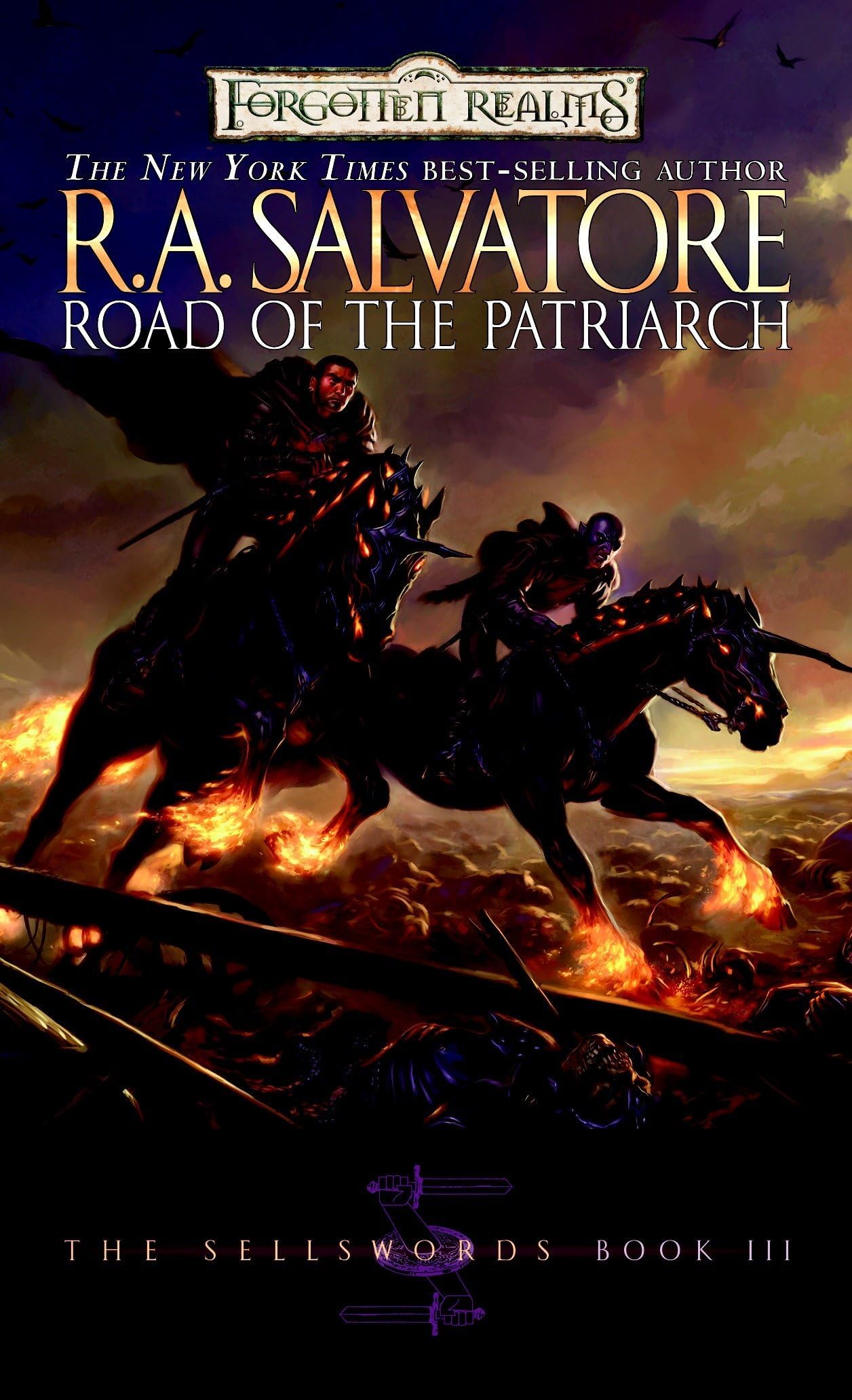
Road of the Patriarch
Product ID: 27223423
Desertcart purchases this item on your behalf and handles shipping, customs, and support to Senegal.
desertcart.com: Road of the Patriarch: 9780786942770: Salvatore, R.A.: Books Review: Salvatore explores the humanity of his antagonist, contrasted by the stereotypes of good and evil inherent in the AD&D game system. - Road of the Patriarch “flips the script” on the standard DnD story. It is a tale of a human assassin and a drow elf mercenary pitted against a “Lawful Good” adventuring Party at the peak of their narrative and powers. Artemis Entreri, the nemesis of Drizzt Do’Urden the drow ranger, and Jarlaxle Baenre (uncle of Drizzt) seek adventure in the Bloodstone Lands, a kingdom in which the major evils have been vanquished by cliché heroes which are emblematic of the AD&D character system. A Paladin King, an old crabbely Wizard whose name is similar to Merlin, a fat Friar, a Grandmaster of Flowers (highest level title a monk character can attain), etcetera. Up until this point the Drizzt novels had mostly the same antagonists, Entreri, the spider goddess matriarchy of Drizzt’s Homeland, and some sentient artifacts. The reversal is very satisfying, building on a plot established in the previous novel. Jarlaxle is a more humorous and entertaining protagonist than pious, strident and uncompromising Drizzt. In some ways, things are a little too easy for him to manipulate the mighty heroes of King Gareth’s band. As with each of Salvatore’s Drizzt novels, there is a philosophical crux to the book, which the plot and characters are meant to illustrate. “By blood or by deed” is Artemis Entreri the lower class “evil” assassin’s ethical challenge to Gareth Dragonsbane the highborn “Lawful Good” King of Damara. Does an inherited title grant moral supremacy? Or is leadership earned through conquest? Are the ethical compromises of conquest forgotten in the laurels and titles of leadership? I would have liked to see more of King Gareth’s band which is a credit to Salvatore’s ability to satisfy a die hard AD&D players cravings. Every dungeon Master has led a campaign in which the players realized the full potential of each character class which would result in a peaceful but stagnant kingdom like the Bloodstone Lands, ruled by omnipotent “good “ characters. Then the game is played again with less stereotypical characters which combine law and chaos, good and evil. The character investigation of Entreri continues with a coda to Road of the Patriarch, in which Entreri returns to his ghetto hometown and confronts his biological father (a corrupt priest of Seluné) regarding the abuse of his mother (a homeless prostitute). The author is taking on more complex moral and social issues, allowing his readers who are growing up to take on bigger questions in life. It is a pleasure to kindle and re-read each of the Drizzt novels for review, and look forward to the next release this fall, in which Drizzt’s father will reveal more detail about life in Menzoberranzan the underdark Capital of Lolth worship, prior to the birth of our favorite drow ranger. Review: Another amazing read! - Salvatore never ceases to amaze with his character building and story telling. This book was just as well told as all the others in the Dark Elf Legacy.
| Best Sellers Rank | #731,363 in Books ( See Top 100 in Books ) #1,180 in Fantasy Action & Adventure #1,447 in Epic Fantasy (Books) #1,928 in Sword & Sorcery Fantasy (Books) |
| Book 16 of 33 | The Legend of Drizzt |
| Customer Reviews | 4.6 4.6 out of 5 stars (1,677) |
| Dimensions | 4.13 x 1.02 x 6.89 inches |
| Edition | First Edition |
| Grade level | 10 - 12 |
| ISBN-10 | 0786942770 |
| ISBN-13 | 978-0786942770 |
| Item Weight | 6.4 ounces |
| Language | English |
| Print length | 384 pages |
| Publication date | July 10, 2007 |
| Publisher | Wizards of the Coast |
D**N
Salvatore explores the humanity of his antagonist, contrasted by the stereotypes of good and evil inherent in the AD&D game system.
Road of the Patriarch “flips the script” on the standard DnD story. It is a tale of a human assassin and a drow elf mercenary pitted against a “Lawful Good” adventuring Party at the peak of their narrative and powers. Artemis Entreri, the nemesis of Drizzt Do’Urden the drow ranger, and Jarlaxle Baenre (uncle of Drizzt) seek adventure in the Bloodstone Lands, a kingdom in which the major evils have been vanquished by cliché heroes which are emblematic of the AD&D character system. A Paladin King, an old crabbely Wizard whose name is similar to Merlin, a fat Friar, a Grandmaster of Flowers (highest level title a monk character can attain), etcetera. Up until this point the Drizzt novels had mostly the same antagonists, Entreri, the spider goddess matriarchy of Drizzt’s Homeland, and some sentient artifacts. The reversal is very satisfying, building on a plot established in the previous novel. Jarlaxle is a more humorous and entertaining protagonist than pious, strident and uncompromising Drizzt. In some ways, things are a little too easy for him to manipulate the mighty heroes of King Gareth’s band. As with each of Salvatore’s Drizzt novels, there is a philosophical crux to the book, which the plot and characters are meant to illustrate. “By blood or by deed” is Artemis Entreri the lower class “evil” assassin’s ethical challenge to Gareth Dragonsbane the highborn “Lawful Good” King of Damara. Does an inherited title grant moral supremacy? Or is leadership earned through conquest? Are the ethical compromises of conquest forgotten in the laurels and titles of leadership? I would have liked to see more of King Gareth’s band which is a credit to Salvatore’s ability to satisfy a die hard AD&D players cravings. Every dungeon Master has led a campaign in which the players realized the full potential of each character class which would result in a peaceful but stagnant kingdom like the Bloodstone Lands, ruled by omnipotent “good “ characters. Then the game is played again with less stereotypical characters which combine law and chaos, good and evil. The character investigation of Entreri continues with a coda to Road of the Patriarch, in which Entreri returns to his ghetto hometown and confronts his biological father (a corrupt priest of Seluné) regarding the abuse of his mother (a homeless prostitute). The author is taking on more complex moral and social issues, allowing his readers who are growing up to take on bigger questions in life. It is a pleasure to kindle and re-read each of the Drizzt novels for review, and look forward to the next release this fall, in which Drizzt’s father will reveal more detail about life in Menzoberranzan the underdark Capital of Lolth worship, prior to the birth of our favorite drow ranger.
B**A
Another amazing read!
Salvatore never ceases to amaze with his character building and story telling. This book was just as well told as all the others in the Dark Elf Legacy.
J**S
another solid book from Salvatore
Salvatore has the unfortunate fate of being a writer of some really great fantasy novels, and now each subsequent work will, no doubt, be compared to them. That said, this book is good, but not as good as "Servant of the Shard." R. A. Salvatore is one of my favorite fantasy writers, and I enjoy reading his books about Drizzt and Entreri. Reading this series of books with Jarlaxle and Entreri gives me a break from the other novels featuring Drizzt because these novels tend to be a bit darker, more chaotic, less moral, to some extent, considering the two characters around whom the stories take place. The plot in this book was a bit weak. Firstly, there is an investigation into the events of the preceding novel, in which a number of notable characters are killed. After this, Jarlaxle manipulates an artifact and entices a king to enter a war against him to basically unite two realms into one kingdom. It's a stretch of manipulation, even for a drow like Jarlaxle. And there is this whole philosophical thread in the novel (voiced by Entreri) about the right to rule and such. When the book should really end, there is a subplot at the end of the book, where we see a culmination in Entreri's reconciliation of his inner turmoil. It seems like the end of the novel should have been after their forced exit from the Bloodstone lands. The subsequent part could have been the start of another novel altogether. There is a lot of serious to the book, particularly with Jarlaxle's manipulation of Entreri's feelings about his past (and, of a lesser extent, Athrogate's, as well). There is also a betrayal that Entreri has to face. But there is humor in the book, too, mainly between Jarlaxle's bantering back and forth with Entreri. The character of Anthrogate is a great addition to the novel. I love how he was developed, and I hope Salvatore brings him back in future books. There are a variety of well developed characters in the novel that really give it a sense of being alive. It gives the characters a robust world in which they play out their parts. I particularly liked the powerful players with which Jarlaxle and Entreri have to deal. The dragon sisters were great (the bit where Athrogate tries unsuccessfully to attack one of them in a bar, not knowing they are dragons, is really funny!). All things considered, it was a good read, an enjoyable escape into Salvatore's fantasy world, and I hope to read more books starring Jarlaxle, Entreri, and Athrogate. Don't skip this book!
R**E
wonderful
What a great adventure that was just ended. The characters were complex and the dangers were great. Add a smattering of humor, and this tale will be one that I will miss.
R**O
R.A. Salvatore Drizzt series
Love this continuation of R.A. Salvatore Dark elf series, had to buy it in hardback.
A**M
Great Book
I really love how the story of Artemis was developed. Really intriguing. He has so much character in him that could be developed even further.
M**Y
One of the best series ever
I think he's passed away now you're missing out if you don't read all of these books
R**A
A trilogia que termina perfeitamente nesse livro. Já chega a dar uma saudade dos Jarlaxle e Entreri lutando lado a lado.
S**F
Pur non essendo in generale un fan dei libri sui villain, ritengo questo terzo libro (in inglese) della trilogia dedicata al nemico di Drizzt do' Urden e ai suoi compagni di avventure di gran lungo il migliore della trilogia e uno dei migliori dell'autore. Inaspettatamente oltre agli elementi che caratterizzano tutti i libri di Salvatore e l'ambientazione (magia, oggetti magici, elfi scuri, personaggi originali e ben caratterizzati, duelli descritti minuziosamente, ecc.) in questo libro ci si ritrova in mezzo ad una complessità di intrighi politici, rovesciamenti e colpi di scena assolutamente originali con un ritmo elevatissimo e una trama avvincente. Un ultimo quarto sconnesso, quasi un racconto lungo a parte, e non allo stesso livello, anche se comunque gradevole, non inficia un giudizio comunque ampiamente positivo. Peccato che sia un libro probabilmente gustabile solo da chi conosce l'ambientazione e ha letto i primi due libri della trilogia (e probabilmente diverse altre trilogie dell'autore). Imperdibile, invece, per gli appassionati.
H**N
Perfect condition, carefully shipped, and a dustcover on the dust cover. 5/5!!
A**S
This is the concluding book in the Sellswords trilogy. Whereas the second book, Promise of the Witch King, was pretty much hack n' slay, which is great since Salvatore is the master when it comes to writing battle scenes, Road of the Patriarch concentrates more on the development of several parties, namely an assassin's guild, a dragon duo, a band of drow and of course Artemis Entreri. While we thought we had met some pretty powerful characters in book 2, that's nothing compared to King Gareth and his friends, who turn out to be the group who had destroyed Zhengyi. Salvatore makes a point of one person of this group in particular, the monk Kane, to be a most powerful force to reckon with. For destroying the dracolich, King Gareth bestows an apprentice knighthood on Artemis, which, as Jarlaxle found, is quite amusing as Artemis is hardly a knight in the making. Indeed members of Gareth's band were pretty dubious about awarding some unknown person such an honour. I found it quite strange that Garath, being a powerful paladin, didn't use his inherent detect evil ability on Artemis, because I'm sure if he did, he would most likely change his mind. Minor quibbles aside, I really enjoyed the book. I found it to be the least predictable Salvatore story yet. You're kept guessing as to whether Jarlaxle and Artemis will have to confront these powerful characters and despite the foot having been taken off the action accelerator, there are some good fights, especially between Artemis and an axe-wielding ranger. The last section of the book comes as a complete change and explores in quite some depth Artemis' background. Salvatore sets up some nasty charaters that you really want Artemis to dispose of. Great fun.
O**E
It is a great book....
Trustpilot
2 weeks ago
2 weeks ago