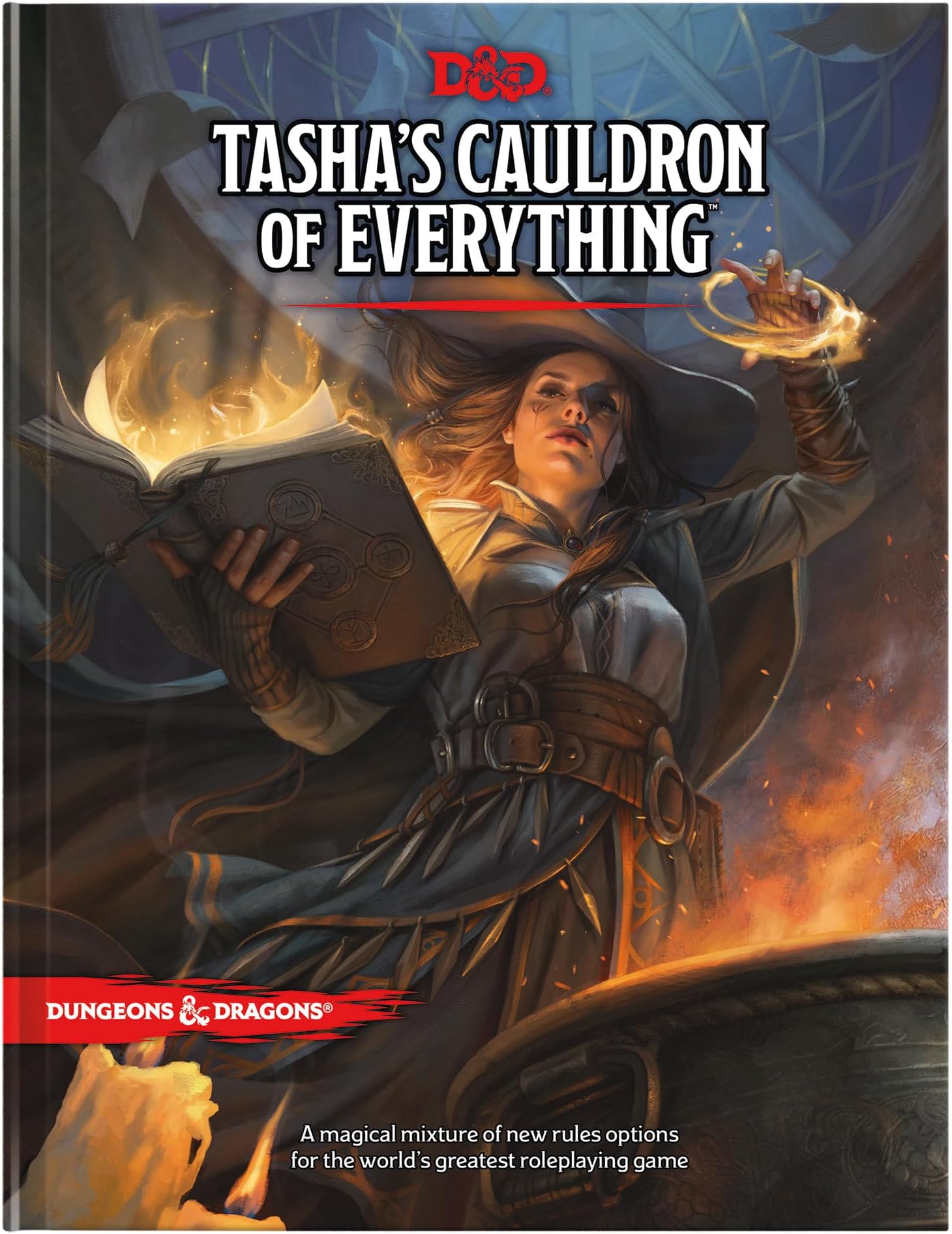
Tasha's Cauldron of Everything (Dungeons & Dragons)
Product ID: 248285568
A magical mixture of rules options for the world's greatest roleplaying game. The wizard Tasha, whose great works include the spell Tasha's hideous laughter, has gathered bits and bobs of precious lore during her illustrious career as an adventurer. Her enemies wouldn't want these treasured secrets scattered across the multiverse, so in defiance, she has collected and codified these tidbits for the enrichment of all. EXPANDED SUBCLASSES. Try out subclass options for every Dungeons & Dragons class, including the artificer, which appears in the book. MORE CHARACTER OPTIONS. Tasha's Cauldron of Everything introduces a host of class features and feats, plus straightforward rules for modifying a character's racial traits and customizing their origin. INTRODUCING GROUP PATRONS. Whether you're part of the same criminal syndicate or working for an ancient dragon, each group patron option comes with its own perks and types of assignments. SPELLS, ARTIFACTS & MAGIC TATTOOS. Discover more spells, as well as magic tattoos, artifacts, and other magic items for your campaign. EXPANDED RULES OPTIONS. Try out rules for sidekicks, supernatural environments, natural hazards, and parleying with monsters, and gain guidance on running a session zero. A PLETHORA OF PUZZLES. Ready to be dropped into any D&D adventure, puzzles of varied difficulty await your adventurers, complete with traps and guidance on using the puzzles in a campaign. Full of expanded content for players and Dungeon Masters alike, this book is a great addition to the Player's Handbook. Baked in you'll find more rule options for all the character classes in the Player's Handbook, including more subclass options. Thrown in for good measure is the artificer class, a master of magical invention. And this witch's brew wouldn't be complete without a dash of added artifacts, spellbook options, spells for both player characters and monsters, magical tattoos, group patrons, and other tasty goodies. Review: Cool magic & rules - Tasha is cool and her new book is cool. QoL rule change and more tools for DM if ur new Review: Bra pris, snabb leverans - Sonen blev nöjd


| Best Sellers Rank | #806,413 in Books ( See Top 100 in Books ) #5,360 in Fantasy Anthologies #5,470 in Military Fantasy (Books) #7,321 in Dragons & Mythical Creatures Fantasy |
| Customer Reviews | 4.8 out of 5 stars 24,513 Reviews |
A**R
Cool magic & rules
Tasha is cool and her new book is cool. QoL rule change and more tools for DM if ur new
L**E
Bra pris, snabb leverans
Sonen blev nöjd
G**A
Good for Gamemasters, but poor for players.
The book as always has an awesome presentation and looks. Although, it is devoid of an index, so you will have to use the contents table at the beginning of the book to help you find what you are looking for. The subclasses are lame. They either make no sense, devalorize another class or feat, or are simply dumb. The "new" class artificer does not let me create things much, so what is the point of this artificer? Also, they create silly psionic sub-classes, why not create a psionic class and put these subclasses in there? Silly. Also, they created a Psylocke Marvel super hero sub-class. Ridiculous! Wild magic barbarian, that is the dumbest class in the book. Why not make a shaman sub-class in cleric instead? It would make more sense. This is just to make them like fighters with their Eldritch Knight. For the fighter's part, they received a really bad fighting style, at least poorly created, which is called unarmed fighting. The style completly makes the Tavern Brawler feat obsolete and depreciates greatly the monk's ability to fight efficiently unarmed. The style should read "does two damage instead of one and can cause 1d4 damage to creatures you have grappled. You also do not suffer from disadvantage for fighting against someone who has a weapon." This would have made more sense than having the fighter's hands be as powerful as a sword. Ludicrous! The only class that received somewhat acceptable sub-classes were the bards and monks. But do not expect to fall off your chair, they are pretty ordinary subclasses. The ones found in the player's handbook and Xanathar's book on Everything are by far much better than those. The healer monk found in Tasha depreciate the value of the Monk of Tranquility's usefulness (or vice versa). Enough about the boring subclasses, now the next part group patrons. This part is someone interesting. It expands the patron subject further with lots of ameritrash random tables which I would prefer they use the space for mechanics rather than waste their time on space consuming tables. Taking gamemasters for idiots by creating tons of tables like that is annoying, a simple small paragraph with examples would do the same trick and take a third of the space tables take. Randomness for the sake of randomness if poor and never makes sense in a story. Aside from that, the chapter is good if you want to use patrons. It gives you a good idea of what you should do to create a patron and guidelines on how to use them. Of course, nothing is really necessary here, if you want to buy this book because the patron part interested you, don't. It is nothing you can create on your own with logic, common sense and the history of the world you are playing in (like local guilds, lords, merchants, crimelords, etc.). Do not waste your money on this book just to get the patron section, really not worth it, but it is still useful for kids who wants to become gamemasters. As for the magical miscellany portion of the book, I have mixed opinions on it. The spells are rather lame as usual. DnD spells are very lame in every edition anyways, making spells casters always weaker than fighters (just to tell you, fighters have seven abillity improvements, but other classes have only 5. So a fighter can become much smarter than a wizard if they wanted to... which of course makes no sense and all classes should have either 5 or 7 ability improvements). Anyways, the summons are somewhat better, they last more than a few rounds or minutes. The downside is that you can only summon one creature... so how the heck are necromancers and demonologists able to summon dozens of creatures at the same time in stories and pre-written adventures? Also, like all summons, they are super weak for the level they can be summoned at. Meaning that they get killed in the same round they get summoned or the next, making the spells useless unless you want to make the summon your beast of burden for a very short while. Again, everything to weakened the magic users. As for the magic items part, well, it is the usual DnD thingy, nothing you cannot create on your own, but useful for lazy gamemasters who do not want to create an item's history and list of previous owners and just go "you've found this". Plenty of fun artifact in there. The Dungeons Master Tools portion of the book is where things gets interesting. Lots of nice things in this section. WotC tells explains to us what is fun about rpg and gives us tips and tools on how to make our games fun as a player and gamemaster. They introduce sidekicks for games that are short on players. Guys that are easier to manage than full characters but can still help out a great deal. Again, lots of tables after that part that you could with the environmental hazard. Instead of wasting your time and causing downtime in your game by rolling on a random table, just use your brains, your knowledge of the world and the location the characters are into and you will never use these tables. These are just for lazy gamemasters who know nothing about the gameworld they are using. Other than that, you can still go through them just to get ideas, but never use random tables or cards during gameplay, it bogs down the game and breaks its rythm. The puzzle part is fun. Gives you lots of ideas on making puzzles. They even give you a couple of puzzles you can use. Although, I am certain gamemasters can come up with better puzzles, more suited to their players. Remember the part on guidelines on how to make a good game? Well, this is where it comes in handy too, making a game for your players not you as a gamemaster. Because if you are making your game, the players might not play for long or not come back after this campaign. Make a game your players wants is what the section on gamemaking is all about. Find something everyone would like to play including the gamemaster! I recommand buying it on Amazon while the price is good. Paying the price it is in stores is really not worth it. No more than 50 CAD or 40 USD. But it is a nice addition to your collection compared to the poor prewritten adventures that the DnD universe gave us (from first in the 1970s to today). Nothing compared to let us say, Power Behind the Throne of the original Warhammer RPG. Oh! If you have Xanathar's Book on Everything, it will be a big disappointment when you get Tasha's. It is a let down compared to Xanathar's.
S**N
Echange rapide et apprécié
Le 1 er colis reçu contenait un livre plié du coin bas-gauche au milieu-haut. J'ai donc du faire une demande de retour et pour un autre exemplaire. Tout s'est parfaitement bien passé, j'ai reçu le nouveau livre avant d'avoir eu le temps de renvoyé le modèle abimé ( on a 1 mois pour ce retour gratuit ). Le livre contient des règles de jeu pour D&D 5-ème édition. Il développe le système de jeu présenté dans les 3 livres de base.
N**S
Slightly damaged, but good
Good book and it gives me what I need for my cleric (peace domain) as well as other useful bits and pieces. Sadly the 1st page has separated from the binding at the bottom, which isn't serious, just annoying.
I**G
Creación de acertijos y opciones para jugadores
Pasta dura. Muchas opciones para los jugadores. Recomendable también para crear acertijos como parte de las aventuras, si eres Dungeon Master.
Trustpilot
1 week ago
3 weeks ago