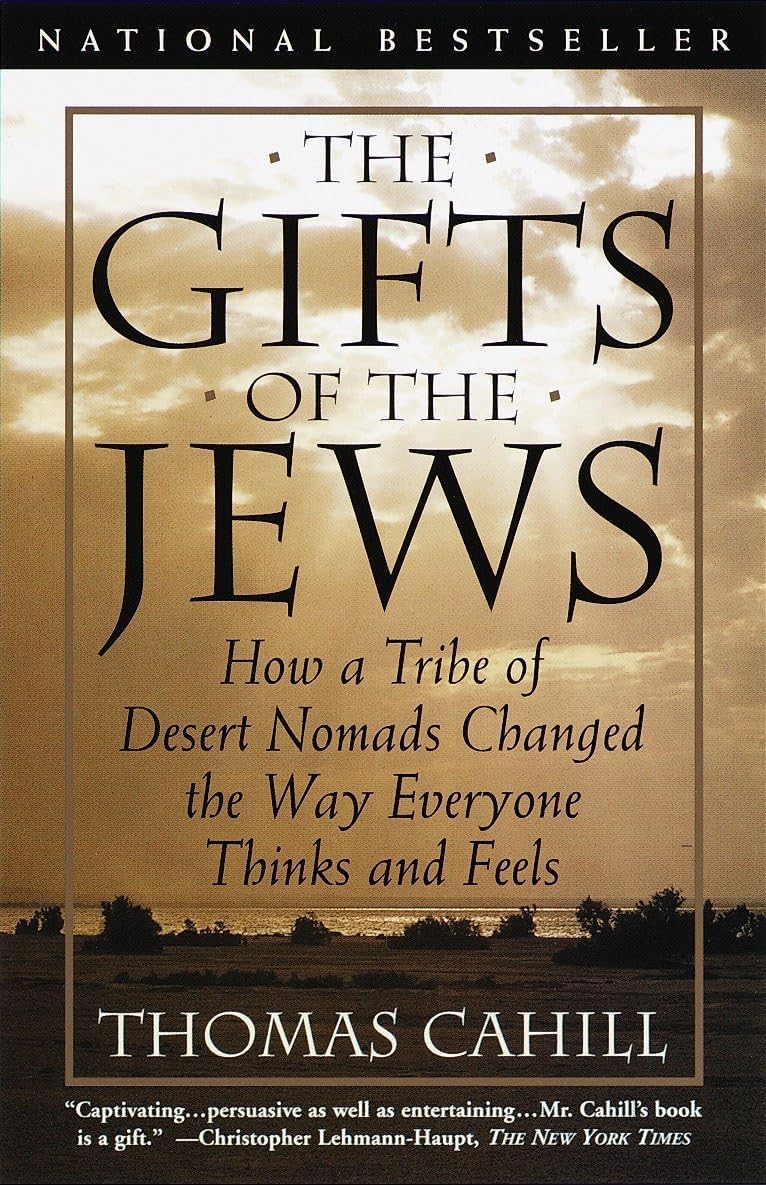
The Gifts of the Jews: How a Tribe of Desert Nomads Changed the Way Everyone Thinks and Feels: 02 (The Hinges of History)
Product ID: 220708983
Desertcart purchases this item on your behalf and handles shipping, customs, and support to Senegal.
NATIONAL BESTSELLER - The author of the runaway bestseller How the Irish Saved Civilization takes us on another "captivating...persuasive as well as entertaining" journey into history ( The New York Times) , recreating a time when the actions of a small band of people had repercussions that are still felt today. The Gifts of the Jews reveals the critical change that made western civilization possible. Within the matrix of ancient religions and philosophies, life was seen as part of an endless cycle of birth and death; time was like a wheel, spinning ceaselessly. Yet somehow, the ancient Jews began to see time differently. For them, time had a beginning and an end; it was a narrative, whose triumphant conclusion would come in the future. From this insight came a new conception of men and women as individuals with unique destinies--a conception that would inform the Declaration of Independence--and our hopeful belief in progress and the sense that tomorrow can be better than today. As Thomas Cahill narrates this momentous shift, he also explains the real significance of such Biblical figures as Abraham and Sarah, Moses and the Pharaoh, Joshua, Isaiah, and Jeremiah. Full of compelling stories, insights and humor, The Gifts of the Jews is an irresistible exploration of history as fascinating and fun as How the Irish Saved Civilization. Review: a good, thought-provoking read - A very interesting presentation of the stories of the patriarchs, and a helpful drawing out of the essence of the ideas that developed and continue to have influence today. Review: an interesting veiw of history - this is an interesting take on history specifically asked for by a family member


| Best Sellers Rank | 841,706 in Books ( See Top 100 in Books ) 226 in Religious History of Judaism 483 in Jewish Studies 894 in History of Civilisation & Culture |
| Customer Reviews | 4.5 out of 5 stars 628 Reviews |
J**H
a good, thought-provoking read
A very interesting presentation of the stories of the patriarchs, and a helpful drawing out of the essence of the ideas that developed and continue to have influence today.
D**S
an interesting veiw of history
this is an interesting take on history specifically asked for by a family member
C**N
Four Stars
Good book, looking forward to reading it. Service excellent.
K**K
In the beginning...
Thomas Cahill's second outing as author of the hinge-histories is a worthy follow-up, if a bit more simplistic. This book was a very easy read for me, both in content and in style, and I think the general reader will enjoy this book, too. I am used to, in my seminary training, to having weighty tomes to journey through -- this was a refreshing walk in a park. Unlike his previous subject about the Irish, this book covers a subject on which almost everyone has an opinion, so Cahill's interpretations on the Hebrew Scriptures and history (Old Testament times) will undoubtedly not satisfy everyone. He does a very good job, though, of steering clear of interpretive controversies. He presents this history as a history of what is important in its legacy for us -- no sense in asking questions such as 'Were these really the first monotheists?' &c., because it is a fact that our cultural tendency toward monotheism in the West derives from this band of people. This is the people from whom much of our Western sensibility is derived. 'This gift of the Commandments allows us to live in the present, in the here and now. What I have done in the past is past mending; what I will do in the future is a worry not worth a candle, for there is no way I can know what will happen next. But in this moment--and only in htis moment--I am in control.' The very idea of regulations, justice, and communal living (beyond the whims of the powerful), and of self-discipline exerted from within, rather than from without, derives largely in our society from these writings. Again, it is not worth haggling over who had the earliest codification of regulations and civil laws--those did not get handed down to us as a living, working text. These texts were, in many respects, the informing texts behind much of Western civilisation. He covers the history well, neither discounting the Biblical authority nor assuming that seeming contradictions in archaeological evidence is either right or wrong. Cahill begins with the pre-history of the Jews, talking about the societal, political and geographic realities that would have influenced the ancient Sumerian named Avram, who set out for the land of Canaan. Cahill examines the period in Egypt as being pivotal for societal development, the era of the judges and kings as experimentations with polity, and the diasporic period as one of deepening identity in the face of massive external pressure and, in the end, threat of extermination. This book is a good sequel, and an important work for the non-historian and non-theologian into some aspects of the history of the Jews that are otherwise often overlooked. 'The Jews gave us the Outlook and the Inside--our outlook and our inner life. We can hardly get up in the morning or cross the street without being Jewish. We dream Jewish dreams and hope Jewish hopes. Most of our best words, in fact--new, adventure, surprise; unique, individual, person, vocation; time, history, future; freedom, progress, spirit; faith, hope, justice--are the gifts of the Jews.'
B**R
Super Introduction
I have found this book that discusses as the Title says "The Gifts of the Jews" to just do this so well. Having spent a life time looking at the different faiths of the world I just wanted a good basic introduction to the Jewish Faith and why this faith is so important and in this book I have found it. Well done!
S**S
Cosmic revolution
Why is 'Western' culture so unlike that of the majority of other societies in the world? Cahill identifies the sources of our culture in ancient Judaism and relates the revolutionary changes introduced by the Jews. In a conceptual rather than detailed treatise, he explains how a small band of people departed from their neighbours by revising their view of the universe and themselves. This feat was accomplished by viewing time as linear instead of cyclical, introducing monotheism to replace a pantheon of deities, and enhancing individuality. These facets of our culture are in direct contrast with those who view Nature as the basis of belief rather than detaching themselves from it. Cahill opens with a quote from Black Elk reflecting the respect for Nature non-Western cultures can sustain. What Cahill leaves out, of course, is the global impact the new ideas have had even on cultures which don't openly subscribe to them. This book is an invitation to reflect on who it is that we really are. That's a question we should ask ourselves from time to time. Gifts doesn't make that query directly, but the implication is as strong as it was in his book on Irish culture. . What is the impact of this novel way of thinking about ourselves? ... For one thing, the linear view of time is the basis for all Western scientific thought. Without such a concept we could never recognize how evolution controls the flow of life. Seeking the mechanics of the Big Bang wouldn't be among our enquiries. We would never have sought an answer to our origins either cosmic or biological. Cahill contends that adopting the new view of time imparted the concept of free will, which allowed us the freedom to pursue such inquiries. Monotheism is the most significant element in Cahill's account. Countless aspects of our society derive from this innovation. History is replete with accounts of gods who dealt directly with humanity, more often amicably than otherwise. Zeus descends from Olympus, frolicking with the peasant girls. Among the Australian Aborigines, Biame joins the hunters, sometimes guiding them to game. Other gods play practical jokes, usually as object lessons. Their company was often sought, and while the gods sometimes acted on whim, fear was not the basis of peoples' relationship with their deities. The gods were as often joyful as terrible. The Jews' god, however, put it point blank: 'I am a jealous god!' In other words, 'I am a petty-minded god concerned with small things!' How much has followed from that dictum? Not only were the Jews forbidden to worship other deities, ultimately it came to mean that no others were permitted to exist. If they manifested themselves, they were to be eliminated. Since the only way a deity can reveal itself is through its followers, those believers must convert or be destroyed. The impact of the global sweep of Judeo-Christian culture over our planet resulting from that one decree remains to be assessed. Cahill describes this imperialism as having 'taken hold in' and being 'subscribed to' by all non-Western societies[p. 250]. He fails to mention the subscriptions were achieved at gunpoint and the bill for the subscriptions paid for in human blood. Those who grizzle about this book not being 'scholarly' clearly have failed to discern its worth. Wrapping up such vast concepts in 290 pages is no mean feat. It is, after all, the foundation of today's Western society he's coping with here. Would this book actually benefit from more citations and a longer bibliography? I doubt it. Perhaps a few of you maligning his efforts should go back and take another look. Cahill's organization and prose style combine to present the reader a worthy addition to any bookshelf. The only real downside is that it's clear we're going to have to buy the entire series to have the whole story. Not a bad investment for those with children.
E**R
Check out the Holy Land
This book is not difficult to read. Cahill writes well and refers to many interesting facts with good insights and observations
B**H
Well - it's okay
I was recommended this book, but to be frank it didn't quite hit the mark for me. Composed of seven primary chapters, the first six take us through the Hebrew Bible (Old Testament) and the stories therein, and how the Jewish thinking and adherence to "YHWH" set them apart from their fellow Bronze and Iron Age neighbours - which it did. However, the title implies that the Jews have given the world much - and indeed they certainly have, more than any other race; for example, since the inception of the Nobel Prize there's been c.1000 recipients, of which 25% have been Jewish. This from a 5th of 1% of the world's population - that is a crazy statistic and gives an idea of the gift of the Jews. Then there's Einstein, Freud, Marx, von Mises, Dylan, Jesus of Nazareth and god knows how many more - but no mention from Cahill who seems to have been an academic historian focused on the Bible (to be fair, he mentioned JC a couple of times). He also veered to accepted historical norms: e.g. without any analysis, stated that "the Exodus pharaoh was probably Rameses", ignoring the fact that the Jews were known as the Hyksos or Asiatics and that they left Egypt in 1521 BCE, 300 years earlier and that there were none in Egypt at the time of Rameses. There are better books out there if you want to know the gift of the Jews.
D**R
Strongly recommend to read.
Very good well written history book..
J**N
OUTSTANDING!!! A Must Read !!!
OUTSTANDING!!! A Must Read !!!
A**I
Absolut lesenswert
Eine gut lesbare, nicht zu theoretische Auseinandersetzung mit den jüdischen Ursprüngen der westlichen Zivilisation. Dieses Buch ist absolut zu empfehlen.
D**N
A Religious History
America is immersed in Judeo-Christian values. Our legal system derives from this heritage. Our moral structure, for which America is revered worldwide, comes from this heritage. This small book traces the development of these ideas back to the earliest times. It gives on a good basis for understanding how God has sculpted our culture. This is not extremely well written. In fact, the beginning of the book is a bit tawdry. But, stick with it to the end, and you will appreciate the material presented more than you could believe. I recommend it to anyone interested in the roots of morality and civilization in religion.
洋**友
旧約聖書を物語風になぞっている・・・
アマゾン・アメリカでのレヴューの数が多いので、読んでみると、信者(それもコアの)向けに旧約聖書物語を語っているだけ。決して歴史主義に立って旧約聖書の成立だの、ユダヤ民族の起源を実証的に解き明かしたものでは全くないので、それを期待すると大外れ(がっかりしたー)。アメリカの素朴で熱心な信者向けのよくあるスピリチュアル物ですね。この著者ならではの特別なところが分からないので星3つ減!!
Trustpilot
2 months ago
4 days ago