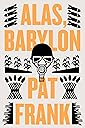
Alas, Babylon: The Classic Apocalyptic Novel of Courage, Survival, and Determination After Nuclear Holocaust
Product ID: 219775
📚352 gripping pages
🔥Timeless apocalyptic survival tale
🕰️Classic 1959 Cold War setting
Desertcart purchases this item on your behalf and handles shipping, customs, and support to Senegal.
📖 Unlock the ultimate Cold War survival saga—because missing this classic is the real fallout!
Alas, Babylon is a 352-page paperback reissue of Pat Frank’s seminal 1959 apocalyptic novel, vividly portraying the aftermath of nuclear war on a small Florida town. With a compelling introduction by David Brin, this classic blends Cold War-era realism with timeless themes of human resilience, making it a must-read for fans of cultural heritage fiction and post-apocalyptic narratives.


| Best Sellers Rank | #18,680 in Books ( See Top 100 in Books ) #87 in Cultural Heritage Fiction #167 in Classic American Literature #201 in Science Fiction Short Stories |
| Customer Reviews | 4.6 out of 5 stars 6,868 Reviews |
R**O
What's the last book you read that you couldn't put down?
What's the last book you read that you couldn't put down? Can't remember? Well, I got one for you! It's a 1959 novel that is more than just a story of the consequences and outcome of a nuclear war between America and Russia. This novel gives the reader the flavor of what America was really about in the 1950's. I remember the air-raid drills in grade school when a student was instructed to dive under their desk in the event of a atomic/nuclear strike. Like that was going to save your butt! I remember President Eisenhower saying the same thing. Here was a man who saw the destructive power of Little Boy in Hiroshima and Fat Man in Nagasaki saying that the desk would save me. Oh, well. Since this novel was published just before the civil rights movement, the ugly head of racism exists in this novel. This is not a knock on the author, Pat Frank, because he was writing in accordance with the prevailing thoughts of 1959. This novel was probably born out the U.S.A.'s fear of being attacked from space after Russia successfully launched the Sputnik satellite into space in 1957. This act most likely sparked the arms race and subsequently launched nuclear war/post-apocalyptic novels like this one into popularity during the 1950's and 1960's. However, this novel gives the reader hope that a nuclear war is survivable, unlike novels such as Nevil Shute's 'On the Beach', where there is no hope for survival after World War III has polluted the atmosphere with world wide nuclear fallout. Alas, Babylon truly gives the reader a taste of that 1950's fear and the general attitude of the citizens. Well done, Pat Frank. The story centers around the town of Fort Repose in central Florida. Our protagonist, Randy Bragg, is contacted by his brother, Mark, a Colonel in the U.S. Air Force stationed at SAC headquarters in Omaha, Nebraska. Mark tells Randy that war is imminent, and he is sending his wife, Helen, and two children to live with him in Florida. The day after Helen lands, the unthinkable happens. The U.S. and Russia exchange nuclear missiles! At first the town had electricity; then, the families witnessed a stunning explosion: "The white flashed back into a red ball in the southeast. They all knew what it was. It was Orlando, or McCoy Base, or both. It was the power supply for Timucuan County. Thus the lights went out, and in that moment civilization in Fort Repose retreated a hundred years. So ended The Day." Several days later, the bombing stops. Randy houses most of the River Road people, including his brother's family, Randy's girlfriend Elizabeth and her family, and the local doctor, Dan Gunn. The Western Union lady, Florence, and the local librarian, Alice, live next door. The Preacher Henry family lives close by, as does the retired Admiral, Sam Hazzard. This constitutes the main core of characters (Those living in the vicinity of Randy's River Road abode) in this cutting-edge story. Luckily for the town, the winds keep the fallout away from them even though Florida is listed as one of the many contaminated zones. The retired Admiral finds out via his short-wave radio that the Secretary of Health, Education, and Welfare is now Acting Chief Executive. Randy knew that: "...The struggle was not against a human enemy, or for victory. The struggle, for those who survived "The Day", was to survive the next." The ensuing chapters deal with the River Road people's efforts to obtain food; avoid typhoid; establish law and order against the many `highwaymen' attacking their town; and to establish ways and means for mankind's survival. I thought that Pat Frank's characterization was as good as it could be based on the many characters in the book. Near the end of the book, Lt. Colonel Paul Hart says to Randy Bragg: "'Some of our scientists think it will take a thousand years to restore a saturated [Contaminated Zone], like Florida or New Jersey, to anything close to normal.'... and Randy turned away to face the thousand-year night." By the way, the story does end with the reader finding out who won the war! I guess you will have to read this sci-fi classic to find out.
K**S
True Post Apocalyptic Fiction - 54 Yrs Old & Still Relevant
I first read Alas Babylon as a teenager. I read it again in my early 30s. This is my third reading of this book and I remember why I keep reading it over and over again. If I didn't know it was written 54 yrs ago, I would have thought it contemporary. Alas Babylon is an excellent cautionary tale about what would happen to a small group of people who survive the end of the world and how it changes them. It is still, to me, the stand alone novel on how to survive a terrible holocaust. The writing is crisp and informative. We get to know Our characters well. It is not told as a condemnation of one or the other political party. It is simply about survival during a time people never asked for and never expected. Pat Frank was way ahead of his time in his writing style and in the story he lays out. I have read much apocalyptic fiction. Alas Babylon remains the best book I have read in this genre. It is realistic, and after reading it, you will have read all you need to know should this awful event, still hanging over our heads in 2014, happen to us. I am a news junkie and know enough about world politics to know we are never but a heartbeat away from being these people. I think what separates Alas Babylon from the rest of the books I have read is that it centers on hope and has a better view about humanity, how they handle the crisis, how they survive without losing their civility. This is a well written story of the upside and hope that we ARE a country of immigrants who are strong and can rise above the terrible losses that will occur, should we find ourselves in the same situation today. Well done Pat Frank! And RIP - wish you had lived to see this amazing book become a classic. And as for us, you left us with many more stories to tell. Very highly recommended.
K**R
Still timely
I've been on this whole science fiction/post apocalyptic kick lately and Alas, Babylon was the second such book I tried because I'd read about it in the after word of another book. Isn't that how you find new books? Another book suggested was Neville Shute's On the Beach, which I read about 8 or 9 years ago when the guy at the post office suggested it. Alas, Babylon and On the Beach both deal with the world after a nuclear strike, except in Neville Shute's world, based in Australia, all human life was annihilated and Australians would soon be dead of radiation poisoning, saved on by their lower position on the globe. In Pat Frank's post nuclear holocaust world, specifically America and Fort Repose in Florida, many people died from the nuclear blasts and more of radiation poisoning, but many survived in a world without technology, electricity, and most of what modern people consider necessary: salt, medicine, antibiotics, doctors, etc. At the beginning of Frank's novel, Randall Rowzee Bragg is on the super highway to dissipation. Randy begins with a bit of liquor in his coffee and runs around with women, many of which come from Pistolville, the other side of the nonexistent tracks in Fort Repose. His family name is old and distinguished, but Randy spends more time in the red at the bank than in the black. He's friendly and well liked, but not what one would consider a pillar of the community unless the pillar is leaning drunkenly to the side and about to topple over. Randy gets a telegram from his brother, Colonel Mark Bragg, to meet him at a nearby Air Force base as Mark is on his way back from Puerto Rico and will touch down there to refuel. He is sending his wife and two children to stay with Randy in Fort Repose, signing his message, "Alas, Babylon," so Randy will know it's serious. Randy goes, meets his brother, gets the bad news that there will be war with Russia, nuclear war, gets a check for five thousand dollars, and drives back to Fort Repose to the bank where he has some trouble cashing the check, but walks away with the cash and a remark to the manager of the bank that cash will be the only thing that matters in a very short time. Randy gets most of the supplies on his list and drives the next morning to get his sister-in-law, Helen, and Ben Franklin and Peyton, his nephew and niece, all of whom were reluctant to leave their father in Omaha at the Strategic Air Command (SAC) base. Nuclear war comes with a double blinding dawn and soon the cessation of electricity amid panic and a world turned upside down where Randy becomes the strongest pillar of the community, coming alive with deadly purpose to preserve his family and his town. Alas, Babylon was published in 1959 at the height of fear of pending nuclear war with Russia -- and Cuba -- and amid racial segregation and the struggle for civil rights. Randy Bragg lives next door to the Henrys, a black family of modest means who were once the Bragg family's slaves. The Henrys bought the land on which they live and are a major asset in sustaining life and purpose for Randy and the extended family he gathers around him. The Henrys are the difference between life and death. Frank was writing at a time when he had intimate knowledge of politics, nuclear capabilities, and civil rights, having written about them as a war correspondent, reporter, and chief of a couple of newspapers. He knew first hand what life would be like in his family's home in Florida and the struggles he -- and indeed the country -- would face. Alas, Babylon is as true today as it was in 1959. I found the characters engaging and amusing and wonderful in their differences and their similarities and enjoyed the change especially in Randy as he squared his shoulders and took charge. Dated though some of the information seems at a glance, Frank pegged human nature, which seldom changes. People rise and fall in times of adversity and those that surprise us the most are the people we often discount before disaster hits. I highly recommend Frank's view of America after a nuclear holocaust, not only for its insights, but for its humor and its pathos. Since I read the Kindle version, I will warn you that there are many mistakes throughout the text with wrong words, doubled and missing words, and typos with most of the mistakes coming at the end of the book. It will take a few seconds to puzzle out what is supposed to be there, but it shouldn't slow you down too much. That is the reason for 4/5 stars when the book itself deserves a hearty 5-star review. This book stands the test of time.
C**R
A bit dated, but still relevant and impactful
Having been published back in 1959, i.e. when the space program and commercial jetliner travel were still in their infancy, and whilst we were still in the Industrial Age and therefore less technology-dependent as we are now, not to mention less vulnerable to the electromagnetic pulse (EMP) effects of nuclear weapons as our present-day society would be, this novel is obviously a tad bit dated compared to more recent post-nuclear and other post-apocalyptic fiction books. Nonetheless, it's still an excellent book, eminently readable and engrossing, and frighteningly realistic, well worth the read. RANDOM STREAM OF CONSCIOUSNESS NOTES AND OBSERVATIONS (and noteworthy passages): --p. 3: "The Russians had sent up another Sputnik, No. 23, and something sinister was going on in the Middle East. Sputnik No. 23 was the largest yet, according to the Smithsonian Institution, and was radioing continuous and elaborate coded signals. 'There is reason to believe,' Frank said, 'that Sputniks of this size are equipped to observe the terrain of the earth below.....'There is a new crisis in the Middle East. A report from Beirut, via Cairo, says that Syrian tanks of the most modern Russian design have crossed the Jordanian frontier. This is undoubtedly a threat to Israel. At the same time Damascus charges that Turkish troops are mobilizing….'" Wow, dated yet paradoxically so prescient in many ways. --p. 9: "Randy knew he wasn’t an alcoholic because an alcoholic craved liquor. He never craved it. He just drank for pleasure and the most pleasurable of all drinks was the first one on a crisp winter morning." Like the joke says, "I'm not an alcoholic, I'm a drunk, I don't go to meetings!" --p. 17: "'Nations are like people. When they grow old and rich and fat they get conservative. They exhaust their energy trying to keep things the way they are—and that’s against nature. Oh, the services were to blame too. Maybe even SAC. We designed the most beautiful bombers in the world, and built them by the thousands. We improved and modified them each year, like new model cars. We couldn’t bear the thought that jet bombers themselves might be out of style. Right now we’re in the position of the Federal Navy, with its wooden steam frigates, up against the Confederate iron-clad. It is a state of mind that money alone won’t cure.'” --p. 29: "B-47’ s," aahh, the pre-52 days of SAC. --p. 35: "'Then in ‘fifty-eight, after the Iraq king was assassinated, we grabbed the initiative and landed Marines in Lebanon. We got there fastest.'" --p. 37: Ah yes, the infamous "missile gap." --p. 55: Since the U.S. was still on the gold standard when this book was written, paper cash could hypothetically still be worth something even during a catastrophe such as nuclear war, I suppose.
K**E
Excellent
I love this book! I've read it at least ten times, probably more. My only complaint is about this e edition. The number of errors is phenomenal. I've reported a bunch, but I know I didn't report all of them. When you read this, please report the typos! Enjoy it anyway!
T**Y
Great book fiction story is based in Florida
Great book I had to read this book in 12th grade it the 70s it was required reading. It’s about nuclear world war how they survived.
K**R
Reads like a fifties black and white
I like the story, the premise. I like the characters, but there is nothing really that binded me to this book definitely not a page turner, but if you take it into context the Year this came out and the impact it must have had on society it is a very good book only. too bad the lessons are now lost.
A**R
A blast from the past
In a day when many think apocalypse means "zombies", this is a still-relevant book from the 1950's about a time when apocalypse fears were largely driven by the cold war and nuclear weapons. I enjoyed this book and found it both educational and entertaining. It indeed reads like a 50's science fiction novel and reflects the attitudes and ideas of the time. Some may be put off by the references to racial discrimination, but even in 1959 when the book was published, you can sense the author's attempts to push the idea that people should be judged by character and not color. Character, in fact is a constant concept in the book. There are some like the book's protagonist, Randy Bragg, who are stalwart but still flawed. There are others who seem of weaker character like his neighbor Florence, who surprisingly flourish in the crucible of the apocalypse, and sadly there are people of questionable character that will always choose selfishness and violence over reason and cooperation. General audiences in contemporary times may look to fantasies like The Walking Dead as their literature of choice for apocalyptic fiction, but even then there is some common ground between the two. They both have their bogeymen of zombies or radioactive fallout, but for both the ultimate threat to humanity is humanity. Still, Alas Babylon is a well written story, even with the few typos in the printed version (and apparently many more in the ebook edition!). There are a couple spots I found confusing; Frank's writing is normally very good but there is a combat scene that is somewhat confusingly described, and a couple areas where characters would be expected to be more emotional and are not. Perhaps those moments, like the presence of some racial and gender tensions in the book, are products of the social standards of the time. Even the ending, which offers some hope, can be criticized for being too pat. But flawed gems can still have value, and this one is less flawed than most.
A**O
Da leggere tutto in un fiato
Fantastico a chi ama il genere fantascienza... Pat Frank un mito nel genere.
L**A
Postapocalyptic classic
One of the best postapocalyptic novels - a classic!
B**N
After a Nuclear Apocalpse
An excellent, well-written story with extremely credible characters. Considering that it was written almost 70 years ago and a decade before the Civil Rights Act, it is very advanced in its social thinking. It is also sobering in the way it brings home the leaps that we have made technologically since 1959. I especially chuckled at the thought of power only coming from hydroelectricity or oil.
J**N
65 years and counting
Look, this book is a classic. It's extremely well-written, both in literary and technical terms. I am of the generation that feared nuclear war from childhood, and now I'm getting old. What I'm trying to say is.. we made it a long time now since mankind first stared down the barrel of nuclear apocalypse. Maybe there is a god.
D**K
"Alas, alas, that great city Babylon, that mighty city! For in one hour is thy judgment come" If you hear this, be VERY afraid
I liked this old classic about nuclear war and its aftermath. Written in 1959 it aged a little, but still is a GREAT read. Below, more of my impressions, with some limited SPOILERS. Randy Bragg lives in the small Central Florida town of Fort Repose. He is not a very successful guy, in fact he is mostly content with eating his inheritance... One day however his much more formidable brother, Colonel Mark Bragg, USAF, sends him a telegraph ending in the words, "Alas, Babylon", a pre-established code between the brothers warning of impending disaster. It appears quickly, that this disaster is a HUGE one... This was one of the very first novels to describe the occurence and the consequences of an all-out nuclear war. The much darker and much more pesimist "On the beach" was published two years earlier and the equally dark and pesimistic "Canticle for Leibowitz" was published in 1960. "Alas Babylone", a much more realistic thing than those other two classics, made quite a splash when it was published. Unlike so many others, the author, whose real name was Harry Hart Frank, knew what he was writing about. He served in military during WWII and watched Korean War as journalist, he studied a lot about the nuclear weapons and it shows in this book. The novel deals less with the nuclear war itself, than with what happens next. There are, quite obviously, survivors, in fact quite a lot of them, but the organised society as we know it initially collapses - the description of this process is quite fascinating. Then, as always, people regroup and re-organise themselves, facing challenges and solving problems. This is an uphill battle, but life always ultimately triumphs over death... Author very wisely states in this book, that it is not the strength of American nuclear arsenal that is the problem - it is the weakness of USA that causes Soviet union to attack, as Moscow believes it can win a nuclear war. It is a very important point showed in this book: in some circumstances a nuclear war CAN be won - it becomes only imposible if BOTH sides have enough primary and back-up fire power to always fully incinerate the enemy, no matter how total the initial surprise and how big the first-strike damage. On another hand, one thing totally absent here is the "nuclear winter", and a mighty good thing too, as it is a total nonsense... This book can be also read as a kinf of post-apocalyptic SF, albeit slightly more optimistic than most of such works. Left-winged people and peaceniks will almost certainly hate this book - which is another point in its favour... I don't want to provide spoilers here so I will keep this review short. This is an important book, still a good read and a thing that makes one think, in fact think a lot. I am glad that I bought and read it. ENJOY!
Trustpilot
3 weeks ago
3 weeks ago