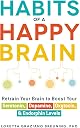
Habits of a Happy Brain: Retrain Your Brain to Boost Your Serotonin, Dopamine, Oxytocin, & Endorphin Levels
Desertcart purchases this item on your behalf and handles shipping, customs, and support to Senegal.
Description
A revolutionary approach to enhancing your happiness level! Get ready to boost your happiness in just 45 days! Habits of a Happy Brain shows you how to retrain your brain to turn on the chemicals that make you happy. Each page offers simple activities that help you understand the roles of your “happy chemicals”—serotonin, dopamine, oxytocin, and endorphin. You’ll also learn how to build new habits by rerouting the electricity in your brain to flow down a new pathway, making it even easier to trigger these happy chemicals and increase feelings of satisfaction when you need them most. Filled with dozens of exercises that will help you reprogram your brain, Habits of a Happy Brain shows you how to live a happier, healthier life!
Specifications
| Dimensions | 5.5 x 0.6 x 8.44 inches |
| Edition | 1st |
| Isbn 10 | 1440590508 |
| Isbn 13 | 978-1440590504 |
| Item Weight | 2.31 pounds |
| Language | English |
| Print Length | 238 pages |
| Publication Date | December 16, 2015 |
| Publisher | Adams Media |
Reviews
User
Life changing Book that is fun to read!
This book is written just the way I prefer - concise, direct and clear to understand with a wry sense of humor (perhaps unintentionally) which makes this an enjoyable read through and through. I rarely write reviews but though thought this book especially deserving. I found this book life changing because it actually gives the reader new, more revealing lenses through which to observe human behavior and therefore one's own sometimes inexplicable behavior. By going through her very clear descriptions and anecdotes I found myself understanding my own and others' drives, tendencies and behaviors in a new and obvious way! Reflecting on her descriptions of how superhighways are built early have helped me to hone in on my "passions" in life as an adult, by identifying what early childhood and adolescent experiences give my brain happy surges and building off of those naturally, while managing expectations and understanding that "happy" surges to fade. The clarity and wisdom that shines through this presentation of what could be a very clinical approach to scientific understanding is a credit to the way in which the author has integrated years of research and study into her own experience of life and is able to share this practical application and uplift net with her readers. Great book, highly recommended.
User
You will never see life the same way again. Mind. Blown.
Easy to read, sensible, simple, structured and to the point. (Repeats the point quite a lot in fact! But for good reason)This book opened my eyes in a big way to the motivating factors of human beings and all mammals. It suddenly makes sense to me why there seem to be so many stupid idiots in the world and why I often behave like one of them! I understand what causes people to look down on each other, why we fish for compliments, why we are never satisfied with what we have even if it seems good on the surface.Once you read this, you may feel like the Matrix of life has been revealed to you. Take the red pill. Humanity is not what you thought it was.The second half of the book teaches us how to bypass those instinctive deep-brain habits, and create new habits that are actually helpful to us. It's based on a 45 day habit creation process which makes so much sense its almost dumb.The first half made me depressed, thinking that I was a slave to my neurochemistry, a prisoner of my monkey-ancestors survival mechanisms which I am unable to avoid, notice or escape once caught up in them, but the second half gives hope, and a technique to create new habits. I base this 5 star review on the first half alone, although after reading it I feel like humankind is not really as clever or free at it thinks it is.At least we have some wiggle room to change a few things!
User
Quick, insightful read!
This book does a good job of providing information in a way that is accessible to everyone. I already had an awareness of these chemicals and what they do before reading this but once I got past a lot of the introductory information that I knew, then the book gets into other areas including comparing and contrasting the chemicals themselves, how they differ in different animals and different ways that you can take action to be able to enrich these levels in your body. The information is concise, understandable and applicable and is a good read for anyone interested in this topic!
User
By “doing nothing.”
While I wasn’t getting drunk everyday, I was drinking copious amounts of alcohol on the weekends which I would come to regret doing so by Monday. This went on for a decade. I really felt STUCK in a cycle. As someone who is extremely introverted, drinking and partying on the weekend was something I deemed as necessary to socialize/be one of the group. I felt that I need to drink to actually survive in a world I didn’t feel comfortable being myself in. I eventually stopped partying but the drinking stayed. It was apparent that the drinking had became something I did out of habit now. How I learned to cope with stress. I wondered if I could ever stop the cycle. I didn’t want to have to go to AA even though I felt like it would be the only thing that would help until I did, as the book suggests, learn how to “do nothing” when I felt that urge to “do something.” At first, it was hard sitting around on a Friday/Saturday night with my own thoughts, bored out of my mind. I honestly didn’t know what to do with myself. Every time I felt like I was going to give in I just reminded myself that the urge I was feeling has a basis in survival and that I can rewire my brain to learn new ways to survive. Anyways, I would definitely recommend this book.
User
Excellent book with loads of information
I found this book to be engaging and filled with very useful information. The author provides a very simple and concise explanation of how our brain chemicals work and their effect on behavior and quality of life. The best part of this is that being aware of how these work, I a, able to make informed choices rather than react to a feeling or thought. Basically my brain is working to protect me or find opportunities for survival. It sounds a little disheartening, but I found being aware of this actually allows me to choose if I will react to it or just see it as consequence of the chemicals being released in my brain. I like the way the book is written and how it took me through various aspects with examples. I will probably read it a second time and will certainly do the exercises to discover happy habit with which I can replace my detrimental habits created from past experiences.
User
I was less than happy with this book
I was less than happy with this book. Although it did describe the different ways that your brain gets happy, it really was less than satisfactory in telling how to help your brain get happy in those ways, especially in regards to seratonin. There was a lot of repetition. When I finished the book, I still felt like I needed more information. It is good for a for a general introduction to the different things that affect your brain, but if you are looking for a way to move forward, this may not be your best choice. On the other hand, I haven't found anything better, so maybe I am looking for something that doesn't exist.
User
Easy to understand view of a complex subject
Years of working in my depression and habits and I finally have a framework I can visualize to create actionable plans for dealing with both. Having an easy to relate to model of brain chemical interactions was the missing piece understanding why certain techniques work, and understanding the why is essential for me to form a long term commitment to change.Experts in psychology and motivation may have a different view. But, I know if I explain things in my area of expertise with all details and nuance a non-expert would be lost or bored before finishing. This author chunked the knowledge and delivered it in just the right detail for me to finally understand my internal struggle for balance.
User
Fascinating, easy read
Loved this book! It was thrilling. I couldn’t put it down and finished it without hours of getting it. It goes through what your happy chemicals are, why we have them, how we stimulate them, why that stimulation sometimes actually decreases our overall happiness, and how to build patterns to stimulate them in new ways. The author does not presume to know how you want to stimulate your happy chemicals, just gives a guide for how to do it. I’m still searching for a book that can apply this to some relatable life experience and give me concrete ways of breaking patters. For example, how do I get out of the habit of comparing myself to people. It’s human, sure, but it’s decreasing my overall happiness how do I make it stop. How can I use this info to deepen my relationships with my loved ones. I know I need to stimulate my oxytocin and serotonin but how can I do that in a healthy way? How do you maintain romantic relationships when the dopamine wears off? Can you stimulate dopamine in a long term partnership? I need a follow up that gives me guides for improving my life.One note. The author kinda shows a side of herself at the end that, even she admits, goes against the grain. She had calculated the risk of not being part of the herd and has probably found some small group of people that feel the same way she does to stimulate her own totally human serotonin. But for people who care about political and social movements, maybe skip the last chapter. There’s kind of this idea presented that each individual is in charge of their own happiness (I agree) and that the world today is not broken at all (hmm ok) and that we indoctrinate people into believing the system is rigged (??). Going so far as to put the word privileged in quotes (yikes). The book absolutely ignores learned helplessness, abuse, oppression, and all the ways our mammal brain hurts people. It’s a fend for yourself world in this book. That’s fine. Personally I feel like there can be balance. You can acknowledge that you won the genetic lottery and that it doesn’t make you happier. Just that it gives you more access to resources that will. She states that in today’s world, there’s no use for cortisol to alert you to existential dangers like death, pain, and starvation so we focus that cortisol on social dangers like rejection, betrayal, and shame. Completely ignoring that for a LOT of people on this planet, that’s not the reality. Even going so far as to put a little shame on some people for prioritizing the happiness of many over their own. I’m aware as I type this that I’m getting a little serotonin bump from feeling like I’m making the better herd choice. So human. But yeah. That part made me bristle but not enough to ruin the book.
User
Won't say it's a life-changing book
Just an average read in my opinion. But book came as described, smooth transaction.
User
The info is good
Seems written in such a way that middleschool children would understand it easily.
User
Bel libro, ma non l'ho ancora finito
Una lettura molto interessante e "rivelatrice" aiuta a cambiare abitudini per vivere meglio, dato che aiuta a capire come "hackerare" il nostro cervello per indurci ad apprendere abitudini più salutari
User
Cured my devastating anxiety about drawing
Best book I’ve read on the topic of anxiety because the practical advice on creating new pathways in the brain has actually worked for me.I am 36, have wanted to be an artist since age 4, think about art everyday of my life but a pathologically dysfunctional childhood had left me unable to get over the terrorising dread of picking up a pencil. Chronic anxiety has dominated my life. I’ve been searching for years on what to do to get over cptsd and this book, while simple to read has been the most understood I’ve ever felt. I felt encouraged that it’s just normal and human to feel this way(given my experiences) and that it can be overcome- and that it’s ok that it doesn’t feel like it can be overcome. Just do the advice on creating the happy habit anyway.So I started doing 10 minutes of art a day to forge a new pathway and teach my brain that it’s safe to do so, I won’t die if I do (anyone who has cptsd knows what I mean here. Anyone who is wondering what on earth I’m talking about, count yourself lucky).It was agony at times but on day 40 I stopped feeling dread and started to look forward to my daily art. I’ve done more drawing in the past 56 days than in the past few years combined. And those times would have been accompanied by excruciating dread, but not anymore.I have an overwhelmingly long way to go to get to where I want to be with my art. But at least I’m on the road now and am just enjoying having art back in my life. Am really, really grateful for this breakthrough.
User
Great read or listen
Loretta takes you on a journey to discover how habits and events that had occured during childhood development have formed neural pathways that can often lead to unhappy emotions. This book aims to enlighten how the pathways or "highways" are formed so that new healthy habits can be formed that lead directly to the chemicals that stimulate happiness in the brain. Well worth the read or listen via audiobook.
Common Questions
Trustpilot