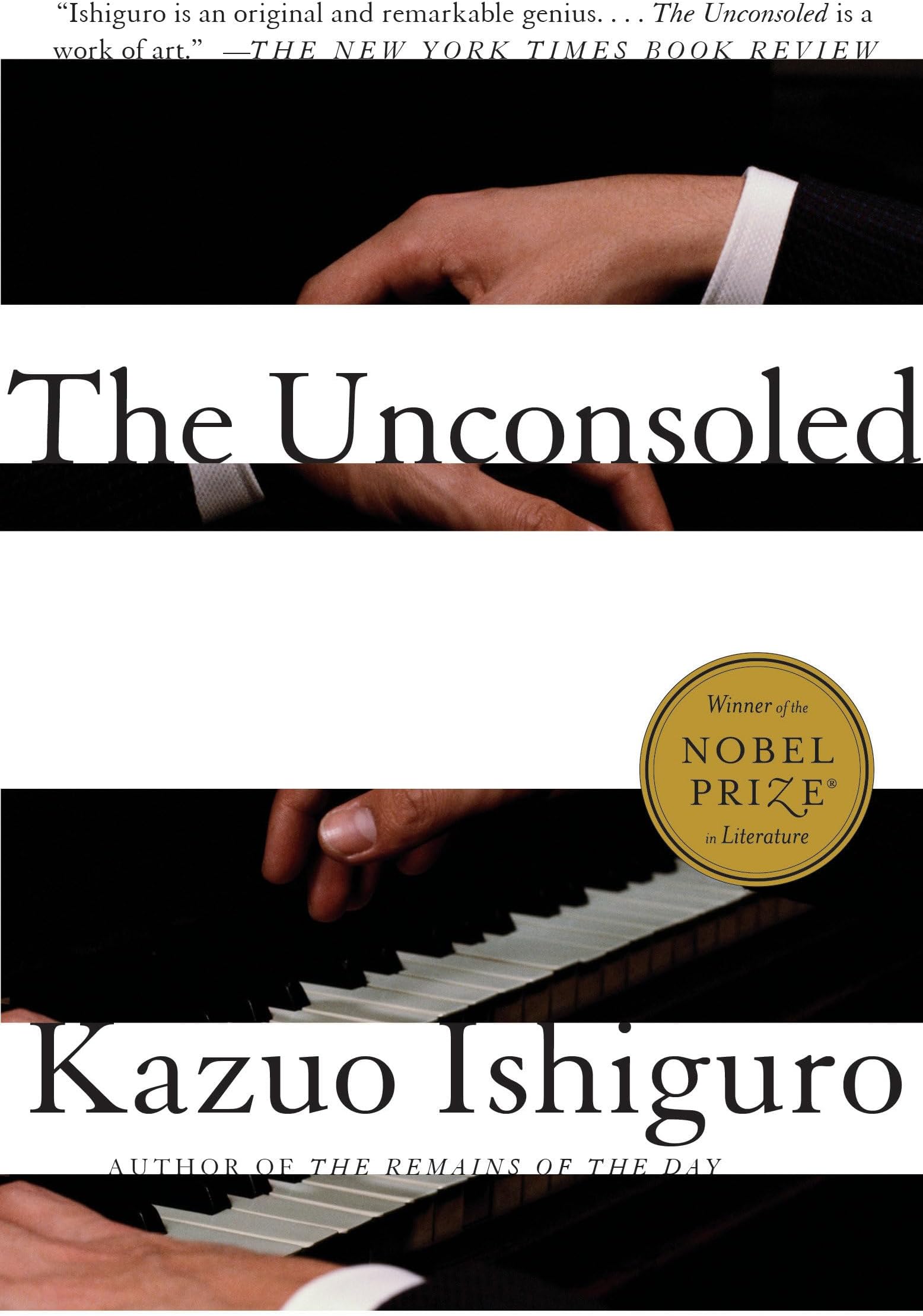
The Unconsoled (Vintage International)
Product ID: 21245802
Desertcart purchases this item on your behalf and handles shipping, customs, and support to Senegal.
The Unconsoled (Vintage International) [Ishiguro, Kazuo] on desertcart.com. *FREE* shipping on qualifying offers. The Unconsoled (Vintage International) Review: A surreal read. Teeth grinding but worth it! - The Unconsoled tells the story of Ryder, an acclaimed pianist, who comes to play in an European town as part as what looks like a tour. And that's -or is it???- about the only clear cut fact of the book. From Ryder's arrival to his hotel, we are -reader and Ryder- embarked in a roller coaster of events, thoughts, interactions, with a narrative following a dream pattern. The sense of time and space are suspended, as are logic and rationality. Streets lead to hotel rooms, minds are read, places magically connect, childhood friends appear, family ties are blurry, to say the least and the anxiety is rising. The dream quickly turns into nightmare as we are trying to make sense of the what, when, who and where. Many parts reminded me of a When we were orphans gone mad, with common themes and characterization. Ryder needs to play a huge part in many events leading to a key performance - the famous Thursday night- but has no idea of any of it. He tries to get a sense of his schedule but is always a step behind, pulled out of his unknown main tasks by constant side line emergencies. Ryder never seems to be acting, but only reacting to external events, pushing him around like a leaf in the wind. No continuity in thoughts or goal is present and he is permanenty jumping from one thing to the next in a chaotic dance that leaves us breathless and on the brink of a claustrophobia attack! That's the teeth grinding bit... Yes, some parts are quite frustrating and you wish Ryder would just suddenly wake up and get on with a "normal" life. Kazuo Ishiguro is literally plunging us in this never ending bad dream and the sense of absolute lack of control is quite something to experience. On the other hand, some parts are downright funny, whether it be the childish -and numerous-outbursts from Ryder (he has so many responsibilities!) or some of the characters' monologues, like Brodsky's. Embodiment of surreal literature, the Unconsoled echoes of course Kafka, but also Sartre and Vian . The main difference though, seems to be that the story symbolic is never truly uncovered. There's no "ah ah" moment here. Moreover, many tantalizing hypothesis seem to disappear as you go on reading. To start with, I wondered if Ryder was in a coma... Then if he was dead and living in his own personal hell. Then if he was in a highly dissociated state and experiencing simultaneously all his personae. And then again, if he was meeting his own self at different stages of his life. Or I f the story was experienced from the perspective of a 2 years old. I hoped the ending would provide some kind of answers, but grew less and less hopeful as I went on reading. And no, it didn't. There is no neat red ribbon tying everything nicely together. The interpretation is only down to us, readers. What is truly masterful though, is that for Ryder, all the events he goes through do not constitute a journey. He seems to be exactly the same at the very end and at the very start. There's no learning. Events just pass through him and he remains unchanged. Upsetting things are forgotten, replaced by what comes next, hurt and emotions give way to present needs. Without spoiling the end, the last few pages are such a vivid demonstration of the latter... The same apply to all the characters, there is NO resolution, they start the story being miserable and end up as miserable, as if they were all acting in a forever circular pattern. When it came to giving it some sense, I chose to think that this work of literature was an allegory of our own mind. That it shows how we get caught up in things lacking utter relevance to help us live our present. How we obsess about trivia and are self obsessed. How we can be prisoner of our own concepts, ways, limitations.That we are made of dozens of contradictory pieces, pulling us in different ways and making clear vision and action difficult. Or may be, it's all about letting go of our mental pieces of luggage, which would put Gustav and his porter job in a interesting new light! So, a very original read, to embark on with an open mind... Review: It got on my nerves - as it was suppose to do - This is an unusual novel, written almost as if it were a dream narrative, with all the frustrations of a bad dream. I would like to discuss three aspects of the novel; the use of a dream narrative to form the basis of the novel, Perl's dream theory, and the modern sense of anxiety and neurosis. The narrative of this novel is dream-like in many ways. A dream has its own sense of time and space and sequencing of events. Oftehn in a dream the sense of time is distorted and space is bent and shortened. That is certainly the case in this novel. The anxieties of everyday life are taken into the dream and thus the dreamer feels a sense of emergency or urgency around nonsense in a dream. Logic,which follows rules in the real world, no longer follows those rules in the dream world. There were wonderful clues to this process throughout the novel. For example, early in the novel Ryder and Boris try to keep up with Sophia as she walks through a maze of old-town streets. No matter how they try to hurry, she always turns a corner ahead of them and they become anxious trying to catch up to her. In another scene, Ryder goes to a movie but the movie seems to be a conglomeration of several films including 2001: A Space Odessey as well as a Clint Eastwood western. In another scene, Ryder responds to an emergency in his bathrobe, ends up in a formal partly, is invited to speak, and when he does the bathrobe opens exposing his nude body. All of these images tell the reader that he is in the world of the dream. Dreams don't necessarily resolve issues. They usually only point to problems and hint at answers. In the Jungian approach the hints are big. However in our modern existence, when we search for a myth to live by, the sense of anxiety becomes the predominant feature of the modern dream. Jung's dream theory indicates that dreams can be used to enrich or existance whereas Perl's dream theory indicates that the anxiety and dread experienced in dreams are symptoms of a larger neurosis, caused by the conditions, pace, relationshis of modern life, to say nothing of the need in modern existance to find meaning in life since we can no longer rely on the dominant forces of the church or state to define our reason for living. I think the dream theory developed by Fritz Perls and revealed in his Gestalt Psychotherapy would shine light on the meaning of this odd novel. Perls would say that everyone and everything in the dream is actually a part or aspect of the dreamer. One way to interpret this is that the young boy Boris reflects Ryder's childhood, the young pianist Stephen reflects the artistic awakening of Ryder, and the elderly drunken Brodsky reflects the despair and end of the artist, no longer able to produce with vitality and creativity. Another piece of evidence that everyone in the dream reflects some aspect of Ryder's personality is the similarity of voice of many of the male characters in the story. They had this extremely polite way of manipulating. Perl's thought that uncertain vague anxiety was a symptom of neurosis, the psychological state of modern man. This dream was full of the anxious dread characteristic of neurosis. Which comes to the point of my review that if a dream reflects the anxiety of modern existence and a novel should reflect modern existence, then the novel should be as anxious as a neurotic dream. This aspect of the novel obvious drove many readers and reviewers to distraction, as evidenced by their scathing reviews of this novel. But what is the source of the anxiety? This novel would indicate that it is our inability to be all things to all people. Ryder is continually asked by strangers to help with this issue or that issue, all of which divert him, cause him discomfort, and yet always help him understand himself better. When modern man is in the state of anxiety, he looks for authoritarian answers. Ryder, a great musician, is seen by others an a wise authority figure and Ryder knows that he has not real expertise in the live and troubles of others. Another interpretation may be that Ryder is a rider, that he is the human soul, continually bouncing from one illogical and nonsense experience to another. Ryder has dream amnesia, not clinical amnesia, since he easily flows from situations where he has no member to a realization that he is familiar with the situation and the persons and flows back into uncertain illdefined relationships with the other characters. Who are the unresolved? I think the unresolved are the vast range of characters, searching for the expert, the wise old man, the artist, the star to in some way address their issue and solve their problem. I did not give this book 5 stars because I found it overly long and overly frustrating. It got on my nerves, as it was suppose to do.

| Best Sellers Rank | #70,517 in Books ( See Top 100 in Books ) #8 in Contemporary British & Irish Literature #526 in Contemporary Literature & Fiction #2,960 in Literary Fiction (Books) |
| Customer Reviews | 3.8 out of 5 stars 1,368 Reviews |
S**U
A surreal read. Teeth grinding but worth it!
The Unconsoled tells the story of Ryder, an acclaimed pianist, who comes to play in an European town as part as what looks like a tour. And that's -or is it???- about the only clear cut fact of the book. From Ryder's arrival to his hotel, we are -reader and Ryder- embarked in a roller coaster of events, thoughts, interactions, with a narrative following a dream pattern. The sense of time and space are suspended, as are logic and rationality. Streets lead to hotel rooms, minds are read, places magically connect, childhood friends appear, family ties are blurry, to say the least and the anxiety is rising. The dream quickly turns into nightmare as we are trying to make sense of the what, when, who and where. Many parts reminded me of a When we were orphans gone mad, with common themes and characterization. Ryder needs to play a huge part in many events leading to a key performance - the famous Thursday night- but has no idea of any of it. He tries to get a sense of his schedule but is always a step behind, pulled out of his unknown main tasks by constant side line emergencies. Ryder never seems to be acting, but only reacting to external events, pushing him around like a leaf in the wind. No continuity in thoughts or goal is present and he is permanenty jumping from one thing to the next in a chaotic dance that leaves us breathless and on the brink of a claustrophobia attack! That's the teeth grinding bit... Yes, some parts are quite frustrating and you wish Ryder would just suddenly wake up and get on with a "normal" life. Kazuo Ishiguro is literally plunging us in this never ending bad dream and the sense of absolute lack of control is quite something to experience. On the other hand, some parts are downright funny, whether it be the childish -and numerous-outbursts from Ryder (he has so many responsibilities!) or some of the characters' monologues, like Brodsky's. Embodiment of surreal literature, the Unconsoled echoes of course Kafka, but also Sartre and Vian . The main difference though, seems to be that the story symbolic is never truly uncovered. There's no "ah ah" moment here. Moreover, many tantalizing hypothesis seem to disappear as you go on reading. To start with, I wondered if Ryder was in a coma... Then if he was dead and living in his own personal hell. Then if he was in a highly dissociated state and experiencing simultaneously all his personae. And then again, if he was meeting his own self at different stages of his life. Or I f the story was experienced from the perspective of a 2 years old. I hoped the ending would provide some kind of answers, but grew less and less hopeful as I went on reading. And no, it didn't. There is no neat red ribbon tying everything nicely together. The interpretation is only down to us, readers. What is truly masterful though, is that for Ryder, all the events he goes through do not constitute a journey. He seems to be exactly the same at the very end and at the very start. There's no learning. Events just pass through him and he remains unchanged. Upsetting things are forgotten, replaced by what comes next, hurt and emotions give way to present needs. Without spoiling the end, the last few pages are such a vivid demonstration of the latter... The same apply to all the characters, there is NO resolution, they start the story being miserable and end up as miserable, as if they were all acting in a forever circular pattern. When it came to giving it some sense, I chose to think that this work of literature was an allegory of our own mind. That it shows how we get caught up in things lacking utter relevance to help us live our present. How we obsess about trivia and are self obsessed. How we can be prisoner of our own concepts, ways, limitations.That we are made of dozens of contradictory pieces, pulling us in different ways and making clear vision and action difficult. Or may be, it's all about letting go of our mental pieces of luggage, which would put Gustav and his porter job in a interesting new light! So, a very original read, to embark on with an open mind...
C**S
It got on my nerves - as it was suppose to do
This is an unusual novel, written almost as if it were a dream narrative, with all the frustrations of a bad dream. I would like to discuss three aspects of the novel; the use of a dream narrative to form the basis of the novel, Perl's dream theory, and the modern sense of anxiety and neurosis. The narrative of this novel is dream-like in many ways. A dream has its own sense of time and space and sequencing of events. Oftehn in a dream the sense of time is distorted and space is bent and shortened. That is certainly the case in this novel. The anxieties of everyday life are taken into the dream and thus the dreamer feels a sense of emergency or urgency around nonsense in a dream. Logic,which follows rules in the real world, no longer follows those rules in the dream world. There were wonderful clues to this process throughout the novel. For example, early in the novel Ryder and Boris try to keep up with Sophia as she walks through a maze of old-town streets. No matter how they try to hurry, she always turns a corner ahead of them and they become anxious trying to catch up to her. In another scene, Ryder goes to a movie but the movie seems to be a conglomeration of several films including 2001: A Space Odessey as well as a Clint Eastwood western. In another scene, Ryder responds to an emergency in his bathrobe, ends up in a formal partly, is invited to speak, and when he does the bathrobe opens exposing his nude body. All of these images tell the reader that he is in the world of the dream. Dreams don't necessarily resolve issues. They usually only point to problems and hint at answers. In the Jungian approach the hints are big. However in our modern existence, when we search for a myth to live by, the sense of anxiety becomes the predominant feature of the modern dream. Jung's dream theory indicates that dreams can be used to enrich or existance whereas Perl's dream theory indicates that the anxiety and dread experienced in dreams are symptoms of a larger neurosis, caused by the conditions, pace, relationshis of modern life, to say nothing of the need in modern existance to find meaning in life since we can no longer rely on the dominant forces of the church or state to define our reason for living. I think the dream theory developed by Fritz Perls and revealed in his Gestalt Psychotherapy would shine light on the meaning of this odd novel. Perls would say that everyone and everything in the dream is actually a part or aspect of the dreamer. One way to interpret this is that the young boy Boris reflects Ryder's childhood, the young pianist Stephen reflects the artistic awakening of Ryder, and the elderly drunken Brodsky reflects the despair and end of the artist, no longer able to produce with vitality and creativity. Another piece of evidence that everyone in the dream reflects some aspect of Ryder's personality is the similarity of voice of many of the male characters in the story. They had this extremely polite way of manipulating. Perl's thought that uncertain vague anxiety was a symptom of neurosis, the psychological state of modern man. This dream was full of the anxious dread characteristic of neurosis. Which comes to the point of my review that if a dream reflects the anxiety of modern existence and a novel should reflect modern existence, then the novel should be as anxious as a neurotic dream. This aspect of the novel obvious drove many readers and reviewers to distraction, as evidenced by their scathing reviews of this novel. But what is the source of the anxiety? This novel would indicate that it is our inability to be all things to all people. Ryder is continually asked by strangers to help with this issue or that issue, all of which divert him, cause him discomfort, and yet always help him understand himself better. When modern man is in the state of anxiety, he looks for authoritarian answers. Ryder, a great musician, is seen by others an a wise authority figure and Ryder knows that he has not real expertise in the live and troubles of others. Another interpretation may be that Ryder is a rider, that he is the human soul, continually bouncing from one illogical and nonsense experience to another. Ryder has dream amnesia, not clinical amnesia, since he easily flows from situations where he has no member to a realization that he is familiar with the situation and the persons and flows back into uncertain illdefined relationships with the other characters. Who are the unresolved? I think the unresolved are the vast range of characters, searching for the expert, the wise old man, the artist, the star to in some way address their issue and solve their problem. I did not give this book 5 stars because I found it overly long and overly frustrating. It got on my nerves, as it was suppose to do.
G**O
Disconsolation Prize
The friend who urged me to read this novel praised its "tongue-in-cheek Kafkaesque humor." I can see what he meant but, to me, it seemed like 535 pages of memorably uncomfortable anxiety in the form of a literarily self-conscious nightmare. If a book could take Valium, I'd prescribe such a cure for The Unconsoled. Okay, so art can be painful and profoundly disturbing. This book is disturbing without much profundity. Artistically, it achieves its effects in the first 200 pages and adds nothing thereafter. If anything, it becomes less and less convincing. I began to suspect that Ishiguro was too much a best-selling writer and not enough a human who has experienced angst and alienation first-hand. The characters are constructed rather than encountered. Some chapters are brilliant - particularly those recounting the narrator's childhood solitudes - but many are mere "writing." The various bits in reference to fictitious modern music are especially hollow and implausible. Ishiguro owes the reader some substance if he chooses to dally with a subject, but he obviously has no knowledge of music. As an alternative to this heavy reading assignment, I'd suggest any book by WG Sebald, whose VERTIGO bears close comparison in content and style and whose "emotional honesty" is vastly more convincing.
M**L
A nightmarish, brilliant novel that defies analysis. A riddle, wrapped in a mystery, inside an enigma.
Nearly 20 years after its first publication, this book continues to infuriate, mystify and beguile readers. Some claim to have explained it, and to have found out what it is all about. I am not one of them. Others have described it as utterly unintelligible. I am not one of those, either. I do, however, immensely admire Ishiguro as a writer with a singular brilliance at capturing the enigmatic. In that, he can be compared to the greatest writers in English. He does not write novels which have easy explanations. Rather, he addresses the aspects of life that can't be explained. "The Unconsoled" does have a storyline, and a central character, a renowned concert pianist named Ryder, who somehow finds himself in a city at once strange and familiar, peopled with figures from his past, ruled by rituals he half-understands, split by fierce rivalries that he gropes to decipher. It appears that he is being asked to give the performance of a lifetime in a short while. But the day lengthens as the hour of the concert approaches, and Ryder moves through a world that is sometimes countryside, sometimes cityscape, associating with strangers who seem to know him, including a woman who seems to be his wife and a boy who seems to be his own child, and hearing about tumultuous events which are never explained. Many readers, unable to bear a novel with so many uncertainties, give up in frustration, and you will see that fully half of the reviews here are four stars or less. Among the highest praise given this novel came from Anita Brookner: 'Almost certainly a masterpiece.' That 'almost certainly' is amusing, a bit of insurance in case the critic is making a fool of herself. What is the book about? Is it the landscape of a man's unconscious mind? Is it about psychological disintegration? Is it actually a metaphor for Life itself, with a capital L? I have no hesitation in recommending this book very highly to all readers. Give it a go, see if you think it's a masterpiece, or 'impenetrable,' as one reviewer has decided. You may find, as I did, that this novel is one of the easiest to read, and most difficult to explain, of all 20th Century novels in English. But I hope you will also find that it is deeply rewarding.
S**E
A work of genius
Review by Dr. Gregory O'Dea UC Foundation Associate Professor of English, UTC The Unconsoled, Kazuo Ishiguro's first novel since the internationally accalimed The Remains of the Day (1989), is by turns a stunning and startling work. In a narrative that suggests nothing so much as an absurd and unsettling dream, the author creates a portrait of an artist who can no longer measure the distance between his public and private selves. Ryder, the novel's narrator, is a celebrated pianist who arrives in an unnamed European city to give an important concert. But as the story proceeds it becomes clear that Ryder recalls very little about the reasons for his visit, and more, that he is expected to perform not merely a concert but a miracle: nothing less than the recovery of the city's aesthetic and spiritual being. During the three days preceding the climactic evening Ryder becomes enmeshed in the lives and incessant demands of myriad (apparent) strangers: a hotel manager and his dysfunctional family, a porter and his distant daughter and grandson, a drunken orchestra conductor and his estranged wife, various prominent citizens and endless others, including improbable figures from his own past, all of whom pop up and disappear like grotesque apparitions in a carnival fun-house. In these surreal experiences, Ishiguro represents the artist's public life as hopelessly entangled in the fabric of a dream. Over the course of impossibly elongated time-frames (but always in a desperate hurry) Ryder navigates broom closets that open onto cocktail parties, dark forests in city centers, and urban back alleys that dissolve into abandoned farmyards. He attends a banquet only to discover he's wearing nothing but a bathrobe. His hotel room bears a vague, uncanny resemblance to his childhood bedroom, and the rusting wreck of the family car from his boyhood turns up in the parking lot of an art museum. And the people he meets, distorted, nonsensical, incongruous, absurd, bend Ryder's ear in hypnotic speeches that reveal the intimacies of their lives: their hopes, their despair, their sense of having been forgotten or left behind in a city that has misplaced its soul. But somewhere in this massive novel, between its lines, in its margins, perhaps in the very fibers of the pages themselves, another story lies and waits to be told, one all too common and deadening in its reality: the story of an unloved, neglected child who has failed to meet his parents' expectations. In a magical process of revelation, the characters in The Unconsoled gradually come to resemble distorted projections of Ryder himself, his mother and father, and his childhood fears and desires, while the city's labyrinthine landscape and slippery sense of place suggest the hidden contours of Ryder's own unconscious mind. These impossible strangers are, eerily, the ghosts of Ryder's psyche, and the soul of the city they want him to save is, we come to feel, also his own. However bizarre they may seem in hindsight, dreams make a great deal of sense while we are dreaming, and Ishiguro's restrained writing creates this necessary effect. In almost any other writer's hands such a psychically ambitious novel might easily slip over the edge, but Ishiguro manages to infuse Ryder's narrative with many miraculous moments of comedy, pathos, and deadpan irony. And his prose is an unqualified marvel: an elegant, controlled, and precise writing that casts a fragile veneer of sanity over a disturbing and profound reading experience. The Unconsoled is a major new work by an enormously talented and important novelist.
P**Y
Disjointed and Unconnected
This is the third Ishiguro book I've read. The first two, Remains of the Day and The Buried Giant I enjoyed very much but the style of this book is completely different from the first two. It's nothing more than a disjointed bad dream that goes from one unconnected scene to the next. It's almost as bad as reading Hillary Mantel. I got to page 100 and then chucked it. I'm not sure I'll be reading anymore books from this author. Sadly, he has broken my trust.
R**7
An Exercise in Frustration
I love a number of Ishiguro's other works (The Buried Giant and Never Let Me Go might make a list of my ten all-time favorite novels) and generally consider him one of my favorite authors (alongside Gene Wolfe and George Saunders), but The Unconsoled is a repetitive exercise in frustration which, even if that is part of the point, does not feel worth completing. Initially, the narrator's experiences being taken off course by people he meets and discovering (sometimes to his own surprise) the deep connections he already has with characters he's seemingly encountering for the first time are intriguing and dreamlike, and there are shades of Kafka in the way people and events conspire to make enacting even his simplest desires impossible. But the same kinds of situations and exchanges repeat themselves over and over, exhausting the concept and Ishiguro's execution of it long before the novel reaches the halfway point. Reading a scene in which the protagonist finds himself unable to speak just when he's required to identify himself to save another character from horrible humiliation, I wanted to throw the book in frustration. Were this a short story or novella or had Ishiguro varied these dynamics so it was not merely the same structure over and over, this could be quite impactful, but stretched out at such great length (500+ pages) and in such a repetitive way, the novel is tedious and unsatisfying. Usually, Ishiguro is able to create sharp irony and/or deep emotion out of his characters' confusion about their own lives and circumstances. They may not grasp (or admit) their errors, or the cruelty of their world, but we can understand, relate, and see what was lost or missed. The Unconsoled is almost the opposite: what is often only mildly frustrating for the narrator is tedious punishment for the reader. Oddly, given the novel is more like a dream than reality, it somehow becomes the one thing dreams almost never are--utterly predictable.
R**.
Frustrating but ultimately worthwhile
Reading "The Unconsoled" was quite disturbing. It was like having a dream (an anxiety provoking, unpleasant dream it has to be said) while being awake at the same time and looking at the dream from the outside. It resonated with me on a very personal level because the story had many similar events to the types of anxiety dream which I personally experience. If this is true of most readers then this is truly a work of genius but I don't know if this is the case for everyone. I did not find the book exciting or moving and I did not particularly empathize with any of the characters but I was compelled to keep going because there were moments in the book which were a little like the epiphanies of James Joyce - at its best the book transports the reader into a state which hovers between the conscious and subconscious. I would have given the book 4.5 stars if I knew how to do that - the reason I would not give it 5 stars is that there are parts of the book which are extremely frustrating and I did consider throwing it on the floor a few times (I read it on my Kindle so this would not have been a good idea). I'm not suggesting that a book must be entertaining or fun but there is very little in the book that is redemptive or positive. It was a bit depressing albeit cathartic in parts. I would definitely recommend it but if you are depressed or suffer from anxiety disorder I'd suggest something a bit more uplifting.
Trustpilot
2 weeks ago
2 months ago