Desertcart purchases this item on your behalf and handles shipping, customs, and support to Senegal.
⚡ Power up your projects with NOYITO’s sleek 4-channel isolator — signal clarity meets industrial-grade protection!
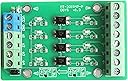
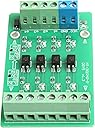
The NOYITO 4-Channel Optocoupler Photoelectric Isolator Module is a compact, high-quality signal converter designed for professional-grade level shifting and isolation between microcontrollers and PLCs. Featuring a 20kHz max conversion frequency, anti-reverse power protection, and LED indicators for easy debugging, it supports multiple voltage levels (3.3V to 24V) and offers versatile compatibility with NPN/PNP signals. Ideal for engineers and makers seeking reliable, modular signal isolation in industrial and embedded systems.
| ASIN | B07TBW8PR5 |
| Best Sellers Rank | #39,187 in Industrial & Scientific ( See Top 100 in Industrial & Scientific ) #53 in Signal Converters |
| Brand | NOYITO |
| Brand Name | NOYITO |
| Compatible Devices | Single chip microcomputer, PLC, NPN, PNP signals |
| Customer Reviews | 4.2 out of 5 stars 8 Reviews |
| Interface | Parallel |
| Interface Type | Parallel |
| Item Dimensions L x W | 3.39"L x 1.89"W |
| Manufacturer | NOYITO |
| Material Type | Copper |
| Maximum Supply Voltage | 24 volts_of_direct_current |
| Minimum Supply Voltage | 3.3 volts |
| Mounting Type | DIN Rail |
| Number of Channels | 4 |
| Number of Items | 1 |
| Number of Packs | 1 |
| Number of Pins | 8 |
| Part Number | fhsru-913 |
| UPC | 680613662736 |
| Unit Count | 1 Count |
| Warranty Description | Manufacturer's One-year After-sale Warranty |
T**R
Great for Raspberry Pi Digital Input
A nice modular solution to getting isolated digital inputs to my Raspberry Pi. The LEDs are a nice touch. Very helpful when you're debugging. You have to do some circuit design to get the inputs powered, but that's to be expected. I use them for digital inputs (like switch contact closures, etc.). I don't use them for analog inputs. I haven't tested them to see if they are linear enough to use as analog inputs and I can't find any documentation on that issue. All-in-all a nifty component to keep on hand for my Raspberry Pi projects. Remember they come in different voltage options that you have to specify when you order them. Looks like the boards are identical with some component value substitutions to get the various voltage levels. There's a little silk-screen checklist where the input and output voltages are marked at the factory. The only thing that would make this product better would be a version that fit the Raspberry Pi like a 'hat' with a stackable GPIO connector and jumpers similar to the relay boards like this: www.amazon.com/gp/product/B07CZL2SKN. As it is, you'll have to solve the mounting problem on your own. I use standoffs and screws to mount them to breadboards.
P**O
Not usable out-of-the-box, but can be fixed easily
I got the 12v to 3.3v. It comes with a 10k pulldown and a 1k in series with a LED pulldown. Low voltage is 700mV, which is higher than most MCU specs for low. It may be detected ok, but it is out of the specs. In the original configuration, it cannot handle over 2kHz without the low voltage increasing to >1V. Adding an additional 500Ohm pulldown fixes the problem and allows to get up to 40kHz. So, 2* because it is a good board for the price and I would buy another one (saves time compared to make a custom PCB). You can fix it easily, but for someone without and oscilloscope, function generator and spare SMD resistors, I would not recommend it. It does not work as advertised. If you need low frequency decoupling and place an additional load resistor at the output, this is a good option.
Trustpilot
3 weeks ago
2 weeks ago