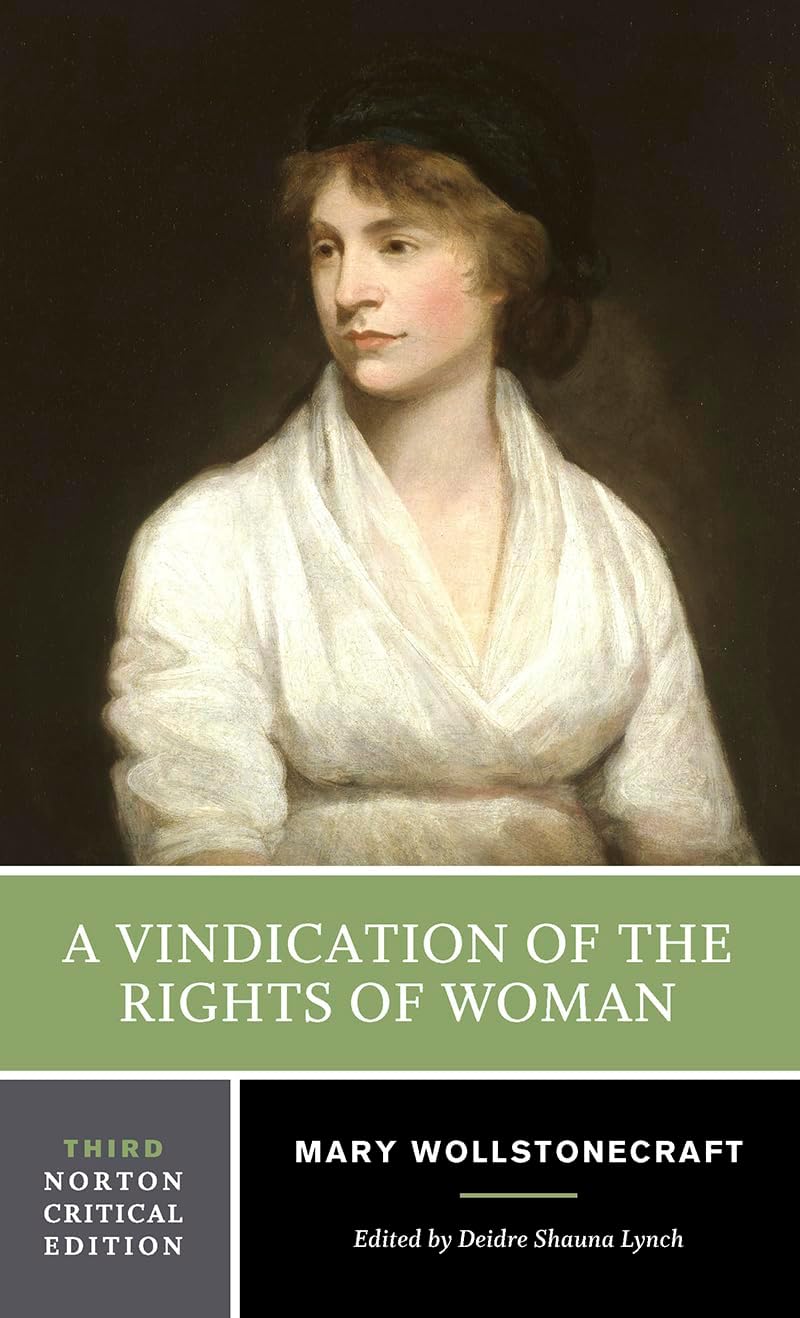
A Vindication of the Rights of Woman (Norton Critical Editions): 0
Product ID: 180244714
Arguably the most original book of the eighteenth century, A Vindication of the Rights of Woman is a pioneering feminist work. Written during a time of great political turmoil, social anxiety, and against the backdrop of the French Revolution, Wollstonecraft’s argument continues to challenge and inspire. This revised and expanded Third Edition is again based on the 1792 second-edition text and is accompanied by revised and expanded explanatory annotations. “Backgrounds and Contexts” is also significantly expanded and contains twenty-four works organized thematically into these groupings: “Legacies of English Radicalism,” “Education,” “Wollstonecraft’s Revolutionary Moment,” and “The Wollstonecraft Debate.” Opinions on a variety of reforms that may be compared and contrasted with Wollstonecraft’s include those by John Milton, John Locke, Mary Astell, Jean-Jacques Rousseau, Hannah More, Richard Price, Edmund Burke, Maria Edgeworth, and William Godwin, among others. “Criticism” includes six seminal essays on A Vindication of the Rights of Woman by Elissa S. Guralnick, Mitzi Myers, Cora Kaplan, Mary Poovey, Claudia L. Johnson, and Barbara Taylor. A Chronology of Wollstonecraft’s life and work and a Selected Bibliography are also included.
| Dimensions | 13.21 x 2.54 x 21.59 cm |
| Edition | Third |
| Isbn 10 | 0393929744 |
| Isbn 13 | 978-0393929744 |
| Item Weight | 1.05 kg |
| Language | English |
| Print Length | 416 pages |
| Publication Date | 24 July 2009 |
| Publisher | W. W. Norton & Company |
User
It is so interesting.
A brilliant piece of literature.
User
Helpful edition of a great feminist classic
Mary Wollstonecraft (1759-1797) followed up her defense of the French Revolution against Edmund Burke in her "Vindication of the Rights of Men" (1791) with a second book, "A Vindication of the Rights of Woman" (1792). It is an extraordinariliy penetrating analysis of the suppression of women in many ways: the withholding of education and concentration on acquiring "accomplishments" that will please men; the blocking of any path to a means of earning their own living instead of having to depend on a husband; the closure of professions, business, politics, and any serious civic career; the corruption of imposing a focus on fashion and even hiring wet-nurses instead of nursing their own children; and most subtly, praising women for beauty, obedience, compliance, instead of for reason and virtue (a demeaning sort of praise). The result of men's domination of women is that women become "cunning" as a way of gaining control even though forced into the role of slaves. Wollstonecraft's account of the endless ways men exert and abuse power over women is penetrating and thorough. It's depressing to realize that almost all of what she says is still relevant! Her style is somewhat clogged--circulocutious, confusingly metaphoric, and often wordier than need be. But the content is so compelling that it repays patient persistence, and virtually every page opens a reader's eyes to some abuse to which he (or perhaps even she) was previously oblivious. A general reader might prefer an edition that simply reprints the text, but as always the Norton Critical Edition gives a reliable text and provides excellent notes, selections from contemporaries that show backgrounds and contexts, a selection of critical commentaries, and a chronology and bibliography. Even if a reader only dips into these materials, I think they make the volume worth the modest price. Most highly recommended!
User
Valuable Reading
Good quality book. A classic, and a must read. Has many fascinating ideas to discuss and think over.
User
Gotta love Norton CEs
I enjoy Norton critical editions because they give so much attention to the critical tradition and to the textual scholarship. Great book!
User
Fine
The book is fine and readable, but half of it is affected by water damage that was not disclosed.
Trustpilot
1 month ago
3 weeks ago
2 weeks ago
3 weeks ago