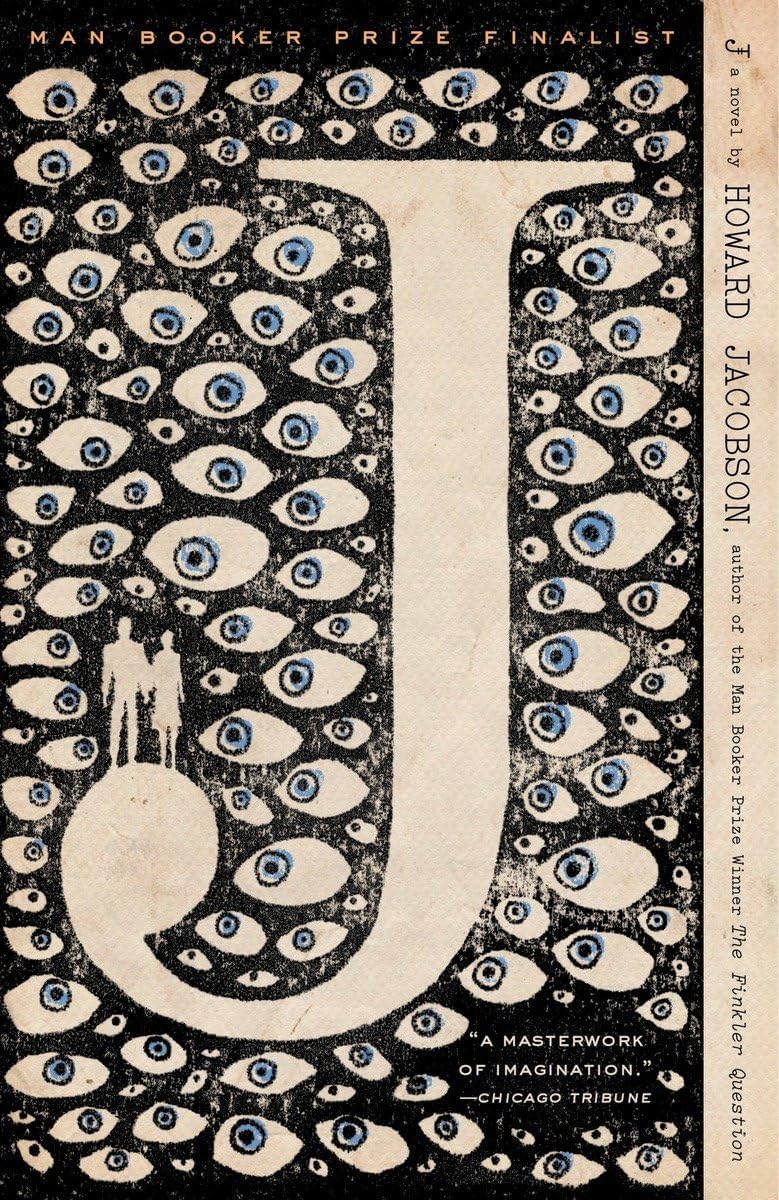
J: A Novel
Product ID: 17685989
Buy anything from 5,000+ international stores. One checkout price. No surprise fees. Join 2M+ shoppers on Desertcart.
Desertcart purchases this item on your behalf and handles shipping, customs, and support to Senegal.
J: A Novel [Jacobson, Howard] on desertcart.com. *FREE* shipping on qualifying offers. J: A Novel Review: Brave, ambitious, stunning, absurd, tragic - I work in a milieu of children, many who have a thought disorder. J is a book about a NATION with a mandatory thought disorder, (at least most of the citizens). The theme of J, which crops up frequently, is, WHAT HAPPENED, IF IT HAPPENED, which would indicate a knowingness, but, for the most part, Jacobson's dystopian world, which takes place in the future (but still the 21st century), is constructed on a foundation of a kind of schizophrenic behavior, but complicit and fraught. The denial-of-reality behavior reminds me of the line in the Matrix, "Did you take the red pill or the blue pill?" This is a nation who took the blue pill--they don't want to know the truth. What is the truth? Read it, and you will realize it, after many oblique twists and turns and drops in the rabbit hole. It is evident that some sinister annihilation of population occurred those several generations ago. But, who? And why? And, the tragedy is, anyone wanting to find out will need to be silenced. In this strange new world, I was also reminded of Orwell's doublethink; the people in this story hold contradictory or paradoxical beliefs, and are at odds with themselves for questioning the societal norms, set by a standard called Project Ishmael, run by a monitoring group called Orfnow. "The overexamined life is not worth living." There's an official monitoring of the public mood, to ensure that everyone is under "moral hypnosis." "A compliant society meant that every section of it consented with gratitude -- the gratitude of the providentially spared." Most of the story takes place in Port Reuben, one of many renamed towns, inhabited by people with renamed (and often ridiculous) surnames. "The past exists in order that we forget it." The central characters, Kevern "Coco" Cohen and his new lover, Ailinn Solomons, might seem paranoid to members of the monitoring group, but they feel something or someone at their heels. It is dangerous to seek too much knowledge. There exists very little technology (except phones for local calls); art, music, and history have been varnished and saturated with the dippy philosophy of annoying optimism. Anything too deep, dark, or knowing is either outlawed--or, if not outlawed legally, it is frowned upon. Yet, ironically, this society is ever the more bleak for not allowing any shadows or clouds to obscure the bright and sunny disposition of life. Even the library books have pages missing, if any suggestion of "J" history is suggested or revealed. Suggestion, implication, intimation--this is how Jacobson slowly peels the layers of this story. The more WHAT HAPPENED, IF IT HAPPENED "folklore" is revealed, the more absurd this Orwellian-esque society becomes to the reader. And, not just absurd, but harrowing. I hesitate to say any more about the book. Like Kevern's father, who would place two fingers in front of his mouth any time he uttered a word beginning with the letter J, I will keep mum about most of this story. It is more a book of ideas than a plot, but the plot in itself is stunning. It is both comical and tragic, chilling, ludicrous, and devastating. Jacobson keeps the humor and tragedy dancing in a delicate balance on the head of a pin. If I have one complaint, it is that he was occasionally repetitive, and the story was strung out a bit sluggishly. However, these are small complaints for such a staggering story. "We've lived through the end of the world," says a character. "This is the aftermath. This is the post-apocalypse." Review: Thoughtful and Thought Provoking - Interesting book about apology, remembering vs forgetting and moving on and about protecting ourselves.from unpleasantness. Colorfully written, and dense with language, this a challenging read, but engaging and unusual. There is some kind of something that has happened but we never find out exactly what it.was, or even for sure IF it was, but the time following is forever affected by it.
| Best Sellers Rank | #2,649,262 in Books ( See Top 100 in Books ) #894 in Jewish Literature & Fiction #12,723 in Fiction Satire #25,591 in Literary Fiction (Books) |
| Customer Reviews | 3.4 3.4 out of 5 stars (591) |
| Dimensions | 5.2 x 0.9 x 8 inches |
| Edition | Reprint |
| ISBN-10 | 0553419560 |
| ISBN-13 | 978-0553419566 |
| Item Weight | 11.2 ounces |
| Language | English |
| Print length | 352 pages |
| Publication date | September 1, 2015 |
| Publisher | Hogarth |
S**N
Brave, ambitious, stunning, absurd, tragic
I work in a milieu of children, many who have a thought disorder. J is a book about a NATION with a mandatory thought disorder, (at least most of the citizens). The theme of J, which crops up frequently, is, WHAT HAPPENED, IF IT HAPPENED, which would indicate a knowingness, but, for the most part, Jacobson's dystopian world, which takes place in the future (but still the 21st century), is constructed on a foundation of a kind of schizophrenic behavior, but complicit and fraught. The denial-of-reality behavior reminds me of the line in the Matrix, "Did you take the red pill or the blue pill?" This is a nation who took the blue pill--they don't want to know the truth. What is the truth? Read it, and you will realize it, after many oblique twists and turns and drops in the rabbit hole. It is evident that some sinister annihilation of population occurred those several generations ago. But, who? And why? And, the tragedy is, anyone wanting to find out will need to be silenced. In this strange new world, I was also reminded of Orwell's doublethink; the people in this story hold contradictory or paradoxical beliefs, and are at odds with themselves for questioning the societal norms, set by a standard called Project Ishmael, run by a monitoring group called Orfnow. "The overexamined life is not worth living." There's an official monitoring of the public mood, to ensure that everyone is under "moral hypnosis." "A compliant society meant that every section of it consented with gratitude -- the gratitude of the providentially spared." Most of the story takes place in Port Reuben, one of many renamed towns, inhabited by people with renamed (and often ridiculous) surnames. "The past exists in order that we forget it." The central characters, Kevern "Coco" Cohen and his new lover, Ailinn Solomons, might seem paranoid to members of the monitoring group, but they feel something or someone at their heels. It is dangerous to seek too much knowledge. There exists very little technology (except phones for local calls); art, music, and history have been varnished and saturated with the dippy philosophy of annoying optimism. Anything too deep, dark, or knowing is either outlawed--or, if not outlawed legally, it is frowned upon. Yet, ironically, this society is ever the more bleak for not allowing any shadows or clouds to obscure the bright and sunny disposition of life. Even the library books have pages missing, if any suggestion of "J" history is suggested or revealed. Suggestion, implication, intimation--this is how Jacobson slowly peels the layers of this story. The more WHAT HAPPENED, IF IT HAPPENED "folklore" is revealed, the more absurd this Orwellian-esque society becomes to the reader. And, not just absurd, but harrowing. I hesitate to say any more about the book. Like Kevern's father, who would place two fingers in front of his mouth any time he uttered a word beginning with the letter J, I will keep mum about most of this story. It is more a book of ideas than a plot, but the plot in itself is stunning. It is both comical and tragic, chilling, ludicrous, and devastating. Jacobson keeps the humor and tragedy dancing in a delicate balance on the head of a pin. If I have one complaint, it is that he was occasionally repetitive, and the story was strung out a bit sluggishly. However, these are small complaints for such a staggering story. "We've lived through the end of the world," says a character. "This is the aftermath. This is the post-apocalypse."
A**M
Thoughtful and Thought Provoking
Interesting book about apology, remembering vs forgetting and moving on and about protecting ourselves.from unpleasantness. Colorfully written, and dense with language, this a challenging read, but engaging and unusual. There is some kind of something that has happened but we never find out exactly what it.was, or even for sure IF it was, but the time following is forever affected by it.
R**E
Disturbing but worth reading
This novel is beautifully written and engaging, though not without flaws. It's both a love story and a dystopian sci-fi novel. At the start, the reader feels a bit disoriented: Where and when are these events taking place, and what is this mysterious event referred to as "WHAT HAPPENED, IF IT HAPPENED"? Clearly we are in some sort of weird future. The world has regressed economically and technologically, and some horrible event has caused a collective erasure of all record of the past. The readers disorientation matches those of the main characters, who are puzzled about their own background and history. It's not giving away too much (because the reader guesses this part early) that the "WHAT HAPPENED" was a second holocaust of some sort. Yet there are many mysteries right at the outset - for example, if the story occurs after a second holocaust, why do all the characters have Jewish names? By the end of the book, some mysteries (such as the one I just mentioned) are cleared up, others are not. I liked the novel, but also found it disturbing. OK, dystopian novels are supposed to be disturbing I guess. But here, too many unanswered questions. How exactly did the world get from now to this imagined future state? Is the backwardness of this future society a cause or an effect of the presumed second holocaust? There's also a disturbing implication in the novel that mankind's nature is inherently evil, and if you try to suppress that (e.g. by banning disturbing art, music, and literature), then the evil will pop out in other ways. I find this a very unsettling notion. Somehow this idea reminds me of a joke that Sarah Silverman tells (just to lighten this review up a bit) that goes like this: She says "If there had been blacks in Nazi Germany, the Holocaust wouldn't have happened". Her straight man asks "How do you figure that?". And she replies "Well, it wouldn't have happened to the Jews, at least". Anyway, "J" is a worthwhile and thought-provoking read.
C**A
Not what you'd call fun.
If you're reading for fun, don't. It's interesting and well-written. The story is a slow burn in which the characters' journeys mostly seem to be a prelude to a fatalistic end. It's almost not plot, but tapestry. And the tapestry is grim and introspective, hence "not fun". For me at least, it was also neither particularly enlightening nor educational. I'm still on the fence as to whether it was edifying in some more nuanced way.
V**A
Excited to begin reading; sad to abandon it
I had such high hopes for this book. However, by 26% in I had lost all interest and had no desire to pick it up again. In fact, in the first few dozen pages, I couldn't wait to resume reading. Imagine a chapter titled, "Twitternacht". Superbly interesting given our current times and communications. But it's a very vague story where the most alluring aspect, what happened to society and why, is only hinted at. Instead, we get two wan characters who can't penetrate their pasts and offer us no reason at all to be concerned about their present or future. Intriguingly, the writing is very fine. Deep, detailed and nice to see for anyone who likes the art of putting words together. But ultimately, so many words require a story what carries the reader through the abstractions. That's just not here. So if you are a reader who requires a story, there are many other books which satisfy that need. This is certainly not one of them, particularly with it's lost premise and promise.
A**R
J is a strange book both to read and review, it is not always intelligible but It always seems important. Other reviewers have expanded on the plot so I will limit myself here to thematic and personal impressions. But initially I must agree with other reviewers that the novel suffers in comparison to the great Dystopia's 1984 and Brave New World, dystopia it may be, a great work of literature perhaps but it is too inaccessible to ever reach the heights of popularity or influence that those novels have. This inaccessibility is perhaps due to the subject matter of the novel, the oppressed group, if it happened that they were oppressed, that is to say, the Jews, Jacobson writes convincingly on this subject but sadly I feel that it is hard to get the majority of readers to care. Traditionally it is has been, and still is acceptable, to demonise the jew as the "other", it is consequently hard to sell a book about the consequences of the demonization of the jew to the majority. There are some wonderful and incredibly insights however, the idea of Twitternacht is one such example, and this is horrifyingly plausible, you only have to pop your head onto social media to see that anti-Semitism, often gathered up in the protective cloak of anti-Zionism, is still alive and well. Could a mass slaughter of jews, or any population happen today, in a modern and civilised society? Judging from the opinions and desires expressed on social media, yes, certainly. These are frightening times. And that is in essence what novel is about, fear, conscious fear or unconscious fear. Fear invades the novel throughout, be it a general sense of unease, such as that of Aileann, a pathological terror like that of Kevern, the nameless dread of his parents, or the impotent fear of discovery. And fear is not a joyful subject to read about. However I can highly recommend this novel and though it is a difficult read it should be read, and I confidently expect that in 20 or so years we will be seeing this book on the school curriculum.
N**R
A mysterious and putatively cataclysmic event described in the book as WHAT HAPPENED…IF IT HAPPENED hangs like a shadow over the love story of two unusual protagonists, Kevern, a worrywart erring too much on the side of caution, and, Ailinn, a wild-haired beauty with an obscure past. The story is set in the future when WHAT HAPPENED…IF IT HAPPENED has marked for humanity the beginning of a new society, a new way of living in which heirlooms and hoardings are discouraged, in which natural beauty in arts is appreciated to abstraction as the expression of creative ideas. But violence and dissent is bubbling beneath the story’s bucolic setting, and as the past of both the protagonists is revealed, it turns out they are individuals less ordinary. A captivating story written not so much in descriptive as in narrative form, ‘J’ is a book that stands out for the power of its language and its biting humour. Many portions of the book left me in stitches. At its heart, it’s a love story set in a world that’s just about taking its bearings. Mind you, it’s not an easy book. But if you work on it, it will reward you well. After finishing this, I immediately moved on to some previous books of Howard Jacobson and plan to read two-three of them back to back. Recommended for a serious reader with a non-serious attitude to life.
A**S
Worth reading? Definitely, but any comparisons with Orwell's 1984 are ambitious if not misplaced. I found the dialogue sometimes difficult to follow and often lost track of who was saying what. The ending too was unconvincing and poorly contrived. It's a good, readable, thought provoking (at times) book but the fact it's on the Booker shortlist says more about the judges than than the worthiness of the book itself..
T**R
Good!
I**A
I don't like the quality of book given to me, the corners were spoilt.
Trustpilot
1 week ago
1 month ago