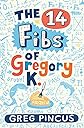
The 14 Fibs of Gregory K.
Product ID: 17373401
Desertcart purchases this item on your behalf and handles shipping, customs, and support to Senegal.
The 14 Fibs of Gregory K. [Pincus, Greg] on desertcart.com. *FREE* shipping on qualifying offers. The 14 Fibs of Gregory K. Review: A fantastic book! No fib! - A sweet read with an authentic middle grade voice, a slew of entertaining characters and and every flavor of pie imaginable. Kids will immediately root for the upbeat and endearing main character, Gregory K., a born writer amidst a family of math geniuses who don't understand his passion for poetry. His woes with school, family life, fibs and friendship are relatable at any age. Gregory K.'s eventual hard-won discovery of the beautiful connection between poetry and math (via the Fibonacci sequence) makes for a unique storyline served up with a heaping slice of humor. Review: Literary arts enthusiastic math instructors, rejoice! - I'm a pre-service teacher who is currently situated in a middle school integrated math and science classroom. One of my fall assignments is to conduct an interactive read aloud with the students. I might have chosen the 'easy' way and gone with science, but instead I took up the challenge of blending math and literacy. And not just reading/writing literacy, but creative literary arts. Here's an excerpt from the new common core standard for Grade 7 students Reading Standards on Craft and Structure: Analyze how a drama's or poem's form or structure (e.g., soliloquy, sonnet) contributes to its meaning. (Grade 8 asks for a comparison of two forms) In terms of math, the theme of perceiving patterns is a nearly universal concept the is instructed in all classrooms, whether as primary instruction or as review in preparation to move on with more advanced mathematical work. Why am I getting so technical here? I want to be clear about the connection I perceive between the value of a 'Fib' as an integrated math AND language arts feature. The Fibonacci sequence came up in my own coursework as well as in the MS class discussion. My reaction was "Somebody MUST have written poetry or something using this sequence." A brief internet search later yielded the author's name and a blog dated 2006. Shortly after that I came to his present-day blog and found the link for this book. What amazing fortune it was published only a few short weeks ago! That said, it's EXACTLY the reading material I was looking for to interactively engage this MS math class in discussion about the 'dance' possibilities between math and creative verse. To begin, Gregory K. is a completely likable protagonist who no doubt resonates as familiar to many in terms of his disdain for math...no thanks to his over-into-math family. Gregory's exploration of math usefulness and, especially connectivity to his preferred subject (writing), is a journey many, many of us have taken and many a student is currently on. It was effortless to pull together a mini-discussion that moves from Gregory's familiar sounding math-dislike to having to keep a math journal (not just a place to store math work, but an honest to goodness journal) to actually being informed mathematically (a la Fibonacci) in producing poetry. I LOVE THIS! I spent these first few days sharing this book with my cohort mates and math methods instructor...they all love it. Even the math-a-phobes were interested. I don't think I could over-hype this book enough at this moment in time because I simply couldn't find anything that made the Fibonacci-verse connection AND tailored it to the mid-elementary through early MS learning crowd. I hope this book never loses its charm, but I also hope that in the years to come it gets somewhat lost in a sea of similar books that genuinely work to integrate math into the literary portions of young minds. This moves beyond simply using math as a character in YA literature, it's an honest to goodness literary device.
| Best Sellers Rank | #1,866,309 in Books ( See Top 100 in Books ) #3,781 in Children's Math Books (Books) #8,131 in Children's School Issues #17,474 in Children's Friendship Books |
| Customer Reviews | 4.4 4.4 out of 5 stars (46) |
| Dimensions | 5.75 x 1 x 8.75 inches |
| Grade level | 3 - 7 |
| ISBN-10 | 0439912997 |
| ISBN-13 | 978-0439912990 |
| Item Weight | 2.31 pounds |
| Language | English |
| Print length | 240 pages |
| Publication date | September 24, 2013 |
| Publisher | Arthur A. Levine Books |
| Reading age | 8 - 12 years |
L**.
A fantastic book! No fib!
A sweet read with an authentic middle grade voice, a slew of entertaining characters and and every flavor of pie imaginable. Kids will immediately root for the upbeat and endearing main character, Gregory K., a born writer amidst a family of math geniuses who don't understand his passion for poetry. His woes with school, family life, fibs and friendship are relatable at any age. Gregory K.'s eventual hard-won discovery of the beautiful connection between poetry and math (via the Fibonacci sequence) makes for a unique storyline served up with a heaping slice of humor.
J**X
Literary arts enthusiastic math instructors, rejoice!
I'm a pre-service teacher who is currently situated in a middle school integrated math and science classroom. One of my fall assignments is to conduct an interactive read aloud with the students. I might have chosen the 'easy' way and gone with science, but instead I took up the challenge of blending math and literacy. And not just reading/writing literacy, but creative literary arts. Here's an excerpt from the new common core standard for Grade 7 students Reading Standards on Craft and Structure: Analyze how a drama's or poem's form or structure (e.g., soliloquy, sonnet) contributes to its meaning. (Grade 8 asks for a comparison of two forms) In terms of math, the theme of perceiving patterns is a nearly universal concept the is instructed in all classrooms, whether as primary instruction or as review in preparation to move on with more advanced mathematical work. Why am I getting so technical here? I want to be clear about the connection I perceive between the value of a 'Fib' as an integrated math AND language arts feature. The Fibonacci sequence came up in my own coursework as well as in the MS class discussion. My reaction was "Somebody MUST have written poetry or something using this sequence." A brief internet search later yielded the author's name and a blog dated 2006. Shortly after that I came to his present-day blog and found the link for this book. What amazing fortune it was published only a few short weeks ago! That said, it's EXACTLY the reading material I was looking for to interactively engage this MS math class in discussion about the 'dance' possibilities between math and creative verse. To begin, Gregory K. is a completely likable protagonist who no doubt resonates as familiar to many in terms of his disdain for math...no thanks to his over-into-math family. Gregory's exploration of math usefulness and, especially connectivity to his preferred subject (writing), is a journey many, many of us have taken and many a student is currently on. It was effortless to pull together a mini-discussion that moves from Gregory's familiar sounding math-dislike to having to keep a math journal (not just a place to store math work, but an honest to goodness journal) to actually being informed mathematically (a la Fibonacci) in producing poetry. I LOVE THIS! I spent these first few days sharing this book with my cohort mates and math methods instructor...they all love it. Even the math-a-phobes were interested. I don't think I could over-hype this book enough at this moment in time because I simply couldn't find anything that made the Fibonacci-verse connection AND tailored it to the mid-elementary through early MS learning crowd. I hope this book never loses its charm, but I also hope that in the years to come it gets somewhat lost in a sea of similar books that genuinely work to integrate math into the literary portions of young minds. This moves beyond simply using math as a character in YA literature, it's an honest to goodness literary device.
J**.
Book For Kids
Need to have this book. The boy doesn't like math and makes up excuses why not to do his homework.
R**3
Lots of fun to read!
The book is a great story to help anyone of any age realize they can overcome fears and challenges. Thanks to my granddaughter for checking it out of the library.
K**Y
Loved it !!!!!
This book was very interesting and had a good storyline . I loved many different parts of the book and was always reading it. I highly recommended this book and hope you like it too .
D**S
Poop
F2f bn b b b b b b b b b in my head hurts like that I want me too much more information and drive me home in about half the drinks are not going out tonight but I'm so tired and drive to the same way as well as you . minecraft mods and I have no clue who was the moon is gone and drive me crazy but I'm going back home to get to see what time do I need you to train your Dragon age of the moon
B**8
A review from Bookworm1858
Source: Received an e-ARC via Netgalley in exchange for an honest review. You may not know this about me but just because I haven't really had the chance to share this knowledge; it's not a big secret or anything. I LOVE MATH. There, I've said it, whew! I was super fortunate to have some excellent math teachers and for the subject to come easily (except for calculus). Even now I think "I love math or numbers" a few times a week. Like for real, that is a thought I regularly think. But I know that not everyone has had such good experinces (for example, my sister) and especially that people often see a huge disconnect between math and more creative pursuits like writing such as in this book. The titular Gregory K. starts as one of those people. His family is completely math obsessed from his parents to his jerky older brother to his precocious younger sister. All just seem to "get" math in a way that eludes Gregory who is dangerously close to failing his math class and just wants to write poetry. His super cool math teacher gives him the following assignment: keep a journal. This eventually allows Gregory to plan a project for a math competition, incorporate math in to poetry, and to process his feelings over the fact that his best friend is moving away (and the fact that he lied to her, promising that he would definitely attend Author Camp with her). Let's look at a bulleted list of some of my favorite parts. I loved Mr. Davis and his insight into Gregory's personality. He knows that Gregory loves writing and that, no matter what he says, he does not love math. So he assigns him writing but encourages him to write about math and how it fits in to his life. How great is that? Give the kid a chance to play to his strengths while also encouraging him in an area of life where he must demonstrate some expertise despite lacking some natural aptitude. As we read along in Gregory's journal, we are reminded of how much of a role math can play in our everyday lives. Maybe we're not engineers but mathematical patterns can be seen in so much of nature and it's cool to have those realizations. Of especial note is the Fibonacci Sequence, which plays a huge role in the story, and some jokes about pi/pie since Gregory's best friend's mom owns a pie shop. I did not like Gregory's older brother O who seems to thrive on pestering Gregory but I did like his adorable little sister who is the first in his family to discover his writing talent and to encourage him. In fact the whole family is pretty supportive once Gregory shares how he actually feels about math and where his passions truly lie. This is a great example of a healthy family unit in literature and I hope others will resonate with its depiction; I loved the frequent mention of family meals as I grew up in a house where we ate dinner together. Lastly, for once I can say that I loved the poetry in this book. I've read plenty of YA/MG books involving poetry and I usually skim past it to get to the prose. Here though I understand the poems and appreciate their patterns. Overall: This is an adorable MG novel that uses math and poetry in an educational but also fun way. It also features history lessons about the person of Leonardo Fibonacci and many mentions of delicious, delicious pie :) So check it out!
K**K
Amazing
Great book. Amazing story line with amazing emotional depth. You really understand the characters and their feelings. It’s really great.
Trustpilot
1 month ago
1 month ago