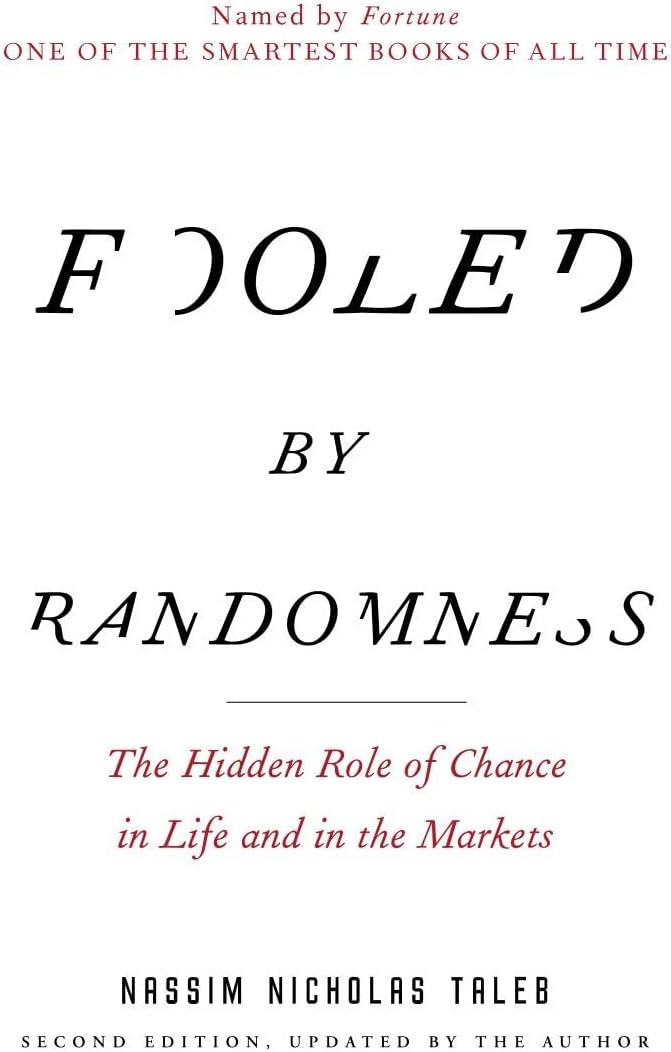
Fooled by Randomness: The Hidden Role of Chance in Life and in the Markets (Incerto)
Product ID: 1699799
Desertcart purchases this item on your behalf and handles shipping, customs, and support to Senegal.
Fooled by Randomness is a standalone book in Nassim Nicholas Taleb’s landmark Incerto series, an investigation of opacity, luck, uncertainty, probability, human error, risk, and decision-making in a world we don’t understand. The other books in the series are The Black Swan, Antifragile, Skin in the Game, and The Bed of Procrustes . Fooled by Randomness is the word-of-mouth sensation that will change the way you think about business and the world. Nassim Nicholas Taleb–veteran trader, renowned risk expert, polymathic scholar, erudite raconteur, and New York Times bestselling author of The Black Swan –has written a modern classic that turns on its head what we believe about luck and skill. This book is about luck–or more precisely, about how we perceive and deal with luck in life and business. Set against the backdrop of the most conspicuous forum in which luck is mistaken for skill–the world of trading– Fooled by Randomness provides captivating insight into one of the least understood factors in all our lives. Writing in an entertaining narrative style, the author tackles major intellectual issues related to the underestimation of the influence of happenstance on our lives. The book is populated with an array of characters, some of whom have grasped, in their own way, the significance of chance: the baseball legend Yogi Berra; the philosopher of knowledge Karl Popper; the ancient world’s wisest man, Solon; the modern financier George Soros; and the Greek voyager Odysseus. We also meet the fictional Nero, who seems to understand the role of randomness in his professional life but falls victim to his own superstitious foolishness. However, the most recognizable character of all remains unnamed–the lucky fool who happens to be in the right place at the right time–he embodies the “survival of the least fit.” Such individuals attract devoted followers who believe in their guru’s insights and methods. But no one can replicate what is obtained by chance. Are we capable of distinguishing the fortunate charlatan from the genuine visionary? Must we always try to uncover nonexistent messages in random events? It may be impossible to guard ourselves against the vagaries of the goddess Fortuna, but after reading Fooled by Randomness we can be a little better prepared. Named by Fortune One of the Smartest Books of All Time A Financial Times Best Business Book of the Year Review: Immensely Entertaining, and Wisely Instructive Too - Taleb is one of a kind and has ascended to becoming one of my very favorite thinker-writers. This is partly because I've myself been interested in this subject matter (uncertainty, probability, risk, judgement, decision making, etc.) for more than two decades, but also because Taleb makes original and valuable contributions to the subject, and does it with an immensely entertaining writing style. The book is too wide ranging to summarize its content in a review, but perhaps the main lesson is that we humans are inherently prone to being irrational in various ways (usually without realizing it), particularly when it comes to adequately judging risks (and opportunities) and thereby making appropriate decisions in the face of uncertainty. We're especially prone to underestimating how often outliers ("black swans") can occur and how severe their consequences can be ("blowing up" in the case of traders). A corollary is that we often underestimate the role of luck (good and bad) in shaping outcomes, and instead overestimate the role of our decisions. Though we can't eliminate our tendency toward irrationality, we can at least be aware of it, and thereby deploy some "tricks" to help control it or compensate for it. My thoughts on this book largely echo my review of Taleb's The Black Swan: The Impact of the Highly Improbable , and both books are similar in content and style, though The Black Swan: The Impact of the Highly Improbable is perhaps a bit more flamboyant (in a good way). To be more specific: - Taleb is confident and may sometimes seem condescending, but his erudition is undeniable, and a strong case can be made for his iconoclastic brilliance as well. In a book like this, perhaps the usual modesty and humility don't make sense. - He's dismissive of those he disagrees with (even Nobel prize winners), and could be accused of oversimplifying their positions, but his criticisms actually seem to have a lot of validity, and recent financial events seem to have significantly (and unfortunately) vindicated him. - He often circles around his points, but his refusal to get right to the point pushes you to think more deeply about the implications of his ideas, rather than just quickly saying "yes, that's obvious, so what?" - His frequent digressions make it harder for the reader to follow the thread of his narrative, but the digressions are fun and many are quite insightful. For an open-minded person with an intellectual inclination, this can be a very gripping book. - I do think the more technical discussions should have been more clear and precise. I guess Taleb tried to "dumb down" the book to reach a broad audience. - Many of the ideas in the book aren't original to Taleb, but the way he's woven them together and presented them with flourish certainly is, resulting in the ideas having lasting impact on the reader. - His suggestions on investing aren't very specific, but this is a book about being fooled by randomness in general, not investing in particular. And Taleb's general advice to arrange safeguards against financial disaster, and also get exposure to potentially huge opportunities, certainly seems sensible. As with The Black Swan: The Impact of the Highly Improbable , the bottom line is that this book is truly unique in its ability to intellectually entertain while conveying some deep insight and wisdom. Few people in the world have the right intersection of ingredients to produce a book like this, so we should cherish the fact that the book exists. Even if you don't fully agree with him, Taleb is worth engaging with. For readers who like this book and also have a strong interest in science, I also suggest Chance and Chaos by David Ruelle. Very highly recommended. In fact, ignore this book at your peril. Review: How We Are All Fools of Randomness - By Mayur Patel How We Are All Fools of Randomness This book was not the simplest book I have ever read, but very insightful for the market trader/investor. I will provide a little insight of my own into the realm of Nassim Taleb. I enjoyed the fact that the author explained concepts of the financial nature in the most basic manner. For a person not to savvy in financial terminology the book was readable, it was actually other topics that the author randomly introduced that was a little harder to read. The book is about how people, who invest in or trade in the market, fail or succeed due to factors outside of their control. The author brings to light many concepts that people more often than not overlook. The author provides countless examples to break his concepts down into a comprehensible level. One point that is emphasized throughout the book is that most people fall into a trap of luck. Taleb started his book by introducing Solon, a Greek legislator. He began his book with Solon, because of Solon's wisdom, "...to admire a man's happiness that may yet, in course of time, suffer change. For the uncertain future has yet to come, with all variety of future; and him only to whom the divinity has[guaranteed] continued happiness until the end we may call happy."(Taleb 3). Then the author explained how people could do everything right, but still fail. This was due to a randomness factor. These factors can be a natural disaster, an election, a terrorist attack, etc. People can crunch every number in the world to until their fingers bleed, but still fail. People can have tips and inside knowledge, but still fail. The author stresses this idea of randomness and repetitively intertwines it into the different scenarios presented into this book. The beginning of the book, the concept of randomness was introduced via two characters Nero and John. Taleb shows how randomness affects both characters that are of opposite mindsets. He later tells of how people's decisions are affected by emotions. He demonstrates this by telling of an experiment done, where a person is alleviated from his emotions. The emotion stricken person was not even able to complete the simplest tasks. The author spoke of emotions, because without it people would get nothing accomplished, on the other hand, with emotions, people can act irrationally which leads to bad decisions. The author makes his position on journalist in his field quite clear. Without hesitation, his detestation for journalist simmered throughout the pages. The author does not agree with journalist, because they are people who are inexperienced in the financial field, yet write about it; they fail to understand randomness. Then their idiocracy(yes I know this is made up, but fits the situation so well) is then consumed by their readers, who take the written fallacies to heart, which can lead to inadequate decisions. Next, Taleb speaks of a Monte Carol engine, which I have gathered as something to produce data of scenarios ran a countless amount of times, with random situations passed into the scenarios every time. The author preferred Monte Carlo methods, because he could care less about the ideas behind mathematics, but only the application. I found this a little intriguing that a person that is so knowledgeable in the financial field, which deals mainly with numbers, does not care for the properties of mathematics. The next topic the author presents is the association of Darwinism and companies. Companies cannot be viewed in the survival of the fittest manner, because the Darwinian ideas cannot and do not accommodate for randomness, which we learn from this book is a big part of the business world. Randomness can be either good or bad, essentially it will all come down to luck. A person will be either lucky or unlucky, but the author explains that eventually it will reverse itself and the unlucky will become lucky and the lucky become unlucky. Taleb introduces many significant subject matter experts throughout the book to support his claim of people being fooled by randomness. I feel as if the author was a bit random himself. The way the text was presented seemed a little unorthodox to me. The author would present a subject, talk about it, provide examples about it, but then the next topic would be totally off on some other tangent, while all in the same chapter. I'm not even sure if everything written in the book could be tied back to randomness in some manner, but that I will go ahead and assume is to be blamed on my inexperience on the subject matter. The structure of the book is one thing I did not agree with. Although, this is the style of writing the author may have intended. I believe the book was well conversed and definitely and eye opener. Taleb did well in explaining complex material in a simplified fashion. I enjoyed all of the examples presented in the book; I felt they gave the book some character. I understand I cannot be considered a person well versed in the financial world, so everything written here completely opinion based. The main piece of knowledge I can confidently say I have gained from this book is that there is nothing that can be done to tame this unforgiving beast that is randomness. For a book whose topic is of a subject that, I believe, many would consider of a dull nature was quite interesting. The book kept my interest with its comprehensible examples and insightful views. I definitely would recommend this book to anyone that has dealings in the economic world. Actually, I honestly believe this book could just about relate to anyone and everyone, because randomness is part of everyone's lives. I did not ever consider randomness to ever be as big of a factor in life as, I know it is, now. I will take the knowledge gained from reading this book and hopefully put it to good use.
| Best Sellers Rank | #14,673 in Books ( See Top 100 in Books ) #1 in Business Statistics #5 in Statistics (Books) #31 in Finance (Books) |
| Customer Reviews | 4.4 out of 5 stars 6,693 Reviews |
C**R
Immensely Entertaining, and Wisely Instructive Too
Taleb is one of a kind and has ascended to becoming one of my very favorite thinker-writers. This is partly because I've myself been interested in this subject matter (uncertainty, probability, risk, judgement, decision making, etc.) for more than two decades, but also because Taleb makes original and valuable contributions to the subject, and does it with an immensely entertaining writing style. The book is too wide ranging to summarize its content in a review, but perhaps the main lesson is that we humans are inherently prone to being irrational in various ways (usually without realizing it), particularly when it comes to adequately judging risks (and opportunities) and thereby making appropriate decisions in the face of uncertainty. We're especially prone to underestimating how often outliers ("black swans") can occur and how severe their consequences can be ("blowing up" in the case of traders). A corollary is that we often underestimate the role of luck (good and bad) in shaping outcomes, and instead overestimate the role of our decisions. Though we can't eliminate our tendency toward irrationality, we can at least be aware of it, and thereby deploy some "tricks" to help control it or compensate for it. My thoughts on this book largely echo my review of Taleb's The Black Swan: The Impact of the Highly Improbable , and both books are similar in content and style, though The Black Swan: The Impact of the Highly Improbable is perhaps a bit more flamboyant (in a good way). To be more specific: - Taleb is confident and may sometimes seem condescending, but his erudition is undeniable, and a strong case can be made for his iconoclastic brilliance as well. In a book like this, perhaps the usual modesty and humility don't make sense. - He's dismissive of those he disagrees with (even Nobel prize winners), and could be accused of oversimplifying their positions, but his criticisms actually seem to have a lot of validity, and recent financial events seem to have significantly (and unfortunately) vindicated him. - He often circles around his points, but his refusal to get right to the point pushes you to think more deeply about the implications of his ideas, rather than just quickly saying "yes, that's obvious, so what?" - His frequent digressions make it harder for the reader to follow the thread of his narrative, but the digressions are fun and many are quite insightful. For an open-minded person with an intellectual inclination, this can be a very gripping book. - I do think the more technical discussions should have been more clear and precise. I guess Taleb tried to "dumb down" the book to reach a broad audience. - Many of the ideas in the book aren't original to Taleb, but the way he's woven them together and presented them with flourish certainly is, resulting in the ideas having lasting impact on the reader. - His suggestions on investing aren't very specific, but this is a book about being fooled by randomness in general, not investing in particular. And Taleb's general advice to arrange safeguards against financial disaster, and also get exposure to potentially huge opportunities, certainly seems sensible. As with The Black Swan: The Impact of the Highly Improbable , the bottom line is that this book is truly unique in its ability to intellectually entertain while conveying some deep insight and wisdom. Few people in the world have the right intersection of ingredients to produce a book like this, so we should cherish the fact that the book exists. Even if you don't fully agree with him, Taleb is worth engaging with. For readers who like this book and also have a strong interest in science, I also suggest Chance and Chaos by David Ruelle. Very highly recommended. In fact, ignore this book at your peril.
M**L
How We Are All Fools of Randomness
By Mayur Patel How We Are All Fools of Randomness This book was not the simplest book I have ever read, but very insightful for the market trader/investor. I will provide a little insight of my own into the realm of Nassim Taleb. I enjoyed the fact that the author explained concepts of the financial nature in the most basic manner. For a person not to savvy in financial terminology the book was readable, it was actually other topics that the author randomly introduced that was a little harder to read. The book is about how people, who invest in or trade in the market, fail or succeed due to factors outside of their control. The author brings to light many concepts that people more often than not overlook. The author provides countless examples to break his concepts down into a comprehensible level. One point that is emphasized throughout the book is that most people fall into a trap of luck. Taleb started his book by introducing Solon, a Greek legislator. He began his book with Solon, because of Solon's wisdom, "...to admire a man's happiness that may yet, in course of time, suffer change. For the uncertain future has yet to come, with all variety of future; and him only to whom the divinity has[guaranteed] continued happiness until the end we may call happy."(Taleb 3). Then the author explained how people could do everything right, but still fail. This was due to a randomness factor. These factors can be a natural disaster, an election, a terrorist attack, etc. People can crunch every number in the world to until their fingers bleed, but still fail. People can have tips and inside knowledge, but still fail. The author stresses this idea of randomness and repetitively intertwines it into the different scenarios presented into this book. The beginning of the book, the concept of randomness was introduced via two characters Nero and John. Taleb shows how randomness affects both characters that are of opposite mindsets. He later tells of how people's decisions are affected by emotions. He demonstrates this by telling of an experiment done, where a person is alleviated from his emotions. The emotion stricken person was not even able to complete the simplest tasks. The author spoke of emotions, because without it people would get nothing accomplished, on the other hand, with emotions, people can act irrationally which leads to bad decisions. The author makes his position on journalist in his field quite clear. Without hesitation, his detestation for journalist simmered throughout the pages. The author does not agree with journalist, because they are people who are inexperienced in the financial field, yet write about it; they fail to understand randomness. Then their idiocracy(yes I know this is made up, but fits the situation so well) is then consumed by their readers, who take the written fallacies to heart, which can lead to inadequate decisions. Next, Taleb speaks of a Monte Carol engine, which I have gathered as something to produce data of scenarios ran a countless amount of times, with random situations passed into the scenarios every time. The author preferred Monte Carlo methods, because he could care less about the ideas behind mathematics, but only the application. I found this a little intriguing that a person that is so knowledgeable in the financial field, which deals mainly with numbers, does not care for the properties of mathematics. The next topic the author presents is the association of Darwinism and companies. Companies cannot be viewed in the survival of the fittest manner, because the Darwinian ideas cannot and do not accommodate for randomness, which we learn from this book is a big part of the business world. Randomness can be either good or bad, essentially it will all come down to luck. A person will be either lucky or unlucky, but the author explains that eventually it will reverse itself and the unlucky will become lucky and the lucky become unlucky. Taleb introduces many significant subject matter experts throughout the book to support his claim of people being fooled by randomness. I feel as if the author was a bit random himself. The way the text was presented seemed a little unorthodox to me. The author would present a subject, talk about it, provide examples about it, but then the next topic would be totally off on some other tangent, while all in the same chapter. I'm not even sure if everything written in the book could be tied back to randomness in some manner, but that I will go ahead and assume is to be blamed on my inexperience on the subject matter. The structure of the book is one thing I did not agree with. Although, this is the style of writing the author may have intended. I believe the book was well conversed and definitely and eye opener. Taleb did well in explaining complex material in a simplified fashion. I enjoyed all of the examples presented in the book; I felt they gave the book some character. I understand I cannot be considered a person well versed in the financial world, so everything written here completely opinion based. The main piece of knowledge I can confidently say I have gained from this book is that there is nothing that can be done to tame this unforgiving beast that is randomness. For a book whose topic is of a subject that, I believe, many would consider of a dull nature was quite interesting. The book kept my interest with its comprehensible examples and insightful views. I definitely would recommend this book to anyone that has dealings in the economic world. Actually, I honestly believe this book could just about relate to anyone and everyone, because randomness is part of everyone's lives. I did not ever consider randomness to ever be as big of a factor in life as, I know it is, now. I will take the knowledge gained from reading this book and hopefully put it to good use.
S**Y
Not a "how to win" book — a "how to not fool yourself" book (and that's better)
If you're looking for a system to learn how to achieve stock market wins, this book is not about that. It is about something more valuable and more humbling: understanding how much of what looks like skill — in markets and in life — is actually just luck in disguise, and how badly wired our brains are to see the difference. Taleb's core message boils down to one idea: you can win almost every time and still be ruined, because the rare loss can outweigh all the frequent wins combined. So the smart question isn't "will this go up?" but "if I'm wrong, can I survive it?" Everything supports that single shift — survivorship bias (you only ever see the winners, never the pile of losers who took the same bet), the black swan (a million calm days never prove you're safe, but one crash proves you never were), and the reminder that a great track record means little until you count how many people were trying. Fair warning: the writing is dense and jargon-heavy, and I had to read some chapters twice — but the ideas underneath are simpler than his prose makes them feel, and they stick. What I appreciated most is the honesty of the ending: Taleb admits he's just as prone to being fooled as everyone he mocks, the only difference being that he knows it, so instead of trying to out-willpower his emotions he just blocks the temptation. You can't out-think your own wiring; you can only build guardrails against it. If you want a trading system, look elsewhere. If you want to become a wiser, more survival-minded thinker who stops mistaking luck for skill, this is essential — it won't teach you how to win, it'll teach you how to not get wiped out, which over a long enough life matters far more. Bet small to live another day.
G**R
A Book Worth Reading More Than Twice
Using his trademark aphoristic bent, Friedrich Nietzsche wrote: "Arrogance in persons of merit affronts us more than arrogance in those without merit: merit itself is an affront". I've come to realize that some people find Nassim Taleb's arrogance quite repugnant, but, personally, I find it rather charming. I suspect that the same people who find Taleb's arrogance off-putting are the people who wish they possessed a shred of his erudition. Nietzsche was certainly on to something; it's hard to avoid being offended by your betters. I think I first read "Fooled By Randomness" circa 2006. Recently, I felt a longing to reread Taleb's first non-technical book again. Wow, what a wise decision that was! I actually digested more from the rereading than I did from the initial reading (and I digested quite a bit from the first reading). Both times, I focused on reading the book very, very slowly. Obviously, the fact that I spent the time to reread this book is indicative of how valuable I think it is. Known for his great wit, the baseball pitcher Vernon Louis "Lefty" Gomez was fond of saying that, "I'd rather be lucky than good." This phrase, in essence, is one of the central themes of the book. Although it sounds like a hackneyed platitude, Gomez, understood the role of randomness in our lives. However, due to myriad biases, we humans often tend to attribute our successes to our skill and blame bad luck for our failures. Is your rich neighbor or your boss really as skilled as she thinks she is? Parts of the book are also about the hindsight bias and the narrative fallacy. We humans are great at fabricating post hoc narratives about our world. It's how we understand (and misunderstand) the world, but we must remember not to take our stories too seriously. "A mistake is not something to be determined after the fact," writes Taleb, "but in the light of the information until that point." One of Taleb's favorite philosophers is Karl Popper. However, Taleb wasn't always enthralled with the man who espoused the beauty of empirical falsification. Prior to rediscovering the great philosopher, Taleb went through a self identified anti-intellectual phase early in his career as a trader. He feared becoming a corporate slave with "work ethics" (a term which he interprets to mean inefficient mediocrity). "Philosophy, to me," Taleb writes, "became something rhetorical people did when they had plenty of time on their hands; it was an activity reserved for those who were not well versed in quantitative methods and other productive things. It was a pastime that should be limited to late hours, in bars around the campuses, when one had a few drinks and a light schedule -- provided one forgot the garrulous episode as early as the next day. Too much of it can get a man in trouble, perhaps turn one into a Marxist ideologue." As they say, the dose determines the poison. Speaking of poison, another interesting idea that Taleb espouses is that being too attached your beliefs is poisonous. As he puts it: "Loyality to ideas is not a good thing for traders, scientists, -- or anyone". I like to think about it this way, there are times we shouldn't trust experts precisely because they are experts. This is because they are no incentives to be brutally critical of your own ideas. A scientist or a preacher who has built their career on a certain idea obviously has a lot invested in that idea. How likely are they to be critical of their own position when their livelihood depends on it being accepted? What if they are putting out pseudo-scientific nutritional guidelines that cause harm, but help them keep their job? According to Popper there are only two types of theories: 1) Theories that are known to be wrong, as they were tested and adequately rejected (he calls them falsified). 2) Theories that have not yet been known to be wrong, not falsified yet, but are exposed to be proved wrong. If you accept Popper's epistemology, like I also do, you can never claim that you know a theory to be true. In other words, we can only gain knowledge through proving that things are false. For instance, when I accidentally find myself in a theistic debate, people often challenge me to tell them how the universe came into existence. When I say `I don't know', they become infuriated. How dare I have the gall to dismiss some of their religion's claims as not true without projecting my own claim to reality? Yet, that's exactly the point. I gain knowledge through knowing what's wrong, not through making claims about what I think is right. So what should we make of Taleb's extreme and obsessive Popperism in a more practical sense? How does he recommend we apply to it our lives? I think it can be summarized in the following passage: I speculate in all of my activities on theories that represent some vision of the world, but with the following stipulation: No rare event should harm me. In fact, I would like all conceivable rare events to help me. My idea of science diverges with that of the people around me walking around calling themselves scientists. Science is mere speculation, mere formulation of conjecture. The following thought experiment really helped me internalize this message. Assume you participate in a gambling game that has 999/1000 chance of winning $1 [Event A] and a 1/1000 chance of winning $10,000 [Event B]. Using some straightforward calculations the expectation of a loss is roughly $9 (multiply the probabilities by the outcome for each event and then sum them) Which event would you bet on? I suspect that most people consider the frequency or probability in their decision, but this is totally irrelevant. According to Taleb, even people like MBAs and economists with some statistical training fail to understand this point. The magnitude of the outcome should be the only relevant factor in the decision. Think of a trader who focuses on event B, sure, he is likely to bleed slowly for long periods of time, but when the rare event happens the payoff is astronomical compared to the losses. Most of us, however, are schooled in environments that focus on games with symmetrical outcomes (e.g., a coin toss). The great psychologist and father of behavioral economics, Daniel Kahneman, also reminds us that we are loss averse and psychologically struggle with idea of bleeding out small losses for extended periods of time, even if there is eventually the opportunity for a huge payday. Once you realize that life is full of scenarios with asymmetrical payoffs, you're thinking (if you're anything like me anyway) will be permanently altered. In fields like, say, writing, the outcomes are asymmetrical. In other words, there is not a linear relationship with the number of hours spent writing and the amount of income one makes. One may spend a long time writing for free and then finally catch a huge book deal. For me, this is somewhat of a moot point because I'd write for free without any other justification other than the fact that it's fun and makes me happy. However, if all other things were equal, and I could also make money doing something I love, I would be very happy. Here's another piece of practical wisdom that I really enjoyed: "stay away from people of a competitive nature, as they have a tendency to commoditize and reduce the world to categories, like how many papers they publish in a given year, or how they rank in the league tables." These are the same kinds of people who think that their GPA reflects their intelligence. Or that the number of hours they spend running on a treadmill reflects their fitness. Or that their inherited wealth says something about their genetic fitness. Or that their expensive clothes make them beautiful. I could continue on and on, but I think you get the point. I often hear those around me complaining about how life will be better when they achieve "X". Alas, I'm human and guilty of making claims like this on occasion too. The trouble is that, for most of us anyway, we won't really experience long-term improvements in our happiness when we achieve "X". Throughout the book, Taleb devotes a fair amount of time alerting readers of what the literature in behavioral economics tells us about our irrational tendencies and biases. For example, there's the social treadmill effect: you get rich, move to rich neighborhoods, then become poor again once you compare yourself to your new peers. Then, you may work your ass off and get rich again, only to repeat the cycle. If you want to feel worse about yourself, then the best piece of positive advice I know of is to hang around people who are wealthier than you. I often try to remind myself that I'm living a life that is materially better than 99.9% of all humans that have ever existed and yet I still have the audacity to claim that I don't have enough sometimes. Pathetic. At one point in the book, Taleb writes: "I see no special heroism in accumulating money, particularly if, in addition, the person is foolish enough to not even try to derive any tangible benefit from wealth (aside from the pleasure of regularly counting the beans)". In other words, money is only valuable if you use it as a tool to extract enjoyment from life. If it isn't clear, I think he is making reference to the likes of Warren Buffett, whom people tend to see as being virtuous simply for the fact that he has been able to accumulate hordes of money. What I think many people fail to understand is that there is nothing virtuous about having money just for the sake of having it. How someone earned what they have tells you a lot more about them than how much they have. We generally tend to think that having money signals other traits about a person, but I'll remind you that there is a lot of noise in those signals (think inheritance). Having money doesn't necessarily signal any superior traits. Those who want to make a lot of money are greedy and shouldn't try to deny that motivation. Greed, however, is not necessarily a bad thing. As Adam Smith taught us, another mans' greed can create more wealth for society as a whole (provided the individual's wealth is ethically obtained). Do cigarette smokers understand probabilities? If so, how can they rationally understand the ills of cigarettes and yet be foolish enough to smoke them anyway? When I go for walks near hospitals I'm always surprised by the number of people in scrubs (perhaps some of whom are doctors and nurses) who I assume are well aware of how harmful cigarettes are, but smoke them anyway. Apparently, intellectually understanding something and being able to put it into practice are two different things. One thing Taleb also writes about is the selection bias in blogging and book reviewing. The cover of my edition of Fooled By Randomness has an excerpt praising Taleb as one of the "hottest thinkers" in the world. While I certainly agree, I couldn't help but smirk after reading that line -- can you say selection bias? Any book that is worth reading twice is worth reading more than twice. When you love a writer, you want to hear his opinion on just about everything. - See more at: [...]
T**Y
Fooled By Randomness...And Big Words
Taleb's 'Fooled By Randomness' is nothing short of an awareness-raising collection of anecdotes, cautioning the dangers of overlooked randomness. Every chapter provides ample details to inform the reader of unforeseeable events - both good and bad. Before I delve too deep into the review of this book, I feel it's important to know who the reader is. For instance, financial structures and markets are far from my comfort zone. I am not an overly-active reader with an obnoxiously expansive vocabulary. I am an engineering student (mediocre at best...) who decided to read this book in order to gain an understanding of how randomness intertwines with the market. If you are someone of great intelligence in regards to stocks and the markets, this review is probably going to be irrelevant to you. Otherwise, this review is written from the standpoint of an average guy. The first thing to know before reading this novel is the structure of the book itself. There are fourteen chapters in which Taleb does a good job hammering the point home - borderline beating a dead horse. The chapters themselves are well-written but seem to have no particular order to the book as a whole. For instance, if you were to read the book backwards (chapter 14 on down), I don't think you would ever noticed you were reading it in reverse - though the overall point and theme would have been received just as well. I'm not sure if that's a sign of an incredibly well-written book or a unorganized collection of thoughts and stories. Also, Taleb has a tendency to use 13 words to describe a 2 word event. Albeit very descriptive, every sentence could probably be reduced by half. Taleb is clearly the intellectually superior between he and I, for I have to look up every third word he writes. Initially, this book grabbed my attention. All of the facts were interesting and really got me thinking about the role randomness not only in the markets, but in our everyday lives. The opening chapters compared two brokers with two different personal as well as professional approaches towards life. One being high-risk and high-reward while the other was conservative and consistent. My emotional side liked the high-risk trader, while my logical side related to the conservative trader. After all, Hollywood has done such a good job painting such a skewed perception of high-risk traders. We often see the rewards people (actors) reap after risking almost everything - high stakes, high adrenaline, last minute decisions - but it all pays off in the end, right? Wrong. Hollywood doesn't show the aftermath of the 99.5% of those people who lose. Thus, my logical side relating to the conservative trader. Taleb creates some of the best analogies I have ever read. As a matter of fact, if it weren't for his analogies, I probably wouldn't understand the book. Once again, I'm not sure if that is a good or bad thing... The most important concept that I took from this book was the notion of Survivorship Bias. We all have it (most to a large extent), yet we hardly ever acknowledge it. In a nutshell (and without spoiling any of his original details/theories), survivor bias is the thought process of `oh that will never happen to me'. It's the notion that we are exempt from certain undesirable outcomes. When buying a lottery ticket, we all envision the most rewarding although lease likely outcome - winning big. In reality, it's quite the opposite. Taleb references this often unaccounted-for bias quite often - each time making the stakes a little more interesting. Second behind survivorship bias, I thought his perception of induction was also informative. We, as humans, tend to induce information that can't be induced. Some systems would rather have wrong data than no data at all - this is a very dangerous method. Some information is just not meant to be induced. Taleb spends a good amount of time (about two and a half chapters) criticizing other wealthy people. He likes to use his Monte Carlo simulator analogy a lot, and with that, he starts to pick apart other people's wealth. If we were to run the course of the people's lives one million times, what are the chances they would still be millionaires? For most of them, the number would be minute. Although I understand his point, I can't help but to notice an undertone of envy and/or anger towards these `lucky' few. All of these stories convey one message: randomness can - and will (more often than not) - appear when it is least convenience. It is always important try to acknowledge obscure events, or at least leave room for error in their cause. In one section of the book, Taleb informs us everything is subject to randomness - including evolution. According to Taleb, there are 6 characteristics that make a person a fool to randomness: 1. An overestimation of the accuracy of their beliefs 2. A tendency to get married to positions 3. The tendency to change their story 4. No precise game plan ahead of time as to what to do in negative events 5. Absence of critical thinking 6. Denial In chapter 5, he explains his reasoning for each of these traits and why they make one a fool to randomness. I agree with his reasoning and in my opinion, most of these traits make a person a fool in general... In conclusion, Taleb does a great job informing the reader on just how much randomness is actually in our lives. We should always try to recognize that randomness attributes mostly to success. Most people spend a lifetime trying to be successful, when in reality, we need to spend that time trying to minimize the variability of the outcomes of our situations. We should also try to analyze most important decision logically as opposed to emotionally. We need to set goals and not pay attention to the surrounding `noise'. As Taleb says, remember that your personal behavior is the only thing randomness can't control.
G**R
Getting past the condescension is most of the battle
Nicholas Taleb can be awfully condescending, indeed. The backhanded dismissal of many persons and ideas, sometimes to the point of scoffing, can put off the average reader. E.g., his equating "work ethic" with "inefficient mediocrity" (p. 124). Still, persist through all this and get to his quite valuable insights. Even simple, semi-obvious ones like, wealth doesn't contribute as much to well-being as does the path getting there. He correctly points out that, in spite of most of us knowing better, we easily (and loudly sometimes) see patterns after the fact or event, whereas seeing them before the event would be next to impossible. Almost trivial, except that this behavior poisons far too much thinking. Taleb's logic then extends the point to show that the "new" is rarely the "excellent," and that inventions do not necessarily imply progress. The same applies to information (witness much of the witless journalism). He saw such behavior in his extensive securities trading career, to the usual detriment of his clientele. There are many references to "one case does not prove a point." Also, see an extended discussion of "relative anchoring" as regards how people value things (section "Where is Napoleon When We Need Him," p. 190). A related idea discusses the inverse relationship of self-imposed pressure to happiness (p. 258), an idea with which one could legitimately quarrel. This excellent book still has things to become irritated over. Taleb often makes "so-and-so will be coming/discussed later" comments. This device, used effectively, keeps readers glued; used too often, keeps readers annoyed. Remembering from chapter 4, something talked about in chapter 11 can be hard on the poor soul who didn't write the book! Be aware, too, that the author will use a double negative in a stretched-out sentence sometimes, a tedium sort of like that chapter 11-4 problem just mentioned. Get the book anyway, especially if you are a stock or options trader. You will think five times before doing any more of that stuff. He speaks truly when he tells us that only a small fraction of traders survive, but almost 100% of financial advisers do. Yes.
R**R
Precisely very random and thought provoking
This is one the first books I ever read on markets and trading. However compared to its reviews it turned out to something completely different. It definitely was not a kind of a book where you can just read and move on but a kind that actually makes you stop and think. I always had the impression that books about the market or the economy come with a baggage of understanding the material and concepts beforehand. Fooled by Randomness threw me back by the way Nassim the author, portrayed the various facets in which randomness and probability not only rule markets or trading but everyone's life in general. It was fascinating to see that such a world even exists and that people who are driven by profit do not always take a straightforward path. Overall the book was interesting for a novice reader but definitely not an easy to follow book. There were many parts of the book where I had to stop and read twice or thrice to understand what the author is trying to say. It definitely shows you a different mindset of the Type A personality investment bankers and traders. The book walks through various phases of how randomness and probability affect people from all walks of life. It is well divided into three major parts, each explaining different angles in which people view probability and randomness in their lives and how they deal with it on an individual level. The author explains well how perception and biases are responsible for people making wrong decisions. He talks about the fact that even though we cannot completely ignore emotions, we cannot as well completely remove probability and randomness while evaluating decisions and risks. The author also explains about the Monte Carlos simulators and how they should always be used to predict outcomes in the future rather than just relying on data from the past. The author also has strong views about denigrate history suggesting that people feel that things that happen to others might not happen to them. Nassim has given a lot of examples to show the reader the various angles in which randomness and probability is perceived, used and interpreted by people. The author also draws light upon the fact that too much information might end up doing more harm than good as it blurs your decision and your ability to choose the right information. Nassim also strongly emphasizes on the fact that any individual should never get completely loyal to his position as it hinders him from looking at different points of views. This in turns affects his decision making and ability to adapt to the changes that come with the position. The author has given examples of people from his life, famous people throughout history as well as people from various field of work to prove his point in several occasions. The author finally suggests that it is inevitable to be affected by randomness as he himself has been affected by it. However whatever the effects of randomness in anyone's life, they never should blame anyone or get angry but just learn to deal with and change is always inevitable. The book has been written in a very personal format where it feels as if the author is trying to convey a message through a personal talk. Talking about experiences in his life and sharing his emotions definitely helps build that connection with the author. The author's style seems very straight and blunt as well. It feels like he has no qualms about how he has experienced life or what he has thought about some people who he has met in life. This is clearly seen in way he expresses feelings about some of his neighbors, coworkers or even people he has heard about. It gives a sort of raw understanding into the mind of the author. In doing so he has been able to sort of organize his book in to the various aspects of randomness, its effects and biases that come with it and finally how several people deal with it. This sort of structure helps in understanding the complex message that the author is trying to convey. There are quite a few quotes that got me thinking, some of which are: "Mild success can be explainable by skills and labor. Wild success is attributable to variance.", "Heroes are heroes because they are heroic in behavior, not because they won or lost.", "A mistake is not something to be determined after the fact, but in the light of the information until that point.", "The only article Lady Fortuna has no control over is your behavior.". However my most favorite line from the book is "No amount of observations of white swans can allow the inference that all swans are white, but the observation of a single black swan is sufficient to refute that conclusion." I love it because it made me think and realize that this applies to so many things in life. Your reputation that you build upon for so many years can all come crashing down with a major mistake. Nassim explains this with an example of a successful banker who earned millions for a bank however a single mistake that cost him millions got him fired and forgotten of the things he had done in the past. After reading through the entire book you have a sense of confusion mainly due to the fact that it does stay close to its name that there is a lot of talk about randomness that exists in the world and the market. However Nassims ability to convince the author is promising. He himself believes that he was fooled by randomness and consciously tries to make certain decision that help him in making the sound decision. Overall this book has great things to offer from head scratching content to knowledge to even humor at times and is definitely worth a read. It helped me step out of my comfort reading zone and challenge me in my thoughts and opinions that I had about various aspects in life.
J**E
A must read for investors, systems thinkers, and ponderers of complex systems and processes.
It's not intuitive that life is laced with as much luck as Taleb claims, especially not while we're surrounded by so many experts providing an endless flow of narratives. Then again, if you took this book, held it up to his current expert musings on Twitter, you'd find yourself looking the other way at his behavior. His journey through the work of Kahneman and Tversky was great. We are hardwired to be biased in so many ways when it comes to data and its interpretation. We're not made for a world with so much randomness. People do suck at probability. You have to go out of your way to activate system 2 to truly understand something. My favorite bias, if that's something you can have a favorite of, was the survivorship bias. It had never occurred to me how much of the story we're missing simply by acknowledging the small sample of winners and survivors at the expense of the set that isn't in the winner's circle. I like to use the term mind blowing when I read a book I really enjoy, but this book is more mind melting, in that you end up questioning your own frameworks and paradigms. As a parent, after reading this book it's easy to view your kids' shenanigans as 'noise' and not necessarily as the 'true signal.' In fact, it's probably healthy to do that. I would say this translates to the work place as well. How often do coworkers annoy us? Well how much of that is noise surrounding a true signal? It's too easy to base so much on the noise while not actually searching for the signal. How much of human events are noise? The news? (Most of it really). But if you can discern the noise from the signal then odds are you're more perceptive than the average bear, or you're just lucky.
P**S
Ode a Nassim Taleb
Articolo perfetto, libro splendido. Dalla prima superiore gli studenti dovrebbero leggere e capire un libro di Nassim Taleb all'anno.
P**O
This is a difficult book to summarize
The main point of this book is uncertainty and its applications (or lack of it) on day to day life. Taleb explores this concept using finance as a starting point, but soon breaches into philosophy, statistics, psychology and evolutionary biology. A central idea is Hume’s problem of induction: it’s easier to disprove something than to prove it, all you need is a single occurrence where the basic premise is not true. In complex environments such as the modern world, betting on the “stability” of systems, where rules don’t change, can have catastrophic consequences, as the financial crises have shown. This asymmetry in the “burden of proof” will eventually evolve into Taleb’s concept of antifragility, that is, systems that actually thrive, rather than crumble, under uncertainty. When compared to Antifragile, Taleb’s third book, one can see the same ideas in a somewhat raw and less polished version. Fooled By Randomness is much more focused on economics and finance than Antifragile’s, which, in a way, turns it more palpable but provides a less “unified” theory on randomness, its impacts on daily life and how to survive and thrive under it. However, this book benefits from delving deeper than Antifragile’s in the topics that it discusses, which contributes to a better understanding of them. Additionally, by staying closer to the “source” of the discussion, Fooled by Randomness is more focused and has fewer ups and downs, in my view. It’s difficult for me to rank this book in Taleb’s corpus. My only certainty is that I’m much less certain about what I truly know and that my list of books to read and authors to explore has grown considerably.
J**Y
great book
great book
T**O
Valuable book
In Nassim Nicholas Taleb's "Fooled by Randomness," readers are taken on a fascinating journey through the intricate world of randomness and human decision-making. Taleb, a renowned statistician and former trader, challenges conventional wisdom and exposes the fallacies that often lead us astray. One of the book's greatest strengths lies in Taleb's ability to blend complex ideas with engaging storytelling. Through anecdotes and examples, he illustrates how randomness influences our lives in ways we often overlook. Whether it's in financial markets, career success, or everyday choices, Taleb demonstrates how randomness plays a far more significant role than we realize. Moreover, Taleb's insights are not just theoretical musings; they have practical implications for how we approach risk and uncertainty. By embracing the unpredictability of the world, readers can learn to navigate uncertainty with more humility and resilience. What sets "Fooled by Randomness" apart is its refreshing honesty. Taleb doesn't claim to have all the answers, but he encourages readers to question assumptions and think critically about the world around them. In doing so, he empowers us to become more discerning in our decision-making and less susceptible to the pitfalls of randomness. Overall, "Fooled by Randomness" is a thought-provoking and enlightening read that challenges readers to reconsider their understanding of success, failure, and the role of randomness in our lives. Whether you're a seasoned investor, a curious thinker, or simply someone interested in exploring the mysteries of chance, this book is sure to leave a lasting impression.
H**A
Into to the world of Randomness
Book-Level: Advanced The book brings "randomness" to the centre of the thought process. The idea that history is just one sample path randomly chosen from all the available sample paths at that point was explained well. Author, as expected, and seen on YouTube videos, does have a different attitude and tone on his writing, but I feel it suits him. Solon's explanation on who is luckiest was a good one too. There are several other characters and points which are explained well but probably I either couldn't recollect as I am writing this review OR I simply glanced them through. Nevertheless, this did make me fan of NNT, and worth a re-read.
Trustpilot
4 days ago
3 weeks ago