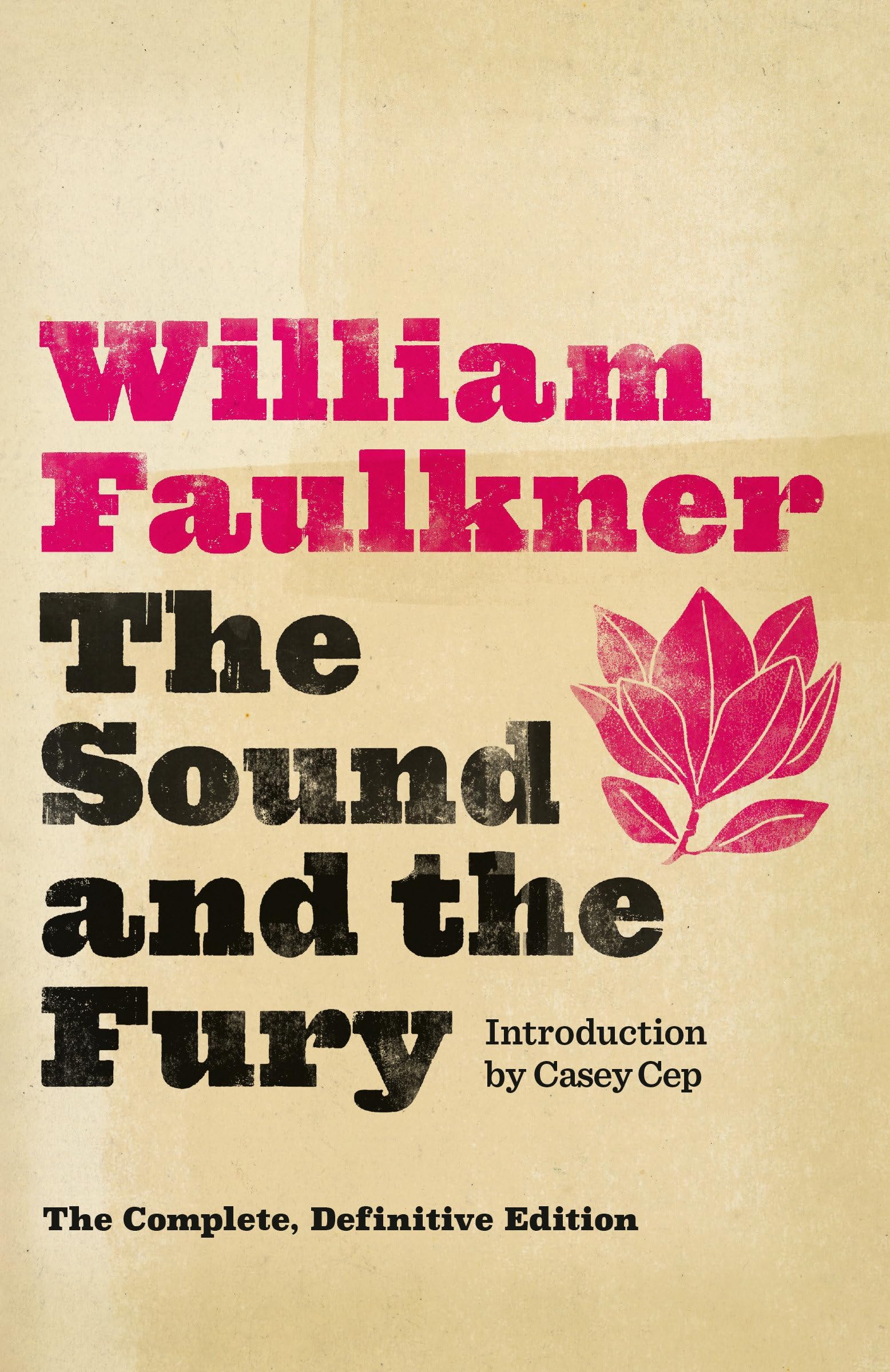
The Sound and the Fury: The Corrected Text
Product ID: 1633098
⏳Explores complex time narrative
🏆Nobel Prize-winning text
📚Classic literary masterpiece
Desertcart purchases this item on your behalf and handles shipping, customs, and support to Senegal.
📖 Unlock the timeless fury of Faulkner’s genius — don’t just read, experience it.
The Sound and the Fury: The Corrected Text is a Nobel Prize-winning novel by William Faulkner, celebrated as one of the greatest literary works of the 20th century. This definitive edition features the corrected text and Faulkner’s original appendix, offering readers a complex, multi-narrative exploration of time, memory, and family tragedy through four distinct perspectives. A challenging yet profoundly rewarding read, it holds a top rank in American fiction anthologies and classic literature.


| Best Sellers Rank | #14,177 in Books ( See Top 100 in Books ) #9 in American Fiction Anthologies #227 in Classic Literature & Fiction #615 in Literary Fiction (Books) |
| Customer Reviews | 4.2 out of 5 stars 2,767 Reviews |
O**E
Poignant, Provocative, and Haunting
This is among the greatest, most mentally challenging, emotionally arresting novel I have ever read. If you want a novel to shatter your concept of the limits of literature and thus transform the way you read, look no further. This book haunts you. Here's the thing. You know that feeling you get when you hear a song or see a face that sparks some vague memory? The memory may have been a dream, or may have been something you saw in a movie. It might well have been something that never actually happened to you, but was some fantasy you had years ago. Maybe there's even a physical reaction? There is a connection, but you can't quite put your finger on it. Still, it occupies your mind for an afternoon and inspires a train of thought you might not have had otherwise. That's good right? Of course. That's what you get with this book. you're trying to find that connection. The more important themes here have less to do with the post-reconstruction era/turn of the century south, and more to do with a broader examination of time and history as it relates to the human/family experience. This is a book that unfolds like nothing I've ever read. You're sort of lost for the first 70-100 pages. Our understanding of time as a linear process will confound your experience with the first section of the book. Benjy's narrative is difficult to be sure, but when the book is said and done, his is arugably the most memorable (though Quentin's honestly rivals it as a literary tour de force). In all, the book is divided into four sections with four different viewpoints. We see through Benjy the past, present, and future existing on a plane rather than a line; Quentin's inability to accept time's passing at all and his longing for the past (a past he was not necessarily a part of); Jason living only in the present and obsessing over an up to the minute existence; and finally Dilsey who seems the only member of the household with the ability to absorb the past as a part of the here and now, and lives without fear the future. This theme is explored through style. It's like reading a dream. The idea is to pull together all these moments, images, and broken bits of dialogue in order to get to the heart of that feeling I was talking about earlier. "where did this come from? why am I thinking about this? When will I be able to pull it together and figure it out?" And in fact, time's presence becomes so prevalent, that by the end of the book it practically becomes another character: "On the wall above a cupboard, invisible save at night, by lamplight and even then evincing an enigmatic profundity because it had but one hand, a cabinet clock ticked, then with a preliminary sound as if it had cleared its throat, struck five times" (341). So why this theme of time in The Sound and the Fury? Is it that the miseries of its people are so held hostage by it? The book is basically 425 pages of nightmare imagery and suffering with no sign of hope. Would it not be human nature to wonder when it would end? Was Faulkner trying to create an emotional reflection of this tragic Mississippi household through the mind's eye of the reader? I am convinced this to be true. Why else would he devote the first 90 pages to a mentally retarded narrator (Benjamin) who can't even feed himself? Why else would he commit the next 80 pages or so to a reasonably intelligent but obviously insane narrator who is about to kill himself (Quentin). And why would he devote a third section, to the "sanest" member of the family (Jason) and make him almost as incomprehensible as the previous two? Thankfully, we have the final section and an opportunity to see the household through the frankness and honesty of a black servant woman's eyes (Dilsey). Though ironically, Faulkner does not grant her narrator status. Rather, as mentioned earlier, Dilsey's voice is heard through an omniscient narrator. The reasoning behind this is the stuff of research papers and the like, but I find it fascinating nonetheless. It is in Dilsey's section that the story finally comes together. All the battered fragments of the story cohere into a bruised understanding of what has transpired, though I was still lost in many of the details. Here, some of the horrid beauty of Faulkner's language emerges. In one scene, the narrator allows what would be considered an archetypal "window image" of beauty (In Romantic literature, for example) and transforms it into ugliness: "The window was open. A pear tree grew there, close against the house. It was in bloom and the branches scraped against the house and the myriad air, driving in the window, brought into the room the forlorn scent of the blossoms" (352). But perhaps my favorite line, involves the wailing of the idiot son Benjamin, and to me, represents the "Sound and the Fury" of this tragic family: "Then Ben wailed again, hopeless and prolonged. It was nothing. Just sound. It might have been all time and injustice and sorrow become vocal for an instant by a conjunction of planets" (359). This contradictory statement sums up the complexity, and evasiveness of the entire novel. Who better to symbolize the unseen ticking of the clock and the gradual deterioration of a family than the moaning of an idiot, who is simultaneously given the credit and dismissed all in the same sentence? Benjamin's sounds lead to other "furies" as well, but I'll not spoil it all for you. Seriously though, Grove has it right--no Southern author nails the plight of the post-Civil War South with more ferocity than Faulkner. It's as if the very air the characters breath has become tainted by the past. So if you feel like losing yourself in words that will horrify and confuse you, if you consider reading more than just a sally on the beach, then buckle your seatbelts and pick up The Sound and the Fury.
D**D
Well worth reading
It's a Pulitzer Prize-winning novel, so it's not standard easy reading. The best suggestion I got was to find notes or a summary of the characters and narrative first so you don't have to slowly figure it out for yourself as you read it. Each of the four sections is written from a different character's point of view as the narrator. The first section is the most difficult, and I liked the third section best (I found it to be funny). I can see that Faulkner did an excellent job of inhabiting the four separate narrators' characters. This is one of those books everyone should read, and I'm glad I did, it's just not easy.
L**E
"Genius" is an over-used term...but not as applied to Faulkner. Amazing.
The Sound and the Fury has been sitting on my bookshelf for some months now. I've always wanted to dip my toe into the pool of Faulkner, but have been intimidated by the unilateral criticisms that he's difficult to follow...that's an understatement; he's incredibly challenging. But his writing, when he's writing linear passages...the language is beautiful, sensual and heartbreaking. And even when he's throwing irregular timeframes around...the payoff is worth the initial confusion. I agree with other reviewers that it helps to equip yourself with a 'cast of characters' for Sound and the Fury. I read every page of Benjy's section THREE TIMES (which, I've never done before) in order to grip fully what was happening. I also referred to Sparknotes (highly recommend) in-between re-readings for some insight into what I might've missed. Once you have the 'key' to unlocking the working of Benjy's mind, it is so much easier to follow. The genius of the Benjy chapter, and why I believe Faulkner chose to lead with it (risking alienating many readers...which only makes him more of a literary giant in my book) is that events and characters are presented with almost absolute objectivity. Seeds are planted and cultivated in later chapters, but the foundation of the story is fairly well cemented. But also, because Benjy's general understanding of everything is so limited, there are plenty of surprises to come when other narrators allude to the same events and people. This detached glimpse into the life of the family over these decades makes it possible to feel more deeply about them later on. The second chapter (Quentin) is the more confusing of the two, I believe, because of the heavy use of stream-of-consciousness. I'm not a fan of that device, with any writer. Gratefully, there was enough linear narration that I grasped what was going on, and when reading it I employed an old high school trick: when I come across passages in Shakespeare that I'm not understanding, I read through them quickly, refusing to dwell on the words, and usually come away with an understanding at least of the action. If that sounds pedestrian, well, maybe it is, but it works! (And liberates me to appreciate other passages of lyrical beauty which I CAN understand, not to mention the work as a whole). The final two chapters are far more approachable, and I found Jason's character to be deliciously villainous and tragic. What touched me most about Faulkner is his talent for understanding the workings of the human psyche. How on earth he was able to craft a fully credible, sympathetic character in Benjy (as opposed to a one-dimensional idiot) I'll never understand. His treatment of the black characters in the book, based on their speech patterns alone and heavy use of the "N" word could easily have thrown their characters into Uncle Tom territory. Instead, he treats them with respect, allowing some to be dignified and noble (Dilsey) and others simple and flawed (Luster), just as he does with the white characters (the juxtaposition between Caddy's empathy and her mother's narcissism...amazing). There are some who believe a book should stand alone on its merits without the need for companion materials in order to understand it. For me, if having some "help" with a book empowers me to squeeze out the most juice, to come away from it with a richer understanding of its themes and appreciation for its complexity and beauty, I am all for it. I probably won't be jumping headlong into "The Bear" anytime soon, because this was an intellectually exhausting read! But someday I'll return to Faulkner, because he's written what is now one of my favorite books of all time. It's truly a masterpiece.
L**S
A puzzling and profound work of genius
The title of this work is taken from Shakespeare’s MACBETH: “Life’s but a walking shadow, It is a tale told by an idiot, full of sound and fury….” ___________ Who, When, Where? The “who” of the story is the once prominent Compson family of Faulkner’s imagined Yoknapatawpha County in the state of Mississippi. The “when,” three consecutive days in April, 1928, culminating on Easter Sunday, 1928, and then June 2, 1910, the day of Quentin Compson’s suicide. The four sections of the novel are not sequential. That is, the first section is April 7, 1928, the second June 2, 1910, the third April 6, 1928, and the last section April 8, 1928. The 1928 action is all centered in Jefferson, Mississippi, while the June 2, 1910 section is set in Cambridge, Mass. and environs, where Quentin Compson would be finishing his first year at Harvard. The last section is author observant (not omniscient). The other three sections are first person accounts. Faulkner employs the stream of consciousness technique for these three sections. Time, therefore, flows back and forth in the minds of the first-person informants. Much of the puzzlement this work produces results from the discontinuity of time and the switches in settings that result from “listening in” on the thoughts of the informants. The puzzlement is most trying in the first section, April 7, 1928, as the informant for the action is Benjamin “Benji” Compson, the family’s severely retarded, re-named, and nearly 33-year-old son. Benji has a limited vocabulary, but does respond to certain words, such as “caddie,” and also seems to understand elementary language. He appears not to articulate speech. He often focuses on colors, lights, smells, etc., and he is obviously very attached to his absent sister Caddy. Besides Benji, the Compson family is populated by an alcoholic lawyer father, a neurotic self-centered and feckless mother, a villainous, sadistic and money-grubbing brother, the “fallen woman,” Caddy, Quentin the mentally ill brother (in love with his sister and perhaps the ideal of Southern womanhood, but who would not touch her himself and who cannot defend her from those who would take advantage), Quentin, the illegitimate daughter of Caddy whose father is unknown, and who absconds with a carnival man in the 1928 sections of the story, after having stolen money rightly belonging to her from her Uncle Jason. Finally, there is Damuddy, the maternal grandmother who dies in the Compson house as recollected in the first section of the story, and the in-and-out Maury, the maternal uncle who seems to live off the Compson family. The cast of characters also includes Negro servants, the most prominent being Dilsey, the matronly, dutiful “protectress” of all the weaker members of the Compson family—the good and faithful servant, compassionate, not sentimental, a woman who preserves her dignity despite the vicious racism that clearly lurks beneath the social surface. I see her as the only heroic individual in the story. A funeral, a suicide, an assignation, a theft a marriage—much of the big action of this novel takes place in the background. Faulkner seems not to want that kind of action as a focus. Rather, he looks at consequences of such action, the psychology of it, the nature of family attachment and family values, the nature of goodness and evil, the richness and complexity of everyday life. Perhaps surprisingly, this novel is filled with subtle humor—amidst all the distress. Still there are many questions left unanswered in my mind. Perhaps I need another read. Another read? That would be my third. I first read The Sound and the Fury as a college senior, in a class called The Experimental Novel—my last semester before going on to medical school. It was too much for me at that time. It didn’t stick. Perhaps one more read in my lifetime is in order. Because this is a classic. lwl
H**D
Stream of Consciousness Confusing
Although William Faulkner considered The Sound and the Fury his favorite novel, I found it inferior to Light in August and As I Lay Dying because of unclear references to who a particular narrator is. Also,, the author's start of a thought and not completing it or jumping to another thought before finishing the previous one has the effect of mental incoherence. Perhaps this is the way the mind works, but it is tiresome to struggle through. An item of major interest is the character of "Dilsey", a black woman who is central to the story as one who "endures" as the old order passes. The title may be a reference to a passage from Shakespeare's Tragedy of Macbeth--that the world is full of idiots in "sound and fury" tales "signifying nothing." One remark about the Vintage International editions of Faulkner's works: They are perfect for reading group studies. The study guides are invaluable, and the format and font is appealing.
R**R
Nice Book
Great addition to my library.
M**T
Can be confusing
The Sound and the Fury is hailed as an American Classic. I’m no judge on which books are deemed a Classic and which ones aren’t ….but, I was thoroughly confused when I began reading it and in my humble opinion, it’s not a Classic. Lucky, in this day of computers, I was able to search and find out what the hell Faulkner was talking about. I gave it four stars because it is an excellent book, just prepare yourself before hand on the writing style which is very unique.
P**E
For me. Hard to read.
Classic
P**P
Difficult but brilliant novel.
This book is a testament to Faulkner's immense shrewdness as a writer. And it expects an equal degree of application of patience and alertness from the reader to finish it. The inventive literary style of disjointed time periods, stream of consciousness amd disregard to grammar & punctuation make the first two sections of the book extremely opaque. Mercifully, Faulkner uses italics to signify shifts in time periods as the first section is described from the viewpoint of a mentally disabled man. The smog clears away by the third section and the final section is completely linear, thus bringing relief to the reader who finally gets to understand the gradual, tragic disintegration of a once proud Southern U.S. aristocratic family. I'd highly recommend this book for its memorable characters and a unique literary experiment by Faulkner.
A**Ò
FANTASTICO
Storia fantastica
L**D
Well Worth The Effort
This book is exceptional. It's not an easy read by any means so don't choose it as part of your holiday reading but the effort is definitely worth it. The book is split up into four parts which get progessively easier to read. They are by four different narrators and four different points of view of what is basically the disintegration of a once wealthy family in the deep south of America circa 1920's. It's well worth reading this book for Faulkner's prose alone.
C**N
Merci
Parfait comme neuf
E**N
amazing
The packaging and design of this book are amazing. It strongly evokes a desire to read.
Trustpilot
3 days ago
2 months ago