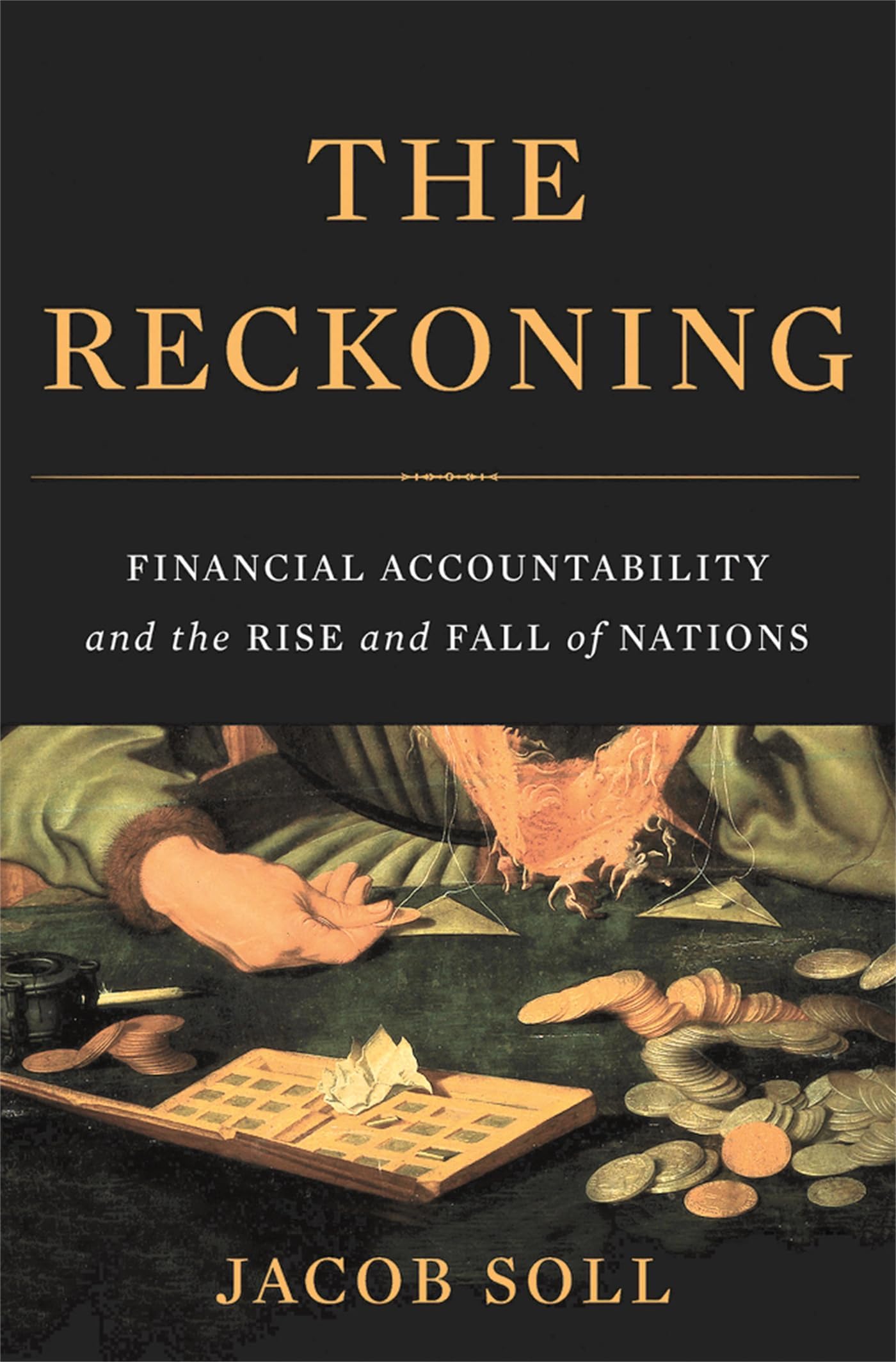
The Reckoning: Financial Accountability and the Rise and Fall of Nations
Product ID: 1623894
Desertcart purchases this item on your behalf and handles shipping, customs, and support to Senegal.
A “brilliant” (Los Angeles Review of Books) history of accounting, showing how financial and political accountability has shaped the rise and fall of nations and empires Whether building a road or fighting a war, leaders from ancient Mesopotamia to the present have relied on financial accounting to track their state's assets and guide its policies. Basic accounting tools such as auditing and double-entry bookkeeping form the basis of modern capitalism and the nation-state. Yet our appreciation for accounting and its formative role throughout history remains minimal at best-and we remain ignorant at our peril. Poor or risky practices can shake, and even bring down, entire societies. In The Reckoning , historian and MacArthur "Genius" Award-winner Jacob Soll presents a sweeping history of accounting, drawing on a wealth of examples from over a millennia of human history to reveal how accounting has shaped kingdoms, empires, and entire civilizations. The Medici family of 15th century Florence used the double-entry method to win the loyalty of their clients, but eventually began to misrepresent their accounts, ultimately contributing to the economic decline of the Florentine state itself. In the 17th and 18th centuries, European rulers shunned honest accounting, understanding that accurate bookkeeping would constrain their spending and throw their legitimacy into question. And in fact, when King Louis XVI's director of finances published the crown's accounts in 1781, his revelations provoked a public outcry that helped to fuel the French Revolution. When transparent accounting finally took hold in the 19th Century, the practice helped England establish a global empire. But both inept and willfully misused accounting persist, as the catastrophic Stock Market Crash of 1929 and the Great Recession of 2008 have made all too clear. A masterwork of economic and political history, and a radically new perspective on the recent past, The Reckoning compels us to see how accounting is an essential instrument of great institutions and nations-and one that, in our increasingly transparent and interconnected world, has never been more vital. Review: A rich history filled with incredible stories and personalities - Picked this up because Soll was my TA in a college course 15 years ago, and I've kept one eye on his writing. Also, as I've gotten older, I've become more interested in understanding why money does what it does, both in my bank account and the nation's. I don't know how many times I've sat across from my accountant, pleading with him to speak English, but as with doctors and car mechanics, that seems not to be one of the options, even when they try. So I had both high and low hopes for "The Reckoning." Both were exceeded, and with real substance and elegance both. I believe any subject can be gripping if the right person tells the right story in the right way, and this story was -- the only word for it is swashbuckling. "The Reckoning" is a rich, rich history, filled with the most incredible stories and personalities, and, ultimately, deep insight into how the world as we know it came into being. Soll is a great writer, a stylist with tremendous personality, and though I don't pretend to be able to evaluate his intellectual arguments, he convinced me that accounting sits at the heart of what modern states have to master in order to prosper and last. Even -- especially -- when you divorce the term from its first association, isn't account-ing -- accountability -- what we lack so dearly from our luminaries and leaders these days? There's a special pleasure to a book masterfully done, especially when you least expected it, especially in a subject you didn't know you cared about. Thumbs up. Review: Excellent read - I saw recommendations for this book online, but admittedly had low expectations when I started reading. A history of accounting sounds fuller than dull. But this book was absolutely great! The author did a terrific job of explaining how accounting has been woven into the cultures of the greatest civilizations and economies throughout history, and also highlights the devastating effects of accounting ignorance. The book has inspired me to try to learn more about accounting principles.


| Best Sellers Rank | #756,554 in Books ( See Top 100 in Books ) #1,379 in Economic History (Books) #2,096 in Accounting (Books) #7,878 in Historical Study (Books) |
| Customer Reviews | 4.4 out of 5 stars 142 Reviews |
V**T
A rich history filled with incredible stories and personalities
Picked this up because Soll was my TA in a college course 15 years ago, and I've kept one eye on his writing. Also, as I've gotten older, I've become more interested in understanding why money does what it does, both in my bank account and the nation's. I don't know how many times I've sat across from my accountant, pleading with him to speak English, but as with doctors and car mechanics, that seems not to be one of the options, even when they try. So I had both high and low hopes for "The Reckoning." Both were exceeded, and with real substance and elegance both. I believe any subject can be gripping if the right person tells the right story in the right way, and this story was -- the only word for it is swashbuckling. "The Reckoning" is a rich, rich history, filled with the most incredible stories and personalities, and, ultimately, deep insight into how the world as we know it came into being. Soll is a great writer, a stylist with tremendous personality, and though I don't pretend to be able to evaluate his intellectual arguments, he convinced me that accounting sits at the heart of what modern states have to master in order to prosper and last. Even -- especially -- when you divorce the term from its first association, isn't account-ing -- accountability -- what we lack so dearly from our luminaries and leaders these days? There's a special pleasure to a book masterfully done, especially when you least expected it, especially in a subject you didn't know you cared about. Thumbs up.
C**D
Excellent read
I saw recommendations for this book online, but admittedly had low expectations when I started reading. A history of accounting sounds fuller than dull. But this book was absolutely great! The author did a terrific job of explaining how accounting has been woven into the cultures of the greatest civilizations and economies throughout history, and also highlights the devastating effects of accounting ignorance. The book has inspired me to try to learn more about accounting principles.
R**N
A good exploration of Accounting
A good exploration of Accounting, good and bad going back through history, especially the start of Double Entry accounting in the City States of pre-Renaissance Italy. While the author can get pedantic at times, he gives good examples of Accounting done well and gone horribly wrong with disastrous consequences. I would have loved if the Author had explored some of the forces that led to the Lapses in Accounting but even more, the forces that have led to Accountants doing Good, Honest work and were honored for it. The examples given of the Good Accounting in Florence and Holland and their subsequent debacles were good as well as the failure in the Spanish Monarchy. For the reader, its a good primer, a good introduction on the importance of Accounting in Government and Politics but don’t expect more than a good introduction and I think you will be happy with this book.
A**A
Great book that has a lot of relevance for today's economic problems
Great book that has a lot of relevance for today's economic problems; Must read for accountants.
G**Y
A fascinating topic, but short on concept
The author is an historian, not an accountant or economist. He describes the development of bookkeeping without getting into the substance of the accounting process. Double-entry bookkeeping, simultaneously tracking stocks and flows, is never defined. The concepts of income and wealth, the quantities being measured by the bookkeepers, are not addressed. The substantial difference between contemporary accounting in the private and public sectors is not treated. There is frequent mention of auditing, but never a word on how auditing is done. There are also quite a number of troublesome errors--"market to market" rather than "mark to market", for example. And the chronology, as another reviewer has noted, is heavily weighted toward long ago, with very brief treatment of recent issues. On the positive side, the historical description is of interest. The theme that there is a continuing interplay of motives for disclosure and for obfuscation is quite well developed. So, overall, the book was worth reading but had it been more analytical it would have been much better.
A**T
A Non-Boring Account of Accounting
Who knew that the process of introducing accounting into statecraft could be so riveting? I didn't. I thought I was going to use this book to help me go to sleep. Instead, I found myself behaving like a kid again, reading the book under the covers with a flashlight so my dad didn't yell at me at 3 in the morning (I'm in my 50s, to put this in perspective, but I was visiting my parents at their house ... and my dad is insomniac, and I had gotten this book for a gift for him). BUT NOOOOOOO.... Dad read it in two days and gave it back to me, said, "this is brilliant, you'll love it!" and he was right. Poor DeWitt, turned into grilled liver and kidney pie for revealing financial information the Prince of Orange wanted kept secret! Poor Colbert, trying to convince Louis XIV to keep accounts! Poor Necker, who never did properly account for the finances of France? Alas for the malfeasance of Enron and the Medici Bank, centuries apart! Oh, what disasters spring from these tales. Naturally, I went out and bought a breast-pocket account book immediately.
S**N
The Reckoning.....
Confirms what we all suspect--we americans are too complacent about the economy and how it works and why accounting knowledge should be more universal. "The Reckoning" exceeds expectations with well documented information about how nations who understand accounting also understand more about the economy--and themselves ( since we all have to give an accounting of our lives as well). "The Reckoning" documents how nations that succeed financially don't do so automatically. Business acumen and accountability are linked and are not naturally understood. To understand, requires disciplining a nation's populace as to how, business, the economy and accountability work together to produce what we all desire: peace and prosperity. ssjackson.
S**R
Very readable history that put accounting in social context
The author puts forth a cohesive tale of the role that sound accounting, or the lack thereof, has played in various societies of the past 500 plus years. His writing is well-researched and entertaining. I recommend this book to students considering a career in business, to financial historians, and to businessmen.
E**O
Five Stars
This was a book for my accounting class. It ended up being more interesting and entertaining than I expected.
A**S
This book turned out to be an essential step to see the wolrd more clearly
When I began reading this book, I was expecting to learn something about economics (since it was recommended by an article titled "top 8 best economics book you must read". So, my expectation was immediately betrayed when I first started reading this book. Yet, I decided to give a shot anyways because I thought I can at least learn something about accounting (which I did but in a different way). First chapter was okay. I learned about double-entry book keeping, which I did not even know existed. However, from the second chapter onwards, the author started talking about the history of accounting. What a boring topic. Yet, this very opinion I had, this book told me, may be the problem we have in our society today in terms of accountabilty. As I learned from this book, political as well as financial accountability is crucial part of our society, and yet, we have failed to obtained it for centuries. The reason for this could be that we are just not capable of obtaining it. But, we can still try (and fail and try and fail). Just like people in Florence in the 1400s or Americans in the 18th and 19th centuries did, we can incorporate accounting in our everyday life and cluture instead of thinking of it (and finance for that matter) as one independent subject so that everyone in the society knows accounting is important rather than a boring subject only educated financial analysts understand. I know I am bad at expressing my opinion (either by writting or speaking), but I can tell you this. Not only did this book teach me the importance of accounting and accountability, but it also helped me realze that we try and fail all the time and we do not really get perfect at anything. We just get better at it and keep failing.
A**R
It was a pure pleasure to read it.
An expression "history of accounting" may sound like "this will be boring as hell". "The Reckoning", however, is both pleasant to read and full of interesting facts. A very well-written book, I absolutely enjoyed it.
C**N
Excellent book
Excellent book, a masterpiece for who is interested in the link between accounting, economics and society. An amazing history of double-entry bookeeping!
Trustpilot
2 weeks ago
1 month ago