Desertcart purchases this item on your behalf and handles shipping, customs, and support to Senegal.
🚀 Elevate your home Wi-Fi game — never buffer, always belong.
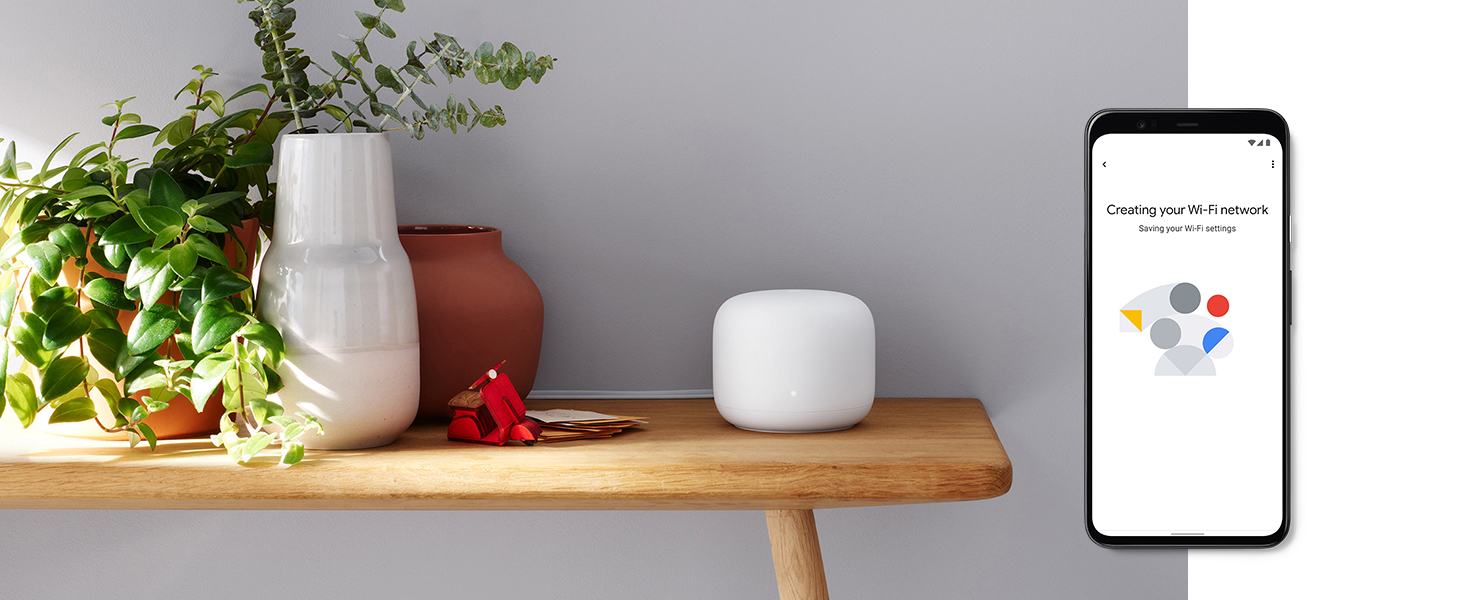
Google Nest Wifi 2-pack is a scalable mesh router system delivering fast, reliable Wi-Fi coverage up to 4400 sq ft. It supports up to 200 devices with speeds up to 2200 Mbps, features easy app setup, voice control, and robust security updates to keep your home network seamless and secure.


| ASIN | B07YMJ57MB |
| Antenna Location | Gaming, Home, Office, Security |
| Antenna Type | Internal |
| Best Sellers Rank | #186 in Computers & Accessories ( See Top 100 in Computers & Accessories ) #16 in Whole Home & Mesh Wi-Fi Systems |
| Brand | |
| Built-In Media | Ethernet cable, Google 1 Year Limited Warranty, Router |
| Color | White |
| Compatible Devices | Laptop, Personal Computer, Smartphone, Tablet |
| Connectivity Protocol | ethernet, wi-fi |
| Connectivity Range | 4400 Square Feet |
| Connectivity Technology | Ethernet |
| Control Method | Voice |
| Controller Type | Google Assistant, Nest |
| Coverage | Up to 4400 square feet (for 1 router and 1 point), expandable in size with additional routers (Up to 2200 square feet per additional router) |
| Customer Reviews | 4.4 out of 5 stars 12,481 Reviews |
| Data Transfer Rate | 2200 Megabits Per Second |
| Frequency | 5 GHz |
| Frequency Band Class | Dual-Band |
| Global Trade Identification Number | 00193575004662 |
| Has Internet Connectivity | Yes |
| Has Security Updates | Yes |
| Is Modem Compatible | Yes |
| Item Dimensions L x W x H | 4.33"L x 4.33"W x 3.56"H |
| Item Type Name | Nest Wifi Router |
| Item Weight | 1.7 Pounds |
| LAN Port Bandwidth | 1 megabits per second |
| Manufacturer | |
| Maximum Upstream Data Transfer Rate | 2200 Megabits Per Second |
| Mfr Part Number | GA00822-US |
| Model Name | Nest Wifi Router |
| Model Number | GA01144-US |
| Number of Antennas | 3 |
| Number of Ports | 2 |
| Operating System | RouterOS |
| Other Special Features of the Product | Guest Mode |
| Router Firewall Security Level | High |
| Router Network Type | mesh |
| Security Protocol | WPA2-Enterprise |
| Smart Home Compatibility | Not Smart Home Compatible |
| Special Feature | Guest Mode |
| UPC | 193575004662 697333827628 |
| Unit Count | 2.0 Count |
| Voltage | 100 Volts |
| Warranty Description | 1 year |
| Wi-Fi Generation | Wi-Fi 5 |
| Wireless Communication Standard | 802.11ac |
| Wireless Compability | 802.11ac |
V**A
I don’t understand how I lived without this...
I live in an old SF home, so narrow and long. There was decent WiFi in about 1/3 of the house. I got an extender about a year ago, but with the current wfh situation, it just wasn’t cutting it. This beauty arrived and, within 10min, I had it all set up and working. First, I installed just one to see the range, and was happy to find excellent signal in 90% of the house. I installed the second router on the other end of the house - lower floor - and now we are fully covered! Three adults working from home; simultaneously streaming, gaming, and in virtual conferences without a single issue. Speed has not been compromised at all and there are no dead zones... I am completely in love! Here are some details, for those that aren’t sure: - When I researched options, I found that most extenders are approximately the same price (for the same range), if not more expensive. - This system has two elements: 1. Router: which needs to be connected - via Ethernet cable - to your existing WiFi Router and it does not replace it. 2. Points: They are used to extend the range of the router and can connect wirelessly. - Most Google WiFi products are compatible with this system and can act as ”points”. - Routers can also be used as “points”, and will connect wirelessly to the main hub (the one connected to your original router). - You really only need one router. Having said this, it was nice to install two routers, since they each have Ethernet connection capabilities. This allowed me to directly connect certain devices, like gaming consoles, so the internet connection is strong and constant. Points don’t have Ethernet ports. - You need the Google Home app and a Google account for the set up. The mesh also needs a few minutes, about 5-10, to be established. This analogy helped me understand it a little better: Imagine you are underwater and WiFi is air. Your current WiFi router creates a big air bubble. You are limited to move around the size of the bubble your router created. An extender would be like creating a separate air bubble so you can go farther. these two are not connected. Each extender you add creates its own bubble, but if the bubbles are too far from the main one the quality of the air suffers. This system is different, it creates a mesh - this means that, when you plug a Nest router into your existing WiFi router, it creates a big bubble, bigger than the existing one. Then you add a “point” outside your bubble and, instead of creating a separate bubble, it expands the main one. The more “points”, the bigger the bubble. As long as the “points” are a certain distance from one another, you can extend the bubble as far as you like from the main router. The air quality is the same throughout this giant air bubble you just created. Hope that helps!
M**5
Simple mesh wifi system
This is a decent, user-friendly, mesh WiFi system. It’s also nice that it’s backwards compatible with the old pods. These 2 pods handle my 2000sf home fine.
H**B
Great value, reliable, easy setup
Got these for my sister as I already had my own. Setup is super easy to do, even if you’re not tech savvy. Anytime I can get rid of crappy spectrum equipment I will, with that said these are super reliable and incase you need to trouble shoot (rare maybe happened 2xs in the 5 years I’ve had mine) cuz internet goes down it’s super easy. You can even do it remotely if you’re not home. Would recommend, value for money well spent. App is super easy to use.
D**U
Installation would be easy if certain steps are followed
Google Nest Wifi has much stronger signals and more covering range than the previous Google Wifi. I had 3 Google Wifi router/points before. They work fine but mesh strength was OK. With the Nest Wifi point, Mesh is always great. I added my old Google Wifi too to the new Nest Wifi mesh so that they are not wasted. I put the one Nest Wifi point to the toughest location, and it still works better than the other 3 Google Wifi points. Installation was easy but I understand quite some people encountered failures. I think there are certain steps that are necessary to drastically reduce the chance of failure during installation. Here're just my experiences. Hopefully it can help some people to get through the process easier. Also the router setup is very easy and there's nothing to say about it. I'm focusing on the installation of Wifi points here. I used the suggested installation scheme which is to use one of the Nest Wifi as main router and the rest as points. The following steps should apply to both Wifi and Nest Wifi point installation: 1. If you have old Wifi points, they need to be reset to factory default before being add to the new mesh. This can be done by Google Wifi app or Google Home app, whichever you use. (step 3 shows a manual way) 2. During the addition of Wifi points, put the point close to the main router, preferably within a room. I made the mistake of not doing this, one of the points always failed to connect. Even worse was that after the mistake, even if I put the point and router side by side, installation would still fail, which leads to the 3rd point below 3. If you hit any problem during installation and it repeats twice or more at the same failure point, do a manual reset of the wifi point before retrying again. There is a physical button on the device that allows resetting manually. The steps are: a. Unplug the point device from power b. Press and hold the button and plug back in the power c. Release the button when you see the blue light flashing. (Note that "flashing", not "pulsing"! Flashing is with fast and equal intervals. Pulsing is like your heart beat.) d. Wait. It's important to wait until the blue light pulsing, which indicating ready to be added e. Make sure the point is in the same room as the route, and try adding the wifi point again Step 2 is quite necessary, I think. Without it, you might still be able to do it. But you'll have a high chance hitting a failure. After setting up, you can move the point device anywhere in the house. It'd just work. Cheers!
F**E
I'm sold
After decades of using Netgear and TPlink and other conventional routers and WAPs, I was finally convinced that many of the smarthome problems I was having were because of firmware bugs. It was a hard decision. There was a lot of "sunk cost" into the many hours of configuring the four (!!) routers and WAPs I had gotten to the point of setting up. But I took the plunge. Two Google Nest WiFi points set up, and suddenly everything works. Multicast works. Devices that required complicated QoS, or routing and port forwarding rules, or to be on the same segment... all set up easily and quickly. Mesh works transparently and without any effort. Whole thing was up and running, and everything connected to it, in like two hours. No more arbitrary limits like 32 devices (made sense back when we had a coupel of computers, but in the era of IoT you can use that up just on your appliances!). Easy to use software, with great live monitoring. There are still a few things they should do but don't. Why can't I throttle a specific device, or limit the overall upstream bandwidth used? Why can't I see something like "which device used up the most bandwidth during the last 24 hours" without staring at my phone for 24 hours? These seem right in line with the kind of control the software gives me, but for some reason they're not there. It'd be a Small Matter of Programming to add it, though. Maybe someday. But unlike my old Netgear configuration, everything JUST WORKS. And it's sad, because Netgear used to be the It Just Works choice for WiFi and routers, like Linksys was before them. But time has passed them by. Netgear routers still work and look and act like a generation of networking for a different time. They're slapping barely-works pseudo-mesh bandaids on top of firmware that's based on assumptions that no longer make sense.
R**T
The improvement is not where you think it is. Totally worth, so simple!
Tips: 1- Do not be affraid of installation, it was very simple. The routers and the points -or 2 routers in this case- create a mesh by themselves wihtout any user intervention. The app guides you through the process. As a tech guy, this was so easy I feel guilty :p 2- This mesh will improve your WiFi speed across the house for any internet service up to about 600-700 Mbps, I daresay. WiFi has its limitations, anything above that is wishfull thinking due to the harware constraints of our current phones and devices. But... the real improvement is not the "speed" itself (read below). 3- This is the 2 router pack, not the classsic "router" and "point/Google assistant" pack. I chose this one expressly since the routers have ethernet LAN RJ45 jacks (ports), which the "points" lack, because my house is already wired with LAN ethernet cable and I already have plenty of "hey google" things around =) Note: you will need proper harware to get anything above 50 Mbps, e.g.: Cat. 5e or Cat. 6 cable , and if you use an ethernet switch make sure it is Gigabit compliant, otherwise stick to the standasrd WiFi mesh, you'll be surprised: this WiFi mesh will be faster than a 10/100 cable or a "Fast Ethernet" switch. 4- It is fast, indeed, but take note: since the mesh talks in both directions, there will be a natural minimal speed loss when connected to a "point" (or the secondary "router" in this case). E.g.: when the mesh is connected wirelessly (pure WiFi mesh), I get 100 Mbps near the router and 50-70 Mbps near the "point"; but when wired (ethernet backhaul between the 2 routers) I get 80-100 Mbps near the "point". I think this is expected, completely normal due to the 2-way wireless communication between both mesh devices. 5- My ISP installed a coaxial Modem/Router combo unit in my house, I was affraid of the dared double-NAT menace, but to my relief they got allong surprisingly well. Actually, I kept my original WiFi network and the new nest mesh network up simultaneously for a couple days, while migrating everything (the easy and recommended way would have been to disable the old WiFi network and use the same SSID name and password on the new one, but I wanted to experiment a little). Anyhow, although they seemed to work fine together, I decided to turn off the ISP Modem/Router's WiFi radios to avoid any possible interference. WiFi can be grumpy when crowded. 6- I chose the newest "Nest" WiFi mesh routers over the previous "Google" WiFi mesh or the Nest points because they have: a) faster WiFi conection (AC2200 vs AC1200), b) bigger area coverage (205 m2 vs 140 m2), c) more antennas (4x4 vs 2x2) and d) the capability of transmitting data to multiple devices simultaneously (MU-MIMO vs no-nothing). THIS is paramount. The improvement is noticeable when the kids are watching video streams and playing games while I hold to that important zoom meeting. (Note: The Nest points do have MU-MIMO, too, but lack the extra speed and extra coverage of the Nest routers. In exchange, they double as Google assistant speakers, so choose your potion) 7- Get both apps, Google Home and Google Wifi. They seem to be migrating everything from Google WiFi to Google Home, but meantine get both! Google WiFi gives some extra options such as a speed test of all connected devices or information about the connection type between points, wired or wireless. In conclusion, the real "speed", the improvement over a standard WiFi network is not measured in Mbps by Speedtest, it's not even the extended coverage or the transparent, automatic handling of WIFi when moving around the house without hiccups nor the beamforming technology which sends the WiFi signal straight toyour device: it's how it handles devices and distributes bandwidth, making each device in my house faster individually, all at the same time, keeping my data transmission speedy and steady when the kids are squeezing the WiFi signal and my internet bandwidth. The only thing I would have wished for is WiFi 6 support (future proof). Otherwise well done, Google. I'm impressed. I have spoken.
I**D
This product has significant issues
BEWARE THIS PRODUCT HAS MAJOR ISSUES that may or may not affect you, depending on how you set it up and use it. I'll share my experience, but you decide whether these issues are essential for your usage scenario or not. Here is the executive summary before I get into technical details. 1) This product is excellent when it works as expected (unfortunately, that's not always the case). Setup is easy and straightforward. 2) The functionality of the device is extremely limited if you opt-out of using Nest Wifi cloud services. Enabling cloud services is a must to have this device provide all of its functions. 3) Local network throughput exhibits severe performance degradation over time if your routers are not hardwired. 4) The router is unable to re-establish Internet connectivity after a power outage (this is precisely the case when using Netgear CM500 as a modem) This review is for 2-pack Nest Wifi routers bundle. Both devices are identical routers, but for the sake of simplicity, I'll be calling the main one Router and the secondary one Point. My initial setup was a true wifi mesh with no hardwired connection between Router and Point. I did extensive post-install testing, and Nest checked all the boxes - 330 Mbps Internet throughput, 600 Mbps over the local network from one device connected to the point to another device connected to the router. All seemed well, but after about 24 hours, I started noticing performance degradation on my local network. At first, the throughput from my Macbook to my NAS dropped down to 100 Mbps, then 50 Mbps, and at some point, it stalled at a snail speed for 150 kbps (yep, kilobits). I got in touch with Google support right away, and they "fixed" the issue by hard rebooting the network and cloud services (make any change in your router's DNS settings, then turn cloud service off/on and reboot the network). However, it was just a temporary fix as the issue came back the next day. I've been in touch with Google support a couple more times, but they were less than helpful. They blamed interference; they blamed the local DNS server; they blamed my MacBook. None of these was the culprit as everything worked well before I bought Nest Wifi, and everything works fine now after I hardwired the router and the point. The only "solution" they could provide was the hard network reboot that "fixed" the issue for less than 24 hours every single time. About a week later, I decided to run a Cat6 cable from the main router to the point, and to my surprise, it completely solved this issue. I'm deducting 2 stars because of this issue. I'm expecting a Wifi mesh product to work as a true Wifi mesh, and hardwiring must not be a requirement. The second major issue I ran into is exceptionally annoying. Nest Wifi router is unable to re-establish Internet connection after a power outage. It's not just a matter of inconvenience as I have to reboot the modem after every power outage manually, but it's also a security concern as our Nest cameras are not coming back online after a power outage when we are not home. Google support wasn't helpful here either. They blamed my ISP and "the extent of the outage", but it has nothing to do with the ISP as I can reproduce this issue by cutting the power on the power strip that both router and modem are connected to. There are numerous similar complaints all over the internet going back 2 years, so it's definitely a well-known issue, and Google still can't get their act together to fix it. How do I know it's an issue with Nest Wifi? First, the network boots up just fine if I swap the Nest router with my old router (8 years old Apple Time Capsule). Second, the modem shows all 5 lights green, but still, there is no Internet connection. Third, if I unplug the Nest WAN ethernet cable, run it into a switch and log into the modem's UI, it shows the link is OK. I have a feeling it has something to do with the timing of each device's boot time. It seems like the Nest router expects itself to be the first one to boot up. Well, you can't expect that if you are that slow... My old router boots up much faster than the Nest router, so that may be the answer here. Anyway, I thought I was clever enough to code a script on my Raspberry Pi, detect this condition, and force-reboot the modem if there is no Internet connection. I thought I was all set, but I was wrong. We had another power outage last night, and as you suspect by now, my network didn't come back online. Why? Because the Nest router wouldn't route packets to the modem. My next idea is to install smart power plugs and control the power from Raspberry Pi. I'm deducting 2 stars because of this issue. This product could have scored all 5 stars in my review if not for the two major issues I described above.
V**N
A magnificent easy to install router with high speed and friendly service.
A high-speed router that is barely noticeable and compliments a woman's home. Like my Google Wi-Fi service itself it is conveniently well-priced in a time when we all need a financial break. I contacted Google for assistance with installation and service, and they joyfully helped me set it up. I strongly recommend this router for people who live alone with a few small devices.
H**S
Overpriced and quite hopeless in terms of range; not a good buy for India
1. Ridiculously overpriced for the performance. My Netgear R7000P works much better. 2. "intelligent" switching between 2.4GHz and 5GHz means you *cannot* choose it yourself. 3. Meshing between levels probably works in countries with wooden floors, but with concrete in India, it doesn't work well - horizontal range is less 50 ft between two levels. 4. Doesn't show devices connected unless you agree to the "cloud" option where it will log every single device and probably its activity. 5. No configuration options for power (of the radio), access-control using MAC, etc. Please don't buy this if you're in India.
N**S
Fantastic product
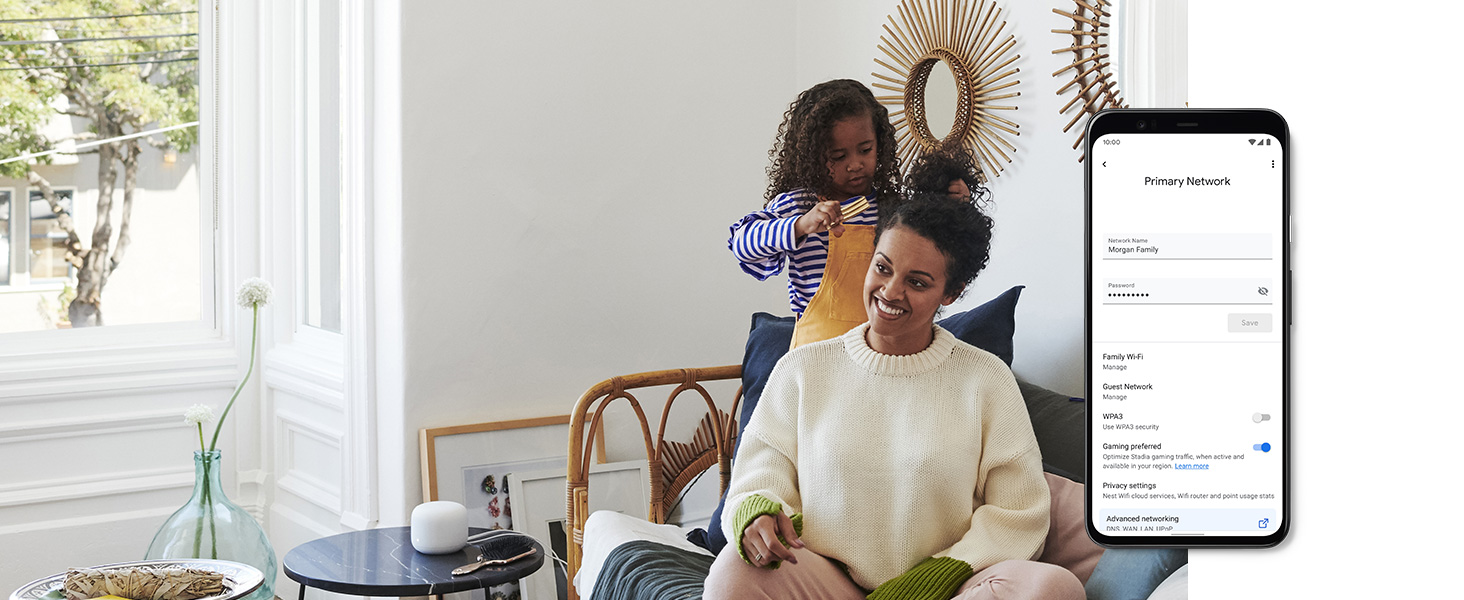
The Nest wifi mesh is very easy to set up, works seamlessly with the google home app and the mesh is flawless. The router communicates with the subunit automatically and without any problems. The wifi signal finally fills my house, and the speed is great. Unplugging/rearranging the router and subunit did not cause any disruption. Once they powered back on, connection was immediately restored. Very happy with this item.
G**Y
Easy set up
Works great and definitely enhances the quality of our Internet! Easy to set up as well.
N**A
رائع
اشتريتة قبل 5 سنوات ممتاز جدا
A**.
Mejora la velocidad del internet y la cobertura
Excelente producto, vale la pena el costo que tiene, es muy fácil de instalar con el celular, solo se tiene que tener una cuenta de google. El rango que cubre el wifi es muy amplio, para una casa mediana con 1 o 2 bastaría para tener wifi en todos lados, teniendo en cuenta donde esta el modem. En mi caso tenía un modem era de Telmex con 200mb contratados, al hacer un speedtest no subía de los 40mb, después de la instalación del nest ya alcanza las velocidades contratadas.
Trustpilot
2 months ago
3 weeks ago