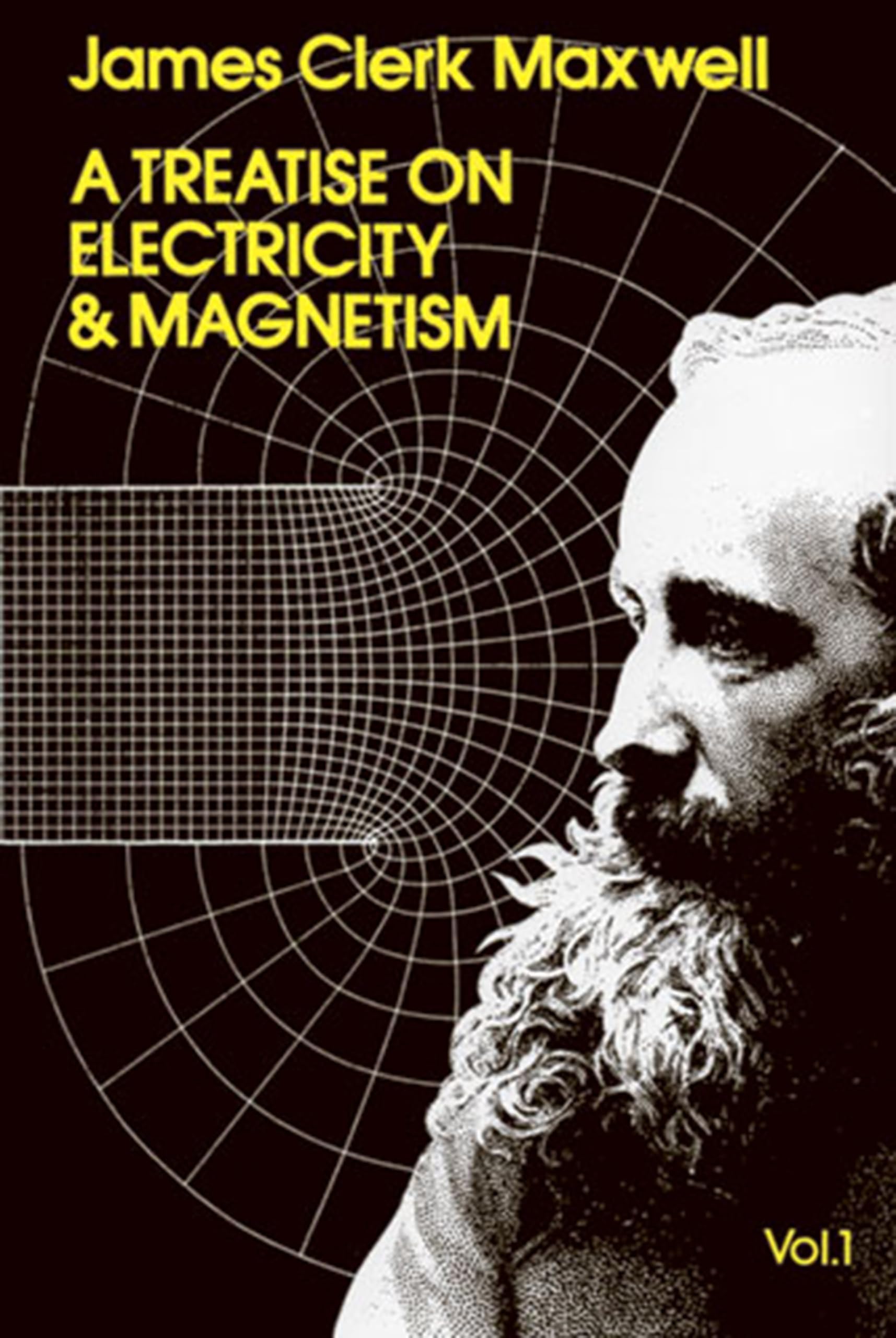
Treatise on Electricity and Magnetism, Vol. 1
Product ID: 14714445
Desertcart purchases this item on your behalf and handles shipping, customs, and support to Senegal.
"Maxwell is without peer. This printing is an opportunity to become thoroughly acquainted with the thoughts of the greatest of our electrical scientists." &; School Science and Math Here is the final elaboration of Maxwell's theory of electromagnetism, including the systematic and rigorous derivation of his general equations of field theory. These equations continue to occupy a central position in the modern physicist's view of the physical world. They are a magnificent summary of the fundamental advances in electricity and magnetism, and later inspired the theories of Lorentz on the electron and Einstein on relativity. Einstein himself has said that "The formulation of these equations is the most important event in physics since Newton's time." ( The Evolution of Physics .) Volume 1, Part 1, "Electrostatics," describes electrostatic phenomena and develops a mathematical theory of electricity. Maxwell discusses electrical work and energy in a system of conductors, mechanical action between two electrical systems, forms of equipotential surfaces and line of flow, spherical harmonics, the theory of electric images, and other topics. Part II, "Electrokinematics," deals with electric current conduction and resistance, electromotive force between bodies in contact, electrolysis, the mathematical theory of the distribution of electric currents, and other topics. Review: Rating - Perfect edition. Review: If only everyone knew Maxwell's contributions - Everyone knows who Einstein is and E=MC^2, and newton and his basic contribution to physics. But the average person has no idea who Maxwell is or how prolific his contributions to physics and modern society. This is a classic book and a great read. I don't have the math background for a good part of it, but it is still worthwhile reading the theorems and his commentary and discussion. As a reprint this is clean, though I wish someone would typeset this to a less cluttered font and presentation. Worthwhile in anyone's library.
| Best Sellers Rank | #239,925 in Books ( See Top 100 in Books ) #19 in Magnetism in Physics #146 in Physics (Books) #319 in Electrical & Electronics (Books) |
| Customer Reviews | 4.5 out of 5 stars 98 Reviews |
H**O
Rating
Perfect edition.
M**C
If only everyone knew Maxwell's contributions
Everyone knows who Einstein is and E=MC^2, and newton and his basic contribution to physics. But the average person has no idea who Maxwell is or how prolific his contributions to physics and modern society. This is a classic book and a great read. I don't have the math background for a good part of it, but it is still worthwhile reading the theorems and his commentary and discussion. As a reprint this is clean, though I wish someone would typeset this to a less cluttered font and presentation. Worthwhile in anyone's library.
S**L
Thanks
Timely delivery, the book in good condition.
P**O
I bought it because Maxwell's equations represent one of the great advance in Physics
I have to admit I haven't read this book; I bought it because Maxwell's equations represent one of the great advance in Physics, i.e. the integration of electricity and magnetism into a single theory. I have read that many physicists didn't understand the work when it was first published. Anyone who is serious about reading this book might want to purchase "A Student's Guide to Maxwell's Equations" by Daniel Fleisch
K**H
good book
I am happy with the seller
D**S
missing pages in table of contents
The book is missing two pages in the table of contents. That's because it was lifted from an internet site whose free copy was missing those two pages.
L**A
Cool book, not for plebs
I order this on a manic learning spree. It is really cool, a piece of history. But I gave it to my coworker better versed in modern physics and math. I couldn't decipher it. She was ecstatic though. Worth it if you know your math.
S**Y
Good stuff
There's alot of interesting stuff here. Very informative about history yes, but it is still probably the best text on eletromagnetic theory. There is some advanced math in here. I only read part of it for a research project(its huge). From this(and the equation contained within) came the basis for all of modern physics. Maxwell's equations are inconsistent in some ways with classical mechanics. To compensate, physicists had to create relatvity and quantum mechanics. Maxwell's work was not all new stuff. He took other people's theories and summed them up in his book. He then predicted the existence of EM waves and such .
M**S
It’s only volume 1
This publication only constitutes volume one of this two volume work however it does not specify that in the title. You are buying a photocopy of volume one of the 1873 Clarendon publication.
D**A
Wonderful !!
This is a wonderful book but quite difficult to understand during 1st time reading.
A**S
Bom
muito Bom
純**ん
索引からも読めるvol.2
凄い! vol.2 は、索引から言葉を選んで読むことが出来る。アラゴのディスク、アンペール、ブリッジ・ホイトストーン……アルファベテイカルに学ぶ電磁気学や! クーロンずロー、ファラデー、ガウス……。
D**.
Fundamente der Elektrodynamik
Die Elektrodynamik gehört neben der Statistischen Mechanik zu den wichtigsten Errungenschaften der Theoretischen Physik der zweiten Hälfte des 19. Jahrhunderts, zu beiden Theorie leistete James Clerk Maxwell wichtige Beiträge. Mit dem Elektromagnetismus befasst sich Maxwell bereits unmittelbar nach seinem Studium in Cambridge, in ‘On Faraday’s Lines of Force‘ versucht er sich erstmals an einer mathematischen Formulierung von Faradays fundamentalen experimentellen Ergebnissen. Diese Thema beschäftigte Maxwell fast 20 Jahre lang und kulminiert in der ‘Treatise‘, der ersten umfassenden Monographie zur Elektrodynamik, die gleichzeitig Maxwells Hauptwerk darstellt. Wie der Autor im Vorwort zur ersten Ausgabe ausführt, studierte er sowohl Faradays ‘Experimental Researches in Electricity‘ als auch die mathematischen Arbeiten zum Elektromagnetismus etwa von F.E. Neumann, C.F. Gauß, W. Weber und B. Riemann und findet eine Diskrepanz in beiden Methoden. Maxwell ist aber der Ansicht, dass keine der beiden Seiten einen Fehler begangen hat, Diskussionen mit William Thomson bestärken ihn in darin. So beginnt der Autor Faradays physikalische Vorstellungen in mathematische Formen zu kleiden, schließlich findet er, dass die mathematisch transkribierten Resultate mit denen der Mathematiker koinzidieren, aber mehr noch – viele dieser fruchtbaren mathematischen Methoden ließen sich mittels Faradays reformulierten Ideen viel natürlicher ausdrücken. Die Organisation der Treatise wurde zum Vorbild zahlloser Lehrbücher zu diesem Thema, sie ist in vier Teile gegliedert, die sich mit Elektrostatik, Elektrokinematik (elektrische Ströme), Magnetismus bzw. Elektromagnetismus beschäftigen. Jeder dieser Teile wird eingeleitet durch eine Beschreibung der jeweiligen Phänomene. Das notwendige mathematische Rüstzeug, wird in einem vorbereitenden Abschnitt zusammengestellt und im weiteren Text dann bei Bedarf ergänzt, dazu gehören insbesondere Kurven- und Oberflächenintegrale mit den Integralsätzen von Gauß und Stokes, den Grundzügen des Vektorkalküls (in einer an Hamiltons Quaternionen angelehnten Form), diese Elemente werden insbesondere in der Potentialtheorie angewandt, dazu gehören auch Theoreme von Green und Thomson. Der Autor legt ferner großen Wert auf die Beschreibung elektromagnetischer Instrumente, Methoden für präzise Messungen elektrischer Größen und der Festlegung derer Einheiten – Maxwell war sei 1862 Mitglied der Kommission zur Standardisierung jener Größen, insbesondere der des Widerstands. Das Werk ist in zwei Bände aufgeteilt, die jeweils die Teile I und II, bzw. III und IV umfassen, Maxwells Hauptbeiträge zur Dynamik des Elektromagnetismus finden sich erst in Bd. 2 -- in Teil iV, Kapitel IX sind die allgemeinen Gleichung des elektromagnetischen Feldes zusammengefasst. Hier kann Maxwell auch Faradays Vermutung, dass Licht eine elektromagnetisches Phänomen ist, mathematisch untermauern. Faraday fand bereits 1845, dass die Polarisationsebene von Licht in schwerem Glas gedreht wird, wenn ein starkes Magnetfeld angelegt wird. Maxwells Gleichung vor Augen, in der Form der zweiten Auflage vom 1873,, zitierte L. Boltzmann, der auch Maxwells Arbeiten in der Reihe Ostwalds Klassiker herausgab, Goethes Faust – etwas frei – “War es ein Gott, der diese Zeilen schrieb?“ Die Treatise enthält sicher eine unschätzbare Fülle von Material und Erkenntnissen, ist aber keine streng systematische Abhandlung. Kein Wunder, dass sowohl zeitgenössischen Physiker, als auch die der nächsten Generation, das Buch als großartiges aber unzugängliches Monument erschien (E. Segre). Auch heute noch, ist die Lektüre von Maxwells Werk eine intellektuelle Herausforderung, auch dann, wenn man mit der modernen Elektrodynamik gut vertraut ist. Aber das Studium von Originalarbeiten zu jedem Gegenstand ist ein unschätzbarer Gewinn, da sie das Gebiet im Zustand seiner Entstehung aufzeigen. Gerade das hatte auch Maxwell in seinem Vorwort hinsichtlich Faradays ‘Experimental Researches...‘ hervorgehoben. Um so erfreulicher ist es, dass Dover Publications inc. Maxwells fundamentale Monographie zur Elektrodynamik wieder verfügbar gemacht hat. In diesem Zusammenhang ist es vielleicht interessant, dass Thomas Simpson eine schöne kommentierte Ausgabe von drei Arbeiten Maxwells zum Elektromagnetismus herausgegeben hat, die den steinigen Weg zu ‘Treatise‘ markieren – darunter auch sie oben erwähnte Publikation zu Faradays Kraftfeldlinien.
Trustpilot
4 days ago
3 weeks ago