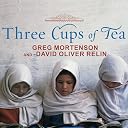
Three Cups of Tea: One Man's Mission to Fight Terrorism and Build Nations
Product ID: 14667300
Desertcart purchases this item on your behalf and handles shipping, customs, and support to Senegal.
In 1993 Greg Mortenson was the exhausted survivor of a failed attempt to ascend K2, an American climbing bum wandering emaciated and lost through Pakistan's Karakoram Himalaya. After he was taken in and nursed back to health by the people of an impoverished Pakistani village, Mortenson promised to return one day and build them a school. From that rash, earnest promise grew one of the most incredible humanitarian campaigns of our time: Greg Mortenson's one-man mission to counteract extremism by building schools, especially for girls, throughout the breeding ground of the Taliban. Award-winning journalist David Oliver Relin has collaborated on this spellbinding account of Mortenson's incredible accomplishments in a region where Americans are often feared and hated. In pursuit of his goal, Mortenson has survived kidnapping, fatwas issued by enraged mullahs, repeated death threats, and wrenching separations from his wife and children. But his success speaks for itself. At last count, his Central Asia Institute had built 55 schools. Three Cups of Tea is at once an unforgettable adventure and the inspiring true story of how one man really is changing the world, one school at a time. Review: Lessons in the art of drinking tea... - A remarkable book that should be read by all Americans. Some of the criticism and quibbles concerning the book and Mortenson are justified, and you sense that the authors would agree with some, yet they are dwarfed by only a few of the "take-aways." Here is a man whose passion was mountain-climbing, and he tackled one of the very hardest in the world, K-2. Serendipity, coupled with exhaustion, lead him into an unlikely village, where the warmest care and hospitality was given to this stranger. Suddenly his eyes were opened to more than mountain peaks; he saw what had always been around him--the lives of those who did the grunt work that got so many mountaineers to the top. He decided to repay the hospitality with more than words, by giving the village of Korphe something desperately wanted and needed--a school for its children. It was a $12,000 promise that he kept. To fulfill that promise he had to master a learning curve in business and social relations as steep as many of the mountains he climbed. He quotes from Helena Norberg-Hodge's "Ancient Futures": "but that industrialized countries had lessons to learn from people like Ladakhis about building suitable societies." Yes, learning is a two way street when cultures meet, in contrast to a prevailing attitude of all too many Americans abroad that "you'll become a better person if you become more like me." Sometimes that takes the form of: "We're just here to help you by bringing you Democracy... as long as you vote the right way." In the chapter appropriately entitled "Haji Ali's Lesson" Mortenson internalizes Norberg-Hodge's dictum after Haji Ali's rebuke: "Doctor Greg, you must make time to share three cups of tea. We may be uneducated. But we are not stupid. We have lived and survived here for a long time." Hence the book's title, and I think Relin did a brilliant and understated juxtaposition of this outlook with that of the insufferable Rumsfeld, who would not even offer Mortenson a seat during their brief meeting in his office. Mortenson also had the insight to convey the image of the hoard of earnest young men in the Pentagon, clutching their laptops, avoiding eye-contact, as they scurried from one office to the next. No doubt the numbers on those laptops were as fanciful as that other hoard on Wall Street who were, until very recently, trading collateralized debt obligations (CDO's). The portrait of Syed Abbas, a conservative, bearded Shia cleric, in the "Red Velvet Box" chapter was quite valuable. I have a sense of unease when I see a beard on a Muslim, and the wilder looking it is, the deeper the unease, knowing that it is a reflection of their "fundamentalism." Abbas was conservative, yes, but in a good sense of the word, and deeply cared for the well-being of the people in his area, and was not so rigid about non-believers that he could not see the good that Mortenson was doing. There are many Abbas's in the Islamic world. One of Mortenson's greatest achievements was appealing to Islamic courts, not once, but twice, concerning fatwas that had been issued against him, and in both cases the courts upheld him. A rule of law that we could learn some lessons from. I liked the choice of chapter epigraphs, particularly the two, back to back, for chapters 19 and 20. One was graffiti spray-painted on the courtyard of the Korphe school: "The time of arithmetic and poetry is past. Nowadays, my brothers, take our lessons from the Kalashnikov and the rocket-propelled grenade." The second was from a bumper sticker seen in his hometown of Bozeman, Montana: "Nuke `em All--Let Allah Sort Them Out." The intolerance, and mindless combativeness of each side. I read all the 1 and 2 star reviews. What were these people's complaints? There were the factual errors of the reviewers, for example, the claim that he spent a million dollars to build one school. Several thought that Relin's rhetorical flourishes were overdone. Occasionally they were, but these reviewers would have been giving James Joyce and Marcel Proust minus 5 stars. Some thought Mortenson was "anti-American"! But what sentient American patriot would not be critical of so much of American domestic and foreign policy over the last 8 years? Others saw the flaw, as did Haji Ali, that Mortenson was a micro-manager who could not delegate. It was one that he saw himself, leading to adjustments with a Board and even a Bozeman staff. Others complained about the editing - true enough - but that seems to be SOP for the big publishing houses - there is a spelling mistake that "Spell Check" would have caught on page 272. But by using these quibbles to trash the entire book, well, I thought of a paraphrase from a Paul Simon song: "... and their bookmarks measured what they lost." Based on the financial information posted on the Central Asia Institute's website, for the latest fiscal year, ending in Sept. '07, they had income of only three and a half million dollars. He has done a remarkable job with an amount that would be a rounding error on a new Pentagon weapon's system. If he was given three additional zeros, yes, three billion dollars, would he be able to handle it? Probably not, but I might give him a 40% chance that he could. Consider that the American taxpayer (and their children's children) have given one US Bank - Citicorp, at least 50 billion dollars, and what do they have to show for it? Schools are not the sole answer to conflict resolution - the ultimate proof is the departing President, "educated," or at least graduated from, two of the finest educational institutions in the United States, including the very coveted Harvard MBA. But schools are much more a step in the right direction than yet more weapons systems. Clean water, sufficient food, and a lack of bombs falling on one's head also helps, something that Mortenson clearly recognizes. There are many other valuable insights and lessons in this wonderful book that should be read for years to come. Review: Three Cups of Tea - Try as I might I've never been much good at breaking the rules. I always studied for spelling tests, wait to be seated by a hostess even if there is an available table right in front of me and no other people in line, and bypass parking spaces that are reserved for the "Handicapped," "an employee of the month," or "expectant mothers." Admittedly, my law abidingness is not always about having a super active conscience. Ever since being exposed to the idea that there might be candid cameras lurking about, I just can't take the risk that I might throw caution to the wind only to have my moment's wild and crazy decision caught on video. (Okay, sometimes I taste a grape before buying a whole bunch, but that's just good shopping!) That said, I often break one of the cardinal rules of book buying. Even though it's common knowledge that you can't judge a book by its cover, I do so on a regular basis. I'm a sucker for a pretty picture or fancy lettering. Sometimes, this particular way of choosing reading material doesn't work very well, but just as often it does. Take for example, the cover photo of Three Cups of Tea - One Man's Mission to Promote Peace ... One School at a Time. The three, young girls pictured are so busy reading that they seem not to even notice the camera photographing them. You can't see their undoubtedly big, brown eyes, but you get the sense that they are Middle Eastern beauties about to embark on a journey that will change not only their lives, but those of their community and nation, and perhaps the world. Well, maybe you have to read the title of the book to get that much out of the picture, but still it's captivating. Three Cups of Tea is, hands-down, the best book I've read in awhile. In a world where Republicans are sending American men and women into harm's way, and Democrats are threatening to cut off funding for their mission and safety; where suicide bombers don't seem to care who they take with them to meet Allah; and where mothers and fathers of several nations cry as they bury their children, Greg Mortenson has not only conceived of a possible way towards peace, he has put his ideas to the test - and begun to make a difference in small Pakistani villages. Mortenson was raised in the shadow of Mt. Kilimanjaro by Lutheran missionaries. He climbed his first "serious" mountain at the age of eleven and was "hooked forever on climbing." Fast forward several years to the point in Mortenson's life where a failed attempt to summit Pakistan's 28,267 foot K2, a chance encounter with the inhabitants of the mountain village of Korphe, and, let's face it, the almighty hand of God merged together to re-direct one climber's and several children's future. Three Cups of Tea is a fascinating read. Co-author and journalist David Oliver Relin, combines several literary elements - adventure, biography, history, geography, romance, and hair-raising suspense - to tell Mortenson's story of keeping a promise to the village elder to return to Korphe one day to build a school. It tells of Mortenson's capture by people so fierce that even Alexander the Great decided to leave them alone, as well as his ability to eat, drink and sleep in some pretty raunchy (by my standards) places. It tells of Mortenson's respect for, and delight ,people who have a different religion and way of life, but who believe in the power of a text book to change lives. It's impossible to succinctly re-tell even a part of the story, but I can tell you that Mortenson miraculously returns to Pakistan time and time again, to construct bridges, schools and friendships. When he is not traveling half way around the world, Mortenson manages to forge a relationship with a new bride (who never whines, as I am sure I would have, "what about ME???"), raise a family, and stay in constant motion while trying to raise funds for his school building crusade. Suffice it to say, the man rarely sleeps. In Three Cups of Tea, Mortenson and Relin offer a very real possibility of peace, even in a world where children are as familiar with IED's as they are pencils. Education, especially for the young girls, is the means they've found to combat the Taliban's influence in some of the world's remotest areas. I encourage you to set aside some time to read and enjoy the book. If you don't trust the cover or my recommendation check out some of the other reviews here on desertcart. After reading the book, process its message of hope, then follow your heart and one of Mortenson's suggestions at the end of the book. Happy reading! ME
J**I
Lessons in the art of drinking tea...
A remarkable book that should be read by all Americans. Some of the criticism and quibbles concerning the book and Mortenson are justified, and you sense that the authors would agree with some, yet they are dwarfed by only a few of the "take-aways." Here is a man whose passion was mountain-climbing, and he tackled one of the very hardest in the world, K-2. Serendipity, coupled with exhaustion, lead him into an unlikely village, where the warmest care and hospitality was given to this stranger. Suddenly his eyes were opened to more than mountain peaks; he saw what had always been around him--the lives of those who did the grunt work that got so many mountaineers to the top. He decided to repay the hospitality with more than words, by giving the village of Korphe something desperately wanted and needed--a school for its children. It was a $12,000 promise that he kept. To fulfill that promise he had to master a learning curve in business and social relations as steep as many of the mountains he climbed. He quotes from Helena Norberg-Hodge's "Ancient Futures": "but that industrialized countries had lessons to learn from people like Ladakhis about building suitable societies." Yes, learning is a two way street when cultures meet, in contrast to a prevailing attitude of all too many Americans abroad that "you'll become a better person if you become more like me." Sometimes that takes the form of: "We're just here to help you by bringing you Democracy... as long as you vote the right way." In the chapter appropriately entitled "Haji Ali's Lesson" Mortenson internalizes Norberg-Hodge's dictum after Haji Ali's rebuke: "Doctor Greg, you must make time to share three cups of tea. We may be uneducated. But we are not stupid. We have lived and survived here for a long time." Hence the book's title, and I think Relin did a brilliant and understated juxtaposition of this outlook with that of the insufferable Rumsfeld, who would not even offer Mortenson a seat during their brief meeting in his office. Mortenson also had the insight to convey the image of the hoard of earnest young men in the Pentagon, clutching their laptops, avoiding eye-contact, as they scurried from one office to the next. No doubt the numbers on those laptops were as fanciful as that other hoard on Wall Street who were, until very recently, trading collateralized debt obligations (CDO's). The portrait of Syed Abbas, a conservative, bearded Shia cleric, in the "Red Velvet Box" chapter was quite valuable. I have a sense of unease when I see a beard on a Muslim, and the wilder looking it is, the deeper the unease, knowing that it is a reflection of their "fundamentalism." Abbas was conservative, yes, but in a good sense of the word, and deeply cared for the well-being of the people in his area, and was not so rigid about non-believers that he could not see the good that Mortenson was doing. There are many Abbas's in the Islamic world. One of Mortenson's greatest achievements was appealing to Islamic courts, not once, but twice, concerning fatwas that had been issued against him, and in both cases the courts upheld him. A rule of law that we could learn some lessons from. I liked the choice of chapter epigraphs, particularly the two, back to back, for chapters 19 and 20. One was graffiti spray-painted on the courtyard of the Korphe school: "The time of arithmetic and poetry is past. Nowadays, my brothers, take our lessons from the Kalashnikov and the rocket-propelled grenade." The second was from a bumper sticker seen in his hometown of Bozeman, Montana: "Nuke `em All--Let Allah Sort Them Out." The intolerance, and mindless combativeness of each side. I read all the 1 and 2 star reviews. What were these people's complaints? There were the factual errors of the reviewers, for example, the claim that he spent a million dollars to build one school. Several thought that Relin's rhetorical flourishes were overdone. Occasionally they were, but these reviewers would have been giving James Joyce and Marcel Proust minus 5 stars. Some thought Mortenson was "anti-American"! But what sentient American patriot would not be critical of so much of American domestic and foreign policy over the last 8 years? Others saw the flaw, as did Haji Ali, that Mortenson was a micro-manager who could not delegate. It was one that he saw himself, leading to adjustments with a Board and even a Bozeman staff. Others complained about the editing - true enough - but that seems to be SOP for the big publishing houses - there is a spelling mistake that "Spell Check" would have caught on page 272. But by using these quibbles to trash the entire book, well, I thought of a paraphrase from a Paul Simon song: "... and their bookmarks measured what they lost." Based on the financial information posted on the Central Asia Institute's website, for the latest fiscal year, ending in Sept. '07, they had income of only three and a half million dollars. He has done a remarkable job with an amount that would be a rounding error on a new Pentagon weapon's system. If he was given three additional zeros, yes, three billion dollars, would he be able to handle it? Probably not, but I might give him a 40% chance that he could. Consider that the American taxpayer (and their children's children) have given one US Bank - Citicorp, at least 50 billion dollars, and what do they have to show for it? Schools are not the sole answer to conflict resolution - the ultimate proof is the departing President, "educated," or at least graduated from, two of the finest educational institutions in the United States, including the very coveted Harvard MBA. But schools are much more a step in the right direction than yet more weapons systems. Clean water, sufficient food, and a lack of bombs falling on one's head also helps, something that Mortenson clearly recognizes. There are many other valuable insights and lessons in this wonderful book that should be read for years to come.
M**N
Three Cups of Tea
Try as I might I've never been much good at breaking the rules. I always studied for spelling tests, wait to be seated by a hostess even if there is an available table right in front of me and no other people in line, and bypass parking spaces that are reserved for the "Handicapped," "an employee of the month," or "expectant mothers." Admittedly, my law abidingness is not always about having a super active conscience. Ever since being exposed to the idea that there might be candid cameras lurking about, I just can't take the risk that I might throw caution to the wind only to have my moment's wild and crazy decision caught on video. (Okay, sometimes I taste a grape before buying a whole bunch, but that's just good shopping!) That said, I often break one of the cardinal rules of book buying. Even though it's common knowledge that you can't judge a book by its cover, I do so on a regular basis. I'm a sucker for a pretty picture or fancy lettering. Sometimes, this particular way of choosing reading material doesn't work very well, but just as often it does. Take for example, the cover photo of Three Cups of Tea - One Man's Mission to Promote Peace ... One School at a Time. The three, young girls pictured are so busy reading that they seem not to even notice the camera photographing them. You can't see their undoubtedly big, brown eyes, but you get the sense that they are Middle Eastern beauties about to embark on a journey that will change not only their lives, but those of their community and nation, and perhaps the world. Well, maybe you have to read the title of the book to get that much out of the picture, but still it's captivating. Three Cups of Tea is, hands-down, the best book I've read in awhile. In a world where Republicans are sending American men and women into harm's way, and Democrats are threatening to cut off funding for their mission and safety; where suicide bombers don't seem to care who they take with them to meet Allah; and where mothers and fathers of several nations cry as they bury their children, Greg Mortenson has not only conceived of a possible way towards peace, he has put his ideas to the test - and begun to make a difference in small Pakistani villages. Mortenson was raised in the shadow of Mt. Kilimanjaro by Lutheran missionaries. He climbed his first "serious" mountain at the age of eleven and was "hooked forever on climbing." Fast forward several years to the point in Mortenson's life where a failed attempt to summit Pakistan's 28,267 foot K2, a chance encounter with the inhabitants of the mountain village of Korphe, and, let's face it, the almighty hand of God merged together to re-direct one climber's and several children's future. Three Cups of Tea is a fascinating read. Co-author and journalist David Oliver Relin, combines several literary elements - adventure, biography, history, geography, romance, and hair-raising suspense - to tell Mortenson's story of keeping a promise to the village elder to return to Korphe one day to build a school. It tells of Mortenson's capture by people so fierce that even Alexander the Great decided to leave them alone, as well as his ability to eat, drink and sleep in some pretty raunchy (by my standards) places. It tells of Mortenson's respect for, and delight ,people who have a different religion and way of life, but who believe in the power of a text book to change lives. It's impossible to succinctly re-tell even a part of the story, but I can tell you that Mortenson miraculously returns to Pakistan time and time again, to construct bridges, schools and friendships. When he is not traveling half way around the world, Mortenson manages to forge a relationship with a new bride (who never whines, as I am sure I would have, "what about ME???"), raise a family, and stay in constant motion while trying to raise funds for his school building crusade. Suffice it to say, the man rarely sleeps. In Three Cups of Tea, Mortenson and Relin offer a very real possibility of peace, even in a world where children are as familiar with IED's as they are pencils. Education, especially for the young girls, is the means they've found to combat the Taliban's influence in some of the world's remotest areas. I encourage you to set aside some time to read and enjoy the book. If you don't trust the cover or my recommendation check out some of the other reviews here on Amazon. After reading the book, process its message of hope, then follow your heart and one of Mortenson's suggestions at the end of the book. Happy reading! ME
K**H
A Cup of Kindness
David Oliver Relin's "Three Cups of Tea: One Man's Mission to Promote Peace...One School at a Time," embodies the universal message of `Peace on Earth' in a gripping, true story as big and rugged, as splendid and awe-inspiring as the Karakoram mountains of North Western Pakistan, where much of the action takes place. Raised in Tanzania, the son of missionaries and teachers who "inspired the humanitarian adventure that shaped [his] life," American Greg Mortenson in l993 decided to honor his deceased sister's memory by climbing to the summit of Pakistan's K2 - the second highest mountain in the world. An experienced mountaineer and trained nurse, he uncharacteristically lost his way, and stumbled into the village of Korphe where he was nursed back to health by the caring and hospitable peoples of Pakistan's Balti region. When he later discovers a circle of Korphe children sitting in the cold , "scratching at their lessons in the dirt with sticks," he realizes he can honor his sister's memory in a more meaningful way, and repay the villagers' kindness at the same time, by building them a school. That promise and commitment sets him on a `path with heart' that would dramatically alter his life, and forever benefit thousands of families from the other side of the world. Mission Impossible? As Relin tells it, the arduous and daring exploits following that decision sound at times like the preposterous script of a movie super-hero - from Mortenson's 8 terrifying days in a Taliban prison to his desperate attempts to raise money (580 letters to stars like Oprah Winfrey) while working in a San Francisco Medical Center and living in his car. Yet his experiences more than justify the description. Until he builds a bridge in Korphe, for example, Mortenson clutches a steel cable connected to a box of scrap lumber to pull his large frame across a death-defying gorge above the Baldu River. He sleeps on rooftops, on sacks of rice, and in filthy, rat-infested corners. He suffers long absences from his wife and children, fights fatwas in foreign courts and despite years of extreme deprivation and seemingly hopeless fund-raising efforts, feels "strangely content." He consistently eats, drinks, smells, and wears things that would fell most of us within a few days (just the aroma of Paiyu cha tea "is stinkier than the most frightening cheese the French ever invented.") He masters Balti, Urdu, Pashto and other languages in order to communicate with his new friends. And he manages to bring together Sunnis, Shiites, Pashtuns, Taliban and traditional rival factions in the common cause of educating their children. For over 10 years now, Mortenson and his Montana-based Central Asia Institute have been building schools (currently 58) in the most remote and impoverished regions of Pakistan and Afghanistan. They are educating 24,000 children, and believe that in doing so, they are literally laying the foundations for peace. You change a culture by educating the girls who stay home and become leaders in their communities, Mortenson believes, and also by providing schools as alternatives to the Saudi-funded terrorist-breeding madrassas. Mortenson passionately asserts that he builds schools first and foremost because he sees his own children in the eyes of children everywhere. But, he also argues, "We need to understand that [the war on terror] is a war that will ultimately be won with books, not with bombs." Oliver David Relin's chronicle is spreading Mortenson's message, and helping readers to understand both the man and his humanitarian mission. Relin is, for the most part, an engaging narrator, often beautifully poetic. However, a little judicious editing would have spared me the avalanche of names, places, historical facts and details that at times threaten to bury the story. Raising a Cup of Kindness "Three Cups of Tea" is a deeply affectionate portrayal of misunderstood tribal peoples remote from us in geography, but bound by a common humanity. In reading it, the promise of Peace on Earth seems as inevitable as the 3 cups of tea the Pakistanis and Afghanis drink to do business: "the first you are a stranger, the second you become a friend, and the third, you join our family, and for our family we are prepared to do anything - even die." According to Haji Ali, Korphe Village Chief. Revered in Central Asia and now in America as well, Greg Mortenson is replenishing the coffers of `Good Will Toward All' that this season celebrates, and on which the future of our world depends.
N**P
hard to beleive, amzing real time story of achievement
Following the Munich Massacre Jean-Paul Sartre said: terrorism is terrible weapon, but oppressed poor have no others... Greg Mortenson discovered one 21 years later called Education. Some suggested that one day he will receive Nobel Prize. I believe he will be better off without one. Rather to be in the company of Mahatma Gandhi, who was ignored by the organizers of this prestigious forum or follow the path of Le Duc Tho, the Vietnamese leader who declined to receive one, because there was no peace in his country than to lump him together with the controversial recipients like Henry Kissinger, Anwar Sadaat, Menachem Begin, Yasser Arafat and Yitzhak Rabin. When my daughter recommended three cups of tea to me, I was skeptic. I told her he is another American humanitarian who wants to be famous and make some money with this book. I was totally wrong and now I feel ashamed to have rushed to the judgment before reading the book. Greg was sincere in his promise he made to the forgotten people of the mountains. After finishing reading the book I feel as if I was awoken from a dream I wanted it to last forever. But it was not a dream it was real, what Greg continues to do is amazing. He is not a specialist in any fields or any authority what so ever. He is just an achiever. This book is a must read. Everyone who truly believes in peace and eradication of ignorance and poverty with the weapon of education cannot ignore reading this book and supporting his mission. He has a long way to go, he has built fifty schools so far in ten years, which is a drop in the ocean, but as Mother Teresa once said: What we are trying to do may be just a drop in the ocean. But the ocean would be less because of that missing drop. When he returned to village of Korphe after raising money in USA for the school he had a shock of his life when the elders of the village told him: we do not want school for children we want the bridge over the river, so the kids from other side of the river could cross to the school. Similarly, in another village the school funds were diverted to dig a well to provide clean water to the village, on the advice of the religious leader of the region, so the children could live longer to be able to attend the school. On another occasion you will encounter elders of two villages competing over the funds to start school in their own village. When a greedy mullah of one the neighboring villages passed a fatwa against an infidel building a school for girls, Greg was fully supported by the Supreme Council of Qom, Iran by overruling the fatwa of ignorant and greedy local mullah in these words: Dear compassionate of the poor, our holy Quran tells us all children should receive education, including our daughters and sisters. Your noble work follows the highest principles of Islam, to tend to the poor and sick...... We direct all clerics in Pakistan to not interfere with your noble intentions. You have our permission, blessings, and prayers." At the time of 9/11 he was in the mountains getting ready to inaugurate another school. At the ceremony the religious leader of the region addressed the gathering: Today is the day that you children will remember forever and tell your children and grandchildren. Today, from the darkness of illiteracy, the light of education shines bright. We share in the sorrow as people weep and suffer in America today, as we inaugurate this school. Those who have committed this evil act against the innocent, the women and children, to create thousands of widows and orphans do not do so in the name of Islam. By the grace of Allah the Almighty, may justice be served upon them. For this tragedy, I humbly ask Mr. George and Dr. Greg for their forgiveness.... My brothers: protect and embrace these two American brothers in our midst... these two Christian men have come halfway around the world to show our Muslim children the light of education... I request America to look into our hearts and see great majority is not terrorist, but good and simple people. Our land is stricken with poverty because we are without education. But today, another candle of knowledge has lit..." I am sure this book will change the misconception of many about Islam and the Muslims, and I firmly believe that if the government follows the advice of Philadelphia Enquirer, who had suggested the book for the policy makers, would not have to spend billions of dollars in weapons and ammunition to fight the terrorists.
J**T
Awe-inspiring -- both intellectually and spiritually
A retired English teacher, I read several books a week. This one stands out as a compelling read above all the others for several reasons: 1) It is a true story about a man whom I can only describe as a male version of Mother Teresa doing an absolutely awesome job in bringing to an isolated part of the world simple things that we, here in America, take for granted. 2) From a literary point of view the book is extremely well-written. It portrays ways of life with which we are utterly unfamiliar in simple, unassuming language, yet interweaves that description with Sufi quotes from Islamic culture (which I comprehend more fully having just read Idries Shah's The Sufis) and observations from mountainclimbing literature, with descriptions of multicultural climbing expeditions, with experiences at glitzy fundraising dinners, with stories of Mortenson's life in Africa and America as well as Pakistan -- resulting in a richly opulent literary fabric. 3) Descriptions are fantastic -- as for example his exquisite description of a Pakistani truck as I saw them pictured a couple years ago in an article in Saudi Aramco World magazine -- it struck me as I read Mortenson that, as the Pakistanis of the high mountains weave fantastic colorful designs into their trucks, so also the Inca residents of the Andes weave fantastic colorful designs into their cloth. 4) As a Trek, I thought Kriwaczek's In Search of Zarathustra was mind-boggling -- but Mortenson's is more so in that his spiritual quest cannot be satisfied without a tangible result of benefit to the people he came to love. 5) In charm this book is unsurpassed. One cannot eulogize about charm; it simply is. 6) I religiously avoid charities that employ obvious fund-raising companies where (if I gave to them) by the time they pay employees to raise funds and expensive TV ad campaigns, maybe $1.00 out of $100.00 that I might donate might actually reach the people portrayed as recipients. Mortenson's cause appears to be one where, if I donated $100.00 to his organization, damn near all of it would get to the intended recipients. 7) It strikes me again and again as I read it that my life here in America (where I often feel squeezed by inability to pay for gas, medications my doctors consider necessary, food, rent, etc.) is far beyond what any of those villagers would dream of as opulence in their wildest dreams. 8) It renews my faith in myself in my chosen area of service, teaching virtues classes to children where I live. It seems to me that just as we take education for granted here, Mortenson's villagers take virtue for granted -- Mortenson deplores that fact that his villagers will be contaminated by the non-virtuous world upon completion of the bridge -- and I know that the need to teach understanding of virtue here is as important as teaching the 3 R's there. 9) Unlike many inspiring books, it gives a simple way in which I, too, could become involved in this great work -- after all, one should not limit one's service to humanity to only one avenue.
J**R
An Unbalanced Story
You have to admire a guy who, after getting lost in the Karakoram Himalaya, after a failed attempt to get to the summit of K2, ends up promising those who rescue him that he will return and build a school. That happened in 1993 when Greg Mortenson survived after being nursed back to health by the people of Korphe. After his return to the US, because he was both stubborn and lucky, the school (mostly) for girls gets built which then leads to another and another and another. Although nothing in the book suggests that these schools were meant to counteract terror/extremism as much as meant to foster education, that becomes a selling point for the publisher. Nevertheless, no matter what Mortenson's motives were the fact is that education is a way to counter the roots of terror. Significantly, the book clearly shows that what Mortenson does is - always - exactly the opposite of what the American government does when it hunts "terrorists" with drone missiles and then excuses the civilian death as "collateral damage." Besides all this, the book, which seems written primarily by co-author David Oliver Relin is a weird experience. First of all it is written in the third person, which quickly becomes disconcerting given Mortenson's billing as the primary author. Then there is the difficult-to-stomach writing. As many others have pointed out the book is burdened with multiple examples of poorly extended metaphors, really horrible sentences, and what comes close to hagiography (also a problem when Mortenson is listed as the primary author...). Among these painfully remembered sentences are these: "And rippling out from Mortenson's headquarters in Skardu, over the parched dunes, through the twisting gorges, and up the weather bound valley of Baltistan, the legend of a giant infidel called Dr. Greg was likewise growing." (210) "As they drove past the scale model of the mountain where Pakistan had detonated its `Muslim Bomb,' Mortenson told his friend and fixer about the explosion of support Americans had provided for the CAI." (304) "In the fall of 2003, at the desk of his aviation company in Rawalpindi, as he tried to arrange a flight for Mortenson to Afghanistan, now that the CAI's work in Pakistan was on firm enough footing for him to leave, Bhangoo's boss, the bull-like Brigadier General Bashir Baz, ruminated on the importance of educating all of Pakistan's children, and the progress America was making in the war on terror." (310) "The widely spaced streams of tracers leaped across the road like ellipses. But to Mortenson, who wouldn't learn his friends had survived until the following week, when he returned to Kabul, they looked more like question marks." (325) Then there is the disturbing and historically impossible tale of his visit to the reportedly just dead Mother Teresa (235). The story seems dated in the year 2000, but Mother Teresa died on September 5, 1997. Did he visit her in 1997 and Relin just forgot? Did no one proof this? Was there another Mother Teresa also preaching against abortion and baptizing the defenseless dying? Weird stuff to have to deal with in a book like this. Nevertheless, if you can wade through the prose, if you can forgive the errors, and if you can ignore the fact that it is more a series of unbalanced articles than a book it is an interesting story.
L**K
One of the best books in my life
I've had this book in my to-do list for years, literally. It just sat there. I wanted to read it but come on. Tea in title? Story about some guy flying off to the land of our enemies to build schools? But I DID want to read it, it was just there were more books I wanted to read more than Three Cups of Tea. I guess I was afraid what the name, theme alluded to and I've already wasted enough time reading about good intentions gone wrong--of course the book itself would never admit the failures, just successes. I don't know why I decided to read it. Nothing in the global events implored me, nothing nudged me. Well, except that I've been on a streak of killing anything I've procrastinated before, and why not start with this book? I expected a lot of grandstanding, arrogance, posturing, a book filled with agenda's and how we've messed up (we, meaning Americans). I got nothing like that from the book. Instead, the book the starts with a little history of the author (Gregg Morgentsen). And the way it starts off already pulls at heart strings. See, Gregg gad a sister, a sister with a brain mal seizures who passed away when she was only 21. He loved her dearly. I think out of all his family members his sister was by far the closest. He wants to do something monumental in her name, for her and decides to climb K2. Being a mountaineer with solid experience, you would think he would do it. He didn't. But that's when the entire story turns in to what his life will come to be. There are differences in words between English and Russian even when there's a straight and plain translation. For example the word kind or dobrii in Russian. Dobrii in Russian means more than just kind--something the word hero used to be mean in the US, dobrii means kind from the core, both genetic and environmental factor. Morgentsen IS that type of a man. He is not a pacifist (ex military), he is not a hippie but he does see a problem in one tiny village and decides to do something about it. The book is exciting, fun, and fast-paced. Starts off with his failure at K2 and then goes even before that and slightly after. Failures all around, failures at love, life, career (although he was a nurse) until he discovers a small town by K2. That's all, you may ask? Sounds basic, simplistic, but it's anything but. For people who constantly question can Islam be good, this book is the answer. For it gives so many excellent examples of good Muslims who care about their people, their children, and elderly. If not for Muslims in this book, there wouldn't be ANY schools but Mortegensen outlines so many examples that you wonder (and blame) about our press and the coverages around Pakistan even today. One of the more moving chapters for me was the one around 9.11.01 and how Pakistanis were dismayed, shocked, and got emotional when America was hit. This wasn't Palestinians dancing in the streets, this was hard people who knew better and also knew who did it the very same day when it happened (unlike our CIA which took weeks and months). People using Gregg as a representative of all that's American was showered with love, dedication, empathy, and handed eggs so he can pass them on to widows of New York and Washington (cultural/religious thing). It went on how Iran Shiia reacted and how, if not for them, Morgentsen would not be anything nor would there be over 3,000 schools in Pakistan today. Finally, the book is a gem, the last time I underestimated a book was "From Beirut to Jerusalem" which put Thomas Friedman on the map of greatness (he has since squandered that status with more nonsense writing than anything). I don't expect Morgentsen to be hailed as Friedman was, but I do expect him to sell a lot of those books in order to help even more people, widows, orphans, refugees. I walked away from the book feeling as *I*'ve accomplished something and it made me feel good that not only are there people in the world like Morgentsen, but people who have helped Morgentsen from the beginning and till now. Most of them Muslim, most of them peaceful, most of them going by the book and hating schools like Madrassa's.
A**N
Inspiring story, but selective depiction of Muslim culture
Three Cups of Tea is a testament to the power of books over bombs, a variation on the proverb that the pen is mightier than the sword. An usual biography in which the subject is billed as co-author, it tells of an American mountaineer who settled a debt of gratitude by building a school for a remote Pakistani village - and then returned to Central Asia to build 50 more. Greg Mortensen laboured in Baltistan, Waziristan and north-eastern Afghanistan, regions scarred by deprivation and high infant mortality, and subject to the advance of Saudi-funded Wahhabism, a militantly anti-Western and patriarchal brand of Islam, taught in boys-only madrassas. David Relin has made Mortenson's story an exciting and inspiring read, told with pace and vigour, and coloured with romantic subplots and the life stories of the Balti villagers and urban wheeler-dealers whom Mortenson befriended. Relin's prose is sometimes ornate, and he has an irritating fondness for facile similes: "the onset of old age stalked him as swiftly as a snow leopard", etc. (This one is particularly silly; since when does a leopard stalk its prey swiftly?) But Relin is skilful at interweaving the personal and fund-raising sides of the Mortenson story in the USA with the man's networking and school-building adventures in Pakistan, infusing the whole with momentum and suspense. There's a gentle humour, too. Relin has the wit to poke fun at Mortenson's foibles and the sensitivity to avoid patronizing his subjects. And so, when he quotes a grateful Balti speechmaker as saying "We are very, very graceful," the moment is funny and poetic, not unkind. However, Mortenson and Relin are insufficiently questioning of the implications of school-building and empowering women in remote, conservative communities. Mortenson's project is, after all, a form of "cultural imperialism": repeatedly he urges tribal leaders and their villages to adopt Western values of socio-economic mobility and gender equality. There are several problems here. First, Mortenson's vision requires deeper discussion. His story forcefully challenges the notion that Western intervention is necessarily a bad thing, but for this argument to convince sceptics, there needs to be acknowledgment that there is a debate. Instead, there is very little admission of the ethical and practical challenges of altering ancient gender roles, encouraging village teens to enrol in city colleges, opening remote communities to networks of commerce, and so on. The authors take for granted that education is always and everywhere a Good Thing. Only incidentally are the benefits sketched (improved health standards are cited most, but seldom in detail), and nowhere are liabilities mentioned. Second, how representative are the father-daughter relationships depicted? It seems a deeply patriarchal society has embraced women's liberation overnight. A few conservative opponents are mentioned, but these are depicted as extremist and often venal mullahs, a tiny minority that advocates attacks on schools or issues fatwas against Mortenson. There's little sign of a middle ground or mixed feelings. Similarly, the authors gloss over the fact that gender equality does not flow from Islam, at least not from the Islam commonly practiced in Pakistan. The local explosion of Wahhabi madrassas cannot owe to Saudi petrodollars alone; the Wahhabis must be offering towns and villages something they already want, a teaching that appeals to the conservative Islamic values they already harbour, if in less extreme form. At pains to correct the U.S. prejudice that all Muslims are fanatics, the authors lean too far the other way, suggesting that most rural Pakistanis and Afghans are enlightened equal-opportunists. This book does not need scholarly interludes with quoted authorities and footnotes, but it could have usefully included more reflective passages and greater recognition of the diversity of Muslim opinion. Then again, a more nuanced book might have failed to capture so readily the public imagination. For Three Cups of Tea is a tale of success, designed to conjure support and inspire the idealist-activists of tomorrow. As such, it does a very good job.
E**I
interesante
Me ha gustado el libro porque cuenta una historia real. Me ha servido para conocer como vive la gente en las montañas de Pakistán y la gran labor que izo Greg ayudando a construir escuelas.
M**I
I just hoped that it would not be a boring and conceited account of a person out to serve ...
When I purchased the book, I just hoped that it would not be a boring and conceited account of a person out to serve humanity. But after reading a few pages, I was so hooked that I could not put it down before finishing it off. The Lahane was lucid, the description captivating and pictorial. It was just a humble account of a person trying his best to do something for the simple people who had loved him back. It was a thoroughly enjoyable reading. There was humour, there was aspiration, there was adventure. Books like this always aspire to make their heroes into demigods. Nothing of this kind in this book. We were reminded that this man is a common human being by the way he suffered in his failed relationship, by the way he committed certain errors, by the way he was duped. You admire the person who braved many hardships in order to fulfil his dream, which was difficult to the point of being impossible. In the modern world where selfishness is considered as the best policy, it was heartening to meet a person who suffered hardship in order to fulfil a dream which would help not him but several downtrodden by lighting the lamp of education in them. I am now aspiring to read his next book, " Stones to School" too.
H**T
A great Yarn
Wonderful story with a most unlikely hero. Greg Mortenson as his long suffering wife states, is definitely not one of us! Great read I thoroughly enjoyed it.
M**E
J'ai beaucoup aimé ce livre.
Sujet très intéressant, surtout quand, comme moi, on a été enseignant et qu'on est une femme.Bien écrit. Je recommande cette lecture.
S**T
Peace or piece
This is a memory of great people, but I do not know it could promote social cohesion or take us to parts of pieces.
Trustpilot
3 weeks ago
1 month ago