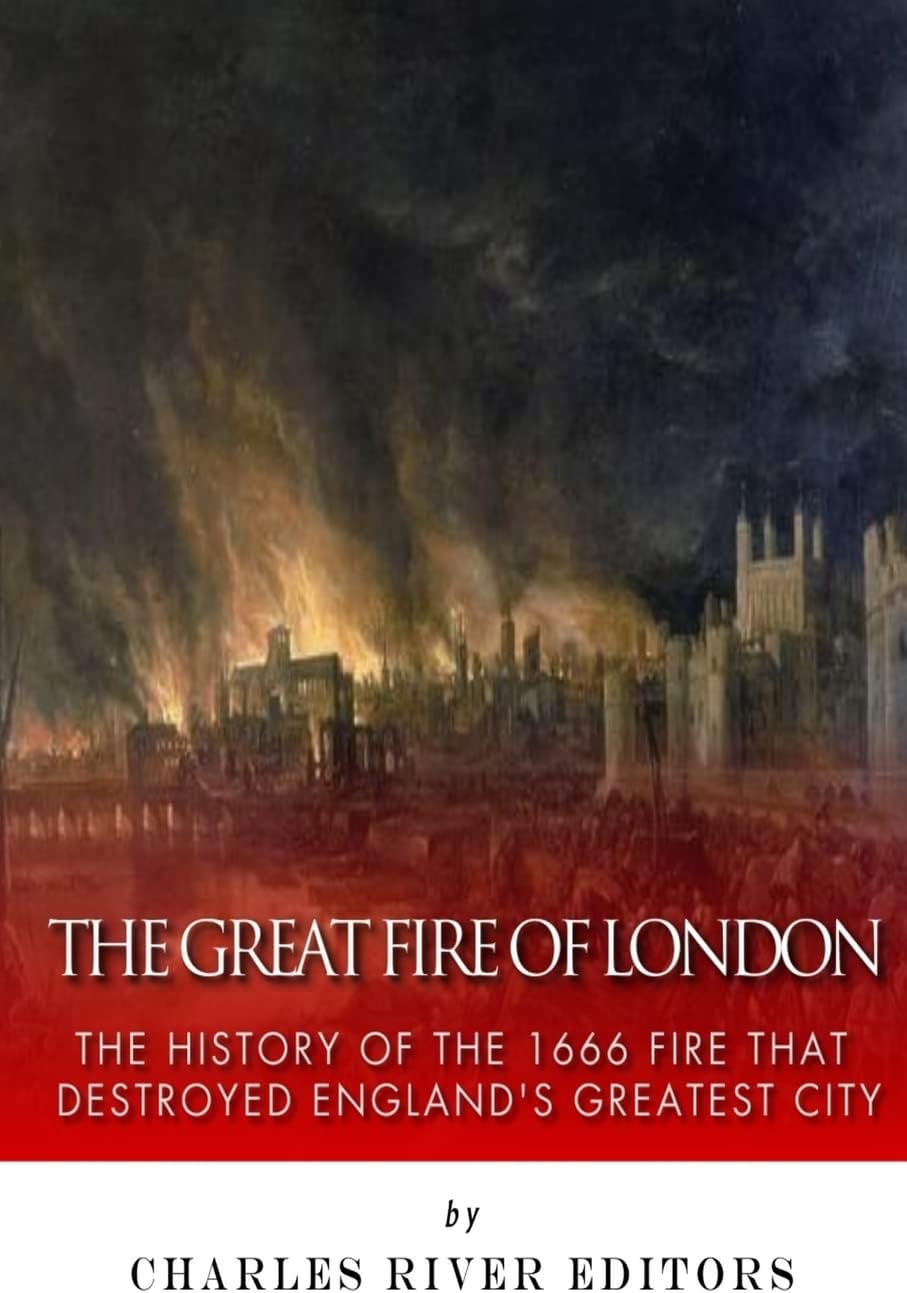
The Great Fire of London: The History of the 1666 Fire that Destroyed England’s Greatest City
Product ID: 14567600
Desertcart purchases this item on your behalf and handles shipping, customs, and support to Senegal.
*Includes pictures *Includes accounts of the fire written by survivors and government officials *Includes a bibliography for further reading “[A] wooden, northern, and inartificial congestion of Houses." – John Evelyn’s description of London before the fire “So I was called for, and did tell the King and Duke of York what I saw, and that unless His Majesty did command houses to be pulled down nothing could stop the fire. They seemed much troubled, and the King commanded me to go to my Lord Mayor from him, and command him to spare no houses, but to pull down before the fire every way." – Samuel Pepys In the 17th century, the people of London could boast that they had developed some of the most advanced firefighting technology and methods in the world, including the use of primitive fire engines. There were even vendors of such machines who advertised in papers of their machines’ abilities to quench great fires. Of course, even with trained firefighters and new devices, the most skillful efforts could still prove limited in the face of a giant fire, as Rome had learned over 1500 years earlier and as Chicago would learn nearly 200 years later. In fact, one of the primary reasons London developed ways to fight fires was the fact that the city was particularly vulnerable. Although London was over 1500 years old and sat at the heart of the British Empire, most of the buildings were made of wood, and the city was overcrowded, in part due to the fact that city planners worked with and around the ancient Roman fortifications that had been constructed to defend it. As such, while there were spacious areas for the elite and rich outside of the city, London itself had narrow streets full of wood buildings that were practically on top of each other. With some bad luck and bad timing, a potential disaster awaited the city, and that finally came in September 1666. As it turned out, the Great Fire of London was so bad that one author who studied the blaze described it as “the perfect fire,” referring to the convergence in the largest city in England of spark, wood and wind in such a way that no one could stop the fire or even fight it effectively. John Evelyn, who had warned of the potential for a devastating fire given the layout of the city, noted that people seemed so stunned by the scope of the fire that they didn’t know what to do: “The conflagration was so universal, and the people so astonished, that from the beginning, I know not by what despondency or fate, they hardly stirred to quench it, so that there was nothing heard or seen but crying out and lamentation, running about like distracted creatures without at all attempting to save even their goods, such a strange consternation there was upon them.” While the fire quickly spread throughout the heart of the city, the only thing that saved London’s suburbs was an ancient wall built around the city to keep the enemies of Rome out, not the fire in. By the time it was finished, most of the city’s homes and churches lay in ashes, and nearly 90% of the city’s citizens were left homeless. The only consolation taken away from the devastation was an astonishing low death rate; although London had about 80,000 residents, only a handful died as the fire raged across the city. The fire lasted three days, and by the end of it, Londoners were shocked by the wide-scale destruction, which was so great that Samuel Pepys remarked, "It made me weep to see it." In the aftermath, people looked for scapegoats, ranging from King Charles II to the Pope and his Catholic supporters, while England’s leaders looked to rebuild the city. The civil and foreign strife ultimately posed obstacles to new plans to rebuild London, which actually meant that the rebuilding efforts were designed in ways that mimicked the old layout that had invited such a disaster in the first place. Review: Nice Read - Excellent read. Concise and easy to read, however very detailed and interesting. If you are looking for a more concise read on the London fire this is the book for you. Review: Four Stars - A very interesting and enjoyable historical account.
| Best Sellers Rank | #4,979,155 in Books ( See Top 100 in Books ) #12,503 in Great Britain History (Books) |
| Customer Reviews | 3.8 out of 5 stars 33 Reviews |
F**8
Nice Read
Excellent read. Concise and easy to read, however very detailed and interesting. If you are looking for a more concise read on the London fire this is the book for you.
J**L
Four Stars
A very interesting and enjoyable historical account.
B**A
EXCELLENT
THE GREAT FIRE OF LONDON is about an Historical incident, little known in the United States. This ebook has lot of interesting information. Read and learn.
S**C
Five Stars
i really liked this book i love anything about history
R**T
Five Stars
This account is excellent.
M**H
A Good Introduction
Interesting and informative as to how those in authority tried to stop the fire which destoryed much of London. This novella incoroprates some of the actuals writings that occurred during this disaster. A short read of about 40 to 60 minutes.
Trustpilot
1 day ago
2 months ago