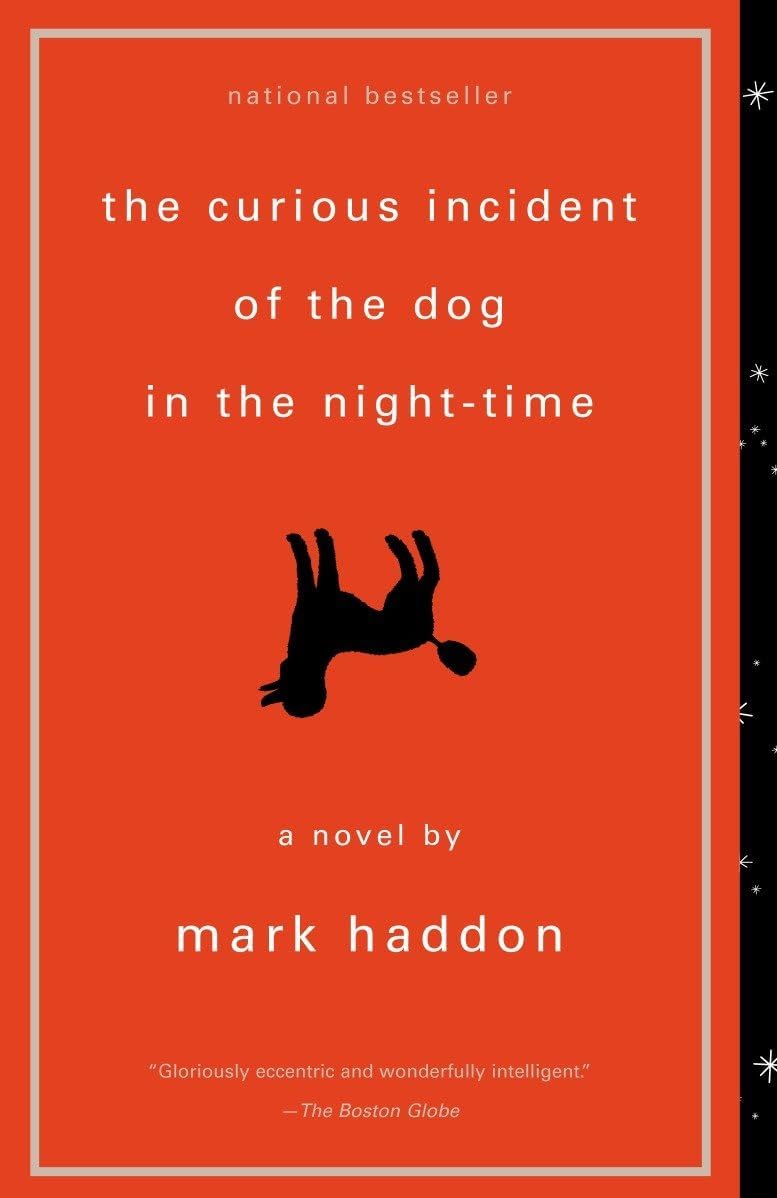
The Curious Incident of the Dog in the Night-Time
Product ID: 1351087
📚Modern classic bestseller
🔢Math & logic-driven narrative
🕵️♂️Unique mystery perspective
Desertcart purchases this item on your behalf and handles shipping, customs, and support to Senegal.
🔍 Unlock the mystery of mind and math — where logic meets heart.
The Curious Incident of the Dog in the Night-Time is a critically acclaimed modern classic that blends a gripping murder mystery with a profound coming-of-age story told through the unique perspective of Christopher Boone, a mathematically gifted boy with autism. Ranked among the top coming-of-age fiction and praised for its authentic portrayal of neurodiversity, this bestseller challenges traditional narrative styles and invites readers to rethink truth, emotion, and human connection.

| Best Sellers Rank | #3,644 in Books ( See Top 100 in Books ) #133 in Coming of Age Fiction (Books) #268 in Classic Literature & Fiction #315 in Family Life Fiction (Books) |
| Customer Reviews | 4.2 out of 5 stars 38,313 Reviews |
P**D
Moving story, deep issues, stylistic tour de force
This remarkable novel starts with the murder of an older dog and ends with the naming of a puppy. In between it achieves a lot with extremely simple means. On the surface it poses as the coming-of-age story of the autistic teenager, Christopher. In the wake of a long and distinguished tradition, coming-of-age novels are encumbered by a time-honored set of conventions, which are rigidly observed here, with the marvelous effect of complementing the rigidity of the autistic boy's behavior. As a "red herring", to use Christopher's terminology, the novel starts as a mystery story, but this pretense is dropped midway when the mystery is solved by a confession, in precisely the way the many "clues" dropped along the way led the reader to believe it would be solved. But by then deep issues of style and substance have been raised and cast in an entirely novel light. We are told that an autistic child is incapable of telling anything but the truth, even if not always the whole truth. Given that the story is told in the first person by Christopher, this has remarkable stylistic repercussions: the author is bound to foreswear the use of metaphor, though not of simile. This leads to an occasionally hilarious exploration of a literature without metaphors. Under this constraint, descriptions turn quantitative. A meadow is described by listing the numbers of cows with different hide markings, and in the interest of "truthful disclosure" we are told that the boy is observing the meadow while "weeing" during a car trip. You say "aha now I know how literature that is close to the truth, and as such much more reliable, would look like." Add to this that an autistic child is incapable of understanding human emotions, another crucial ingredient of a good novel, and you are led to say "now I know what literature devoid of any understanding of emotions would look like." And then, when you are through with this novel, you suddenly realize that all its unassailable component truths add up to one big lie. For why should a human being haunted by fears and suffering, as overwhelming as those experienced by Christopher, care about understanding the emotions of those around him? Anyway why should these creatures, subject to the whole usual gamut of human emotions, from love to jealousy, from hatred to revenge, serve as a worthwhile example to him? His pain is much deeper than theirs and in final analysis what he experiences as physical pain of all kinds (in his chest, his head, wherever) is really a gamut of emotions compared to which all the petty emotions of those around him pale. So, accepting the basic premise of this book --- that Christopher understands nothing about human emotions --- is the biggest lie of all and we are back on the territory of novels in which bored capricious women, be it in a French small town or in Russian high society, are driven to adultery, and when despair sets in, to suicide. Cristopher's despair dwarfs that of Mmes. Karenina and Bovary, but he at least has figured out how to groan or take the cubes of integers and thereby to cope and survive. Even what might be thought of at first as a weakness of this book, in the end turns out to be one of its strengths. I have in mind the rigid matter-of-fact style appropriate to Christopher's narration, which starts wearing on the reader after a while. My reaction was one of impatience, of I have seen that, can't you do something else. But then, this going on the reader's nerves is marvelously tailored to make him understand through first hand experience what living with an autistic child feels like, even if only for the short time it takes to read this novel. Rather than simply assuring us that Christopher is intelligent and scientifically talented, the author has him elegantly rendering some beautiful and well-known ideas of mathematics and physics. It is clear that this boy is headed for a life in the sciences, but will his autism stand in the way of his doing original work? Creative work, as has been realized over the years, has an important emotive component. Will Christopher be able to come up with what it takes at the emotional level? To judge by what we know about him from this story, he does have all it takes, and if there is a danger it is that he even has too much of it. Besides being a future scientist, Christopher is known to us as a writer who has us rethinking the description and understanding of emotions in literature and the meaning of truth, or at least of truth as reflected in a work of art.
O**S
Curious Review
Christopher John Francis Boone is a fifteen year old boy who lives with his father, loves animals, and doesn't understand human emotions-including his own. With help he has learned what makes him feel :) good, like orange crush and licorice laces, and Toby his rat and starring up at the stars at night. And he knows what makes him feel :( bad, like new places, people, too much information, or anyone touching him. But he doesn't understand a lot of the faces that Siobhan from school shows him or Mr. Jeavons the school psychiatrist asks him about. Christopher is different from a lot of other teenage boys and he goes to a special kind of school with other special students. He doesn't like to be compared to them because he thinks a lot of them are stupid, but he's not allowed to use that word or call them that according to what his mother used to say or Siobhan at school, he's supposed to say they have learning difficulties or that they have special needs (but that's stupid too because everyone has learning difficulties). But it is his book so he can write what he wants in it. He's keeping this book for his investigation. He's investigating like Sherlock Holmes and he is investigating a murder. There was a murder on his street of Wellington the big poodle at Mrs. Shears house, which is right down the street from his house and Mrs. Shears is a friend of their's and so was Wellington because Christopher likes dogs. The Police and Siobhan says that killing a dog isn't the same thing as killing a human and they don't investigate or search as hard for things like that because it isn't a human, but Christopher liked Wellington and he thinks dogs are just a good as humans, in fact he likes them more. This is a book written from the first-person point of view of a fifteen year old boy with autism and a very good understanding of facts and numbers (maths). He focuses and relies on the here and now, the real things of this world, and math problems. He doesn't like idioms, similes, metaphors, slang, or imagination. Facts are much more preferred, thank you. The book starts on the night that he finds Wellington skewered with a garden fork on Mrs. Shears front lawn, an event that he is later blamed and questioned about. He determines that he has to find out who murdered Wellington and the life that he thought he knew and was comfortable with swiftly begins to unravel. For a boy who doesn't understand human emotions a lot of events puzzle him and he has a hard time coping and understanding why some people do and choose the things that they do, it's not logical, even if it is human. Mark Haddon does a remarkable job at capturing the mindset and ideas of an individual with autism and expressing it in a way readers can relate to. This book illustrates how some mindsets can be different. Where some individuals focus on feelings, others enjoy literature, and still others are focused on numbers and facts, things that are measurable and recordable, like Christopher. Sometimes different mindsets make certain things easy for individuals to understand while other topics and ideas are alien and something that makes ones' head spin. This is a tale of murder, mystery, a hidden past, and an unsure future of a boy who likes to deal in absolutes and certainties. But all it takes is one variable in the equation to change for the outcome be to a different world entirely. Overall this book is really well-written and an interesting read. Highly recommended for those working with individuals with autism or other neo-neurological learning disabilities. Also a good read for those looking for different perspectives or books that make you question the writer/reporters point of view.
R**7
Terrific, unique and thrilling to read!
This is a wonderfully entertaining and touching and sometimes frustrating book. What first attracted me to it was the basic premise...a mystery (the "murder" of a neighbor's dog) investigated by an autistic boy...told through the eyes of the boy himself. Christopher, our narrator, is as unlikely a hero as you're going to encounter in a piece of fiction that isn't science fiction or fantasy based. Apparently Mark Haddon worked with autistic people for awhile, and his knowledge of their traits clearly informs the book. It is a novel with a hero that is incapable of showing empathy or even sympathy for others. He is totally self-involved and pretty well insulated. Yet his unique humanity shines through. What's also terrific in Haddon's approach is that while Christopher cannot really tell us what other people are thinking or feeling...we empathize with them anyway. Whole pages of dialogue are given without any inkling from the narrator as to what tone of voice people are using, what their faces are showing (he doesn't like to even look at people's faces), etc...yet the crispness of the dialogue leaves no doubt. We see through Christopher's blindness to the "normal" people beyond. Yet we also buy into Christopher's world-view pretty easily, and we actually have a basic sense of how he needs to cope. For example, when people try to touch Christopher, he may begin screaming or banging his head on the ground. Imagine how embarrassing and frustrating this must be for his parents, how annoying or startling for those around him! We can feel, as a "normal" person, that Christopher is frustrating kid. Yet from Christopher we also know that he doesn't like to be touched, it's too much stimulus and by screaming or groaning or banging, he finds some escape. And sometimes that escape can't stop because he doesn't dare risk stopping to see if he's no longer being touched, only to discover that he IS still being touched. Hence, the screaming goes on. In Christopher's matter-of-fact manner, we see how he isn't really doing anything "wrong." The book really doesn't turn into much of a mystery about the death of a dog. It's full of amusing or inciteful digressions...as Christopher shows us how he can't understand things like facial expressions, but is brilliant at turning everyday problems into mathematical problems. I suspect he may be a "higher functioning" autistic person than most or many, but he has to be in order to write the book in the first place. Towards the later part of the book, Christopher takes an enormously brave journey, venturing into a world he knows virtually nothing about. You can feel the fear in him, the isolation and the bravery. And yes, even some pride. It's a wrenching and dramatic final act, and at this point the book is pretty much impossible to put down. The true story behind the story is the relationship of Christopher to his father, and to a few other key people in his life. And when the end of the book comes, we find that we can actually be moved to tears by the events that have taken place. It's a riveting and unique book. There are a few casual bad words or phrases in the book (mostly Christopher seeing graffiti and reporting it to us) and thus I wouldn't recommend it for anyone under, say 15 or so...but I think it's brief enough, fast-paced enough, and just well-written and entertaining enough to be for almost anyone who enjoys reading.
A**A
Well written and moving, even Impressive but not Entertaining
"The Curious Incident of the Dog in the Night-Time" is a story of an autistic teenager who is excellent with numbers and has a photographic memory but lacks communication skills. His view of the world is simple: if it is not true, it is a lie. If he doesn't know a person, he shouldn't talk to him or her. If it is yellow or brown, it can't be touched. And nobody, not his father, not even his mother can touch him. Mark Haddon's first book puts him in the league with great authors of our time. The book is so well written and the story has been narrated in such convincing tone, that at times I had to make sure that Mark was not writing his autobiography! When Fifteen-year-old Christopher John Francis Boone finds a murdered dog in his neighbors's frontyard, he picks him up instinctively. That is because he likes dogs. The neighbor assumes he killed the dog and from there start's Christopher's long and arduous journey to find the killer and unravel the mystery. However, in doing so, Christopher finds more than he had bargained for. His simple autistic mind cannot comprehend why anybody would kill a dog. While the answer, which he uncovers by the middle of the book, makes no sense, it does bring him face to face with the surprising truth about his dead mother and that ultimately convinces him to travel to London. Now begins the story of a boy, a child, who hasn't stepped beyond his street alone but travels boldly all the way to a metropolis where even adults with all their sense and knowledge of the world can get lost. Does he make it? What happens to the killer of the dog? What was the secret about his mother? The book links all questions rather beautifully but still fails to impress. This is a very one dimensional book. The story didn't seem to be very original. We have all read books, watched plays or movies of handicapped children who undertake huge tasks and complete them. The book also fails to explore the relationship between Christopher and his mother even though his bond with his father has been explained well enough. The only charcters that are well developed are Christoper and his father. Readers get no insight into rest of the characters who could have very well defined the nature of relationship between Christopher and his parents. CONCLUSION: Well written and moving but not entertaining. Very one dimensional. Read a few pages before you buy it.
L**A
Uniquely told by the unique main character
I've never met, seen, or read about anyone quite like Christopher John Francis Boone, the uniquely eccentric protagonist of The Curious Incident of the Dog in the Night-time. This highly acclaimed, award winning book by Mark Haddon, tells from a first person point of view the difficulties of this socially-impaired, fifteen-year-old boy who lives with his father in Swindon. Although Christopher never discusses autism with the audience, he shows certain signs of this disorder, including mathematical genius, apathy, and the inability to understand others. Due to this syndrome, many of the details in this novel are seemingly irrelevant, such as the number of holes in someones shoes and the differences between a metaphor and a simile. However, the digressions are perhaps the most interesting reads, as they allow the reader to understand just how differently his mind functions. I also find myself chuckling over some of these moments, such as when he explains how five red cars equals a good day and wonders why the Orion is called Orion. As he struggles to navigate the world of people, his adventures help him to gradually gain independence and mature. Since it is labeled as a murder mystery novel by Christopher himself, the first half covers the death of a neighborhood dog and his quest to discover the murderer. It is from here on that he begins to gain the courage to become independent: "So talking to the other people in our street was brave. But if you are going to do detective work you have to be brave, so I had no choice." But through his investigation, he uncovers an even deeper secret. Two years ago, his mother died of a heart attack--that's what his father said. But she's actually living in Willesden with another man. When Christopher discovers who kills the dog, his fear prompts him to confront his consternation of highly populated areas, and he takes a train alone to London to meet his mother. Mark Haddon narrates this story beautifully through Christopher's blunt voice that doesn't need to be glossed over with flowery details or superficial sympathy to get the point across. Readers will come to appreciate how realistic his view of the world is, and understand him better from his frankness in describing it: "And anyway, Orion is not a hunter or a coffeemaker or a dinosaur. It is just Betelgeuse and Bellatrix...and 17 other stars I don't know the names of. And they are nuclear explosions billions of miles away. And that is the truth." This novel will surprise you with its twists and turns, make you laugh out loud and say, "I never knew that," and, perhaps, call for some teary-eyed action near the end.
M**N
But they do not mean this because you are not allowed to tell old people that they are old and you are not allowed to tell people if they smell funny or if a grown-up has made a fart
I was introduced to this book when I was required to read it for my high school English class. I do not usually find assigned books interesting, but this one was different. I found my lost in the pages; engaged in every word. As a sophomore in high school, I knew very little about autism, so to actually be able to look through the eyes of a child with autism and go on his journey with him was so invigorating. I did not want to stop reading the book. I was so invested in Christopher John Francis Boone’s life. Now as a sophomore in college, I still have these emotions when I read this book. One quote that stuck with me from the book was, “People say that you always have to tell the truth. But they do not mean this because you are not allowed to tell old people that they are old and you are not allowed to tell people if they smell funny or if a grown-up has made a fart. And you are not allowed to say, "I don't like you," unless that person has been horrible to you.” (73.2) Throughout the book, I could sense Christopher’s frustration, confusion, and innocence. I developed sympathy for Boone because of how difficult it was for him to connect with people and no one took the time to understand him due to the fact he lacked some social skills. Despite how emotional this book made me feel, others who read this book, unfortunately, cannot relate to my feelings. Books have the same effect on people just like music. We do not all like one genre of music nor do we like one type of book. One Amazon review stated, “Very overrated book; never felt invested in any of the characters, plot was weak, kept waiting for the book to meet the hype. Book not worth your precious reading time.” Everyone is entitled to his or her own opinion, but I completely disagree. This book gave me the rare opportunity to really see through the eyes of a child with autism. There was a strong sense of pathos in this book. I felt a lot of pity for Christopher because people did not truly understand him or what he was going through. It helped me try to get a better understanding and become more patient with my 4-year-old cousin with autism. Not only did show how autism can affect the person themselves, but their families as well. His parents even struggled with their son’s serious mental condition. I even saw myself in his mother when Christopher did not want to be touched by his own mother. It is hard to connect with someone like him, but it can be done through understanding and patience. Maybe the person who wrote the review did make the connection like I did, but I know for a fact that thousands of others will. I would recommend this books to parents who have children with autism to assure them they are not alone and thousands of parents are going through the exact same thing. I believe that this is such a powerful and timeless book. Everyone should give it a read just to better educate themselves on how life really is for someone dealing with autism and how it can affect the people around them.
P**N
Isn't he really like the rest of us?
It is simple, and yet deep. It is hilarious and a little sad too. While the subject of autism touched many of us a decade ago through Dustin Hoffman in the movie "Rainman", autism is many faceted. As a medical condition, it is poorly understood; a fact that is brought home in the book. I was told that autistic individuals lack a sense of empathy. And yet the author, an autistic 15-year-old boy abounds with empathy! He says that he relates better to animals than to people, is frightened by loud sounds, especially by touch, is overwhelmed by specific kinds of speech and sensations, notices smells, colors, manners and appearances more than personal traits that may touch the rest of us. He takes in visual sensations more than verbal ones. And he picks out part of the world around us that I for one tend to miss. His little book enriched my life for this reason and many others. And my friends who read it had similar reactions. Just like we are all unique, one should not expect that autism is a one-dimensional human condition. Autistic individuals are like you and me! The book is autobiographical and yet it concerns us all. It is both poetic and poignant. It is suspenseful, but above all, this little book is different and truly original: A delight to read. I read it in a plane going south. A page turner! Couldn't put it down! While it is a mystery, or a detective story with suspense and surprising twists, it is also a sweet mix of deductive logic and emotional complexities. And my plane ride had two legs, so I read the book twice. When I returned home the next week, I checked amazon and found that it's a runaway bestseller. The book is penned by a teen age boy who is autistic in some sense. He is mathematically gifted but socially helpless. To find out exactly how, read the book. And I won't give away the plot or the ending! The book is probably not meant to be hilarious, but perhaps this made it all the more fun. Actually, I never knew if I should laugh or cry! Christopher Boone, the autistic 15-year-old narrator reveals that he is from a broken home. That is part of the story. He is uniquely observant and honest. Not because he is better than the rest of us, he says, but because he is unable to lie! At times his narrative reminded me of Albert Camus's "The Stranger". Christopher's uniquely honest narrative is helped by a photographic memory: He remembers spoken sentences to the letter! Initially, I came across a review of it in a math journal. Why a math journal? It is believed that mathematicians are a bit crazy too. Aren't we all!? And that is perhaps why many of us can relate to it: We recognize a little of ourselves in it. (Reviewed by Palle Jorgensen, March 2006.)
J**I
Remarkably engaging
I just cared so much for this boy and wanted things to work for him. He was so real to me. To be inside his world oddly opens me up to be more inside my own world, with caring and understanding in a strange new way. We do our best with what we have and who we are. I won’t forget this book, or this boy.
H**K
dili çok güzel
dili b1-b2 seviyesinde akıcı bi okuma sağlanıyor çok güzel bir kitap
V**A
Excellent Read with Decent Print Quality :)
I really enjoyed reading this book. The storyline is unique, engaging, and keeps you curious from beginning to end. It was definitely worth the money. The book quality is also decent. The pages, print, and binding are good for the price, making it a great value overall. If you’re looking for an interesting and easy-to-read novel, I highly recommend it. Totally worth buying!
G**O
Satisfecha
A mi hijo de 12 años le gustó mucho, lo atrapo en la historia y me dice que quiere otro libro del mismo autor
R**.
Great story
After long time I read a book from start to finish Thx
A**.
Wundervolles Buch
Habe das Buch für den Englischunterricht erworben. Eigentlich war ich wenig begeistert, dass wir dieses Buch in der Ausbildung lesen sollten. Als es dann geliefert worden war, wollte ich eigentlich nur kurz mal reinlesen... Daraus wurde nichts, ich habe es binnen 2 Tagen fast vollständig gelesen. Es ist aus der Sicht eines autistischen 15 Jahre alten Jungen geschrieben und obwohl dieser Junge selbst, die Emotionen anderer Menschen nicht erkennen und verstehen kann, ist das Buch wundervoll emotional. Zunächst geht es nur darum, dass der Junge herausfinden möchte, wer den Hund der Nachbarin umgebracht hat, doch daraus entspinnt sich in kurzer Zeit eine große Story, bei der es um die Familie des Jungen geht, vor allem um die Mutter, die doch eigentlich tot ist, oder? Und der Vater, der seitdem den Jungen alleine großzieht. Und um Briefe, die von der Mutter geschrieben wurden.. Kurzum, aus einer so einfachen Begebenheit wie der Mord an einem Hund, wird eine rasant erzählte Geschichte, mit interessanten Einblicken in das Denken und Handeln und auch Fühlen eines autistischen Jungen. Wunderbar! Einfach lesen!
Trustpilot
2 months ago
2 months ago