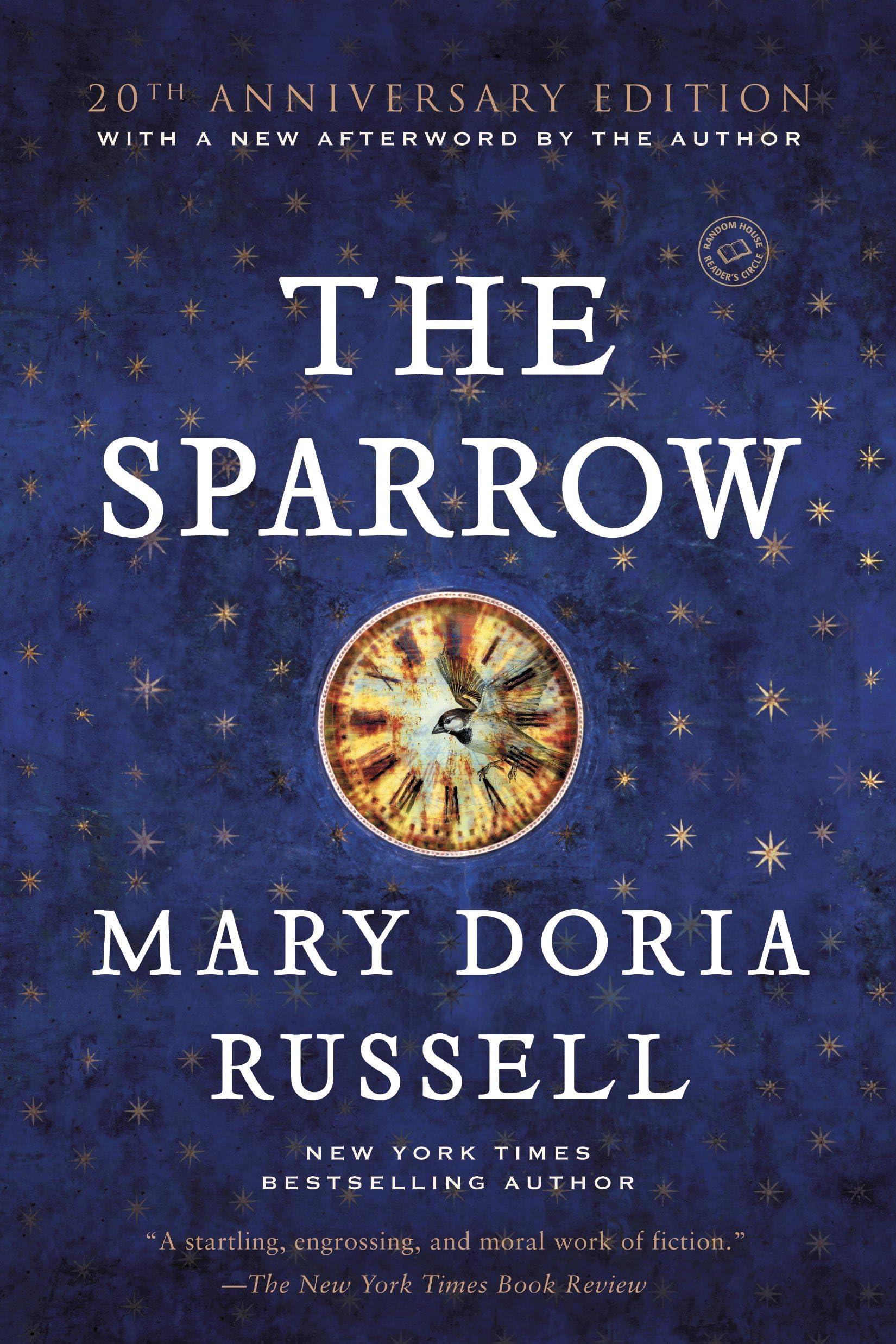
The Sparrow: A Novel (The Sparrow series Book 1)
Product ID: 119128905
A visionary work that combines speculative fiction with deep philosophical inquiry, The Sparrow tells the story of a charismatic Jesuit priest and linguist, Emilio Sandoz, who leads a scientific mission entrusted with a profound task: to make first contact with intelligent extraterrestrial life. The mission begins in faith, hope, and beauty, but a series of small misunderstandings brings it to a catastrophic end. Praise for The Sparrow “A startling, engrossing, and moral work of fiction.” — The New York Times Book Review “Important novels leave deep cracks in our beliefs, our prejudices, and our blinders. The Sparrow is one of them.” — Entertainment Weekly “Powerful . . . The Sparrow tackles a difficult subject with grace and intelligence.” — San Francisco Chronicle “Provocative, challenging . . . recalls both Arthur C. Clarke and H. G. Wells, with a dash of Ray Bradbury for good measure.” — The Dallas Morning News “[Mary Doria] Russell shows herself to be a skillful storyteller who subtly and expertly builds suspense.” — USA Today Review: God is in the Why - “Not one sparrow can fall to the ground without your father knowing it.” “But the sparrow still falls.” The fascinating premise of Mary Doria Russell’s book attracted me, that once an extraterrestrial intelligence is discovered a few decades from now, the Society of Jesus (aka the Jesuits) is the first to send a contact mission. It struck me as an original approach to a first contact story and makes sense. While governments and private corporations jockeyed for advantage and tried to get out of their own way, the Jesuits quietly did what they have done for centuries. They set out to bring the knowledge of God to the aliens, or to find out whether such knowledge is universal among all God’s children. Beginning at the Arecibo telescope with a gawky SETI astronomer, the revelation that we’re not alone travels quickly among a circle of friends with extraordinary talents and connections. THE SPARROW is a character-driven story that draws the reader into the lives of people embarking on an historical expedition. I’m not Roman Catholic, but I appreciated the insight into the life of a Jesuit priest. Service, celibacy, and honor are explored alongside secular issues. This is not a ‘Christian’ book, per se, but more an exploration of how intelligent people approach the concept of why an omniscient and omnipotent God allows terrible things to happen, whether he simply watches atrocities or orchestrates them for some purpose hidden from us. This is a wonderfully-written thinker’s book that encourages the reader to examine the logic of whether God exists, what evil looks like, whether one society’s morality is more valid than another’s, how faith and science can overlap and complement one another, and too many other concepts to list in this review. Russell has an impressive background in anthropology, and it shows in this compulsively readable, thoroughly approachable speculation on how interaction with an alien culture impacts humanity in general, and one man’s faith in particular. Without giving too much away, I’ll say that the book begins with a disaster having taken place. Details of the events are shrouded in mystery, but one thing is clear: it’s not going to end well. I spent most of the book enjoying the intelligence and humor of the dialog and character interaction, falling in love with Russell’s characters, and living in a kind of dread for the hard ending I knew was coming. The main character says at some point in the story, “God is in the why.” This is reflected in the way the author chooses to structure the novel. We know the ending from the beginning of the book, but the book isn’t about what happens, it’s about why, and the effects of the ‘why’ on one physically, emotionally, and spiritually ravaged man. The profound sadness of this book lingers, along with grand ideas that I can keep and turn over in my mind like exotic artifacts. My conclusion: at the point where science can no longer answer there are mysteries we have to accept–assumptions that must be made–in order to go on living and working and loving. For some, I think, this is what is required to bridge the gaps in our knowledge that otherwise would lead to despair. Another word for this is faith. Review: A tragic tale full of wonder, mystery, and the search for meaning. - Father Sandoz is the Job of the future, except he failed his test. From page one, we know him to be the sole survivor of a first contact mission to the planet Rakhat, four light-years away. His friends are all dead, his alien hosts were slaughtered, he is ill and maimed, and his spirit is broken. What had begun as a beautiful leap of faith ended in unimaginable misery, and he is judged culpable. This story, told from the beginning and the end simultaneously, slowly reveals how the Jesuit mission to Rakhat failed, but the meaning - or as the author would say, the poetry - lies in the why. The Sparrow is unlike anything I’ve ever read before. It is a well-written and potent mix of science fiction and theology, highlighted by masterful world-building and peppered with shrewd banter. The characterization is thorough and compelling; the twists are unpredictable yet felicitous. It is truly incredible writing, and I may certainly read more by this author. However, I am conflicted about the choice of structure: starting us at the end. How could I allow myself to become attached to characters I knew would not survive? And yet, if I had to watch them all die one by one, without warning, I would have been appalled by the tragedy. As it is, I failed to connect with the characters and still found it to be a sad story. Amazing and stirring, but sad. As a parable, though, it is superb. It provides a powerful example of warped faith overstrained. Faith based on the law of sowing and reaping expects temporal rewards, is audacious enough to presume the mind of God, and is destined for disappointment. “... God will reach toward us if we reach toward Him ...” This is the root of the myopic “problem of evil” which has plagued religious faiths for millenia. The various responses to the “problem of evil” are named theodicy (vindication of providence). There are several such arguments in Christianity. In Hinduism and Buddhism, the answer is Karma, either from this life or another. Judaism has a soul-making theodicy: suffering is natural and provides growth opportunities for the sufferer as well as virtue exercises for their neighbors. However, my favorite theodicy is that of Alan Watts. ”When we examine our bloodstreams under a microscope we see there’s one hell of a fight going on. All sorts of microorganisms are chewing each other up. And if we got overly fascinated with our view of our own bloodstreams in the microscope we should start taking sides, which would be fatal. Because the health of our organism depends on the continuance of this battle. What is, in other words, conflict at one level of magnification is harmony at a higher level. Now could it possibly be, therefore, that we—with all our problems, conflicts, neuroses, sicknesses, political outrages, wars, tortures and everything that goes on in human life—are a state of conflict which can be seen in a larger perspective as a situation of harmony?” - Alan Watts, The Myopic View of the World


| Best Sellers Rank | #46,431 in Kindle Store ( See Top 100 in Kindle Store ) #92 in Literary Sagas #195 in U.S. Historical Fiction #335 in Historical Literary Fiction |
S**L
God is in the Why
“Not one sparrow can fall to the ground without your father knowing it.” “But the sparrow still falls.” The fascinating premise of Mary Doria Russell’s book attracted me, that once an extraterrestrial intelligence is discovered a few decades from now, the Society of Jesus (aka the Jesuits) is the first to send a contact mission. It struck me as an original approach to a first contact story and makes sense. While governments and private corporations jockeyed for advantage and tried to get out of their own way, the Jesuits quietly did what they have done for centuries. They set out to bring the knowledge of God to the aliens, or to find out whether such knowledge is universal among all God’s children. Beginning at the Arecibo telescope with a gawky SETI astronomer, the revelation that we’re not alone travels quickly among a circle of friends with extraordinary talents and connections. THE SPARROW is a character-driven story that draws the reader into the lives of people embarking on an historical expedition. I’m not Roman Catholic, but I appreciated the insight into the life of a Jesuit priest. Service, celibacy, and honor are explored alongside secular issues. This is not a ‘Christian’ book, per se, but more an exploration of how intelligent people approach the concept of why an omniscient and omnipotent God allows terrible things to happen, whether he simply watches atrocities or orchestrates them for some purpose hidden from us. This is a wonderfully-written thinker’s book that encourages the reader to examine the logic of whether God exists, what evil looks like, whether one society’s morality is more valid than another’s, how faith and science can overlap and complement one another, and too many other concepts to list in this review. Russell has an impressive background in anthropology, and it shows in this compulsively readable, thoroughly approachable speculation on how interaction with an alien culture impacts humanity in general, and one man’s faith in particular. Without giving too much away, I’ll say that the book begins with a disaster having taken place. Details of the events are shrouded in mystery, but one thing is clear: it’s not going to end well. I spent most of the book enjoying the intelligence and humor of the dialog and character interaction, falling in love with Russell’s characters, and living in a kind of dread for the hard ending I knew was coming. The main character says at some point in the story, “God is in the why.” This is reflected in the way the author chooses to structure the novel. We know the ending from the beginning of the book, but the book isn’t about what happens, it’s about why, and the effects of the ‘why’ on one physically, emotionally, and spiritually ravaged man. The profound sadness of this book lingers, along with grand ideas that I can keep and turn over in my mind like exotic artifacts. My conclusion: at the point where science can no longer answer there are mysteries we have to accept–assumptions that must be made–in order to go on living and working and loving. For some, I think, this is what is required to bridge the gaps in our knowledge that otherwise would lead to despair. Another word for this is faith.
J**N
A tragic tale full of wonder, mystery, and the search for meaning.
Father Sandoz is the Job of the future, except he failed his test. From page one, we know him to be the sole survivor of a first contact mission to the planet Rakhat, four light-years away. His friends are all dead, his alien hosts were slaughtered, he is ill and maimed, and his spirit is broken. What had begun as a beautiful leap of faith ended in unimaginable misery, and he is judged culpable. This story, told from the beginning and the end simultaneously, slowly reveals how the Jesuit mission to Rakhat failed, but the meaning - or as the author would say, the poetry - lies in the why. The Sparrow is unlike anything I’ve ever read before. It is a well-written and potent mix of science fiction and theology, highlighted by masterful world-building and peppered with shrewd banter. The characterization is thorough and compelling; the twists are unpredictable yet felicitous. It is truly incredible writing, and I may certainly read more by this author. However, I am conflicted about the choice of structure: starting us at the end. How could I allow myself to become attached to characters I knew would not survive? And yet, if I had to watch them all die one by one, without warning, I would have been appalled by the tragedy. As it is, I failed to connect with the characters and still found it to be a sad story. Amazing and stirring, but sad. As a parable, though, it is superb. It provides a powerful example of warped faith overstrained. Faith based on the law of sowing and reaping expects temporal rewards, is audacious enough to presume the mind of God, and is destined for disappointment. “... God will reach toward us if we reach toward Him ...” This is the root of the myopic “problem of evil” which has plagued religious faiths for millenia. The various responses to the “problem of evil” are named theodicy (vindication of providence). There are several such arguments in Christianity. In Hinduism and Buddhism, the answer is Karma, either from this life or another. Judaism has a soul-making theodicy: suffering is natural and provides growth opportunities for the sufferer as well as virtue exercises for their neighbors. However, my favorite theodicy is that of Alan Watts. ”When we examine our bloodstreams under a microscope we see there’s one hell of a fight going on. All sorts of microorganisms are chewing each other up. And if we got overly fascinated with our view of our own bloodstreams in the microscope we should start taking sides, which would be fatal. Because the health of our organism depends on the continuance of this battle. What is, in other words, conflict at one level of magnification is harmony at a higher level. Now could it possibly be, therefore, that we—with all our problems, conflicts, neuroses, sicknesses, political outrages, wars, tortures and everything that goes on in human life—are a state of conflict which can be seen in a larger perspective as a situation of harmony?” - Alan Watts, The Myopic View of the World
B**L
An amazing, award-winning story well worth reading
Like at least two others who have read and reviewed this book, I purchased it because I had read something else by Mary Doria Russell and had enjoyed it very much. Then I realized that it had been categorized as science fiction. I don't have a problem with science fiction but I also don't read it often and for some reason I hesitated to begin reading this. Still I eventually reached a point where I reached for it, determined to find out why this author wrote this form of story, when I had so enjoyed a WESTERN by her. And it pretty quickly became evident. It is a book on the future with its very beginnings apropos of today (and the early part of the book does indeed begin almost this year — what a shock!). Simply and most obviously, this is a book about the human spirit and the search that all of us seem to go through for a sense of place, of worth and meaning. So much more than I ever envisioned when I bought the book or began the book. The story kicks off in the year 2059 with a Jesuit priest who has been 'rescued' from a mission to the planet Rakhat. Remember that this is indeed the beginning of the book and as a plot will finish the story, but it really begins with a group of disparate people who slowly come together: the Jesuit Emilio Sandoz who has spent his career in the Society of Jesus, traveling the world as a linguist but never staying for very long until he returns to the place where he grew up, the small village of La Perla in Puerto Rico. It is there that he meets the others: A retired engineer and his physician wife; a technician working at a listening station seeking transmissions from other worlds and Sofia Mendez, an artificial intelligence specialist. They form strong bonds and relationships with each other and it is those ties that bind when the technician hears singing from a distant planet. He shares the discovery with his friends but it most strongly resonates with Sandoz, who has struggled with his faith but sees the songs as a sign that it is God's will that this group of people not only have come together for this moment but that it is for them to travel to the planet and learn about the creators of the songs. Needless to say, the book is told in flashbacks, the report that made it back to Earth and from Sandoz himself, who is the sole survivor of the trip, as a broken man barely holding together mentally, as well as physically. And it is to him to make sense of the trip and the experiences he faced. This is the main focus and what sets this book far from being just — if you can say that without demeaning the genre — science fiction. For ultimately this is a story about a man who in one of the characters words came very close to God, who felt the rapture of belief and then has his faith perhaps irreparably shattered by what happens during the trip he once thought was planned by God. It is what makes this so hard to write, to frame and give a true reflection to what this book is all about because whether we are believers or not, we feel and know what Emilio Sandoz is going through. As others have said this is really a philosophical novel. Nancy Pearl of "Library Journal" describes it as about the nature of good and evil and what happens when a man tries to do the right thing, for the right reasons and ends up causing incalculable harm. I agree. This is an amazing book and well worth all the honors that it has received. It's sometimes difficult reading. The story is haunting and beautiful and very sad.
A**P
This was brutal
I don't read a lot of science fiction, but a friend whose taste I trust told me I absolutely had to read this. I was surprised upon reading the description, to learn that a number of the characters within are Jesuits. I'm not particularly religious, but I don't have an aversion to reading about it, either. At any rate, this is not something I would have chosen without a personal recommendation. Immediately going in, I am given to understand that I'm about to read a tragic story. It begins when Emilio Sandoz returns to earth, the sole survivor of their mission to the planet Rakhat. The story goes back and forth between Emilio's present, and his past, the events leading up to the mission, and the mission itself. I almost thought I'd prefer to read it chronologically, and not know what to expect, but I changed my mind when I realized that the things that were revealed after the mission only made me really want to know what happened to cause those events. Why did everyone but Emilio die? Why did he do the things he was accused of doing? So, I have to admit, the format worked. All of the characters were extremely poignant, and I loved them all. They were so complex, and thus very human, very believable. The love they have for one another is incredibly touching. The early portions of the book had humor in them that surprised and delighted me. I find it interesting, reading a science fiction book with such a strong focus on the spiritual. I feel like a lot of sci fi gets rather lost in the technology, at the expense of depth and character development. Feel free to correct me with recommendations that demonstrate the contrary if you like. That is what generally keeps me away from the genre. Despite knowing from the very beginning that a number of tragic events were going to occur, I was not expecting the way things played out. It was very hard to read. And honestly, there are a lot of people to whom I could not recommend this, because of just how awful some of the events are. If you want something light that's going to leave you feeling happy, this is not for you. If you are easily triggered, skip this book. If you enjoy reading a book that explores some very difficult concepts, of Game of Thrones proportions but with far more introspection, then do not pass this one up.
D**O
Leaves you wanting more, and you should have gotten more
The premise of the book is promising and intriguing, and certainly keens your interest through at least half the book. But somewhere near the middle, after the group reaches their destination, the dissapointment begins. There is little description of the flora and fauna of the alien planet, even though the reader has been chomping at the bit now for days to learn what it all looks like. Worse yet, shortly after the first contact with alien intelligent life, you are a little annoyed that the aliens' culture, living quarters, utensils, furniture, are all too familiar. They are reminiscent of native american culture, maybe pueblos or mayan. Shouldn't an alien culture be a bit more exotic, a bit more ...alien??? The writing is good, I admit, and there are marvelous passages in the book that left me thoughtful. The writing doesn't sprint at a clip but doesn't slog, either. You have the feeling that you need to read every sentence or you may miss something. Overall the character development is flat. You simply don't care about anyone except Emilio. Sofia is too perfect and too pretty and too cold. Jimmy is two-dimensional and D.W. is too much like Ross Perot. Anne approaches being a little more real, but George is barely a shadow of a man with no personality or motivation except to be Anne's faithful husband. Unfortunately because I didn't care about most of the characters I wasn't too saddened by their untimely death. And I agree with one reviewer who was disgusted by everyone's goody-two-shoed-ness. I enjoyed reading this book, but theologically speaking, it was no Life of Pi. The religious tone was a bit heavy-handed at times. However, I like the theme that Russell claims for the book: do your best and you may still get screwed. Oh, and don't expect God to micromanage your life. He's just an observer, not a participant. The Jesuit's (esp Emilio's) fatal flaw was that they believed God had a hand in what was happening. Thus, they felt they could do no wrong, and no wrong could be done to them. Oops. I recommend this book as good for plot, good for premise, good writing, but bad for hard-core sci fi fans or readers looking for characters to feel deeply about.
A**S
The problem of evil worked out in scifi narrative
The Sparrow is not a new book. It will be 20 year old next month. But I had not heard of it prior to Marion’s suggestion. The Sparrow is the story of a group of people, mostly Jesuit priests, that travel to the first new alien world that has been discovered to understand the population for eventual evangelization. The story starts at the end. We know that Emilio Sandoz (one of the Jesuits that specialized in linguistics) was the only survivor of the trip. He was found by a team from a follow-up United Nations mission and sent back to earth. Once the initial introduction to the story occurs, then we start at the beginning of Sandoz’s journey out of poverty through the priesthood. We see how God appears to have gathered together a team of people put at the right place and time to providentially be prepared to take on a first contact mission. Theodicy, or how a good God can permit evil, is the main focus of the book. It takes until the very end of the book to really get the story of what happened to the mission and how everyone else died and why Sandoz was found in the status that he was found in. Sandoz at the start of the book is a completely broken man, physically, mentally and spiritually. The telling of the story is in part about the care of the man who has been brutalized (in ways that are not completely unique to other missionaries in history.) The Sparrow is the first of two books and it feels incomplete. I have not picked up the second book, so maybe the second book will fully round out the story. But most reviews suggest that the second books is not quite as good as the first. Mary Doria Russell, I would have assumed was Catholic. It is interesting that like The Book of Strange New Things, which The Sparrow is often compared to, neither was written by Christians. Mary Doria Russell is Jewish, as is one of the main characters. The question of theodicy is both a Jewish and Christian question. In many ways, fiction seems to be a better place to handle the question than straight theology. I think this was a very engaging novel. The method of going back and forth in time makes sense to the way that the author seems to want to reveal the story, but I did find it a bit annoying at times. I was also a bit annoyed that after more than 15 hours of audiobook, it still felt like an unfinished story (and I do think that was intentional). I am somewhat surprised that I have not really seen anyone compare it to Endo’s Silence. Both books are about Jesuit missionaries, both have to deal with the reality of faith in the face of serious evil perpetrated not only on themselves but on those around them. They are much more alike than The Book of Strange New Things is similar to The Sparrow. The Book of Strange New Things and The Sparrow both are about the idea of how Christianity relates to aliens as one of their themes, but other than the setting, the books are really not related. This is not a book you want to read if you want everything to work out nicely or without some real questions. But it is a book that handles faith well and for its weaknesses I still strongly recommend it. It is yet another example of ‘secular’ books handling questions of faith better than most Christian fiction. There is some real content warning on the book (violence, sex, torture and language). But none of it is gratuitous and it all makes sense in the context of the book and its themes.
K**N
A good story with astronishingly 3d characters
This story starts slowly and is presented in a sometimes-frustrating order (the reason for which becomes more motivated as the story reaches its climax), but all I can say is that it's worth putting up with these issues for a number of reasons: The characters in this book are amazingly life-like and often quite endearing. Often, one is lucky if they get an author who has sufficient insight into a single character that you can really see the story through that person's eyes. This story gives you a view of the story through the eyes of several characters, all of whom are richly described and quited varied in their points of view. Indeed, the whole story-telling challenge for Ms. Russell to show how the same set of facts can lead to radically different interpretations, depending on one's point of view. Something that's interesting about this story is its heavy reliance of religion as a central theme, without being either religious or anti-religious. One can see and appreciate both the religious and the non-religious characters without feeling one's own position (or lack thereof) challenged. I'm not religious myself, but I came away with tremendous respect for the religious characters presented. And yet there were also characters in the book who were more to my personal leaning and I liked them as well. Another strength of the book, for those who like that kind of thing, was the detailing of the linguistic and sociological issues involved in the alien world. Often this is given short shrift, but it takes more center stage here because it's central to the plot. I found this detailing both intellectually interesting and, often, artistically beautiful. As I mentioned, the plot starts slowly--enough so that I might have given up on this except that the reviews of the book had been so powerful that I figured I'd better hang in there. I was glad I did. The story itself builds toward an ending that I worried would disappoint, but I found to be quite powerful and unexpected. This goes beyond "simple scifi" to issues most scifi leaves aside. It deals in depth with themes of life and death and truth and honor in ways I usually don't find myself reading about--but in an enchanting way that made it a real treasure to find. My "reading" was of the unabridged audio cassette, and I enjoyed the reader quite a lot. A good use of voices and a very entertaining read. I preferred this reader to the reader of the abridged version of the sequel, Children of God, and I hope to see this reader to an unabridged reading at some point. (I was a little disappointed by the sequel in some ways, and I find myself wondering if my disappointment was with the sequel itself or the fact that I heard its abridgment. At the time of this review, no unabridged sequel was available on audio.)
M**M
Exellent novel, not an easy read
It's August 2019 when I complete this book. In August 2019 the Jesuit linguist Emilio Sandoz and his friends are getting ready for a life-altering expedition that leads them to question faith and morality. - The prose is elaborate, detailed, shows a lot. Sustains interests by delaying revelations and keeping the suspense throughout. It achieves that by shifting between the before the expedition and after it. Really enjoyed this approach, worked really well. - The characters jump out at you. They feel complete, thre stories are properly explored and fleshed out. I cared for them, cheered for them. I miss them. I wanted to stay with them a little longer. Emilio is at the heart of this story but I really loved Anne and George, Jimmy and Sofia as well as the Jesuits and the girl Emilio taught English on Rakhnat. - Faith means different things to different characters. The question it. The priests in this book are also treated like humans. At the heart of it all is Emilio who searches for od and for the meaning of his vocation - is it even a vocation for him? He is sorely tested, shattered, destroyed. "You see, that is my dilemma. Because if I was led by God to love God, step by step, as it seemed, if I accept that the beauty and the rapture were real and true, then the rest of it was God’s will too, and that, gentlemen, is cause for bitterness. But if I am simply a deluded ape who took a lot of old folktales far too seriously, then I brought all this on myself and my companions and the whole business becomes farcical, doesn’t it. This is a memorable book with big questions, lots of great cultural and linguistic detail and great characters. It's a wise and shattering read. Not easy but one that provokes thinking and makes me really attached to characters. The ending drove home Emilio's struggles. I never felt it went overboard, with this pacing all was revealed in the right way, with the right time and mood. The narration shifting between the present and the last both stirred curiosity and prepared me for the final blows. The build-up and repercussions went very well together. The suspense kept up my curiosity to read it all as soon as possible. In short: great prose, good theme, memorable characters you care for.
A**J
Blood-curdlingly and beautiful
The ending is horrific and not for the faint of heart - cannot exaggerate this. Yet everything fits together with great deftness and delicacy. It's difficult to describe a book that weaves together so many disparate scientific fields seamlessly, with unexpected characters full of pathos, in a delicate puzzle. Fair warning, the first 20-40% is terribly slow and then it explodes! Absolutely phenomenal past that and worth the investment.
9**9
Interessant
Ich hatte das Buch second hand bestellt. Ich wusste nicht so ganz was man bei einer Gebrauchtversion erwarten kann aber wurde positiv überrascht. Es kam in sehr guter Verfassung an obwohl es schon deutlich oft gelesen wurde. Ich habe noch einen Zettel in den Seiten gefunden, der von der Mutter oder dem Vater vergessen wurde rauszunehmen: Es ist ein Grundschul Englisch Test ihres/seines Sohnes, sehr süß finde ich also macht es mir natürlich nichts aus. Wenn man dem Klebezettel auf dem Buchrücken, dem durchsichtigen Umschlag und dem Stempel auf der ersten Seite trauen darf ist das Buch davor wahrscheinlich in einer Bibliothek auszuleihen gewesen. Das Buch kam außerdem im angemessenen Zeitrahmen an. Alles in allem eine sehr interessante Bestellung und ich bin mehr als zufrieden mit dem Buch (mit dem ganzen drum herum aber mit dem Inhalt noch viel mehr).
D**Y
Harrowing, Sci-fi infused with theology and philosophy
Very rarely books move me to a harrowing scale of profound sadness, hollow and dread, and leaves me with a devastating ache of numbness and void. Mary Doria Russell's The Sparrow does everything and more. What a great start to reading in 2026.
P**3
the misunderstandings that arise especially regarding contact with the ruling Ja'anata and the struggle Emilio Sandoz undergoes
This is one of the few books that I have read in recent months that I have found difficultt o put down and yet did not want it to end. The story has stayed with me and I find myself returning to some of its themes. Russlee employs a science fiction background to explore themes of friendship, belief, trust, powere and accepted conventions to an effective degree. Providing one is able to suspend disbelief regarding the means of interstelllar travel ( using adapted asteroids) then all else becomes believable and a challenging to read. The key character - Father Emilio Sandoz - is a jesuit priest with a skill in languages and conflict regarding his postion in the priesthood. His early life has mirrored the jesuit philosopy of evangelization and exploration but by he time the novel begins doubst have begin to arise. Responding to a signal from a planet ( Rakhat) he and a small group of people set forth on what can be seen as a 'mission' to explore the source of the signal. Events rapidly unravel espcially when contact is made with the indigenous population which had, over the centuries, evolved into two distinct groups and a stable society but one whose practices are unethical to the mission group. The loss of the original party, the misunderstandings that arise especially regarding contact with the ruling Ja'anata and the struggle Emilio Sandoz undergoes regarding his belief in a god and his postion in the jesuit order are beautifully told and I am still mulling over some of the points to come out of the book. There is no facile redemption in this book and the ending is uncomfortable. I would suggest, also, reading " Children of God" which is essentiallya sequel and in whihc many of the unfinshed threads of the first book are bought together. Also not an easy read but worthy of another 5 stars
M**A
たとえ一羽の雀でも
ワーナーブラザーズがこの小説の映画化権を獲得し、ブラッド・ピットが共同製作・出演予定というニュースを知って、読んでみました。ミーハー根性丸出し。 2059年、イエズス会が計画した惑星Rakhatの探索が無惨な失敗に終わり、心身に深い傷を負った唯一の生還者エミリオ・サンドス神父は頑なに沈黙し続け、信仰を捨てようとしている――という興味をそそられる導入部で始まる物語は、Rakhatとの最初の接触から探索員たちが旅立つまでを描く2019年、Rakhatへ向かう(地球時間で)約18年の旅、Rakhatでの4年間の出来事が交錯し、神の名の許に異星を訪れた地球人が彼の地とその人々に何をもたらし、何が起きたかが次第に明らかになっていきます。 マタイ伝の一節からの引用であるタイトルを始め、キリスト教に関係する用語や固有名詞が数多く登場しますが、終盤のサンドス神父の凄惨な告白に至るまでのスリリングな展開、やや類型的ながらも個性豊かな登場人物たちの示唆に富んだ思索と会話の妙には、私のような無宗教者でも静かな感動が訪れる結末まで飽きることなく惹きつけられました。 キリスト教とイエズス会の辿った歴史を彷彿とさせるエピソードや暗喩は、クリスチャンの読者にはことさら興味深いものと思われます。 絶望の果てに一条の光を見出しかけたサンドス神父に再び試練が訪れることを予感させるラストシーンは、続編 "Children of God" に繋がっていくようです。 さて、映画化が実現したら、ブラピの役は何だろう?残念ながら、サンドス神父はイメージが違うか。いずれにしても楽しみです。
Trustpilot
3 weeks ago
2 months ago