๐๏ธ Elevate your analog legacy with precision and speed โ donโt let your memories settle for less!
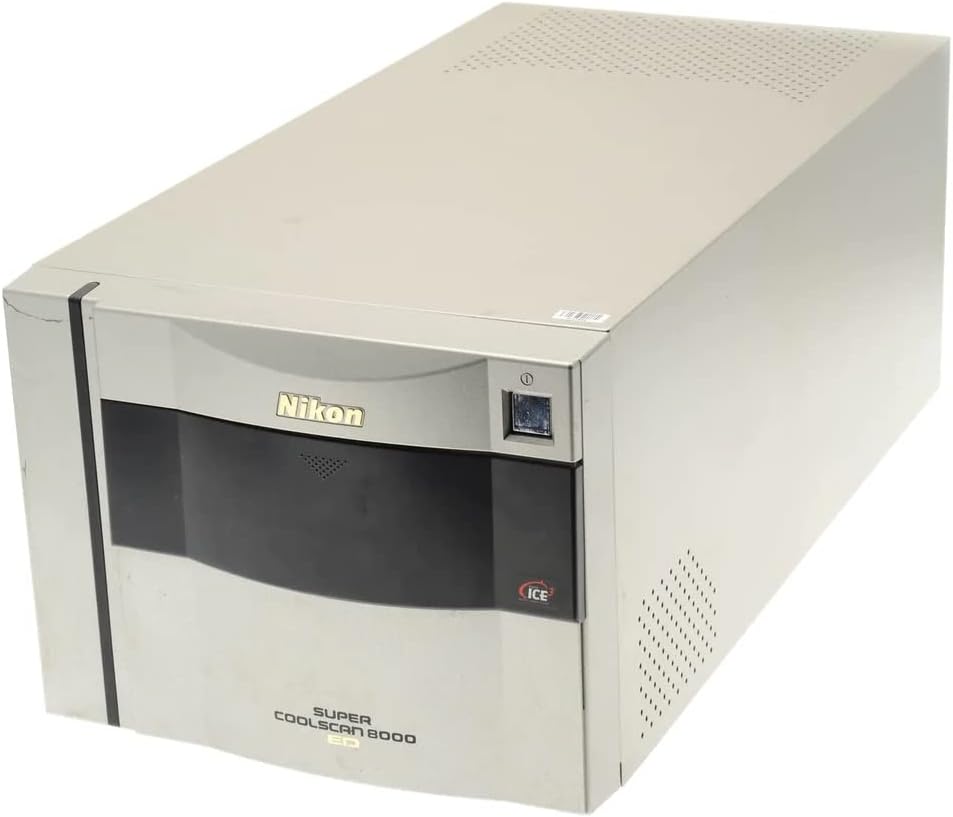
The Nikon Super Coolscan 8000 ED is a professional-grade film scanner delivering true 4000 dpi optical resolution across multiple film formats including 35mm, 120/220, 16mm, and microscope slides. Equipped with a custom SCANNER NIKKOR ED lens and advanced LED lighting technology, it ensures sharp, color-accurate scans with minimal distortion. Featuring Digital ICE3 for automatic dust and scratch removal plus color restoration, and a high-speed IEEE-1394 Firewire interface for seamless PC and Mac compatibility, this scanner is the ultimate tool for photographers and creatives demanding top-tier image quality from their analog film archives.
| ASIN | B00006IS3O |
| Best Sellers Rank | #1,222,641 in Office Products ( See Top 100 in Office Products ) #462 in Slide & Negative Scanners |
| Brand | Nikon |
| Color Depth | 48 bpp |
| Connection Type | Firewire |
| Connectivity Technology | Firewire |
| Customer Reviews | 3.1 out of 5 stars 6 Reviews |
| Global Trade Identification Number | 00018208092468 |
| Greyscale Depth | 8 bits |
| Light Source Type | LED |
| Manufacturer | Nikon |
| Media Type | Slide |
| Minimum System Requirements | Windows 7 |
| Model Name | Nikon Super Coolscan 8000 ED |
| Optical Sensor Technology | CCD |
| Resolution | 4000 |
| Scanner Type | Film |
| UPC | 018208092468 |
| Unit Count | 1.0 Count |
S**C
Best scanner for the $$--still.
When Nikon discontinued the 9000 scanner, the price shot into the stratosphere. So what's serious film photographer supposed to do now? At less than half the price of the 9000, the 8000 does almost the same job, though a little slower. Let's face it--there is simply nothing besides the 8000 between the Epsons at around $700 and the 9000 at $4000 used or $6000 new (if you can even find one...). Yes, the 8000 is a little long in the tooth, and most units are at least 10 years old. It's a little slow, a little noisy, and has a few quirks that need to be worked around. But if you shoot MF film and want the highest possible resolution and can't afford $40 for a single drum scan, the 8000 will do it. Sharpness compared to an Epson flatbed (I own the V500) is noticeably better, and the 8000 is resolving grain that the Epson cannot. What else is better compared to an Epson? For one thing, the Nikon, supposedly due to its light source, picks up far less dust and scratches on the film. And Digital ICE is more effective. Color in general is better--sometimes it seems the Epson only guesses at what colors my negative are. If you need to print big, the Epsons simply aren't suitable. And there's no point in using fine lenses (I have a Mamiya 6 system) unless you can get a good scan. I had no idea my lenses were so sharp until I started using the 8000. Surface detail on objects suddenly appears, and other fine details invisible to the Epson. The 8000 does have its quirks, however, and they are well-known and discussed on the internet. The first is that while the holders are generally excellent and heavy-duty (they put the Epson film holders to shame), the standard MF may not get the best sharpness from 120 film due to the difficulty of holding the film flat. Many users opt for the glass holder, which holds the film flat between two sheets of glass, but at over $250 (used), it's not a cheap option. There's a cheaper one: the glass from my betterscanning.com film holder fits perfectly, and can be had for only $29.99. My scans are now consistently grain-sharp. The second quirk of the Nikon is its tendency to create banding patterns. This only happens in fast mode, and can be eliminated by always opting for "fine" mode. I've only seen it so far in 120, but not in the last set of 35mm scans I did. It's not a big deal, but does slow down the scans considerably. Software may be an issue for some users, depending on the computer/operating system used. Some report success with Nikon Scan software (free from Nikons' website), and some don't. I worked great for a while on my Mac running 10.5.8, but then it refused. Fortunately, Vuescan has come to the rescue with it's ridiculously cheap ($39.99) scanning software. It does just about everything the Nikon software does, including batch scanning (many have claimed it won't batch scan on the 8000, but that's nonsense--you just have to configure it correctly. One advantage of Vuescan is that it'll run any other scanner you have. The same can't be said of Silverfast, which is scanner-specific. Although Silverfast is probably better, it's also over $400. In summary, the NIkon 8000 ED does have its shortcomings, but there is currently nothing that gets close to its native resolution for what it costs (I never have to sharpen scans). If you're committed to film and can't afford the 9000, then get an 8000--it's the next best thing. The price will no doubt drift upwards with that of the 9000 (all the other recent Nikon scanners are now multiples of their original price), so if you can find one, buy it.
R**Y
Great scanner from an excellent seller.
Excellent scanner. Excellent seller!
J**H
i've had this scanner for over 6 years. Its great,
I paid a lot less than current prices for this...I think my cost was around $2K. At today's price I would not buy it new. I'd spend the money on a great Nikon digital cam or Canon, etc. I've scanned dozens of rolls of 120 film with it. I had problems in the past with scan quality because I lacked computing power. Recently, using 120 film, Silverfast AI8 Studio and a new Mac Pro this scanner (and the silverfast sw) produces mind blowing quality when printed ( i use an Epson 4900 and Canson High gloss paper). Silverfast is very good, I especially like its ability to manage colors well and amazingly good at cleaning dust spots from the image. Also, Thank god Apple provides a firewire 400 to thunderbolt adapter :-) The scans are easily saved as PSD files. I can honestly say that for me, the Coolscan 8000 produces digital color and black/white images with Silverfast AI8 that are as good as the native digital files I produce with my 50 megapixel Hasselblad camera. With Fuji 50, I'd say the film and scan results in better colors than the 50MP Hasselblad CFV-50. Don't get me wrong though, I believe the CFV-50 is fantastic, but harder to work with than film, because its resolution is so fine, far better than the human eye, that its not as forgiving of any vibration, whereas film seems more forgiving. I simply never hand hold a shot with the digital back, but I still can do so with a film back in place. Its common to be able to use the Coolscan 8000 to produce files that can be printed at 8 x 10 and 450dpi. These are RAZOR sharp images, which I like...i do use PS CS6 to finalize images... Its so good, I am continuing to use film as well as digital. 1 big reason is that I also use the glass film holder which helps keep the negatives flat. IF they are not held flat the scanner has great difficulty and can often produce garbled banding in the image (thereby ruining it). Its noisy, and slow, but very effective. Another tip worth considering: I have the scanner sitting on the floor to minimize possible vibration from tables and desks. I added additional rubber feet too. These steps seem to have a positive impact on quality. Its easy as cake to scan 5 35mm slides at a time. Just be sure to walk away and do something else while it works..not long ago I scanned a few 50 year old Kodachrome slides. The results are amazing. The digital pics look like the day the pics were shot. If you have a lot of old slides and negatives, its a great scanner at the used price.
D**Y
Nikon's Medium Format Film Scanner--the 8000ED
It's time for a timely update to this review. Now written in 2021, I purchased this scanner new in 2004--I think. Been awhile! For several years I was unable to use the 8000ED because Nikon literally stopped supporting it! Legacy software was not for them so it became a bit of a boat anchor, until I found another scanner software developer who brought the unit back to life. And back it is! With the aid of an iMac running Big Sur (11.4) and VueScan 9.7.55, it performs incredibly well. A special note for you with these scanners. They're getting older. Parts do fail on them but they are still reparable. When I attempted to resurrect my 8000ED I discovered it had gotten some hardware issues while it sat under a dust cover for a number of years. Thanks to a support network out there, it was repaired (two fairly large surface mounted chips were replaced) and it got a mirror cleaning and general CLA. About $300. I use it for both negatives and positives. I shoot a variety of films--all seem to be handled quite well. The best part of the 8000ED is that it handles medium format--2-1/4" square or 2-1/4 by 2-3/4" negs or slides. I use it for Nikon, Leica, Leicaflexes, and even Hasselblad films. The VueScan developers ($99.99 lifetime subscription) have brought these back to life. They have also permitted them to work with so many films, and allow you to exploit so many options that the Nikon Super Coolscan 8000ED had built in. The only downside is that you can't really do batch scanning. The smaller strictly 35mm machines from Nikon do that. This big daddy is for 35 and 2-1/4 and handles things one at a time, sort of. (You can load up to 5 slides (35mm) or 2 (2-1/4) at a time or up to 12 35mm negatives (or uncut transparencies). Of course, most are buying it for the medium format. Sometimes it may appear slow, when doing multi-passes on a difficult slide, the results are phenomenal. I can easily produce a 440mb file (TIFF, or even RAW) if needed. Even if you find one that is New Old Stock, immediately ship it out for a CLA. Today, you will find that the 8000ED has some advantages over the pricey 9000ED--it's more reliable. When Nikon produced the 9000ED model around 2007 they changed some things to save $ and so from strictly a reliability/maintainability perspective, the 8000ED will be the better choice. I couldn't be happier with the Nikon Super Coolscan 8000ED. I am very pleased to have it. It keeps film viable in today's digital age.
E**A
Medium Format Film Scanning Bang For Your Buck Best
. This review was written for Ebay in 2008. With it's successor going for twice as much on the used market (when it can be found) and Nikon's shipping schedule as inconsistent as it can be just when your looking for the newer LS-9000, the 8000ED becomes a real alternative, especially when, with a little research, you begin to realize that even though the 9000 solved the few problems the 8000 has, those problems are minor and always ready for a simple work around that can result in scans to be proud of, even if the process might become somewhat lengthened. In the end it's about image quality; color, contrast and resolution along with a basis for beautiful output. At today's used price, the Coolscan LS-8000ED is more than hard to beat. The gratification your film should engender as it moves to be seen in the digital world will come well within reach with the 8000ED.
Trustpilot
2 months ago
2 months ago