Buy anything from 5,000+ international stores. One checkout price. No surprise fees. Join 2M+ shoppers on Desertcart.
Desertcart purchases this item on your behalf and handles shipping, customs, and support to Senegal.
🔦 Illuminate Your Underground Mysteries!
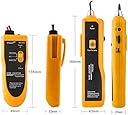
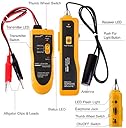
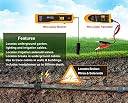
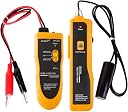
The NOYAFA D3IN0580-B Underground Cable Wire Locator is an essential tool for professionals and DIY enthusiasts alike, designed to accurately locate buried wires, including pet fence wires, metal pipes, and electrical cables. With a remarkable range of up to 1000 feet and a depth capability of 2 feet, this device ensures you can track down hidden wires safely and efficiently. Ideal for non-energized cables, it helps you avoid costly mistakes while drilling or making repairs.

| ASIN | B0086GE2C2 |
| Best Sellers Rank | #440,192 in Industrial & Scientific ( See Top 100 in Industrial & Scientific ) #843 in Network & Cable Testers |
| Brand | NOYAFA |
| Brand Name | NOYAFA |
| Color | Black, Red, yellow |
| Customer Reviews | 3.8 out of 5 stars 592 Reviews |
| Global Trade Identification Number | 07535001705744 |
| Included Components | pcb |
| Item Weight | 16 ounces |
| Manufacturer | DEHANG |
| Measurement Type | Multiple |
| Model | D3IN0580-B |
| Part Number | D3IN0580-B |
| Power Source | Battery Powered |
| Style | Digital |
| Style Name | Digital |
| Unit Count | 1.0 Count |
T**T
Works great!
We had a break in the underground dog wire fence and could not locate the exact location - calling the dog fence company is $100 per visit so I took a chance on ordering this product and it worked great! Once I figured out how to use it, we located the wire and then determined that our neighbor's retaining wall was built on top of the line, so I just cut the line and strung a new wire to connect where the break occurred. I made a few mistakes first using the product, so here are some ideas on what worked for us. I located the outdoor panel which is energized from the box inside our garage. There are two wires coming out of that panel and going underground - one goes one direction around our yard and the other goes the opposite direction to form a complete circuit. I unplugged the power going to the box in the garage so we were working with un-energized wires. I turned on the unit that turns the wire into a receiver and attached both alligator clips to both wires and tracked the noise using the receiver. That worked, but I was able to track the line in one direction but not the other (of course the break was in the other direction). I then separated the wires and attached one clip to one wire and the other to a screwdriver which we grounded in the dirt (just pushed it in a few inches). I tried both wires and got the same result several times - we could find the wire going in one direction but not the one that we wanted. So, I disconnected the wires from the outside panel. In our panel there are two wire nuts which easily un-screw using pliers. We tried each wire separately after that and were easily able to track both wires, each going opposite directions. We followed the one that we wanted to the wall and then dug down and found the wire in just a few seconds. I clipped the wire, attached new wire to that side and then to the broken wire on the other side and it worked the first time. We filled the wire caps with caulk and re-buried the wire. Voila! Saved $50 for this time and more if the line breaks again. Total time invested - less than one hour, including learning time. The way the unit works is very intuitive. Attach the transmitter (see above), turn the receiver on high and then swing the wand close to the ground - the instructions say 6 inches, but I was using it closer than that. Start with where you know the wire is You will hear a static/radio noise when you are near the wire and then nothing (or a "null") when you are directly over it. As you swing the wand, you can follow the wire and then pinpoint it near where you need to dig. In our case, the retaining wall effectively put us out of business as we were not going to dig that up, but if you are not dealing with that, you should be able to find the break when the unit goes totally silent - that means you are not above the wire which is transmitting a signal to the receiver.
B**R
Works well once you train yourself using the tips in my review on how to use. Used it to fix my dog's invisible fence.
Finally got around to writing a review. This thing saved me a couple hundred dollars and hours of digging and searching. I used it to find a marette style twist connector that had corroded and developed bad connection that eventually failed on the signal line of my dog's invisible fence. I will say that I eventually figured out how to use it after right away taking it for a spin and failing miserably. Took a couple hours just learning how to work it. The sensitivity adjustment is well... sensitive and inconsistent sometimes. I finally trained myself on how to use it by laying out a extension cord in my yard attached to the signal generator end and learning to trace a wire I 100% knew the location of. The best technique I could come up with was to hold the sensor by the wire and swing it perpendicular to the wire or line you're trying to trace. The tone emitted by the sensor will blip as it goes over the wire. If you get good at walking and swinging and you train yourself to be proficient with knowing what the tone and pitch changes are with your control test using an extension cord first you'll have a much better time. For the dog's invisible fence I had to walk the perimeter both directions from the signal source and eventually I found a 15 foot section that the signal trailed off from approaching from both sides. I ended up having to dig up almost 10ft of signal line before I ran into the bad twist connection but it's better than digging up 400 feet of it or paying a couple hundred dollars for the dog fence installers to come do it. All in all, this thing did what it needed it to do, just took some experimentation and learning on my part.
P**S
Works well
I needed to locate an underground conduit with #12 electric wires in it. After digging around and trying to track the conduit back with no success, I decided to try this product. Within 20 minutes I had located the 3/4 inch pvc conduit about 30 inches deep. The instructions are lacking but this is what you do: First, after attaching the transmitter to your un- energized wire, roughly locate the conduit by holding the receiver vertically a few inches above the ground. Don't let it touch the ground as this will give a false signal. Note it is not as sensitive thru pavement or concrete. This will get you in the ballpark but could be an area 6 or more feet wide. Next, zero in by holding the receiver at a 45 degree angle and come in from each side of the general area you have found. Point the receiver at 45 degrees towards the area identified. When the signal is first heard, put a stone or stick at the point you first hear the signal on each side of the general location identified. Once you have marks on each side, dig in the center between the marks. The distance between marks is roughly the depth to the conduit, giving you some idea how deep you need to dig. The signal will be coarse and sound like static as you are roughing in the location. As the receiver gets very close to the conduit, the sound will become clearer, with less static. The clearer the signal, the closer you are to the conduit. Although I have only used this once, it was better than spending hours looking for the conduit by digging random holes, or hiring a backhoe to come in and find it, most likely damaging it. This is a homeowner quality instrument but it does work and is worth the money.
A**R
Okay for troubleshooting at home
Works well enough. I found the fault in my dog fence wire in about 10 minutes. Directions leave a lot to be desired, though. An obvious poor translation from some language into English, it took a few minutes to get the transmitter set up correctly. Directions state that tone is lost when on top of wire, but in my case, I received a loud tone when on top. Also, not sure about the range. Box says 1 kilometer, but direction pamphlet says 1000 feet. Based on the performance on my fence, I'd say it's the latter. If you want a fairly inexpensive tool to troubleshoot your own fence, occasionally, I would say give it a try. If you are a professional looking for a consistently reliable and robust tool, I would look elsewhere.
G**O
Useless for wires in walls. Toy-like quality.
Wow. With the authority of an instrumentation engineer: this is just so so bad. I'm tempted to give it two stars because, technically, it does "work." But construction is so cheap that it it is really little more than than a toy. It probably would work for a single wire over long distances in wide open spaces where there are no extraneous interference. But it is absolutely worthless for tracing wires in a house. In my case I'm trying to debug a house with decades of poorly hacked DIY wiring. It's especially worthless if the detector is less than 15 feet from the transmitter where there is no useful orientation in which to hold the receiver and antenna. The receiver just squeaks random noises dependent on how you hold it. The receiver module (not just the antenna) will receive signal. The wire to the antenna will receive signal. Your body will interfere/amplify signal differently depending on how you hold the receiver module/wire/antenna. At longer distances the signal and noise become indistinguishable. I attempted to trace the path of a known wire that was disconnected from all other circuits: useless. Sure I could find positions where I got a strong signal from the target wire. But only because I knew the location of the wire could I find that position. There is no way of deciphering the seemingly random squawks if you don't already know the target wire position. To complicate matters the signal appears to cross to adjacent wires. I have a dead hot leg with no AC present that I've attached the transmitter to. How is it that the signal comes across very strongly 20 feet away when next to the hot leg of a line with AC present? The fact that the signal indicates strongly on both a HOT and a DEAD line makes me want to just chuck it out the window. The concept has merit. I am aware of instruments with this mechanism that do what I want. I suspect there exists a simple and inexpensive implementation. But this isn't it. Perhaps it is the fact that the antenna is separated from the receiver by an un-shielded wire?. I can only speculate. Anyway, bottom line is that this is a toy useful for only the least challenging wire-tracing tasks.
J**G
works well but is cheaply made
I purchased this for two reasons. First, to track down my irrigation wires. Second, to track down some Ethernet cables. For tracking down wires, it does a good job. It is somewhat of a brute force approach. You just have to place one banana clip on a wire, turn the signal unit on full blast, and those wires just get noisy. And not just the wire you clamp onto. Wires that are within close proximity to that wire also get a signal. I thought I was chasing down irrigation wires but I was chasing down phone and cable because they happened to cross paths with an irrigation wire. It didn't help that my irrigation wires had the same black sheath that a coax cable has. Either way, it found wires, quick and easy. Now the bad parts. It's not durable. The sensor already had its front cap come off exposing the internal sensor electronics. So, I'm going to gorilla tape that next. The headphone jack is just bad. I have to laterally push on the headphone jack to hear it, making me think the internal soldering is poor.. or the jack mechanism is poor. I only needed the headphones when trying to hear some "chatter" that was added to the line by my sprinkler controller, which worked by the way. Given the price of this and the usefulness of the unit, I love it. It is well worth it.
J**M
Worksjust like they said. Needed to learn how to use it first and then there was no question where the wire ran.
I was hesitant to try this but I had few other options for tracing underground cables. I read through the instructions and went at it understanding that the biggest hurdle was the learning curve. the unit worked almost too good. I decided to connect to the valve wire at the last known point to reduce the length which may have helped but the signal was very strong. I tried searching in directions I knew were wrong to get used to how it worked before finally understanding what the signal sounded like when I was on top of the wire. I didn't trust the signal because it kept putting me where I though I had a sprinkler head and not the valve box. After testing a number of times I determined that I was going to have to dig in a 2 foot area. I could have trusted the signal and dug just a small hole to find the buried valve box. The wire was between 12 inches and 18 inches deep and I had a very strong signal even having to lift the antenna above the bedding plants. I would say that if you are not technically minded this might be difficult to understand. If you can figure out most electronics though, it should be just another learning curve. The packaging was not built for rough service but it comes with a nice pouch to keep everything organized and I wouldn't try abusing something of this type anyway. I think that this is a good solution to most problems locating underground pipes and wires. I would buy it again except I think this one will last me awhile. If not I will buy again.
R**.
Will probably break when you change the battery.
On the day I first used this, I would have given it 5 stars. Then I left the unit on all night and killed the battery (totally my fault). So, I start the hunt for replacing the battery which is one of those rectangular 9 volt batteries which I haven't purchased in years. I replaced the battery and today began the hunt again. After wasting a couple of hours getting various results, I realize that the battery connection to the connector was failing and the power was in and out, mostly out so I was out searching without the benefit of the transmitter. There is a power indicator on the transmitter unit but that is the part that stays behind while you go out searching. So... My tip of the day is to be extremely careful when replacing the battery, and most importantly, if you are getting results that just don't make sense, go back to the beginning and make certain that everything is working correctly. I suppose I will have to go to radio shack and get a new battery connector and splice it in and then acquire some batteries in order to continue my search. Not how I wanted to spend my day. How much nicer this would have been if they had paid another dime to get a decent connector. I gave it two stars instead of one star because I think it did help me the first day.
F**Z
Works as claimed
Works well. I have used it to locate buried low voltage (12 volt) lighting cables, buried 115 VAC wire in plastic conduit and a buried eaves trough drain pipe with a heating cable inside it. I haven't tried to locate coax cables, phone wires or water pipes yet, but I have no reason to think that it won't work for those as well. I simply used a 10" metal nail as the ground connection and that was sufficient to allow detection of a buried line over its entire length (150 feet). The instruction booklet is short, but clearly written and gives all the information you need to use this thing.
M**N
but after a while it worked fine for the first 170 feet at a 2 foot ...
Initial test was with a 200' extension cable lying on the grass. There is a learning curve, but after a while it worked fine for the first 170 feet at a 2 foot height. After that signal got quite weak. I affixed a 1/4" dowel with a rubber band to the antenna pickup. Makes it a lot friendlier to use. Then I took it out to another property where there is 350' of buried electrical cable (10/2) at a depth of about 2 feet. I got the same kind of results - tricky but it will work for about 170 feet. You really have to listen carefully to find the cable. (Do not use the earphones - they will blast your ears.) I connected the RED lead on the xmitter to one of the wires, and the BLACK lead on the xmitter to a steel grounding rod. I also tried moving the grounding rod about 100' closer to the mid point of the cable I was trying to locate. Not much difference in signal strength, and still the limit of 160'. The next step for me is to hookup the Noyafa to the other end of the cable, and work backwards. The spec says good for 1000' length, and 3 foot depth. I would say 200' max at 2 foot depth. The 1000' might work for cable that is exposed such that you can actually touch the antenna of the receiver to the cable. A 1000' AND 3' depth will NOT work. A 1000' at 0' depth is a maybe. If the second step works like the first step, than it will be a useful product for me. M...
J**E
Position
La facilité d’utilisation localisée des fil
A**R
Made sure to run a wire attached to a ground spike to make a good ground as suggested and it worked like a charm
Did exactly as i needed to allow me to fund my sprinkler system valve box whicch was buried under a plant by the previous owner. Made sure to run a wire attached to a ground spike to make a good ground as suggested and it worked like a charm. Great purchase.
A**E
Mauvais produit
Trouver un cable souterrain à 36 pouces. L'appareil n'est pas efficace et ne réponds pas aux critères minimums du fabricant inscrits dans le manuel d'utilisateur et sur son emballage. Ne vendez pas ce produit, c'est un arnaque
Trustpilot
2 weeks ago
4 days ago