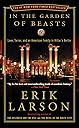
In the Garden of Beasts
Product ID: 106753110
Erik Larson, New York Times bestselling author of Devil in the White City, delivers a remarkable story set during Hitler’s rise to power. The time is 1933, the place, Berlin, when William E. Dodd becomes America’s first ambassador to Hitler’s Nazi Germany in a year that proved to be a turning point in history. A mild-mannered professor from Chicago, Dodd brings along his wife, son, and flamboyant daughter, Martha. At first Martha is entranced by the parties and pomp, and the handsome young men of the Third Reich with their infectious enthusiasm for restoring Germany to a position of world prominence. Enamored of the “New Germany,” she has one affair after another, including with the suprisingly honorable first chief of the Gestapo, Rudolf Diels. But as evidence of Jewish persecution mounts, confirmed by chilling first-person testimony, her father telegraphs his concerns to a largely indifferent State Department back home. Dodd watches with alarm as Jews are attacked, the press is censored, and drafts of frightening new laws begin to circulate. As that first year unfolds and the shadows deepen, the Dodds experience days full of excitement, intrigue, romance—and ultimately, horror, when a climactic spasm of violence and murder reveals Hitler’s true character and ruthless ambition. Suffused with the tense atmosphere of the period, and with unforgettable portraits of the bizarre Göring and the expectedly charming--yet wholly sinister--Goebbels, In the Garden of Beasts lends a stunning, eyewitness perspective on events as they unfold in real time, revealing an era of surprising nuance and complexity. The result is a dazzling, addictively readable work that speaks volumes about why the world did not recognize the grave threat posed by Hitler until Berlin, and Europe, were awash in blood and terror. Review: Riveting and thought provoking - First of all, if you want to learn things you didn't know about the major events leading up to World War II, this is probably not the book for you. There are already plenty of good books on that subject and it wasn't Larson's intent to write another one. His goal was to make you feel as if you were living through the events as an involved, but somewhat detached observer. It's a little like reality TV, if reality TV actually had an interesting topic. I found it completely absorbing. I'm an easily distracted reader, and this was one of those rare books that I "couldn't put down". The book tells the story of William Dodd and his family, who lived in Berlin while Dodd serves as the US ambassador to Germany from 1933 to 1937. This a pivotal period which begins just after Hitler has become Chancellor and Nazi power is still somewhat tenuous, and ends after the "Night of the Long Knives", when Hitler murderously suppresses all opposition and absolutely establishes himself as an unchecked dictator. Larson relies primarily on the writings of Dodd and his daughter Martha, so they are the central characters in the book, while his wife and son are largely peripheral. The overarching theme of the book is their journey from skepticism and rationalization about the actions of the Nazis to horror and revulsion. In Dodd's case it goes from his nostalgia for his time spent in Germany as a student and ends with his quixotic attempt to convince the US government of the danger presented by Germany. Martha's transition is even more dramatic. She goes from an enthusiastic apologist for the Nazis to a Soviet spy working against them! The juxtaposition of the normalcy, even tedium, of everyday life with the increasing madness in Nazi Germany is what gives the book its real impact. These are people who interacted socially with the likes of Goebbels and Goring and other high ranking Nazis, so we see them not as epic figures in history, but rather as petty thugs. If they weren't so vicious, they would be comical; in some cases, they're comical anyway. There have been many atrocities in history, and they continue to this day; however, the genocide of the Nazis will always hold a terrible fascination for the Western world, because they were a "civilized", First World country, not fundamentally different from other Western countries. We are unable to kids are ourselves that "it can't happen here" and can only ask "Would we recognize if in time to stop it if it did?". He points out that in the beginning, the treatment of the Jews by the Nazis was really no worse than the treatment of blacks in the Southern US at the time - something which was largely accepted by most Americans. Watching through his eyes as the German people (who he likes and admires) descend further into madness makes the story haunting and thought provoking. Although the story is written like a novel, Larson maintains high standards as a historian. He never presumes to know what his characters are thinking or invents details of conversations that aren't recorded in writing. Given these standards, it's amazing how much detail is in the book. I can't imagine how much material he had to sift through to put this together, although the sheer size of the end notes give some clue. There's been a lot (too much?) written about Hitler and the Nazis, but this book offers a unique perspective and is definitely worth the read. Review: Stunning illumination of a dark corner of history... - There are some serious detractors among the reviewers of this book, but I found it to be extremely interesting, well researched, and an intriguing story that has been lost, somehow, in the glut of other stories about the rise of Hitler. Author Erik Larson has, I believe, carved out a strong niche genre for himself that combines some of the best aspects of scholarly research with human interest and narrative robustness. Some have preferred earlier works of his, but I find this one to be even more well-documented and compelling because of its snapshot of an intersection of U.S. and German history in a short but pivotal period: 1933 to 1934. It depicts the 1933 appointment by Franklin Roosevelt, newly elected as president, of an unlikely college professor -- William E. Dodd -- to the position of America's first ambassador to Hitler's Germany. It chronicles the experiences of Dodd and his colorful family as they arrive in Berlin in the summer of 1933 and are courted by the Nazi regime but later become increasingly aware of the dark side, the disappearances, the murders, the political intrigue, and exactly a year after their arrival, "The Night of the Long Knives." Dodd's spiraling awareness of the atrocities already being perpetrated, the intoxicating influence that Hitler commanded over the people of Germany, and his powerlessness to convince the American State Department of its significance, comprise the main drama of the book. Interesting side stories that add to the readability include the promiscuous antics of Dodd's attractive daughter Martha, her flirtation with Communism, and her social links with a wide swath of society in Berlin. I had not appreciated, before reading this book, how early in Hitler's regime the power-grabbing and Jewish persecutions had begun. The "Night of the Long Knives," a three-day purge of political assassinations and centralization of Nazi power, took place in the summer of 1934 and was, for Dodd and many who experienced it, the loudest warning bell to date of the horrors to come. "For Dodd, diplomat by accident, not demeanor, the whole thing was utterly appalling. He was a scholar and Jeffersonian democrat, a farmer who loved history and the old Germany in which he had studied as a young man. Now there was official murder on a terrifying scale." The back story of Dodd's appointment was interesting in itself -- he was not the first choice for the ambassadorship and was not supported by many in the State Department at the time, including Secretary Cordell Hull. It was not a job that many wanted, but Dodd had been stalled in the eddies of a lackluster career and dreamed of being recognized as well as being afforded the time to write his career masterpiece about the history of the Old South. When it was offered to him, he felt it was an important life and career move, as well as a chance for his family, including his grown son and daughter, to be together on a sort of adventure. He was deemed weak by many at the State Department, and his warnings about what was happening in Germany, including the beatings and incarceration of American Jews and non-whites, were essentially ignored. Ironically, in spite of his inability to get America to act, Dodd used the influence of his position and took grave personal risks to interrupt or intervene in several instances of Nazi violence in Berlin. Larson ends the book with an interesting reflection on the legacy of Ambassador William E. Dodd. He feels it depends on whether the evaluator was in Europe or America. "To the isolationists, he was needlessly provocative; to his opponents in the State Department, he was a maverick who complained too much and failed to uphold the stands of [the Department elite]. Roosevelt...was maddeningly noncommittal." He later states, "In the end, Dodd proved to be exactly what Roosevelt had wanted, a lone beacon of American freedom and hope in a land of gathering darkness." I feel greatly richer for knowing more about this man and the important role he played in world history.

| Best Sellers Rank | #29,709 in Kindle Store ( See Top 100 in Kindle Store ) #5 in Historical German Biographies #7 in History of Germany #10 in Jewish Holocaust History |
E**N
Riveting and thought provoking
First of all, if you want to learn things you didn't know about the major events leading up to World War II, this is probably not the book for you. There are already plenty of good books on that subject and it wasn't Larson's intent to write another one. His goal was to make you feel as if you were living through the events as an involved, but somewhat detached observer. It's a little like reality TV, if reality TV actually had an interesting topic. I found it completely absorbing. I'm an easily distracted reader, and this was one of those rare books that I "couldn't put down". The book tells the story of William Dodd and his family, who lived in Berlin while Dodd serves as the US ambassador to Germany from 1933 to 1937. This a pivotal period which begins just after Hitler has become Chancellor and Nazi power is still somewhat tenuous, and ends after the "Night of the Long Knives", when Hitler murderously suppresses all opposition and absolutely establishes himself as an unchecked dictator. Larson relies primarily on the writings of Dodd and his daughter Martha, so they are the central characters in the book, while his wife and son are largely peripheral. The overarching theme of the book is their journey from skepticism and rationalization about the actions of the Nazis to horror and revulsion. In Dodd's case it goes from his nostalgia for his time spent in Germany as a student and ends with his quixotic attempt to convince the US government of the danger presented by Germany. Martha's transition is even more dramatic. She goes from an enthusiastic apologist for the Nazis to a Soviet spy working against them! The juxtaposition of the normalcy, even tedium, of everyday life with the increasing madness in Nazi Germany is what gives the book its real impact. These are people who interacted socially with the likes of Goebbels and Goring and other high ranking Nazis, so we see them not as epic figures in history, but rather as petty thugs. If they weren't so vicious, they would be comical; in some cases, they're comical anyway. There have been many atrocities in history, and they continue to this day; however, the genocide of the Nazis will always hold a terrible fascination for the Western world, because they were a "civilized", First World country, not fundamentally different from other Western countries. We are unable to kids are ourselves that "it can't happen here" and can only ask "Would we recognize if in time to stop it if it did?". He points out that in the beginning, the treatment of the Jews by the Nazis was really no worse than the treatment of blacks in the Southern US at the time - something which was largely accepted by most Americans. Watching through his eyes as the German people (who he likes and admires) descend further into madness makes the story haunting and thought provoking. Although the story is written like a novel, Larson maintains high standards as a historian. He never presumes to know what his characters are thinking or invents details of conversations that aren't recorded in writing. Given these standards, it's amazing how much detail is in the book. I can't imagine how much material he had to sift through to put this together, although the sheer size of the end notes give some clue. There's been a lot (too much?) written about Hitler and the Nazis, but this book offers a unique perspective and is definitely worth the read.
E**L
Stunning illumination of a dark corner of history...
There are some serious detractors among the reviewers of this book, but I found it to be extremely interesting, well researched, and an intriguing story that has been lost, somehow, in the glut of other stories about the rise of Hitler. Author Erik Larson has, I believe, carved out a strong niche genre for himself that combines some of the best aspects of scholarly research with human interest and narrative robustness. Some have preferred earlier works of his, but I find this one to be even more well-documented and compelling because of its snapshot of an intersection of U.S. and German history in a short but pivotal period: 1933 to 1934. It depicts the 1933 appointment by Franklin Roosevelt, newly elected as president, of an unlikely college professor -- William E. Dodd -- to the position of America's first ambassador to Hitler's Germany. It chronicles the experiences of Dodd and his colorful family as they arrive in Berlin in the summer of 1933 and are courted by the Nazi regime but later become increasingly aware of the dark side, the disappearances, the murders, the political intrigue, and exactly a year after their arrival, "The Night of the Long Knives." Dodd's spiraling awareness of the atrocities already being perpetrated, the intoxicating influence that Hitler commanded over the people of Germany, and his powerlessness to convince the American State Department of its significance, comprise the main drama of the book. Interesting side stories that add to the readability include the promiscuous antics of Dodd's attractive daughter Martha, her flirtation with Communism, and her social links with a wide swath of society in Berlin. I had not appreciated, before reading this book, how early in Hitler's regime the power-grabbing and Jewish persecutions had begun. The "Night of the Long Knives," a three-day purge of political assassinations and centralization of Nazi power, took place in the summer of 1934 and was, for Dodd and many who experienced it, the loudest warning bell to date of the horrors to come. "For Dodd, diplomat by accident, not demeanor, the whole thing was utterly appalling. He was a scholar and Jeffersonian democrat, a farmer who loved history and the old Germany in which he had studied as a young man. Now there was official murder on a terrifying scale." The back story of Dodd's appointment was interesting in itself -- he was not the first choice for the ambassadorship and was not supported by many in the State Department at the time, including Secretary Cordell Hull. It was not a job that many wanted, but Dodd had been stalled in the eddies of a lackluster career and dreamed of being recognized as well as being afforded the time to write his career masterpiece about the history of the Old South. When it was offered to him, he felt it was an important life and career move, as well as a chance for his family, including his grown son and daughter, to be together on a sort of adventure. He was deemed weak by many at the State Department, and his warnings about what was happening in Germany, including the beatings and incarceration of American Jews and non-whites, were essentially ignored. Ironically, in spite of his inability to get America to act, Dodd used the influence of his position and took grave personal risks to interrupt or intervene in several instances of Nazi violence in Berlin. Larson ends the book with an interesting reflection on the legacy of Ambassador William E. Dodd. He feels it depends on whether the evaluator was in Europe or America. "To the isolationists, he was needlessly provocative; to his opponents in the State Department, he was a maverick who complained too much and failed to uphold the stands of [the Department elite]. Roosevelt...was maddeningly noncommittal." He later states, "In the end, Dodd proved to be exactly what Roosevelt had wanted, a lone beacon of American freedom and hope in a land of gathering darkness." I feel greatly richer for knowing more about this man and the important role he played in world history.
G**K
A partial review, but rather lengthy, of an incredible book
In the Garden of Beasts Love, Terror and an American Family in Hitler's Berlin by ERIK LARSON 1. Introduction. This book is divided into ten parts, with a total of fifty five chapters. The writer of this review has a strong need for both an Index and a Table of Contents. Since the author of this book does not include the chapters in his Table of Contents, an expanded version is produced below. Note that Das Vorspiel is defined by such words as: prelude; prologue; preliminary match; foreplay and audition. Note also that the photo credits refer to the pictures on the book title pages that are part of the title page for each PART. Opening Quotation xi Das Vorspiel xiii 1933 The Man Behind the Curtain 3 PART I: Into the Wood Chapter 1: Means of Escape 9 Chapter 2: That Vacancy in Berlin 16 Chapter 3: The Choice 23 Chapter 4: Dread 27 Chapter 5: First Night 40 PART II: House Hunting in the Third Reich Chapter 6: Seduction 53 Chapter 7: Hidden Conflict 61 Chapter 8: Meeting Putzi 70 Chapter 9: Death is Death 74 Chapter 10: Tiergartenstrasse 27a 83 PART III: Lucifer in the Garden Chapter 11: Strange Beings 93 Chapter 12: Brutus 103 Chapter 13: My Dark Secret 113 Chapter 14: The Death of Boris 120 Chapter 15: The "Jewish Problem" 128 Chapter 16: A Secret Request 132 Chapter 17: Lucifer's Run 138 Chapter 18: Warning from a Friend 145 Chapter 19: Matchmaker 154 PART IV: How the Skeleton Aches Chapter 20: The Führeur's Kiss 157 Chapter 21: The Trouble with George 163 Chapter 22: The witness Wore Jackboots 169 Chapter 23: Boris Dies Again 174 Chapter 24: Getting Out the Vote 175 Chapter 25: The Secret Boris 179 Chapter 26: The Little Press Ball 184 Chapter 27: O `Tannenbaum 194 !934 PART V: Disquiet Chapter 28: January 1934 209 Chapter 29: Sniping 216 Chapter 30: Premonition 218 Chapter 31: Night Terrors 223 Chapter 32: Storm warning 229 Chapter 33: "Memorandum of a Conservation with Hitler: 231 Chapter 34: Diels, Afraid 242 Chapter 35: Confronting the Club 245 Chapter 36: Saving Diels 249 Chapter 37: Watchers 254 Chapter 38: Humbugged 255 PART VI: Berlin at Dusk Chapter 39: Dangerous Dining 263 Chapter 40: A Writer's Retreat 268 Chapter 41: Trouble at the Neighbors 277 Chapter 42: Hermann's Toys 278 Chapter 43: A Pygmy Speaks 283 Chapter 44: The Message in the Bathroom 290 Chapter 45: Mrs. Cerruti's Distress 292 Chapter 46: Friday Night 297 PART VII: When everything changed Chapter 47: "Shoot, Shoot" 304 Chapter 48: Guns in the Park 309 Chapter 49: The Dead 313 Chapter 50: Among the Living 319 Chapter 51: Sympathy's End 323 Chapter 52: Only the Horses 330 Chapter 53: Juliet #2 336 Chapter 54: A Dream of Love 340 Chapter 55: As Darkness Fell 349 EPILOGUE: The queen bird in Exile 359 CODA: "Table Talk" 365 Sources and Acknowledgments 367 Notes 377 Bibliography 423 Photo Credits 435 INDEX 437 End Quotation 449 There are also very interesting maps inside the front and back covers. The back cover map is entitled: "Pharus Plan Berlin." It has a highlighted section for the Tiergarten Area. The front cover map is for this area in 1933. Ten locations are flagged, including 27a Tiergartenstrasse; Soviet, French and British embassies; the U.S. Embassy Chancery, and the U.S. Consulate; and the German Foreign Office, the Reichstag Building and the Gestapo Headquarters. 2. Major Inputs . This is a large book with 60 segments, 55 chapters plus five other components.. Many of these will be reviewed. A picture of the "American Family" is shown on the PART I cover. Chapter 0. The Man Behind the Curtain. Perhaps the worst exhibition of Nazi brutality against Americans occurred on Thursday, 06/29/1933. An expatriate, a Joseph Schachno, 31 year old physician from New York, came to the consulate, but in terrible condition. The skin had been literally whipped off his body. "From the neck down to his heels he was a mass of raw flesh." George S. Messersmith (GSM)--the America's consul general for Germany since 1930, was visiting the consulate that night and learned his wounds were nine days old. Messersmith ordered him taken to a hospital and issued him a new U.S. passport. He soon fled to Sweden and then to America. There had been beatings of Americans before, but not as brutal. For GSM this new beating was another indicator that life under Hitler had changed Germany in a fundamental way. He understood it, but was convinced that few others in America did, including the State Department. Messersmith was sure that Hitler was secretly leading Germany to another war of conquest. However, Germany still did not have a U.S. ambassador in residence. The former ambassador had left in March at the end of FDR's inauguration. The new appointee was not expected for another three weeks. GSM did not know him, but he knew that "the new ambassador would be entering a cauldron of brutality, corruption, and zealotry and would need to be a man of forceful character, capable of projecting American interest and power, as power was all that Hitler and his men understood." However, the new man was said to be most unassuming, and had vowed to live a modest life in Berlin. He was even shipping his beat up old Chevy to Berlin, to "a city where Hitler's men drove about town in giant black touring cars each nearly the size of a city bus." Chapter 1: Means of Escape. The American Family in this story were the Dodds. William E. Dodd (WED) was a professor of History at the University of Chicago, and a summertime farmer in Virginia. He loved his farm with a passion. His wife, Martha, known to one and all as Mattie, did not enjoy it nearly as much. They had two children: William, Jr. and Martha Dodd (MD), both in their 20s in 1933, when this story began. While Dodd loved teaching history, the routine demands of his job bothered him. Although he had worked out a reduced schedule with his department, staff departures and pressures coupled with the Depression had left him working as hard as ever. He was also very concerned that he should have been along further in his career, but the above demands left him little time for writing in rather uncomfortable conditions, such as a very cold office. On 03/15/1933, Dodd went to DC to meet FDR's new Secretary of State, Cordell Hull. They talked of a possible assignment to Holland or Belgium. Suddenly, "forced to imagine the day-to-day reality of what such a life would entail" Dodd backed off. He told Hull he could not accept such a position. "But his name remained in circulation. "And now, on that Thursday in June, his telephone began to ring." Chapter 2: That Vacancy in Berlin. No one seemed to want this job. FDR offered it to several other and better qualified individuals than Dodd, but they all declined. FDR also had far more important items on his agenda: the depression; serious unemployment; the drought; an unusually hot Washington springtime; an "all consuming fight to pass his National Industrial Recovery Act, a centerpiece of his New Deal," and a congress eager to close down for their summer vacation. On Wednesday, 06/07/1933, FDR met with several close advisors. One of them in attendance was Commerce Secretary Roper. After considerable discussion Roper threw out a fresh name of a longtime friend. "How about William E. Dodd?" FDR reacted that this was not a bad idea and he would consider it. Now Dodd did not have the usual credentials for such a post. He was not wealthy or politically influential. He was not one of FDR's friends. But he did speak German, and was said to know Germany well. He was also a historian of sober temperament. FDR took Secretary Roper's recommendation seriously. On 06/08/1933, he called Chicago and told Dodd: "I want to know if you will render the government a distinct service. "I want you to go to Germany as an ambassador." He added, "I want an American liberal in Germany as a standing example." Dodd told FDR he needed time. FDR gave him two hours. The university officials urged him to accept. After an intensive, but brisk discussion with his wife, they agreed he should accept. Dodd called the White House, a half hour late, and informed FDR's secretary he would accept the job. Two days later his appointment was placed before the Senate, and was confirmed the same day. Next, he invited his two grown children to join them in Berlin, promising them the experience of a lifetime. Chapter 3: The Choice. With the Depression well underway, Dodd's children were lucky to have jobs. Bill was a teacher of history, but far more interested in automobiles. In contrast, Martha was an assistant literary editor at the Chicago Tribune. Sne had fared much better, than her brother, in her work. Martha was her father's great pride, but her life style was of great concern to him. The rest of this chapter is very like Hedy's Folly, when Hedy was between 16 to 19. MD had many flirtations, many engagements, at least one affair and her first marriage in 01/1932. However, they even kept this marriage secret and spent most of the first year apart. She soon began flirting again, and had begun an affair with Carl Sandburg, a longtime friend of her parents. Later her marriage failed, in part, because she couldn't bear the idea of leaving her parents, particularly her father. Hence, when her father invited her to join their trip to Berlin, it was irresistible. Chapter 4: Dread. On 06/16/1933 Dodd met FDR at the White House. They talked about several issues of importance to the new ambassador. Repayment, Jewish concerns, Dodd's salary and entertainment needs. He left the White House and headed to the State Department, where he wanted to study the Messersmith reports. They depicted Germany descending from a democratic republic to a brutal dictatorship. Many of the reports were long, as GSM was known as "Forty page George." One of the memos however, suggested that the higher echelons of the Nazi Party were becoming more positive and more co-operative. Very shortly after that memo, another memo on June 26, rescinded it. However Messersmith did not see this. It concluded that Germany was quietly readying itself to become "the most capable instrument for war that ever existed." His departure to Germany included stops in North Carolina, Virginia, New York and Boston. He met with his father, many friends and many politicians, bankers, bureaucrats, reporters and photographers. Some inputs included that Germany's Jews were at least partly responsible for their own troubles. One input expressed great admiration for Hitler, and advised Dodd to "Let Hitler have his way." Aboard ship the reporters pressed Dodd to pose as if waving good-bye. He did so, but the resulting picture caused a minor outcry as it appeared to capture Dodd in a mid Heil. By now Dodd's misgivings flared and he began to dread leaving his old life in Chicago. His daughter wept. Chapter 5: First Night. MD continued to cry over the next two days. She was crying--not from a concern on where they were going, she had no idea on what life in Hitler's Germany would be like--for what she was leaving: her friends, her job, the comforts of their house and her affair with Carl Sandburg. As days passed the voyage was grand, with bright days and calm seas. And she got to know FDR's son, who was also aboard. They danced and drank champagne and danced some more. Now Sandburg instructed her to keep notes on everything. Above all he urged her, "find out what this man Hitler is made of, what makes his brain go around, what his bones and blood are made of." While MD had thought of Hitler as "a clown who looked like Charley Chaplin," clearly, Sandberg was far more concerned. Another friend advised MD to avoid writing for newspapers as such work would destroy the concentration she would need for serious writing. He also told her to keep a diary of "what things looked like--the rumors and opinions of people during a political time." Later such a diary would be of great interest to you. Jewish events and issues occurred on this week long voyage. On the second day Dodd met Rabbi Wise, who he had met three days earlier in NY. They spoke repeatedly about Germany. Dodd also spoke at length about American history. At one point he told the Rabbi that: "one cannot write the whole truth about Jefferson and Washington--people are not ready and must be prepared for it." Wise was disturbed by this statement. He noted that if people must be prepared for the truth about Jefferson and Washington what will Dodd "do about the truth when he learns it about Hitler." As the voyage ended Dodd realized that his role was no longer one of a mere observer and reporter. He believed he might even moderate Hitler's views. The best approach was to be sympathetic and try to understand Germany's perception that it had been wronged by the world. The Dodds landed at Hamburg on 07/13/1933. Dodd had assumed, erroneously, that arrangements had been made on the "Flying Hamburger" which would make the trip to Berlin in a bit over two hours. Chapter 10: Tiergartenstrasse 27a. This address is the first location flagged on the front cover map. It's only immediate neighbor is the U. S. Chancery. However, other important locations,are not far off. The matter of an official residence for the U.S. Ambassador had long been an embarrassment. Fire had destroyed one plan near the British and French embassies. Dodd was not unhappy, as he liked the idea of a home outside of the embassy. Hence MD and her mother toured Berlin's grand residential areas. On this walk they discovered such items as: (1) many parks and gardens, with planters and flowers on every balcony; (2) on the outskirts, tiny farms, perfect for MD's father; (3) squads of uniformed young people, marching and singing; (4) much more threatening formations of Storm Trooper recruits and (5) "the leaner, better-tailored men of the SS, in night black, accented with red," like some blackbirds. One area they particularly liked, had a property available. It was owned by a wealthy Jewish banker, an Alfred Panosky (AP). Now there were many Jews--some 16,000 or nine percent of Berlin's Jews--who lived in this area. Although many Jews were being evicted, AP was not one of them. This house was a four story mansion. It was across the street from a park But Dodd learned that AP was leasing only the first three floors. The fourth floor would be occupied by himself and his mother. He really did not need the income from this lease, but since Hitler's appointment as Chancellor, no Jew was safe from persecution. He offered this house specifically to Dodd, with the intention of gaining an increased level of protection. He felt that Storm Troopers would not attack a house shared by the American ambassador. The Dodds would gain a fine residence, and a street presence sufficiently impressive to communicate America's power and prestige. The interior was sufficiently grand to allow the entertainment of government and diplomatic guests without embarrassment. He wrote to FDR: "We have one of the best residences in Berlin at $150/month--due to the fact that the owner is a wealthy Jew, most willing to let us have it." Dodd loved the quiet, the trees, the garden and the prospect of walking to work each morning. He probably also loved the high steel fence and gates. On 08/05/1933 the Dodd family moved into their new home. Dodd noted later if he had known AP's motives for this lease, he would never have accepted it. On entering the house, the Dodds walked "first into a large vestibule, flanked on both sides by cloakrooms and then up an elaborate staircase to the main floor. It was here here that the grandness of this house became apparent. At the front there was a ballroom with an oval dance floor and a grand piano. Next was a reception room, then a vast dining room, with walls covered with a red tapestry. Though the house struck Dodd as far too luxurious, he loved the Wintergarten at the south end of the main floor, a glassed-in chamber that opened onto a tiled terrace overlooking the garden. The family's favorite room was the library, with a great old fire-place and stained glass windows set high in one wall. This house became known as a place where people could speak without fear. "Martha and her father fell into an easy camaraderie. "They traded jokes and wry observations." They laughed at the Nazi's. MD noted that her mother was in good health, but a bit nervous. On balance she was enjoying it all. Her father was also doing well, she reported he was "flourishing incredibly," and seemed "slightly pro-German." MD added, "We sort of don't like the Jews anyway." The Dodds soon discovered they had a high level and much-feared Nazi as a nearby neighbor. He was a Captain Rohm, commander of the Storm Troopers. Every morning he would ride a large black horse in the Tiergarten area. However Dodd continued to walk to work, alone and unguarded. Soon the Dodds--and a new friend of MD, correspondent Quentin Reynolds (QR)--set out to see more of Germany. They headed south to Leipzig where they split up, with MD and friend and brother continuing south towards Austria. Their trip was laden with an incident that would provide the first challenge of MD's rosy view of the new Germany. Chapter 11: Strange Beings. QR, MD and her brother decided to head to Nuremberg first. They encountered groups of the SA parading and singing and carrying their Nazi banners aloft. Often, onlookers would turn to them and shout "Heil Hitler." The excitement of the people was contagious, and MD "Heiled" as vigorously as any Nazi. While both her brother and her new friend were dismayed by her behavior, MD confessed: "I felt like a child, ebullient and careless, the intoxication of the new regime working like wine in me." They found their hotel. QR had been here before, but recalled it as a quiet town. However, tonight they found the town full of revelers. He asked the clerk if there was going to be a parade. The clerk answered that it was going to be kind of a parade. "They are going to teach someone a lesson." Although the noise was loud outside, they could tell it was even louder, three blocks away. The "parade" finally came into view. First a column of SA troopers, in brown uniforms, carrying torches and banners. Next came two huge troopers, "half supporting, half dragging" the figure along the street. As they got closer they could see the figure was a young women. Now the genial Nurembergers became transformed and teased and insulted this women. The troopers then lifted her high so that the sign around her neck became visible. It stated: "I have offered myself to a Jew." When the procession moved on MD stated "I wanted to follow." She had been shaken by this incident, but she would not let it dampen her view of the country and the new spirit brought forth by the Nazis. They headed to the bar. QR vowed to get drunk. QR, as a correspondent, knew this event was far more important. Other correspondents had reported on such abuses before, but their stories had all been based on after-the- fact investigations. Here the act had been witnessed first hand by a correspondent, namely QR, with important supporting witnesses. His editor advised QR to send it by mail and to keep the ambassadors name out of the dispatch. When he returned to Berlin he was summoned immediately by the German foreign-press chief. He charged there was no proof at all in QR's story. When told that QR had two witnesses, and found out who they were, he was speechless. The U.S. made no formal protest, and an official of the German foreign office apologized, but dismissed this incident as isolated. MD accepted this view and remained seduced by the life in the new Germany. However the State Department was not satisfied that Dodd was handling this incident and others appropriately. "Forces opposed to Dodd began to coalesce." Chapter 12: Brutus. On 08/30/1933 Dodd drove to the palace to present his credentials. Hindenburg conveyed a sense of strength and virility that belied his 85 years. Hitler, Goebbels and Goring were not there. Dodd and the "Old Gentleman" conversed on topics from Dodd's university experience in Leipzig to the dangers of economic nationalism. Dodd and the embassy officials soon left the building to find soldiers of the regular army lining both sides of the street. It was over and Dodd was now "a duly accepted representative of the United States in Berlin." Two days later Dodd found himself confronting his first critical crisis. On 09/01/1933, H. V. Kaltenborn (HVK), an American corresponent, called GSM, the consul general to give his regrets that he could not stop by for one final visit, as he and his family were heading back home. Their train left at midnight. He told GSM that he still had seen no evidence to verify the Consul's criticism of Germany. He accused him of doing Germany wrong in not presenting Germany as it really was. They decided to do a last bit of shopping at a huge department store. As they left this store a formation of Storm Troopers were parading down the boulevard in their direction. HVK instructed his family to face the windows, and not salute. Several troopers accosted him, and the crowd began insulting him and his family. They began walking back to their hotel when a young man grabbed their 16 year old son and struck him in the face, hard enough to knock him down. HVK grabbed the assailant and marched him to a nearby policeman, but the crowd got more agitated. Finally an onlooker interceded, and the parade moved on. From his hotel HVK called Messersmith and reported the incident. In turn he arranged for them to be escorted to the train. However, he saw this as a positive event as HVK could no longer go back and tell his radio audiences that the American officials were misrepresenting the situation. GSM asked Dodd if it was not time to issue a warning against travel in Germany. Officially Dodd was against this, and managed to keep several attacks out of the newspapers. At home, over dinner, he condemned the attack, but "if he hoped for a sympathetic expression of outrage from his daughter, he failed to get it." MD continued to think the best of Germany. Her father would call her "a young Nazi." Another correspondent, Pulitzer Prize winner, Edgar Mowrer, was also leaving, but to Japan. He had wanted to stay in Berlin, but GSM declined to support him. At the station GSM embraced him. As he boarded the train he turned to Messersmith and said: "And you too, Brutus." In addition to managing various situations such as above, Dodd had to get started on the demands of protocol that came with the job of being the American Ambassador. This meant going to parties at other embassies and giving parties at the American Embassy. Dodd and his wife were not major party goers, or heavy wine drinkers. And they very much preferred early retirements. Fortunately it was not all drudgery. Goebbels was known for his wit. MD, for a time considered him charming. Her mother, Mattie, enjoyed being seated next to him. Goring, in contrast, was hard to take seriously. "He was like an immense, if exceedingly dangerous little boy." His huge size and his love of new, Goring designed, uniforms made him the brunt of many jokes. The final demand of protocol was the installation of Hitler as official head of Germany. A 14 car Sondurzug was planned to take all the ambassadors to Nuremberg, but this was cut back to nine as regrets came in from all the major embassies. Attendees included representatives from Haiti, Siam and Persia. Chapter 13: My Dark Secret. MD soon found herself sought after by men of all ranks, ages and nationalities. Her divorce from her first husband was still pending, but she considered herself free to disclose or not disclose her status as she wished. "Outwardly she looked the part of a young American virgin, but she knew sex and liked it - - -." Their house was always full of students, embassy secretaries, correspondents and men from the SA, SS and Reichswehr. These later officers carried themselves with aristocratic élan. She found them "extremely pleasant, handsome, courteous and uninteresting." What follows is a rather detailed list of her affairs. Some of these affairs were actually conducted in their house, taking advantage of the fact that her parents retired early. This amount of detail is in order to help complete a character sketch of MD, perhaps the most dominant person in this book. One German she found most interesting was Ernst Udet, a flying ace from WWI. Since then he had become famous as an aerial adventurer and stunt pilot. MD went falcon hunting with Udet and his fellow ace, Goring, at his vast estate. What follows is a brief listing of other affairs that MD had during this period. ' Putzi Hanfstaengl (PH), according to his son. ' Thomas Wolfe, when he visited Berlin. Wolfe described her "like a butterfly hovering around my penis." ' Armand Berard, 3rd secretary of the French embassy, 6½ and "incredibly handsome." He treated her at first as a "sexual ingenue." She had great power over him and even her most casual act could drive him to despair. ' In their estranged periods she would see other men, and make sure he knew it. You are the only one who can break me, "but how well you know it and how you seem to rejoice in doing so." Next was a ' Max Delbrück, biophysicist. "He was slender, had a cleanly sculpted chin and masses of dark, neatly combed hair, for a look that evoked a young Gregory Peck. His accomplishments included a Nobel Prize. Family correspondence is surprisingly free of any criticism of her behavior. Others noticed and disapproved including the Consul General, GSM. Specifically he knew of the Udet affair, and believed that MD had been involved in other affairs with top Nazis, including Putzi Hanfstaengl. GSM assessed these as mostly harmless except for that with Hanfstaengl. Her "seeming lack of discretion caused diplomats and other informants to be more reticent about what they told MD, fearing that their confidences would make there way back to Hanfstaengl." GSM wrote in a memo that "she had behaved so badly in so many ways, especially in view of the position held by her father." Their butler framed his criticism more bluntly: "This was not a house, but a house of ill repute." MD's love life took a dark turn when she met a Rudolf Diels, the young chief of the Gestapo. Diels moved with ease and confidence, yet he entered a room unobtrusively, "seeping in like a malevolent fog." When he arrived at a party he "created a nervousness and tension that no other man possibly could." MD described his face as "the most sinister, scar-torn face I have ever seen." On balance his appearance was striking, like "that of a damaged Ray Milland." However, MD was drawn to him immediately, his "lovely lips, his jet-black luxuriant hair, and his penetrating eyes." Diels was said to have much charm. He was said to be sexually talented and experienced. "Involved affairs with women were a regular thing with him." Another thing that MD found compelling about him was that everyone else was afraid of him. He was noted as the "Prince of Darkness." MD's father liked Diels. He found this Gestapo chief to be a helpful intermediary in several areas such as extracting foreign nationals from concentrations camps. I was convinced we were about to see a classic case of what happens when an irresistible force (MD) meets an immovable object (Diels). However, exactly the opposite happened. They had a rather tender afair. They took long walks together in the Tiergarten area.. They drove for hours in the country and they went to movies and nightclubs. MD loved being known as the women who slept with the devil. Her father did not know of this. GSM suspected it. The more MD got to know Diels the more she could see he too was afraid. He told her that Goring and Goebels loathed each other and spied on each other and both spied on Diels. However, it was through Diels that she began to temper her view on the Nazi revolution. She began to see "a vast network of espionage, terror, sadism and hate, from which no one" could escape. Not even Diels. Chapter 14: The Death of Boris. MD still had another affair, the most important in a very long list. It was with a doomed Russian. She first caught a glimpse of him at one of the many parties Sigmund Schultz held at her apartment. She lived their with her mother and her two dogs. At a party in mid-September 1933 MD glanced across the room and saw this tall good looking man. He was very attractive, around 30, with short blond-brown hair, strikingly luminous eyes, and an easy fluid manner. One of MD's friends--Agnes Knickerbocker, wife of correspondent H. R. "Knick" Knickerbocker--described his movements as those of one who could go from sternness to laughter in a split second. They exchanged glances for only a few seconds, but still an important event. Several weeks later the Knickerbockers invited MD to join them for drinks and dancing at a popular nightclub. Knick introduced MD to the "tall man" from across the room. His name was Boris Winogradov. He asked her to dance. She quickly learned that his natural grace did not extend to the dance floor. He told her "I don't know how to dance." They both laughed. He also told her he was with the Soviet Embassy. And he confessed he had noticed her several times before, and asked if he could call on her. They met at her home. He brought her a gift, a disc entitled: "The Death of Boris." It was about a death scene in an opera, sung by a famous Russian singer. After that MD gave Boris a tour of her house, and they very gradually started to become acquainted. What did she do in Chicago? What were her parents like? This period was a bit more awkward due to their language differences. Their common language was German, but both were amateurs in this language. However, they became regular companions. They left diplomatic receptions early. They met for secret meals at fine restaurants. And they would often go dancing at the club where they first met. And like Diels, he would often take her for long rides in the country, sometimes staying out until daybreak. Now and then reality intruded into this emerging romance. He was especially dismayed at how readily the world accepted Hitler's protestations of peace, while he was clearly guiding Germany towards war, with the USSR the likely target. His embassy also disapproved of this relationship. In turn MD's father was concerned that they might get married. At this point Martha seemed to have no hint as to what might be his official role:, namely an operative of the NKVD, the predecessor of the KGB. Conclusion to this partial review. As noted at the start this is only a partial review. While the intent initially was to review maybe 10 chapters, this turned out impossible to do, as each subsequent chapter "begged to be included." For example while this presentation stops at Chapter 14, it includes 11 chapters. I will try to add to this later.
C**N
The Fascinating Martha Dodd And the Men She Slept With
The Fascinating Martha Dodd And the Men She Slept With would be a more accurate title to this book. While about the entire family of US Ambassador to Germany, William Dodd, who served from 1933 to 1937, Martha steals the show. She was twenty-four years old when she accompanied her father, mother, and older brother to Berlin in 1933. (The book is only about the family's first year in Berlin.) She had been secretly married and was now getting secretly divorced. She seemed as innocent as a preacher's daughter but she had taken an early interest in sex and was quite talented in its delights. She especially enjoyed being "seduced" by worldly men only for them to discover when the clothes came off that Martha was no blushing young girl. "I rather enjoyed being treated like a maiden of eighteen knowing all the while my dark secret." Martha was first engaged at age twenty-one although she broke that off after a few months and took up with a local novelist whom she threw over for a Chicago businessman, James Burnham. No sooner had she become engaged to said gentleman, then she met a banker from New York, Mr Roberts, at a social occasion at the home of her parents. Martha found Mr Roberts irresistible. But Martha was one smart person. Although she carried on with Mr Roberts in New York, she remained engaged to Mr Burnham in Chicago. Finally she married Mr Roberts. However, being a trifle uncertain about their marriage, the two kept it a secret from everyone. I think you might predict what the result of this early ambivalence was. When she went to Germany in 1933, she and Mr Roberts were getting an amicable divorce. This was good because in Berlin she seduced the head of the Gestapo, Rudolf Diels, or he seduced her. Either way, they both had a talent for the sensual and it didn't take long for them to disrobe. Along with him, Martha carried on with a French diplomat, with a senior general in the Luftwaffe, with the heir to the Prussian throne, with various newsmen, diplomats, visitors from the US, and different men high in the German government and Nazi Party. As the author of a An Honorable German, a World War Two naval epic told from the point of view of a German U-Boat commander, I have read several thousand books on the Third Reich. I can say that this one captures a slice of life which is relatively unknown. An Honorable German + Martha Dodd "This was not a house, but a house of ill-repute" said the Dodd's stuffy German butler. (He was on the payroll of the Gestapo but so clumsy at spying everyone knew it.) Martha didn't slink around to cheap hotels to have affairs. If your place wasn't convenient, then her place was fine. It is a measure of the sexual repression of the era and the fear of uninhibited female sexuality that what she did caused various small scandals. Finally, Martha became infatuated with a Russian diplomat and by all accounts they fell in love. This wasn't good since Boris was an agent of the NKVD (later KGB). And this is where I began to have some doubts about the facts of this book. Erik Larson is a talented writer and thorough researcher. I've read several of his other books, Isaac's Storm: A Man, a Time, and the Deadliest Hurricane in History and The Devil in the White City: Murder, Magic, and Madness at the Fair that Changed America, both of which I give three stars or even 3.5. But he skips over something which countless authors and historians have written about: Martha Dodd spied on the US for the Soviets at the behest of her lover, Boris. While Larson certainly mentions this as a possibility he doesn't make an effort to reconcile what he is writing with the vast number of historians who insist Martha Dodd was an out and out agent of the Soviet NKVD who spied on her father. In fairness, the book isn't about Martha. It's about her father and her family and the first year of their life together in Berlin. Yet the author depicts her as just a naughty girl. Although she could be vapid, mildly anti-Semitic, selfish, vain, and annoying, Martha was also fascinating, artistic, clever, and a keen observer. Martha came to see the true nature of the Hitler régime and of the terrible nature of anti-Semitism. She later married a wealthy Jewish businessman, Alfred Stern. Because of their sympathy and work for the Soviet Union, both were under surveillance by the FBI and in 1957 a Soviet defector accused them both of espionage against the US. They were indicted and fled the country living variously in the USSR, Cuba, and Czechoslovakia. Martha settled in Prague for the last decades of her life and died there in 1990. Espionage charges against her were finally dropped in 1979. Martha Dodd was a sexually liberated woman in an oppressive time and certainly a woman who had an independent mind and an independent life. This is still threatening to people today, including it seems, the author of the book in question. Unfortunately, Martha Dodd somehow missed the similarity between the Third Reich and the Soviet Union, which is just as replete with unspeakable atrocities. It's hard to understand. But she was a very unusual woman and it's worth reading the book just to get to know her. This is her obituary from: New York Times 29 August 1990 Martha Dodd Stern Is Dead at 82; Author and an Accused Soviet Spy by Glenn Fowler Martha Dodd Stern, an American author who in the 1930's and 1940's wrote popular books about Nazi Germany and later fled behind the Iron Curtain when she and her wealthy husband, Alfred K. Stern, were accused of being Soviet spies, died on Aug. 10 in Prague, friends reported. She was 82 years old and had lived in the Czechoslovak capital for more than three decades. Victor Rabinowitz, a New York lawyer who received word of Mrs. Stern's death, said that although the cause of her death was not reported, she had recently suffered an intestinal blockage. Martha Dodd came to public attention in 1939 when her first book, Through Embassy Eyes, was published. It told of her four years in Berlin beginning in 1933 when her father, William E. Dodd, was appointed by President Franklin D. Roosevelt as Ambassador to Germany after Adolf Hitler's rise to power. Then in her 20's, she was at first favorably impressed by the new leaders of Nazi Germany but her later disillusionment was reflected in her book. In 1938, a year after her return to the United States, she married Mr. Stern, a former chairman of the Citizens Housing and Planning Council of New York who had inherited through an earlier marriage part of the fortune of Julius Rosenwald, the Chicago philanthropist. In 1941, after her father's death and nine months before the United States entered World War II, Mrs. Stern and her brother, William E. Dodd Jr., published the Ambassador's diaries. Critics said that by failing to edit the comments of Germans who were opposed to Hitler they endangered the anti-Nazi underground. Subject of McCarthy Investigation In the last days of the war Mrs. Stern published Sowing the Wind, a novel that dealt with the moral degradation of Germans under the Nazi hierarchy. In the early 1950's she and Mr. Stern became persistent targets of Senator Joseph R. McCarthy in his anti-Communist investigations. The couple moved to Mexico City in 1953, and four years later Boris Morros, an American counterspy, testified to the House Committee on Un-American Activities that the Sternses were part of a Soviet spy network. When they were indicted on espionage charges in 1957, the couple fled to Prague, where they settled. They later traveled to the Soviet Union and other Eastern European countries and to Cuba but never returned to the United States. Mrs. Stern did translations of books and articles. Mr. Stern died four years ago at the age of 88. Mrs. Stern is survived by a son, Robert, who lives in Prague.
C**A
A Great Book that Brings History Alive
Larson specializes in the "nonfiction novel" genre pioneered by Truman Capote's "In Cold Blood." He does a tremendous amount of research that allows him to write a true story in a way that reads like a novel. This is by far his best book, in part because of the gravity of the subject matter and in part because everyone can identify with an American family that moves wholesale over to Germany at the very moment that Hitler consolidates his power in 1933-34. Dodd is a Jimmy Stewart type figure -- an everyman, thoughtful professor who is unexpectedly appointed ambassador to Germany because no one else wants the job and because he knows the country and the language (and, of course, is an old supporter and friend of Wilson and Roosevelt). He decides to bring his whole family along to experience the adventure -- including his two adult children. His daughter, Martha, is a charismatic and sexually adventurous free spirit who ends up having affairs with some Nazis and even a Soviet diplomat. One Nazi actually introduces her to Hitler in attempt to set up the sexually hapless dictator -- to no avail. There are compelling lessons to this tale. First and foremost is Larson's ability to capture the heady spirit of the times. When we think about the Nazis we know the evil and tragic result of their regime -- but the people in 1933 didn't know. Instead of shaking our heads and saying how could they be so stupid as to follow Hitler, we have to put aside our knowledge of what happened next and think like those who lived the early years. The intoxication of power and the feeling that the Nazis were reinvigorating a dead society go a long way toward explaining the Nazis' success. But Larson also captures the growing unease and tensions created by the new regime -- and the ability of the regime to grow too strong before any meaningful resistance could be mounted. Even the Nazi lords who interact with the Dodds are haunted by the insecurity of their position. In a regime premised on survival-of-the-fittest, continued rivalries for power, and pressure to demonstrate more and more harshness and party orthodoxy, all the participants saw the path before them as either keeping intoxicating power by becoming more ruthless or accepting purge and death. Some, like Diehls (the early head of the Gestapo), refuse to take steps toward greater and greater ruthlessness, and pay with loss of position and threats to life. Dodd himself immediately appreciates the evil of the regime, though initially deludes himself into thinking that it can be moderated or persuaded by rationality. His daughter is at first taken with the regime, but witnessing public humiliation and oppression of Jews and the growing repression and tensions of the regime persuade her otherwise. Dodd is ultimately powerless to either change the regime or to persuade Americans to pay attention to it and to do something before it's too late. Dodd did suffer from some of the easy anti-semitism of the day, but to his credit refused to blame the Jews for their own predicament or to tolerate inhumane treatment. He became a hero to me in one fantastic meeting he had with Hitler in 1933. Hitler does his usual rant about the injustice of the Versailles Treaty imposed on Germany after World War I. Hitler's embrace of victimhood for Germany allowed him to stoke hate at home, demand appeasement, and ultimately to justify any kind of evil/aggressive action (when you are a victim, all is permitted). Dodd said the one thing to Hitler that no one else did and that everyone else (German and non-German) should have: the peace of the victors is always unjust, that's why we have to work to avoid future wars. He told Hitler, in essence, to grow up and to get beyond this victimhood. Hitler just sat and looked at Dodd and was briefly at a loss for words. Unfortunately, nothing was going to sink in or persuade him rationally. But it's a beautiful scene. Dodd is a tragic figure in the end. But he really could have done nothing differently. The USA was not ready to see the evil of the Nazis or the necessity of intervening in European affairs. This is an extraordinary book that recreates the lost world of 1933-34 Berlin. I read virtually all of the book in one sitting because it's impossible to put down.
D**N
Fascinating Glimpse into Nazi Germany
I picked this book in a hurry without researching it much. I don't usually do that, but I was in a rush and needed something to read. I knew I was taking a chance, but that's fun sometimes. Because of this though, I mistakenly thought this would be a fictionalized account of a true situation. Boy was I mistaken. I'm glad though, because this book was much more enriching than I had expected. In the Garden of Beasts is very much a documentary account of a very narrow set of circumstances. This book tells the story of William E. Dodd and his family during his tenure as American ambassador to Berlin, Germany, during the years leading up to WWII: more specifically, from 1933 until ... well, I won't be a spoiler ... but before the war actually began. This isn't the telling of a story per se, but a compilation and retelling of events based on historical documents: official correspondence, personal correspondence, diaries, and so on. The book is full of quotations, and everything in quotes was cited from firsthand sources. This might sound boring, and it would have been boring if it weren't for the fact that this family was inserted directly into the heart of one of history's most unbelievable periods. Dodd and his family interacted officially and socially with many of the key figures of Nazi Germany in Germany's capitol city. The glimpse that this afforded them is almost too much to believe. The accounts paint a picture of Hitler's inner circle as juvenile bunglers. It's unbelievable that they were able to attain so much power. From what I can tell, this account doesn't sugar-coat any of the details. For example, as much as Ambassador Dodd actively worked to maintain peace and warn the Roosevelt government of Hitler's escalating aggression, his treatment of the "Jewish Problem" is dumbfounding. Dodd himself was extremely antisemitic and had very little sympathy for Germany's Jews. In fact, his family rented the home of a Jewish family who cloistered themselves in the attic levels of the home during this time. So while Dodd held official functions in the residence levels of the home--hosting the likes of Himmler and Goering--the Jewish family who owned the home quietly lived in exile in the upper floor. The two main figures of this book are Ambassador Dodd and his daughter Martha, both of whom left enough of a paper trail that their stories could be reassembled. Martha was a fascinating character who socially mingled throughout Berlin's salon society and was personally involved (and often romantically involved) with a variety of characters, including men such as a French official, a Gestapo leader, and a Russian operative (and many many more). The salacious stories of her relations were often more interesting and enlightening than her father's. I'm glad I read this book. Although this story only covers a few short years, the level of detail is incredible. I have studied Germany and the German language for decades, but so far this is the clearest account that I've read of the details of Hitler's assent to complete rule of Germany and of the German people's complicity and of the world's complicity in Germany's treatment of the Jews. Let us hope that history never repeats itself.
L**K
Excellent book but for different reasons for me
I think the year was 1977 but it's not important, what's important was that this was Kharkov, Ukraine, 5:30 AM in the morning. I recall it was freezing and I forgot my gloves out of haste. So there I stood, with a metal empty baton that was going to be filled up with milk soon by the extremely obese and yet lithe woman in a while jacket over her heavy coat. I was on queue to get some milk before it ran out. This was the only time to get it, a few minutes of tardiness and you had to wait till the day after. "Oh, the kike is already here... kike is always here before us," said the two women gathering behind me in line with their batons. That was my greeting, before I knew what the word meant. And thus became a quest - albeit longer than I've anticipated -- to find out what is a kike and why people labeled me as such. This quest, unbeknown to me at time, would be more than an easy one that would be answered by adult's intelligence, knowledge of history, or their wisdom. I am still on this quest and I doubt I will fully get it done. What's the quest? Throughout my life there were always lingering questions of why "our people" -- that being every day Jews -- were treated, mistreated, discriminated, and downright killed for not who they were or what they were doing but what they were on their passports (at the time, Soviet Union would have a "Jew" stamp for those who had at least a father who is Jewish You were not Russian nor Ukrainian, despite being born in either Russia or Ukraine, you were simply a Jew). In my teen years I was a voracious reader due to my curiosity of how one people can bring out so much hate. There had to be not just one reason! A side, and more serious quest, is why the Jews simply marched in to the ovens with the knowledge of being marched in to the ovens. I've read many books on the topic, in English, Russian, a long time ago, even in Hebrew. Some books just failed miserably, got too artsy (Primo Levi) and guilt ridden (Yahuda Nir), or simply didn't approach the issues. When I got in to twenties, family, career took over and I had less time, plus the books I did encounter and read didn't offer anything I have not known before. One book finally gave me an answer on how an educated, civilized, literate public could turn and do what they did in Germany (and other countries). Daniel Jonah Goldhagen did just that with his Hitler's Willing Executioners. If you want to understand the plethora of events, feelings, and the setting that lead a madman (actually there were more than just one madman) on a crusade so willingly, this is it, a bible of answers. Still, many questions from my quest remained and I've all but given up. About a month ago or so, I was recommended a book and I have to admit I was more than skeptical. After all, I've read so many books and many of them failed so miserably that I just gave up, notched it up to the point that Jews were simply too naive and too much of pacifists to recognize mortal danger. "It's not from a point of view of Jews or Germans, but from America's Ambassador at the time, who was a German supporter and one who moved to Berlin with his entire family in 1933," came my friend's reply. Certainly much different than anything I ever read, so why not. See, as of January 1933 only about 1% of Germany's sixty-five million people, were Jews. Amazing that so few can piss off so many! So let's get going then, because this was a good era to begin the trip of an American Ambassador Dodd. Why this book needed to be reviewed here, and spent more time on is that this is one of the few books on the topic if Nazi Germany that made me forget about my quest. It made me care about the Dodds, how they first sympathized with Germans and thought they did, in fact, "have a Jewish problem". It made me care for the hosts, guests, friends and people they just met about their lives and how they played their role in the whole tragic play that was Germany. Larson did a tremendous job in writing, no matter how honed your vocabulary is, this book will make you look up a word here and there and I love that challenge to learn something new-and yet not overbearing. His writing is via Dodd's family letters, diary entries, paper clippings. It also came from the people who surrounded them or who were in the Dodd's circles. Laron took entries and made it a book that will immerse you in to Berlin, 1933, and makes you one of the family. What they saw, how and why they felt the way they did. The book was unique because of aforementioned immersion but also detailed, almost day by day account of what was happening. The strength of the book is it details 1933 to 1935 exceptionally well. Unfortunately it stopped with The Night of Long Knives and quickly wrapped up many of the questions. The book was so good, I would have read another just like it that went from 1936 to 1938, and then `39. It's that good and it reads that fast.
B**S
Compelling Account of Early Nazi Germany
People today view Nazi Germany through the past with none of the uncertainty of the summer of 1933. Some back in those days, while deploring the repression, anti-Semitism, and aggressive intentions of Adolf Hitler, saw positives in the "New Germany;" a country whose citizens had regained their self-respect and enthusiasm in order to solve economic and social ills, not to mention serve as a buffer to the Soviet Union. Hitler could not really be serious about the dark side of Nazism and would ease up once he consolidated power. Germany was on the right path. Besides, the German people and military would put him out of power if he went too far. Anti-Semitism was much more open in those days and a common feeling what that if the Jews did suffer a bit, maybe they were too powerful and needed to be knocked down a notch or two anyway. Finally, surrounded by powerful neighbors and constrained by the Versailles treaty, a threat to the rest of Europe was fantasy. Into this world, came a new American ambassador, William Dodd and his family, most notably his daughter, Martha. Dodd, a history Professor active in Democratic politics, was not the usual man for the job and was far from the first choice. A man of modest means, he lived in a frugal manner (even bringing over his own Chevrolet) which brought derision from his colleagues and German counterparts. However, he entered into his work with a vigor, independence, and open mind about Germany which led to an eventual revulsion towards the Nazi regime. The book is the story of that transition and is semi-documentary in the narrative which may bore and disappoint some readers. I, in fact, initially expected it to be a fictional thriller. Along with his free-spirited daughter, many of the prominent Nazis, including Hitler, come on to the scene. While such personalities were charming, interesting, and sometimes attractive, the dark side of the changes in Germany could not be hidden, even if dismissed at first as aberrations. His daughter Martha even became romantically involved with some of them (and also a Soviet agent), but eventually reached the same conclusions as her father, and spent the rest of her life active in left-wing politics. Her life could be a book in itself. Dodd left his Ambassadorship in 1937, returned home, and became one of the voices in the wilderness warning of the Nazi threat. He died in 1940 just as truths began to be apparent. Largely forgotten and mostly a footnote in history, Dodd and his family's story is still compelling and gives a chilling picture of the first few years of Nazi Germany when nobody know what the future would bring.
M**S
Excellent!
Excellent!
V**K
Ottimo !
Testo arrivato velocemente e in ottimo stato come descritto !
I**E
Fabulous book on WWII
Erik Larson has scripted this so darn well, you can visualise it. A must read!
B**A
Superb read!
This book was part of our Book Club reading this year. It was recommended by a member after it 'got her through' a hugely difficult week in her life as her son underwent surgery for a cancerous brain tumor. I dreaded reading it - not 'my kind' of story. It was an incredibly wonderful read! Every page pulled me onward! I often regretted that I had to put it down. The story is true, the events are real, the perspective is historical - giving the reader room to view the events through time, limiting 'horror', while not erasing the facts of the events. The story is beautifully crafted and balanced, moving from family issues of American Ambassador Dodd (Berlin), to group gatherings including the Berlin Politico, Dodd's very busy, young daughter who is infatuated with the Nazis, and Nazi 'power movers' - all in the same room in social events. Treachery abounds - even from the State Department at home and in Berlin! Be sure to read the author's sources and acknowledgements at the end - rich indeed! This book re-awakened my interest in history! It is a superb read!
R**N
Very interesting and worth a read!
I lived in Berlin for seven years and have travelled there many times on other occasions. It is a city I love, but until now I have avoided spending much time on its Nazi past. I've visited very few of its WW2 museums or famous sites and, being Jewish, I have always found it tiresome that any mention of Germany or Berlin, immediately conjures up the Holocaust. So, I was actually reluctant to read Eric Larson's book. But, thankfully, I picked it up anyway and was pleasantly surprised to find that this book is quite interesting. It has two very good things going for it. First, it is an honest look at how real people viewed the rise of Adolph Hitler. And it is an honest look at how anti-Semitism played a huge part in those views. However, Larson doesn't condemn the characters for not protesting enough, or for their anti-Semitic beliefs, or even for openly accepting and admiring Hitler's government. Nor does he praise them in the end, when they finally realize how bad the situation really is. Rather he tries to understand their thoughts, feelings, and actions from their own vantage point and give us a good feeling of what it would have been like if we were there. It's a refreshing, more objective view of history and one I thoroughly enjoy. The second wonderful part of this book is the feeling of walking the streets of Berlin. Larson has a good flair for narration and the reader is transported to those streets, and can feel, see, smell, and almost touch the sights and sounds of the end days of the Weimar Republic. I hope on my next trip to try and find some of those sights. The book had deepened my love and interest in the city and has opened my eyes to a part of its history I had thought to ignore. As for history books, this is less a conventional history, and more a personal insight. There is a general overview of the events that led to Hitler's seizure of power, but if you are looking for a deeper reading, than Larson's book is not for you. This book is unlike his others and I don't think his intention was to write just narrative history, but rather to try and experience a historical moment from the eyes of its witnesses. Fascinating. Definitely worth five stars. I read it in less than 48 hours.
Trustpilot
1 week ago
3 weeks ago