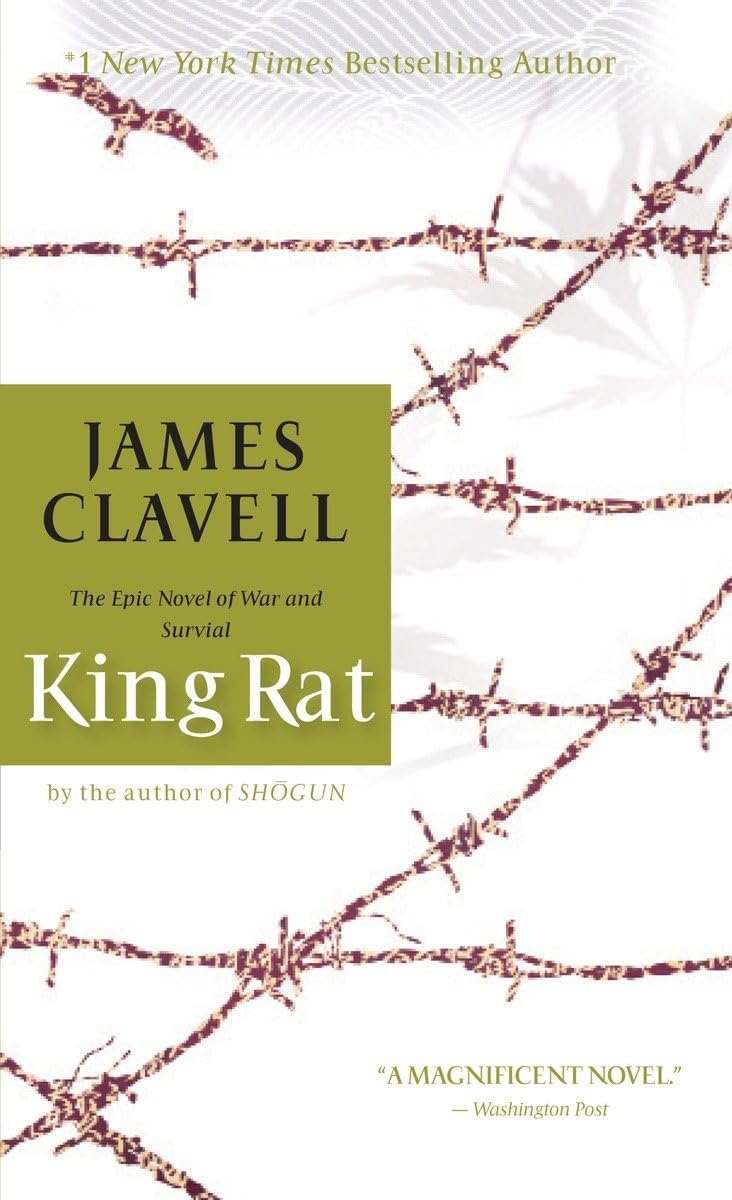
King Rat (Asian Saga)
Product ID: 10598768
desertcart.com: King Rat (Asian Saga): 9780440145462: Clavell, James: Books Review: James Clavell's first and best book - I read King Rat (KR) shortly after it was first published. I remember thinking then that KR was an exciting book, but perhaps far-fetched, even if the author was a POW in Singapore. A decade later I was posted to Singapore, and met a few people who remembered the years of Japanese occupation, and some who were prisoners themselves. It seems that Mr. Clavell was not exaggerating. Having recently read a couple of volumes of the author's Asian Saga, I decided to read KR again. This edition has an informative foreword, in itself very good literary criticism, and some parts in the book which may not have been in the first edition - I am not entirely sure. This time around, the book struck me not merely exciting, but positively dramatic, and many scenes could indeed have been combined into a very dramatic play. As other reviewers have already described KR's background and plot, I would add only that character development is first rate, as are the sections depicting the lives and fates of the prisoners' families. Most of these are bleak, and some are not resolved, but there are few happy endings, apart from the fact that most of the main prisoner characters survived, a great accomplished in view of happened in Changi in 1942-45. It was a horrible place, and KR is its dramatic chronicle. One may perhaps also think of it as the requiem for the British Empire military, and certainly for the UK Army. In any case, I reckon KR is one of the most powerful novels from the Second World War, and I recommend it wholeheartedly. Review: surprisingly good! - this is about the inhabitants of a japanese prison camp, and takes place during WW2. i’m not a fan of books about war, and i’ve read too many nonfiction books about the holocaust to enjoy “prison camp fiction”. but i’m rereading james clavell’s asian saga, and this is book four. i’ve started this a couple times, but then i would stop and just move on to ‘noble house’ (book five). so, a few days ago, i decided to give this book one last push, and i read enough of it (maybe fifty/sixty pages) to get hooked on the story. i was doomed! turns out, this is a great book. the best part is the character development, and the complex relationships between the men. these are people just barely surviving, but most have formed tight, small units they can trust. the units work together in order to live, but they play, too. there are running card games, and high stakes manipulation in order to get some fresh coconut, for example. even a few pranks come into play, but they’re extremely mean spirited. they still made me snicker. periodically, the book features a few women - these characters are not well fleshed out, and they’re usually just a story device, imo. it’s odd, bc clavell can write women when he wishes. his first book in this series, shogun, has a wonderful female character, and the women around her, while not given quite as much personality, still get their own moment in the sun. obviously there is much sadness, but there is warmth and camaraderie too. even some humor, albeit very dark. i’m so glad i read it, i didn’t know what i was missing!
| Best Sellers Rank | #546,295 in Books ( See Top 100 in Books ) #150 in Military Historical Fiction #670 in War Fiction (Books) #4,844 in Family Saga Fiction |
| Book 3 of 6 | The Asian Saga |
| Customer Reviews | 4.5 4.5 out of 5 stars (4,962) |
| Dimensions | 4.2 x 1.3 x 6.9 inches |
| Edition | Mass Market Paperback |
| ISBN-10 | 0440145465 |
| ISBN-13 | 978-0440145462 |
| Item Weight | 8 ounces |
| Language | English |
| Print length | 480 pages |
| Publication date | September 1, 1986 |
| Publisher | Dell |
C**S
James Clavell's first and best book
I read King Rat (KR) shortly after it was first published. I remember thinking then that KR was an exciting book, but perhaps far-fetched, even if the author was a POW in Singapore. A decade later I was posted to Singapore, and met a few people who remembered the years of Japanese occupation, and some who were prisoners themselves. It seems that Mr. Clavell was not exaggerating. Having recently read a couple of volumes of the author's Asian Saga, I decided to read KR again. This edition has an informative foreword, in itself very good literary criticism, and some parts in the book which may not have been in the first edition - I am not entirely sure. This time around, the book struck me not merely exciting, but positively dramatic, and many scenes could indeed have been combined into a very dramatic play. As other reviewers have already described KR's background and plot, I would add only that character development is first rate, as are the sections depicting the lives and fates of the prisoners' families. Most of these are bleak, and some are not resolved, but there are few happy endings, apart from the fact that most of the main prisoner characters survived, a great accomplished in view of happened in Changi in 1942-45. It was a horrible place, and KR is its dramatic chronicle. One may perhaps also think of it as the requiem for the British Empire military, and certainly for the UK Army. In any case, I reckon KR is one of the most powerful novels from the Second World War, and I recommend it wholeheartedly.
S**✨
surprisingly good!
this is about the inhabitants of a japanese prison camp, and takes place during WW2. i’m not a fan of books about war, and i’ve read too many nonfiction books about the holocaust to enjoy “prison camp fiction”. but i’m rereading james clavell’s asian saga, and this is book four. i’ve started this a couple times, but then i would stop and just move on to ‘noble house’ (book five). so, a few days ago, i decided to give this book one last push, and i read enough of it (maybe fifty/sixty pages) to get hooked on the story. i was doomed! turns out, this is a great book. the best part is the character development, and the complex relationships between the men. these are people just barely surviving, but most have formed tight, small units they can trust. the units work together in order to live, but they play, too. there are running card games, and high stakes manipulation in order to get some fresh coconut, for example. even a few pranks come into play, but they’re extremely mean spirited. they still made me snicker. periodically, the book features a few women - these characters are not well fleshed out, and they’re usually just a story device, imo. it’s odd, bc clavell can write women when he wishes. his first book in this series, shogun, has a wonderful female character, and the women around her, while not given quite as much personality, still get their own moment in the sun. obviously there is much sadness, but there is warmth and camaraderie too. even some humor, albeit very dark. i’m so glad i read it, i didn’t know what i was missing!
D**L
Sobering and well told
We talk about the greatest generation with so many stories written and movies made about their sacrifices. It has been a long time since I last read this book and find myself humbled and sobered. There are son many elements In play--the stark class differences of the British, cultural differences between the nationalities, the divisions between ranks, and the roles of the period between men and women. The story is compelling and pulls you along. But then suddenly, after 3+ years of creating their own isolated society with its own rules, the POWs are forced to deal.with the enormous anxiety of returning to their families and normal society and what WILK be left for them. You cannot read this and not come away with extraordinary respect for Clavell and all other POWs, and all those who served their country, both friend and foe. I enjoyed this more the second time than I did the first.
D**L
A Classic!
This is, and has been for 30 years, one of my all time favorite reads. Shogun, probably Clavell's best known book, is wonderful too but it's nearly 1,300 pages. This masterpiece is short and sweet and it lays to the bone the pain and suffering endured by the poor souls unlucky enough to find themselves confined in Changi prison camp and, even more horrific, Utram Road Prison..a place men are sent.. never to return. It has to be one of the best WWII books about the Allied soldiers captured by the Japanese. He doesn't pull any punches and yet he manages to find humor in among the horror these men endured. The author, himself a POW held by the Japanese, claims that while the settings are very real places, the characters and the story told are fictional; but it's difficult not to sense his own experiences coming through as he develops the characters inside these pages. It's an impossible book to put down once you start. It includes an unlikely buddy story and is full of subtle, and sometimes not so subtle, social commentary as well. The author's able to put you inside each man's mind and lets you view this nightmare world they're forced to live in through their very individual points of view. It's a cops and robbers story too and it's a wonderful example of capitalism at it's finest and at it's worse. It's about betrayal, devotion, loyalty, love and friendship. For such a small book, it packs an amazingly large punch! While it is not for the faint of heart, I still highly recommend it.
R**.
Excellent Clavell.
Excellent read. Keeps you interested.
D**Y
One of the great novels of WW2. If you read this book, it will stay with you forever. James Clavell was a master storyteller.
S**R
An excellent tale. Clavell said somewhere that all his novels were actually a number of short stories strung together. That applies to this novel, certainly, though not in a disparaging way at all. The story of men stuck in a prisoner-of-war camp in Japanese-occupied Singapore. For three years. Naturally, the novel is episodic. The title refers to a character, an American corporal, called King, who is also a kind of king in the camp. He's a fixer, a dealer. He can find anything, sell anything. He lives a life of relative luxury in the camp, where the prison-camp economics reign. The king is one of the main characters. The other main character is a British RAF officer, Philip Marlowe, brought up in a military family with a long history of military service, and filled with a typical British snobbery about money and trade. Marlowe is both attracted and repelled by the King: repelled by his apparently totally mercenary attitude to life, and attracted by his brimming confidence and dare-devil risk-taking. In time, they become firm friends, and the King saves Marlowe from losing a limb, thanks to his skills in wheeling and dealing and prison-camp survival. The "rat" in the title refers to an episode when the King and his "unit" get the idea of breeding rats under one of the huts and selling the meat. Only they won't tell anyone what kind of meat it really is, and they will only sell it to people they hate, which means the officers. Given the title, the reader may believe this episode is going to become central to the entire novel, but it doesn't. It fizzles out and is superseded by other story threads. It surfaces briefly from time to time, and then is brought up again in an odd codicil to the novel which runs rather counter to the mood and tone of the novel. Marlowe slowly learns that the wheeling and dealing the King does is really a highly sophisticated activity requiring quick reflexes and great intelligence and cunning, not one for the weak or the faint-hearted. In addition, the King actually does a lot of good, for many of his schemes involve food and medicines, and he can get these to people who need them when everyone else has failed. However, the codicil suggests that the King was just top of the heap in a rat-eat-rat world, which is not what the reader deduces from the various episodes involving the King and Marlowe. The rats may perhaps refer to human beings generally, not just the main characters and not just the prisoners in the camp. All fighting each other just for survival. All in all, it is a remarkable story, unlike many POW stories. It is remarkably upbeat and full of life. The shock and incomprehension when the camp is liberated at the end of the war is superbly managed, and the scenes of suspense are also excellent.
M**R
This was a captivating and challenging read. The flow of the story moved powerfully from start to finish, but the eddies and undercurrents were both thought provoking and counter-cultural. Speaking from experience of having served time in the Changi jail, Clavell can somehow look past the brutality of his captors to see how the awful conditions broke down so many of the social conventions and prejudices that had previously given them some security and sense of self worth. He probes deeper than the obvious breakdown of differences in class, religion and military rank to question his own morality and whether or not the need for survival justified the compromises that had been made during the war. Although the depiction of the ‘King’ is vibrantly colourful, the nuances of his character are carefully shaded - and in his depiction of his downfall Clavell tears the canvas to pieces with a mixture of sadness and horror.
C**E
This novel - really different from the others of the saga, more "historic" and less clan story - is as the others ones very interesting and captivating.. I've learned a lot, thanks !
G**I
Bellissima storia sul coraggio e la resistenza contro le brutalità della prigionia in tempo di guerra.
Trustpilot
5 days ago
2 weeks ago