
Desertcart purchases this item on your behalf and handles shipping, customs, and support to Senegal.
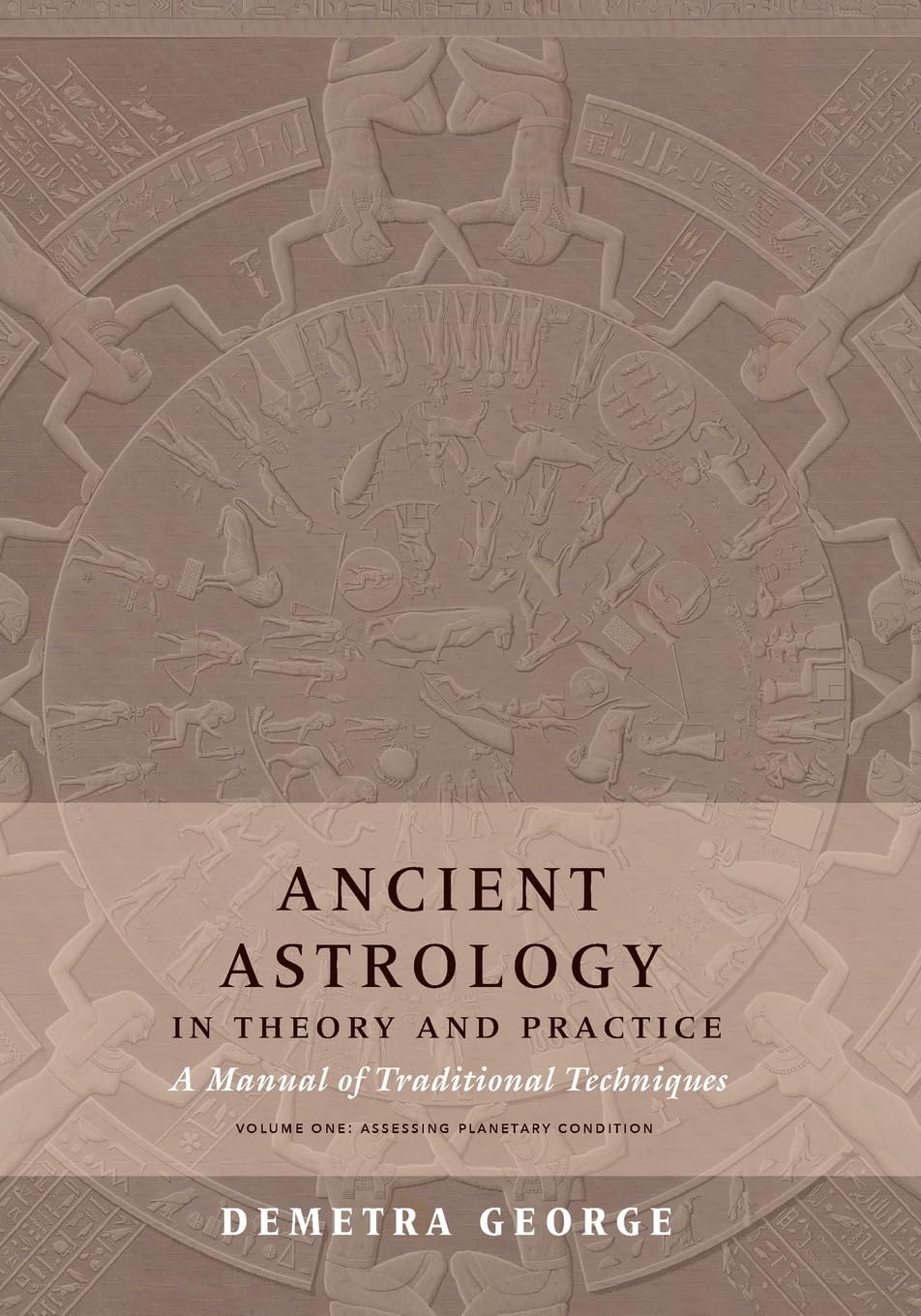
DEVELOPED UNDER THE SHADOWS of the Egyptian temples, Hellenistic astrology is an ancient form of divination inherited from Mesopotamian wisdom traditions. Distilled in Græco-Roman antiquity, and refined in the fires of philosophy and astronomy, it forms the bedrock of traditional western astrology (while also bearing profound similarities to Jyotish or Vedic astrology). Drawing on a body of Greek texts that have remained largely untranslated for almost two-thousand years, Demetra George brings the contemporary practice of astrology back to its ancient roots. Scholar, translator, and practitioner, her work reveals the potent cosmological veins that bear the lifeblood of traditional astrology. Ancient Astrology in Theory and Practice is, in essence, a training manual for the study and practice of Hellenistic astrology. In two volumes, it provides the complete foundations and detailed dynamics of ancient chart-reading techniques. Each volume and each technique is richly illustrated with diagrams, example charts, and practical exercises. Volume 1: Assessing Planetary Condition In ancient cosmology, the planetary divinities symbolised the hierarchy of forces that shape our lives in the sublunary world. Not all planets are created equal in a given nativity, however, and so the first step of the practicing astrologer is to assess the condition of each planet in a chart in order to determine its effectiveness (or lack thereof) in the native's life. To this end, this volume provides a series of rigorous methods for evaluating the condition of each planet in a birth chart through the lenses of classification (sect, gender, benefic/malefic), signs and rulerships (residences, reception, exaltation, trigons, bounds), the solar phase cycle (speed, direction, visibility, phase, phasis), lunar considerations (course, phases, bonding, nodes, bending, eclipses, prenatal lunation), and aspects (configurations, witnessing, testimony, bonification, maltreatment, adherence, overcoming, rays). Finally, it brings all of these factors together in a powerful synthesis that unlocks the layers of a chart with unrivaled precision. Review: Cannot recommend enough! - Demetra delivers very clear and concise material here. You never lose interest as you go through it, because it never gets too longwinded, and it’s still information packed. I’m almost done with volume one and very much looking forward to moving on with volume two. It’s been an incredible journey inwards for me personally as a lot of things in my life finally made sense at a very high level. You should have at least some basic knowledge about astrology if you want to keep up here in my opinion however. I haven’t taken her classes, but I’d imagine they’re very good for complete beginners looking to learn. Review: Top Tier Manual for Aspiring Astrologers - I bought this book after having had a conversation with someone on Twitter about good textbooks to read to further my knowledge on Ancient Astrology. I had originally bought “Hellenistic Astrology” by Chris Brennan (which is an EXCELLENT book, btw), but the person I had the conversation with recommended this to me, as they stated it was more approachable. While I love Chris Brennan’s book and recommend it for use in tandem with this two-part series, I realized Demetra’s book was more in alignment with what I was looking for for my journey and where it is right now. Demetra George’s book goes into methods of Ancient Astrology with just enough detail to provide context, but not with overwhelming amounts of information. She has tons of descriptive visuals that make it digestible, without compromising on info. Both she and Brennan are the pioneers of our time that are going to help those of us who want to change the narrative that modern astrology has created to make astrology too digestible (ie, compromising on or leaving out imperative details and complexities, and making it oversimplified to make it more marketable). Demetra’s approach gives us a way for us to be able to take the complexities of astrology, and make it more digestible. I stated this in my review of Chris Brennan’ book, but If I could make a recommendation to anyone who is trying to advance, I would recommend the following journey: “The Only Astrology Book You’ll Ever Need” by Joanna Martine Woolfolk (this is a great first step, but keep in mind that it will require a lot of learning, with some unlearning of the info in the book, as the author mostly follows a modern approach to astrology - think three steps forward, one step back) “Ancient Astrology in Theory and Practice” by Demetra George, Volume I and II “Hellenistic Astrology” by Chris Brennan Following this format goes from easiest to hardest. I think this is the most optimal, as it is the journey I have followed. This makes it a lot easier to gradually increase the knowledge in a way that is approachable. All in all, this book is phenomenal, and I cannot recommend it enough. Astrology requires, patience, perseverance, and gradual learning. If You approach it from that angle, You will thrive in Your studies of Astrology. Happy studying celestial scholars!
| Best Sellers Rank | #86,931 in Books ( See Top 100 in Books ) #71 in Scientific Reference #124 in Cosmology (Books) #152 in Astrology (Books) |
| Customer Reviews | 4.9 out of 5 stars 377 Reviews |
A**R
Cannot recommend enough!
Demetra delivers very clear and concise material here. You never lose interest as you go through it, because it never gets too longwinded, and it’s still information packed. I’m almost done with volume one and very much looking forward to moving on with volume two. It’s been an incredible journey inwards for me personally as a lot of things in my life finally made sense at a very high level. You should have at least some basic knowledge about astrology if you want to keep up here in my opinion however. I haven’t taken her classes, but I’d imagine they’re very good for complete beginners looking to learn.
E**N
Top Tier Manual for Aspiring Astrologers
I bought this book after having had a conversation with someone on Twitter about good textbooks to read to further my knowledge on Ancient Astrology. I had originally bought “Hellenistic Astrology” by Chris Brennan (which is an EXCELLENT book, btw), but the person I had the conversation with recommended this to me, as they stated it was more approachable. While I love Chris Brennan’s book and recommend it for use in tandem with this two-part series, I realized Demetra’s book was more in alignment with what I was looking for for my journey and where it is right now. Demetra George’s book goes into methods of Ancient Astrology with just enough detail to provide context, but not with overwhelming amounts of information. She has tons of descriptive visuals that make it digestible, without compromising on info. Both she and Brennan are the pioneers of our time that are going to help those of us who want to change the narrative that modern astrology has created to make astrology too digestible (ie, compromising on or leaving out imperative details and complexities, and making it oversimplified to make it more marketable). Demetra’s approach gives us a way for us to be able to take the complexities of astrology, and make it more digestible. I stated this in my review of Chris Brennan’ book, but If I could make a recommendation to anyone who is trying to advance, I would recommend the following journey: “The Only Astrology Book You’ll Ever Need” by Joanna Martine Woolfolk (this is a great first step, but keep in mind that it will require a lot of learning, with some unlearning of the info in the book, as the author mostly follows a modern approach to astrology - think three steps forward, one step back) “Ancient Astrology in Theory and Practice” by Demetra George, Volume I and II “Hellenistic Astrology” by Chris Brennan Following this format goes from easiest to hardest. I think this is the most optimal, as it is the journey I have followed. This makes it a lot easier to gradually increase the knowledge in a way that is approachable. All in all, this book is phenomenal, and I cannot recommend it enough. Astrology requires, patience, perseverance, and gradual learning. If You approach it from that angle, You will thrive in Your studies of Astrology. Happy studying celestial scholars!
M**K
Outstanding in depth overview of Hellenistic Astrology
This is a beast of a book, and only the first volume of a complete 2 volume course in Hellenistic Astrology. I am frankly surprised that there were so many 5 star reviews way back in 2019 because this combination of textbook and workbook (one of Demetra’s specialties IMO) is quite topically dense. Not that it doesn’t deserve them, but this material has to be slowly processed, especially for the beginner (whether they have modern astrology experience or not). I came to it after taking Chris Brennan’s course shortly after UAC 2018 in Chicago. His book was already out then. This one wasn’t out just yet. Huge shout out to Aaron Cheak at Rubedo Press for the high publication standard of this series (I have Vol 2 already). Aside from his own work, he has published Chris Brennan, Gary Caton, and now Demetra George. Check him and those other authors out. You won’t regret it. I would recommend reading other introductory works on the topic (Benjamin Dykes TRADITIONAL ASTROLOGY FOR TODAY and Chris Brennan’s Text) before starting this one. The writing is clear but still “academic” and will be a slog for the undisciplined reader. Sorry if that offends, but it is what it is. Each chapter breaks down concepts and provides clear references to source material that all originated from Project Hindsight. The most amazing and fun aspect of this book is that it gradually builds up the concepts so that you may originally think “Oh no! My planets are a mess!” And then recognize many other factors which give you a very balanced and clear perspective on your Hellenistic Chart (the modern Uranus, Neptune, Pluto, and Chiron aren’t included but for those with an experienced modern astrology background, there is much that can be gleaned from those placements with these foundational principles). For better ease of learning, I would recommend scanning the worksheets, and some tables, and filling in info as you go so that you don’t mark up the book. It also helped to read the worksheet material before reading each chapter which helps in understanding concepts. All in all, wow! I’m resigned to being patient about getting through it before volume 2 because it’s just a treasure trove of old knowledge. Grateful to everyone involved, and especially to Demetra herself - whose name derives from that great goddess of old Demeter. Very apt given the harvest of information provided. Outstanding!
N**Z
La guía completa
Un libro muy completo, muy contenta con esta compra
K**L
A Perfect "First Look" Into the Tradition
This is an excellent introduction for all those interested in a more traditional approach. It includes the history or periods, and explains how the different concepts and techniques were applied in the traditional logic. Other books will definitely supplement, expand, and clarify the information here, but this is A PERFECT BOOK FOR ALL SKILL LEVELS
A**.
Best Resource for study
This book is a brilliant compilation of the practices and application of Hellenistic astrology techniques. Anyone who wants to learn astrology should have access to this book and keep it on hand to ground their studies.
S**S
Very Good Study Guide
Great book. She consolidates the ancient teachings into an understandable format. There are worksheets to help you to retain the lessons. You will gain a lot from this text. I would, however, take the first page of the book about the history of astrology with a grain of salt. Astrology was in the United States far earlier than the 20th century, no matter what a Boomer might tell you, and there is evidence of astrological and astrophysical research as far back as the cave paintings of Lascaux. (Check out that Taurus painting from sometime between 17,000- 22,000 years ago - or the magnificent stone circles along the ley lines of Western Europe.) Anyway, certain things about astrology should always be kept in mind as conjuncture alone, such as the descriptions of how it works (Quantum Field Theory hasn’t fully established, but “rays from planets” does not hold up with the times), or even that it had a discrete starting point in Mesopotamia. Maybe it became an established and developing art in Mesopotamia, but they evidently drew from the work of their ancestors, and I imagine that all of our ancestors have been working on this study since they first looked up into the starry night sky and asked their first questions about it, then formed their first philosophical ideas based on their best guesses. But I suppose that at the time of publication, these data were what everyone who was considered a peer would agree on, even if they claim that astrology did not come over with any of the folkways that settled in the American colonies until it appeared in the 20th century.
S**E
Love it!
I absolutely love this book. If you’re a deep astrological lover this is for you!
B**E
Leitura obrigatória para astrólogos
Demetra faz a Astrologia tradicional ser um assunto extremamente prazeiroso de se estudar. O livro é grande, e trata apenas dos planetas. Traz muita referência histórica, o que geralmente falta nos livros de “astrologia contemporânea “. Já virou o livro de cabeceira.
A**R
Wonderful book
This book is so wonderfully written and interesting. Demetra knows her stuff well and how to share it with us. I like the structure of this book as it makes the sometimes profound stuff easy to follow and understand. The little exercises at the end of each chapters are simple, quick and helpful. Will keep this as a reference, probably like forever. ♥️
D**A
Best Option on traditional astrology
One of the best books in traditional astrology I have read
L**.
Ottimo manuale
Il testo accompagna il lettore, passo dopo passo, a valutare la forza dei pianeti di un tema natale secondo i principi dell'astrologia classica (ellenistica, medievale e rinascimentale). Alla spiegazione teorica di ogni argomento seguono esempi pratici relativi a 2 temi natali. L'unico limite di questo manuale è che all'analisi dei vari fattori che devono essere presi in considerazione per valutare la forza dei pianeti, e alle valutazioni, non seguono le interpretazioni dei due temi riportati a fini esplicativi. Forse il secondo volume darà più spazio all'interpretazione. Credo che questo testo, unico nel suo genere, meriti 5 stelle perché l'autrice riesce a rendere accessibili argomenti piuttosto complessi, senza dare nulla per scontato, ritornando a più riprese sui concetti spiegati per chiarirli al meglio.
M**S
I wish I could write a book like this
The way the book is researched, written and presented went beyond my expectations. The manual format and the way Demetra guides you through the exercises gives the reader/student chances to consolidate their knowledge in every page. Eagerly waiting for Volume 2 and (hopefully) for a Volume on ancient predictive techniques.
Trustpilot
2 weeks ago
2 months ago