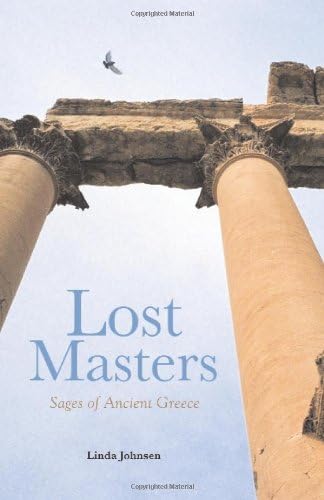
Lost Masters: Sages of Ancient Greece
Product ID: 101823497
This work is an insightful and often startling look at the development of Western thought. Linda Johnsen has uncovered significant parallels between the teachings and the spiritual practices of early Greek Philosophers and enlightened sages of the East. She skilfully ties in concepts of the great religions of the world to the ideology of each great sage. History often swept aside the deep-seated connections between the East and the West, but Johnsen reveals how ideas about Karma, the afterlife, reincarnation and God were taught in the Ancient Western world and how yogic traditions influenced early Greek culture. Linda Johnsen is a leading author in the field of Eastern spirituality. She holds a masters degree in Eastern Studies and Comparative Psychology. She is known for prior titles including "Daughters of the Goddess", "The Women Saints of India" and "A Thousand Suns". Review: A perfect intro to the Ancient sages of Greece - An enlightening read, full of amazing facts about some of the most brilliant minds that ever lived and the connection between ancient Indian philosophy with Greek Roman philosophy. This book ignited my interest in a topic I should have been more interested in as a native Greek. Review: Five Stars - Great book would certainly recommend it.
| Best Sellers Rank | 3,247,737 in Books ( See Top 100 in Books ) 58,946 in Spiritual Thought & Practice 80,224 in Philosophy (Books) 109,182 in New Age (Books) |
| Customer Reviews | 4.3 out of 5 stars 24 Reviews |
S**S
A perfect intro to the Ancient sages of Greece
An enlightening read, full of amazing facts about some of the most brilliant minds that ever lived and the connection between ancient Indian philosophy with Greek Roman philosophy. This book ignited my interest in a topic I should have been more interested in as a native Greek.
E**E
Five Stars
Great book would certainly recommend it.
J**.
"Lost Masters" is inspiring and well written.
Many years ago I bought a used book that included the surviving texts of Epicurus, Epictetus, Plotinus, and Marcus Aurelius. Having long been interested in Indian philosophy, I was constantly struck by the similarity between these thinkers and Indian/Yogic ideas (including Advaita Vedanta). Later I read Peter Kingsley's books about Parmenides and Empedocles and was again struck by the connections between these men and the study of consciousness (India). "Lost Masters" is an excellent introduction to the holistic, practical philosophies of the ancient Greek and Mediterranean world, and how well they integrate with ancient Indian thought. I call these philosophies practical because they addressed how man might best live his life so as to achieve wisdom and peace. Like she says in her introduction, Greek philosophy is often presented in very boring ways. Partly this is because such a small subset of the Greek books survived to our times. Also, Christianity (not any Jesus but the Roman church started by Constantine) led to the dumbing down of Europe and the Dark Age prohibition of philosophical investigation. Even the Renaissance took place in a Christian political culture that eschewed or punished truly open philosophical discourse. Though we grew up with the world view that most sophisticated human studies were pretty recent, common sense, the reading ancient Greek and Indian texts, and continuing archeological discoveries (Gobekle Tepe, etc.) indicate that serious human knowledge of many sorts is probably extremely ancient, and that various cataclysmic events probably wiped out entire cultures. There is also increasing evidence that the ancients traded ideas as well as goods over vast distances. "Modern" culture is temporally provincial. It tends to teach that our scientific knowledge makes us superior to the ancients. Yet many of these ancients investigated the human condition and how to achieve liberation from suffering. In our time, most people are philosophically lost and lead lives of quiet desperation. We are blessed that ancient Indian ideas and practices survived the Moslem invasions, and that some of the Greek works survived Christian book burning. "Lost Masters" clearly shows the similarities between ancient Greek and ancient Indian thought, and presents inspiring introductions to some great men of history. I would like to see this book used as a text for Middle and High school students. It is fun to read, food for thought, and makes me aspire to grow spiritually.
K**Y
Well written
Recommend by a friend. Fascinating collection of little known masters.
S**M
Fascinating and well-written
I love this book so much. I have an e-book version but wanted it in print also. This book was my catalyst for a passionate interest in Greek philosophy and the history of religious influences.u
C**Z
Finally - someone who "gets it"!!!
Linda Johnsen's book on "Greek Sages" is almost too good to be true. There are, in fact, lot's of good books to read about Greek philosophy that more or less accurately convey its spiritual content - but most of those books are fairly or even extremely demanding of the reader. Three good examples of what I'm talking about are Pierre Hadot's "What is Ancient Philosophy?", Robert Lamberton's "Homer the Theologian" and Gregory Shaw's "Theury and the Soul." Those just aren't books that I can recommend to most of my friends - not because my friends are stupid, but because to tackle those books you have to already have a pretty high level of interest and motivation - which most people don't have when it comes to the "boring" topic of Greek philosophy. But Johnsen has a Goddess-given gift for not only communicating her infectious enthusiasm, but also for making things as simple as possible - but no simpler (as Einstein advised). Reading "Lost Masters" is like "taking the red pill" in the Matrix - the veil isn't just lifted - it is rent in two and you see what was there all along, but which had been invisible before. The artificial barrier between "East" and "West" dissolves and you realize that the great wisdom of the Pagan sages could never be extinguished, because it's origin was Divine. You see, the great Sages of both Greece and India were both in touch with the same Divine source of Wisdom. And not only that, but there certainly were direct human contacts between "East" and "West". Johnsen does a good job of (1) drawing parallels between Greek philosophy/spirituality and that of India, (2) pointing out the historically well-documented fact that the Greeks looked to India and Egypt for spiritual inspiration and information, and (3) at the same time avoiding extravagant claims that might otherwise ruin a book like this. The single most important thing about this book is that Johnsen emphasizes the importance of understanding the ancient sages of "Western" philosophy in their own terms. We can read what they wrote in their own words (or in translation, in the likely event that your Attic Greek and/or Latin are a little rusty) - and when we do we can hear the genuine voice of a Pagan spiritual tradition that has never truly died - in part because it was one piece of seamless whole that also included the Wisdom of India (which has survived intact, despite the best efforts of centuries of Muslim and Christian invaders). Johnsen manages to cover an enormous amount of material in this book - but she does so without oversimplifications or "dumbing down." At the same time, this book should only be the beginning for anyone who is serious about taking up this path of the "Sages of Ancient Greece." I would strongly recommend going directly from "Lost Masters" to Pierre Hadot's book mentioned above - and then directly to Plato himself. But as Johnsen points out, you absolutely need "spiritual practice" as the basis for your path, so, of couse, you'd better be meditating, too! Hadot, by the way, also emphasizes the fundamental necessity of "practice". There are actually a few minor things that I could complain about. I wish the book had an index!!!! Arrrrgh. And Johnsen is a little too easy on the Christians in the chapter "Extinguishing the Light" - and she is a little too positive (to put it mildly) about Gnosticism. She should re-read Plotinus' extensive critique of their dualistic version of Christianity. And she could have had a lot more to say about Roman/Latin sources of Pagan wisdom, like Virigil and Apuleius - who played a very important role in keeping Pagan spirituality alive even in the darkest of the Dark Ages. Despite these complaints I would give this book six stars if I could!!! This is possibly the most revolutionary book on Paganism since Starhawk's "Spiral Dance." Seriously.
T**I
Leads us to Plotinus
'Lost Masters' is a popular and not altogether reliable treatment of a fascinating but complex subject. If, however, it leads you to Plotinus your time will not have been entirely wasted. Those who may prefer a somewhat more objective and thoroughly documented scholarly account of the relations between Early Greek and Indian thought might find their needs better served by Thomas McEvilley's recent and more comprehensive study, details of which are as follows: Thomas McEvilley, 'The Shape of Ancient Thought: Comparative Studies in Greek and Indian Philosophies.' New York: Allworth Press, 2002. ISBN 1581152035. Hardback, 731 pp. Illustrated with b/w plates, maps, and with a detailed bibliography and index. The Shape of Ancient Thought: Comparative Studies in Greek and Indian Philosophies And for more on Plotinus see my Listmania List: 'Why not let Plotinus guide you Home?
Trustpilot
3 weeks ago
1 month ago